Norway Country Guide
What I want every first-time visitor to know about fjords, ferries, weather and prices, from someone who lived in Voss and guided in Vestland in the summer of 2025.
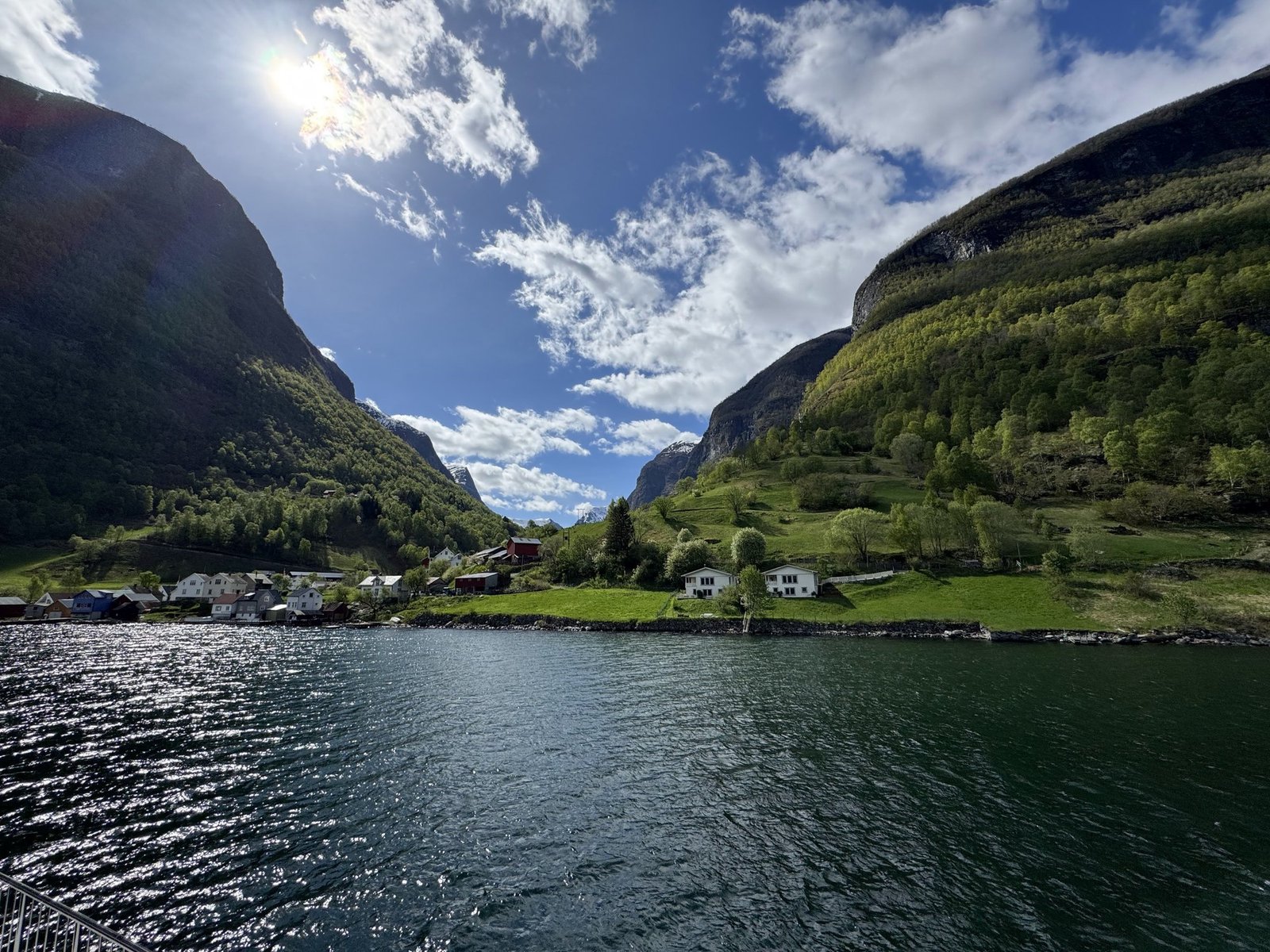
I had visited Norway many times. But from May to July 2025, I lived in Voss and worked as a tour guide in Vestland, the fjord region in western Norway. That was different.
I rode the Bergen Railway so often that I stopped counting. I guided groups of more than 40 people through the fjords. On my days off, I hiked the mountains above Voss.
This guide is what I learned. It covers the practical things: entry rules, money, trains and ferries, weather and food. It also covers the quiet things, which I only understood after I lived there.
Norway at a glance
Norway is long, narrow and steep. About 5.6 million people live here, most of them near the coast. Norway is in the Schengen Area, but it is not in the EU.
The basics
- Capital
- Oslo
- Area
- 385,206 km², with Svalbard and Jan Mayen. Mainland Norway is 323,807 km².
- Government
- Constitutional monarchy and parliamentary democracy. The head of state is King Harald V.
- Languages
- Norwegian, written in two forms, Bokmål and Nynorsk, and Sami. In Vestland, many signs are in Nynorsk. Almost everyone speaks good English.
- Currency
- Norwegian krone (NOK)
- Time zone
- CET (UTC+1). Summer time is CEST (UTC+2).
- Electricity
- 230 V. Plug types C and F.
- Country code
- +47
- Emergency numbers
- 112 police, 113 ambulance, 110 fire
- Doctor, not urgent
- 116 117 (legevakt, the out-of-hours doctor)
- Tap water
- Safe and very good
Nature in numbers
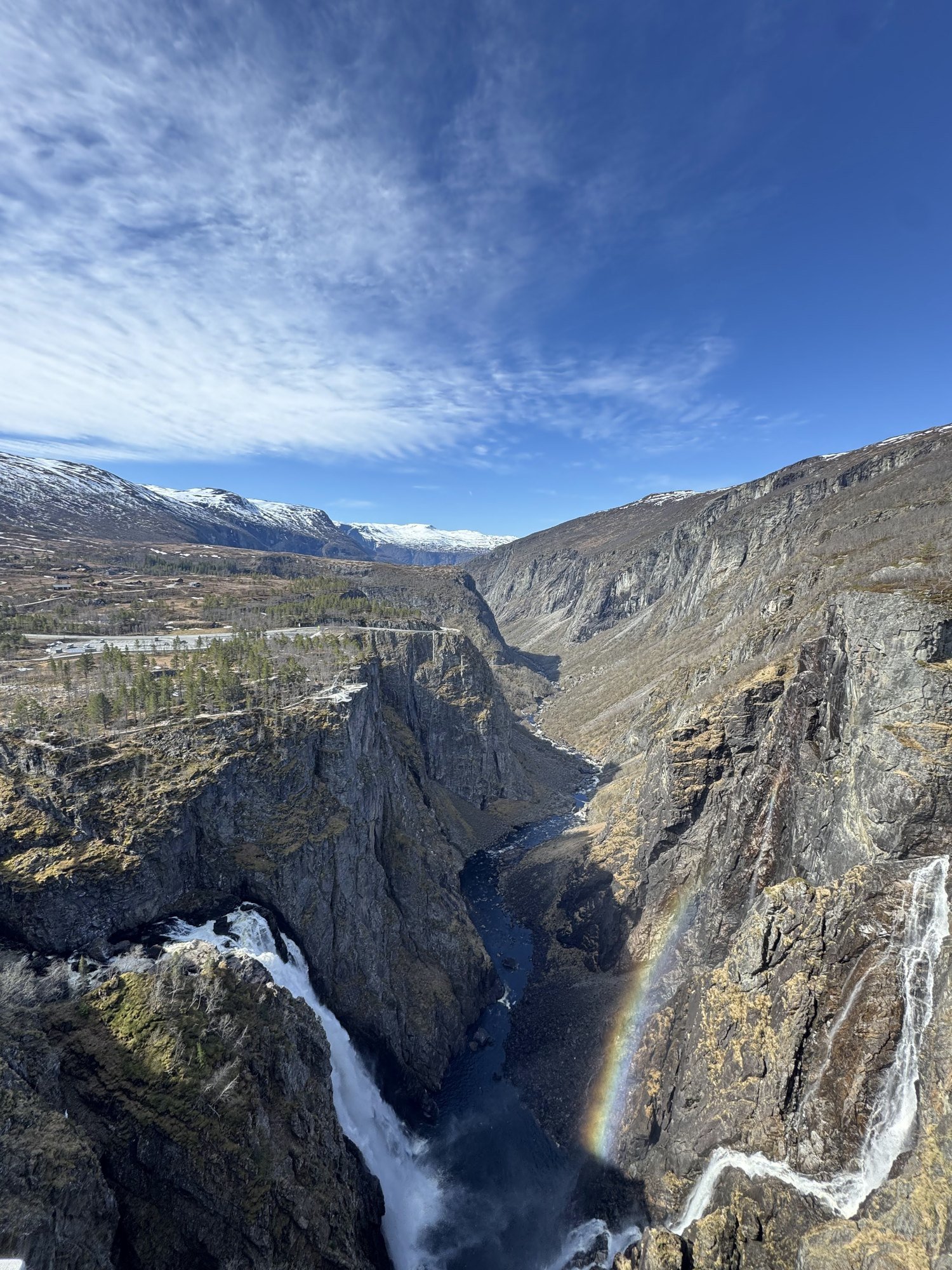
Norway has 48 national parks. Seven of them are on Svalbard. The newest is Østmarka, near Oslo, from 2023. The highest mountain is Galdhøpiggen, 2,469 meters. The Sognefjord is Norway’s longest fjord, about 205 km, and more than 1,300 meters deep in places.
Words that open doors
| Norwegian | Say it like | Meaning |
|---|---|---|
| Hei | hay | Hello |
| Ha det | HAH-deh | Goodbye |
| Takk / Tusen takk | tahk / TOO-sen tahk | Thank you / Thank you very much |
| Ja / Nei | yah / nay | Yes / No |
| Unnskyld | UN-shil | Excuse me, sorry |
| Skål! | skohl | Cheers! |
| Hvor mye koster det? | voor MEE-eh KOS-ter deh | How much is it? |
| Snakker du engelsk? | SNAH-ker doo ENG-elsk | Do you speak English? |
| God tur! | goo toor | Have a good hike! |
Norwegians say fjell for mountain. We Swedes say fjäll. The words look alike, but they do not mean exactly the same. I wrote about it in Berg vs Fjäll: the Nordic difference.
Passports and entry rules
Norway is not in the EU, but it is in the Schengen Area and the EEA. The same entry rules apply as in Sweden.
- EU, EEA and Swiss citizens: A valid passport or national ID card is enough.
- Many other nationalities: You can visit for up to 90 days in any 180-day period without a visa.
- The Entry/Exit System (EES): Border staff record non-EU visitors with fingerprints and a photo. Plan extra time at the airport.
- ETIAS: It has not started yet. When it does, apply only on the official EU website for ETIAS.
Check the rules for your passport with UDI, the Norwegian Directorate of Immigration.
Money and costs
Norway is expensive, even for me, and I live in Stockholm. In Voss, I cooked most of my dinners.
Cards, not cash
Cards work almost everywhere, and some places do not take cash at all. You will see Vipps on signs. It is a mobile payment app, and it mostly needs a Norwegian bank account. Pay by card.
What I paid in Vestland in 2025
- Coffee in a café
- 40–50 NOK
- Restaurant main course
- 200–300 NOK
- Groceries
- Cheapest at Rema 1000 and Kiwi
Daily budget per person
These are my rough estimates for 2026.
- Tight budget
- 900–1,300 NOK a day: a hostel or cabin bed, supermarket food and public transport
- Mid-range
- 2,000–3,000 NOK a day: a simple hotel, one meal out and a fjord boat trip
- Comfortable
- 4,000 NOK a day and up
How to spend less
- Nature is free. Every mountain, fjord and viewpoint I explored on my days off cost only the bus fare. Many people pay for tours to views they can reach on their own.
- Cook your own food. Many cabins and hostels have kitchens.
- Buy alcohol duty-free when you land. In Norway it is expensive.
- Tipping is not expected.
Getting around
From Oslo Airport to the city
- Flytoget: About 19 minutes to Oslo Central Station. 243 NOK.
- Vy regional train: 25–30 minutes to Oslo Central Station. About 124 NOK.
- Flybussen airport bus: 45–60 minutes. 149–199 NOK.
Trains
The Bergen Railway was my lifeline. It runs between Oslo and Bergen in about seven hours, over the mountain plateau, and stops at Voss and Myrdal. At Myrdal, change to the Flåm Railway, a steep line of about 20 km down to Flåm.
Buses and ferries
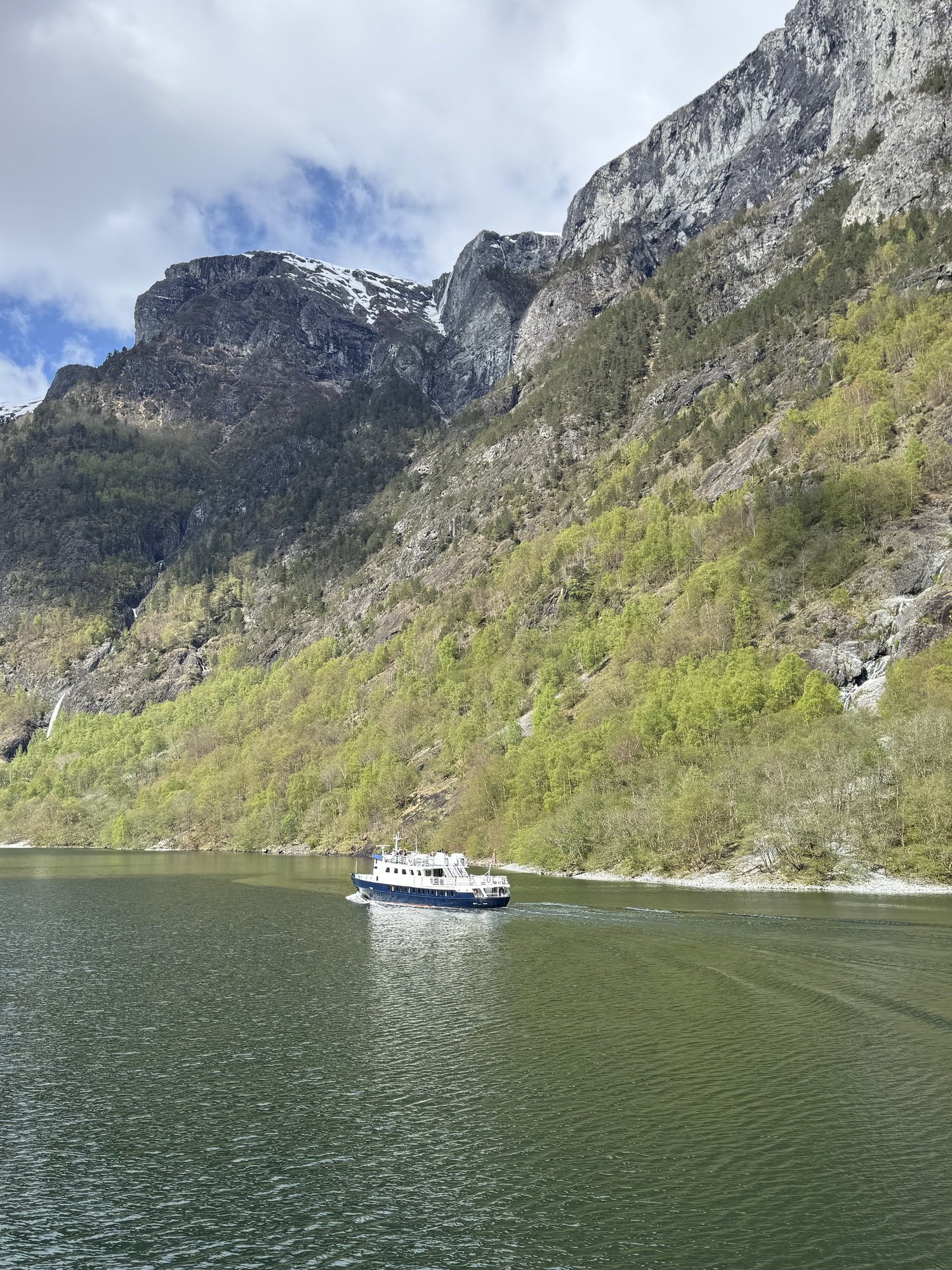
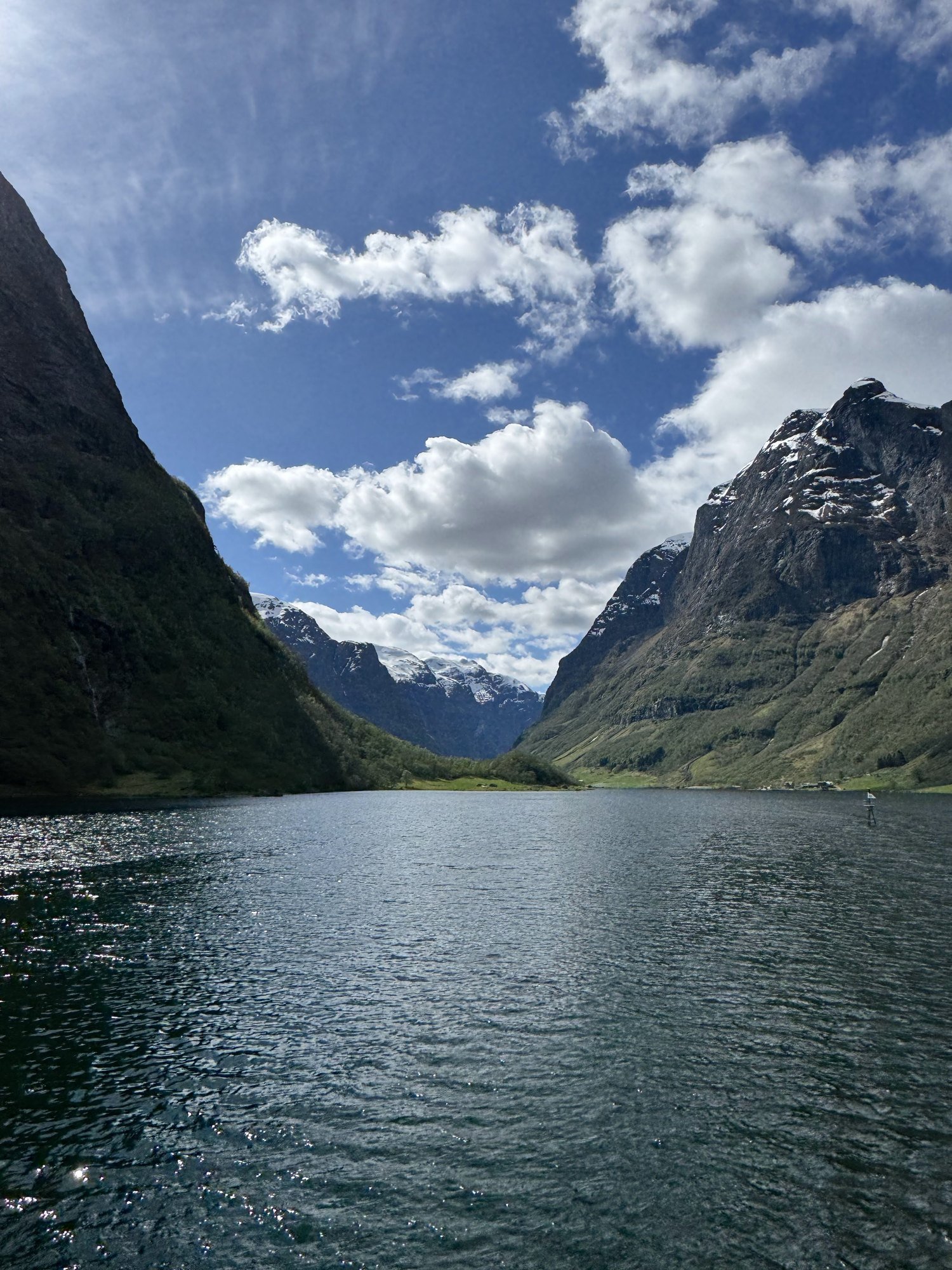
Buses connect almost everything, but timing is everything. In fjord country, ferries are not only transport. They are part of the trip. The ferry from Flåm to Gudvangen through the Nærøyfjord was my “office” on many days.
Public transport apps
- Ruter: Oslo. A 24-hour ticket pays off if you travel more than three times in a day.
- Skyss: Bergen and Vestland
- Entur: Journeys across all of Norway
Driving
- Tolls: Most toll roads and many ferries charge by license plate (AutoPASS). Rental cars have the tag.
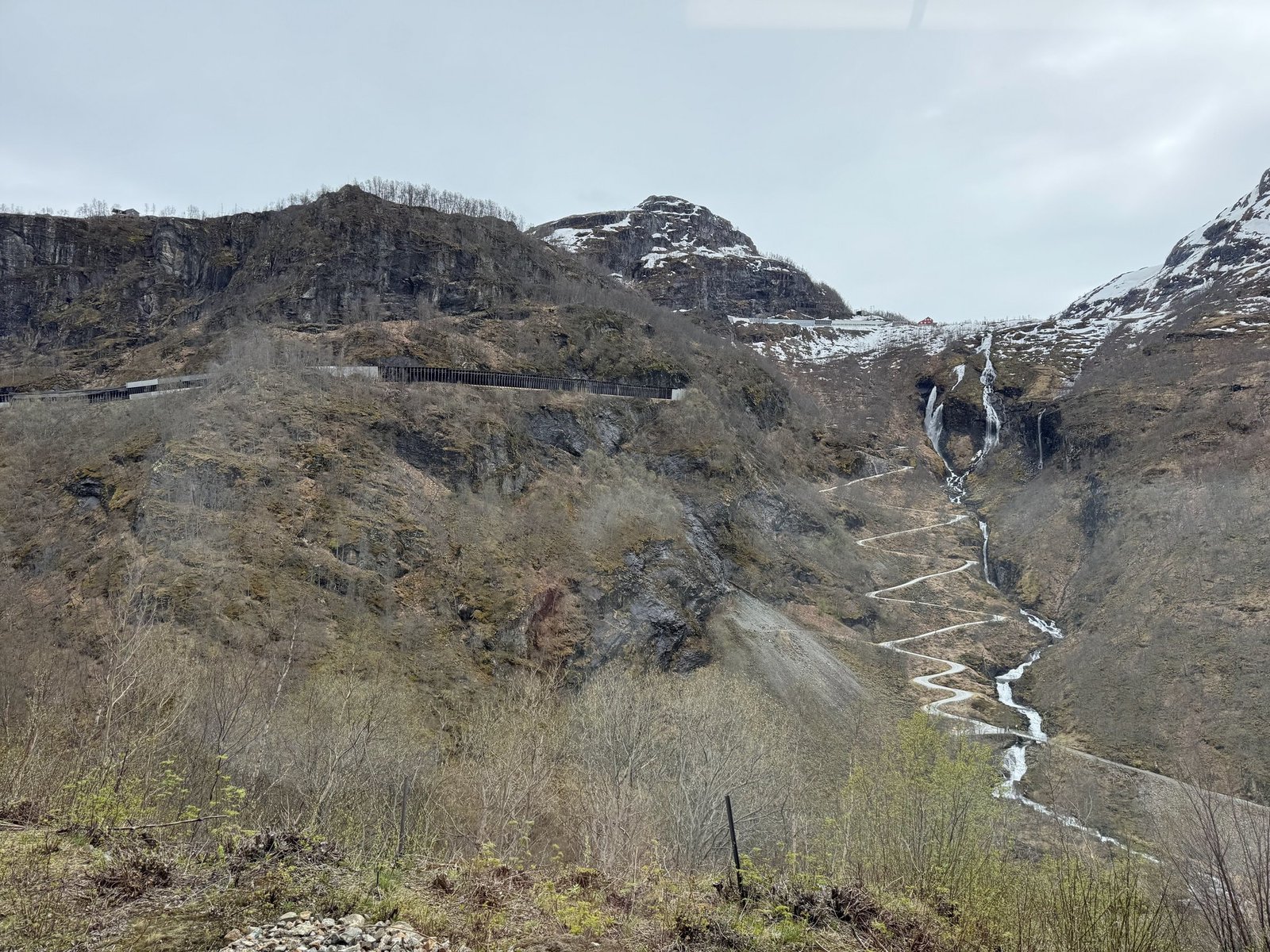
- Mountain passes: Many close in winter and open in late May or June. I watched the Aurlandsfjellet road open in early June. Before that, you take the tunnel.
- Time: Roads are narrow, with many hairpin bends. Plan more time than your map app says.
- Tunnels and bridges: The Lærdal Tunnel on the E16 is the longest road tunnel in the world, 24.5 km. It opened in 2000. The Hardanger Bridge opened in 2013. It is Norway’s longest suspension bridge, with a main span of 1,310 meters.
When to visit
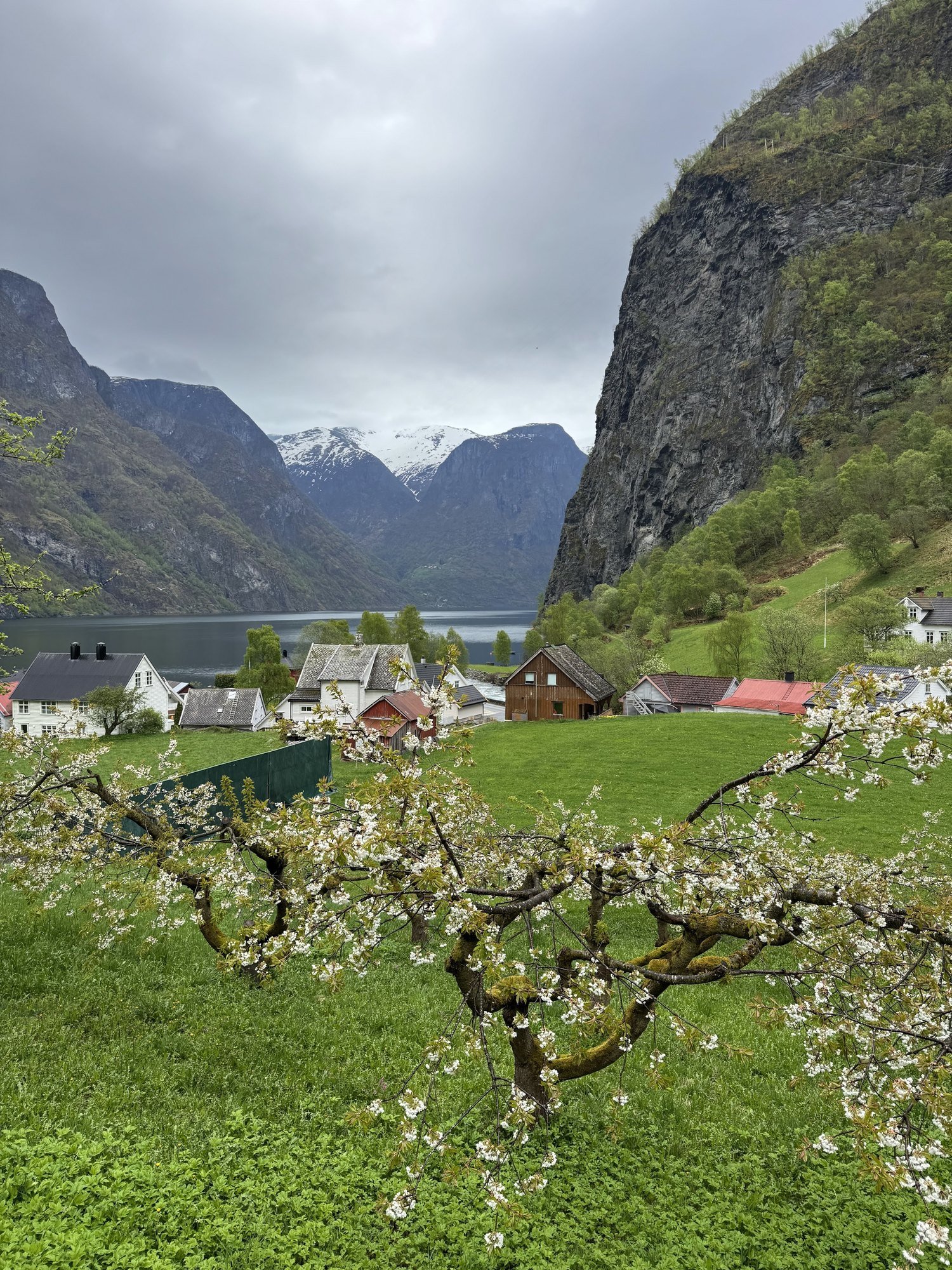
The weather in the fjords changes fast. I have started tours in sunshine and finished them in rain.
My three months in Vestland
- May
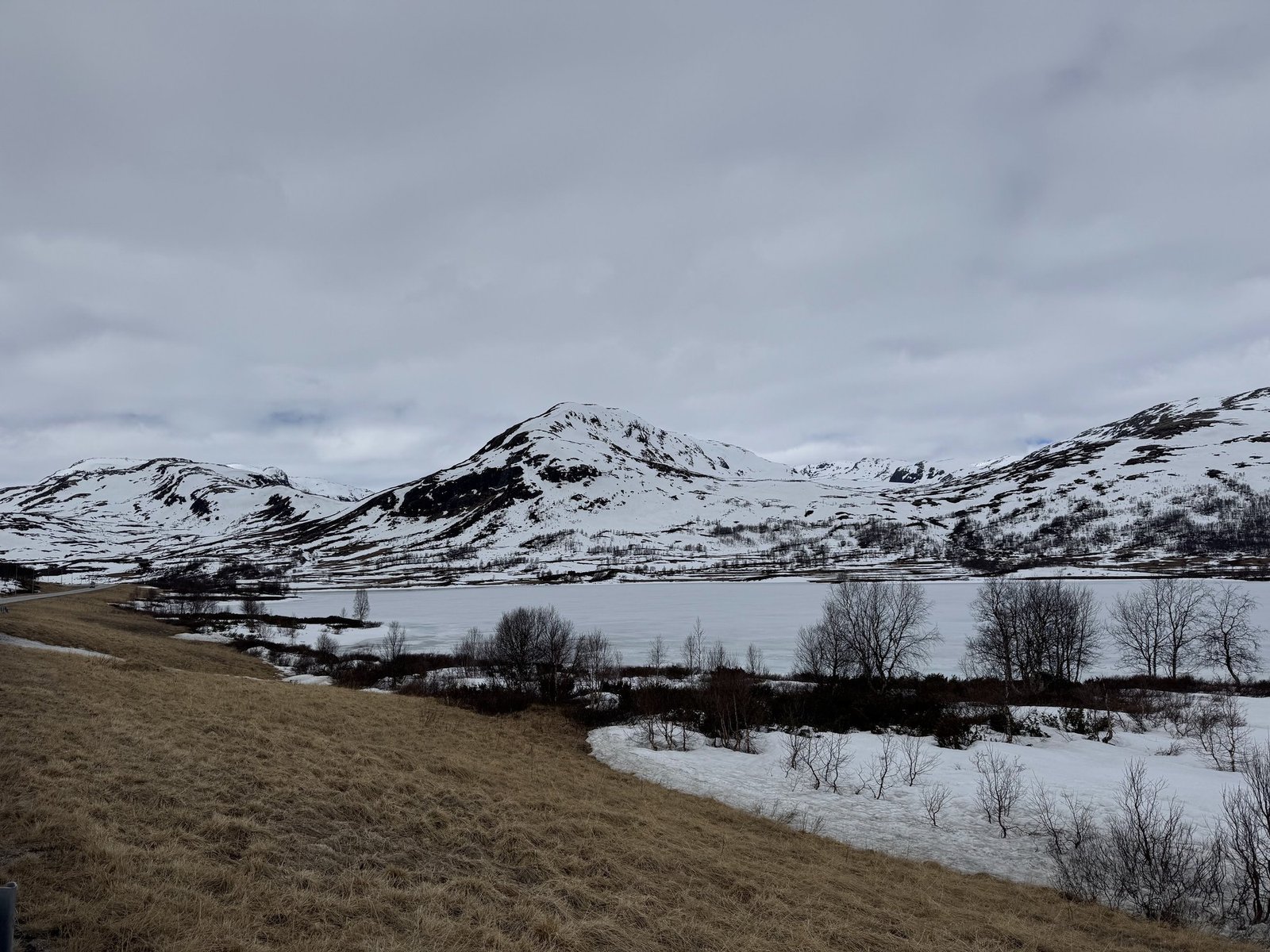
- 1°C in the morning and snow on the mountains. Locals said the tourists “had not woken up yet”. Perfect for hiking without crowds, but some places had short opening hours.
- June
- The best month. More than 20 hours of daylight, better weather and fewer people.
- July
- The warmest month, but also the busiest and most expensive. Book early.
North Norway
In Tromsø, the midnight sun lasts from about 20 May to 22 July. The northern lights season is from about September to March.
What to pack
A waterproof jacket and trousers (I wore mine almost every day), a fleece, a merino wool base layer and a thermos. Norwegians say: there is no bad weather, only bad clothes.
My pick: June, or September.
Trip ideas
Five days: Oslo to Bergen through the fjords
- Day 1: Oslo
- Day 2: The Bergen Railway to Myrdal, then the Flåm Railway down to Flåm
- Day 3: A boat on the Nærøyfjord to Gudvangen, then a bus to Voss
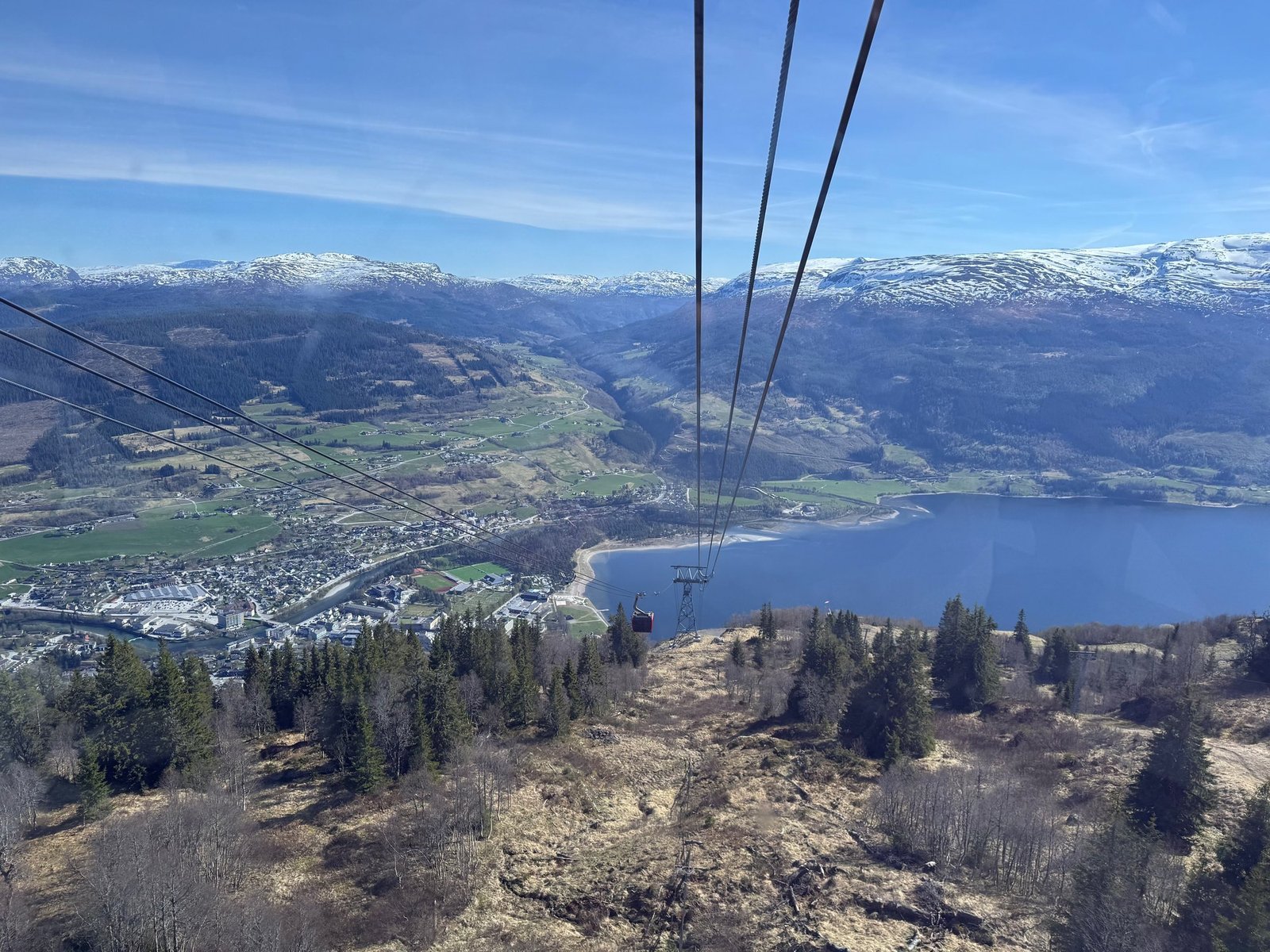
- Day 4: Voss: a hike up Hanguren, or the folk museum
- Day 5: Bergen
Ten days of fjords and mountains
- Days 1–5: The route above
- Days 6–7: Hardanger: orchards, cider, waterfalls and the Hardanger Bridge
- Days 8–10: Stavanger and the Preikestolen hike
Two weeks with the Arctic
Add Tromsø and the Lofoten Islands to the ten-day trip. Go in June for the midnight sun, or in winter for the northern lights. Fly north, because the distances are long.
Places worth the trip
- Oslo: The Opera House roof, the Munch Museum and saunas on the fjord.
- Bergen: The colored wooden houses of Bryggen, a UNESCO World Heritage site, with mountains right behind the city.
- The Nærøyfjord and the Geirangerfjord: Both are UNESCO World Heritage fjords. See them by boat and on foot.
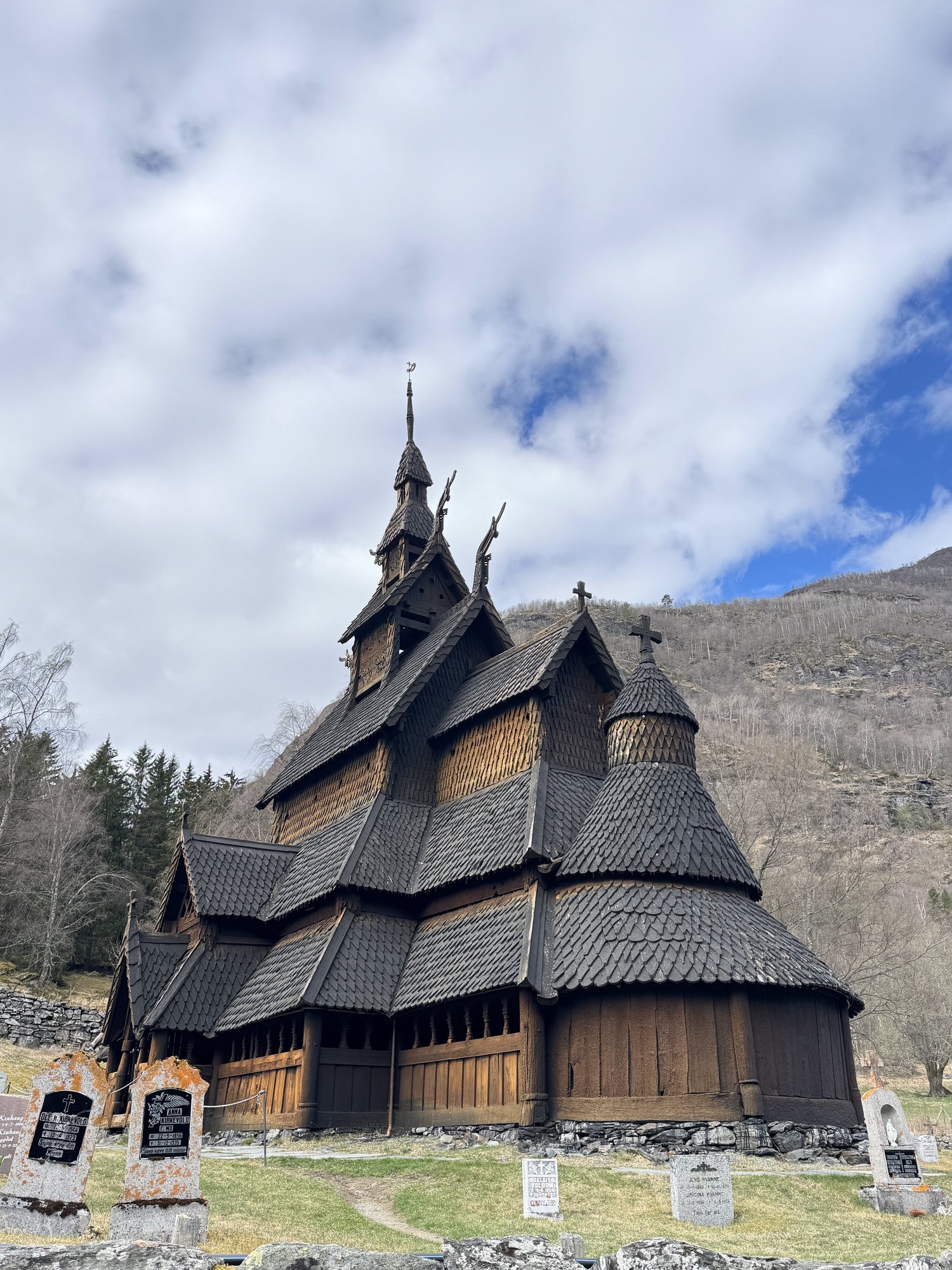
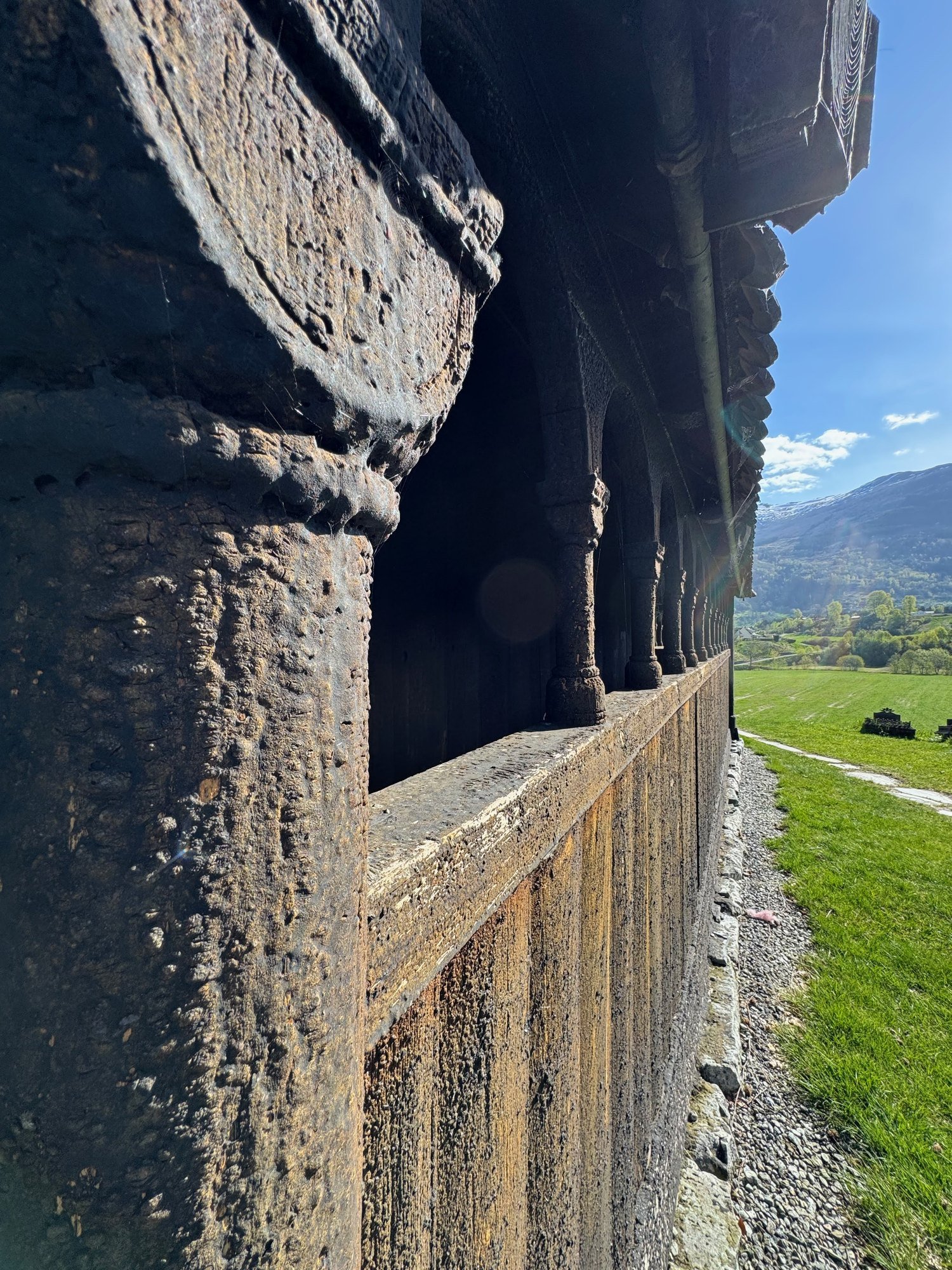
- Borgund Stave Church: A wooden church from around 1200, with carved dragon heads on the roof. It is one of the best-preserved stave churches in Norway.
- Preikestolen: A rock platform 604 meters above the Lysefjord. The hike is about 8 km there and back and takes about four hours.
- Lofoten: Sharp peaks, fishing villages and the midnight sun.
- Tromsø: The base for the northern lights in winter.
- The National Scenic Routes: 18 roads chosen for their views. Aurlandsfjellet, with the Stegastein viewpoint, is one of them.
Cities in Norway
| City | People | Why go |
|---|---|---|
| Oslo | 728,714 | The capital. Museums, the fjord, and forest at the end of the metro line. |
| Bergen | 294,860 | The gateway to the fjords. Rain, the fish market and Bryggen. |
| Trondheim | 218,460 | Nidaros Cathedral and old wooden houses by the river. |
| Stavanger | 151,669 | The oil city, an old town of white wooden houses and the road to Preikestolen. |
Farther north, Tromsø is small but full of life, with a university, the Arctic Cathedral and the northern lights.
My summer in Vestland
From May to July 2025, I lived in Voss and guided tours through Vestland, from the steep Nærøyfjord to the orchards of Hardanger. Voss is a small town with a stone church from the 1270s, and it calls itself Norway’s adventure capital. By the lake stands Fleischer’s Hotel, a wooden hotel in Swiss style from 1864. The same family still runs it.
I arrived as someone who had visited Norway. I left as someone who had lived there. I learned to read ferry timetables in my sleep. I learned to see the weather build over the Atlantic. And I understood why Norwegians go quiet when they stand in front of their mountains.
What surprised me most
- The quiet in the mountains. Thirty minutes from Voss center, I could walk for hours and meet two or three people.
- The midnight sun. It is hard to sleep when it is still light at 23:00.
- The trail markings. Red “T” markers are everywhere, and they are excellent.
- The honesty boxes. Farm stalls by the road trust you to pay. And people do.
What travelers should know
I saw some visitors rush through Vestland in one day, and others who stayed longer. The difference in what they experienced was huge. Vestland shows itself slowly.
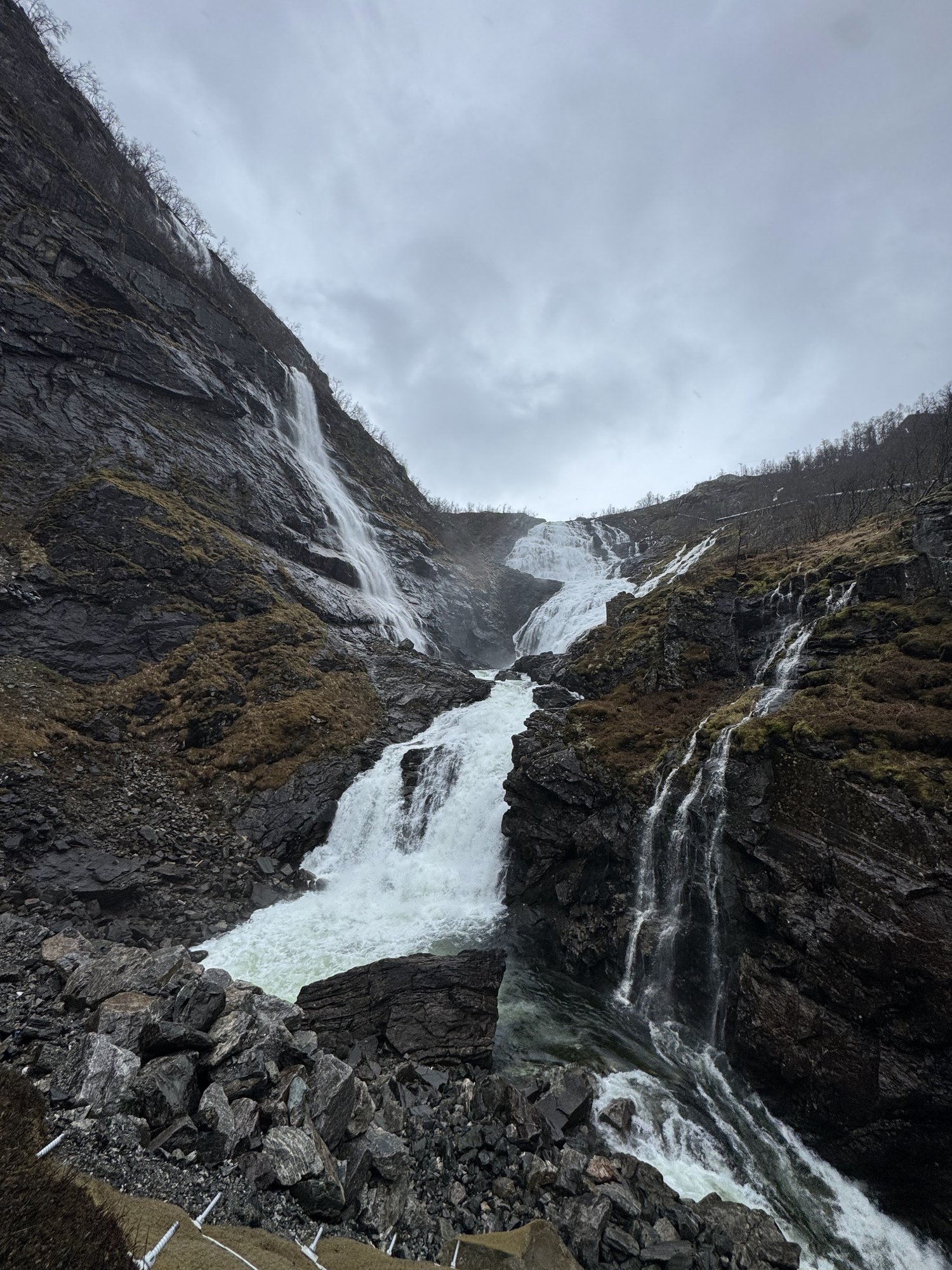
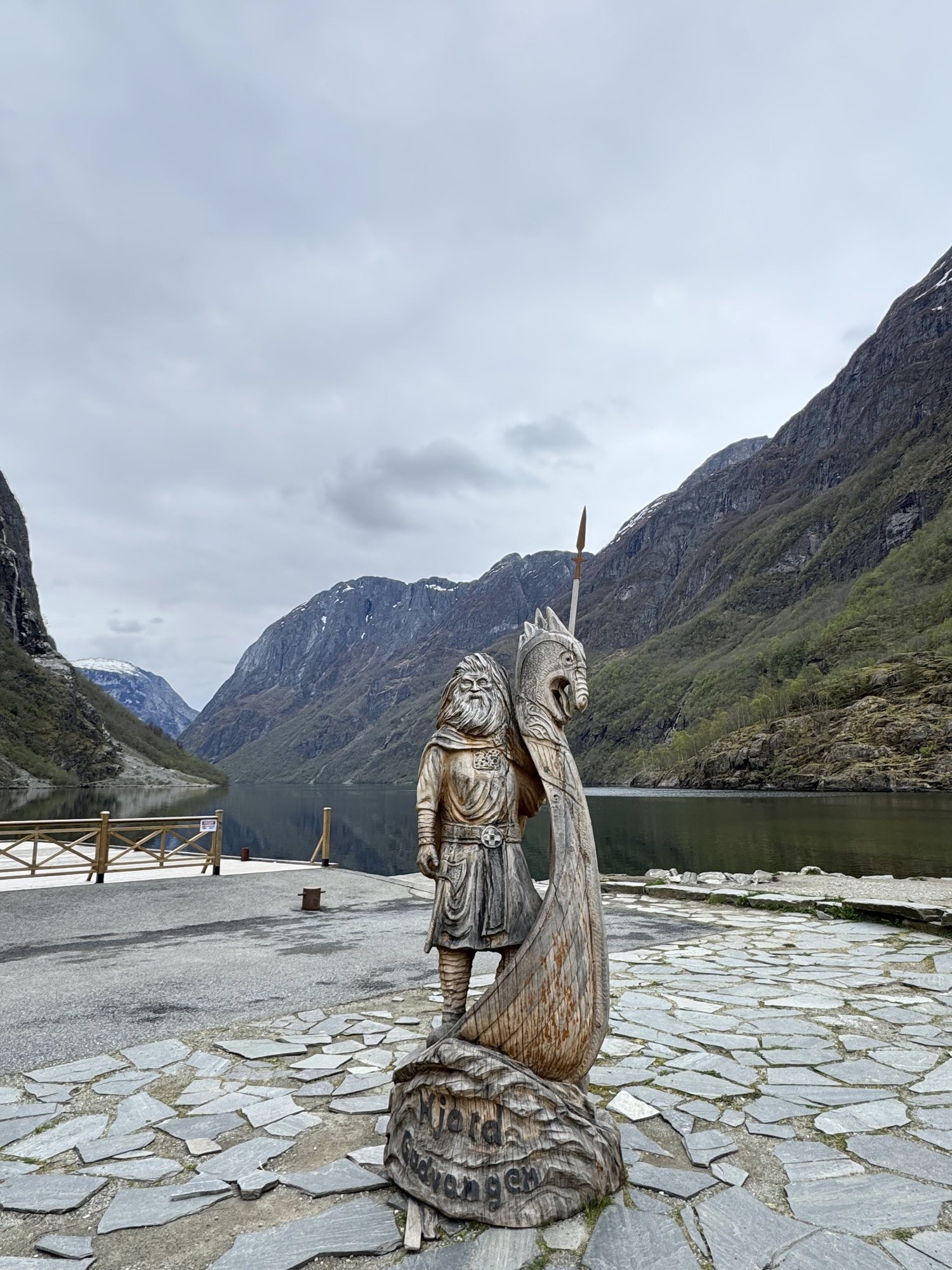
My Vestland stories
I wrote more than 25 posts about that summer. Here they are, by subject.
Places I lived in and explored
- Discover Voss: history, culture and adventure in the fjords
- Voss Folkemuseum: rural life at Mølstertunet
- Myrkdal and Vik in the Sognefjord
- Bergen’s Leprosy Museum: science, suffering and the ethics of progress
- Bomoen: where ice shaped the land and water still sings
- Stalheim: history, WWII and the most dramatic view in western Norway
My mountain hikes
- Hiking from Voss to Hanguren
- Hanguren to Vadalseggi (950 m)
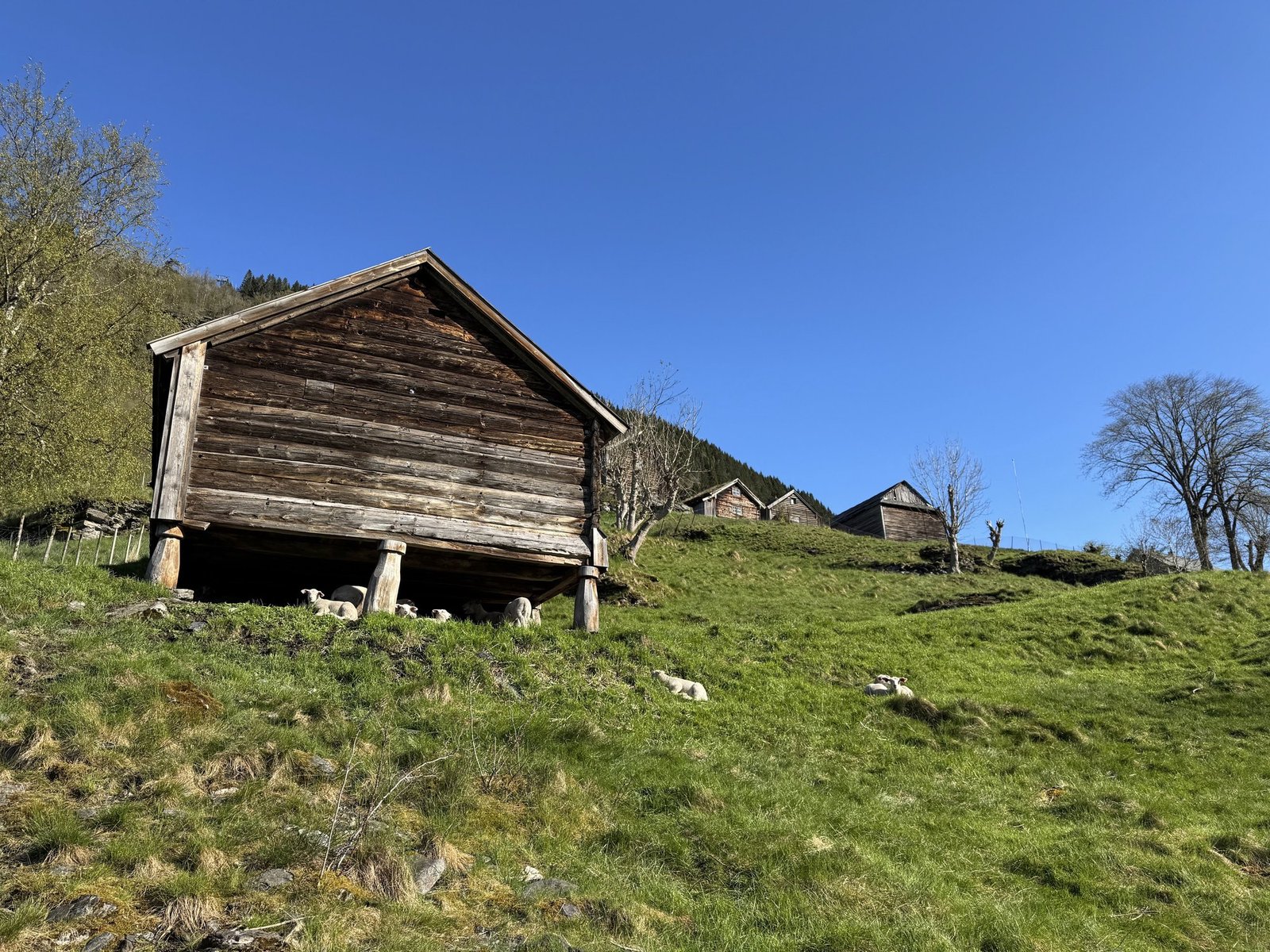
- Hiking from Kvanndal to Kvanndalsstølen mountain farm
Routes I guided and traveled
- Nærøyfjord boat tour guide: viewpoints, hikes and fjord villages
- Voss to Flåm: a self-guided route via Tvindefossen and Stalheimskleiva
- Aurland to Hardanger: a fjord and cider loop
- From Gudvangen to Vik and the Hardangerfjord route
- Guided fjord route: from Voss to the Hardangerfjord
- National Scenic Route Aurlandsfjellet
Norwegian culture I learned about
- Hardangerbunaden: Norway’s national icon
- Rose-painted chests: more than storage
- Vossa kvanne: a heritage plant
- Harriet Backer: the painter who mastered light
- Berg vs Fjäll: why Norwegians and Swedes see mountains differently
Understanding the landscape
- Fjords 101: how ice carved Norway’s coast
- Norwegian nature: trees, wildlife and life outdoors
- The Atlantic salmon of Sognefjord and Lærdal
- How salmon farming works in Norway
Food
Guiding
Customs and everyday life
- Friluftsliv: Life outdoors. It is part of who Norwegians are. On weekends, the cities empty into the mountains.
- Kos: Cosiness. Candles, wool socks, waffles and time together.
- Janteloven: The Norwegian version of our Swedish jantelagen: do not show off.
- At home: Take off your shoes, be on time and keep your voice low on public transport.
Traditions
- 17 May, Constitution Day: The biggest party of the year. People wear the bunad, their regional folk costume, and children march in parades.
- Easter: The country goes to the mountains to ski and read påskekrim, Easter crime novels.
- Julebord: Christmas parties with colleagues and friends in November and December.
- Taco Friday: A modern family tradition. Yes, really.
The right to roam
Allemannsretten lets everyone walk, ski and camp in nature, also on private land that is not farmed.
- Camping: Put up your tent at least 150 meters from the nearest house. You can stay two nights in one place without asking the landowner.
- Fires: From 15 April to 15 September, fires near forests are not allowed, unless it is clearly safe.
- Trails: Stay on the path. Short cuts across bends cause erosion.
- Wildlife: Keep your distance.
- Rubbish: Take everything back with you.
I saw tourists leave rubbish and walk too close to animals. Don’t be that person. The landscape looks untouched because people treat it that way.
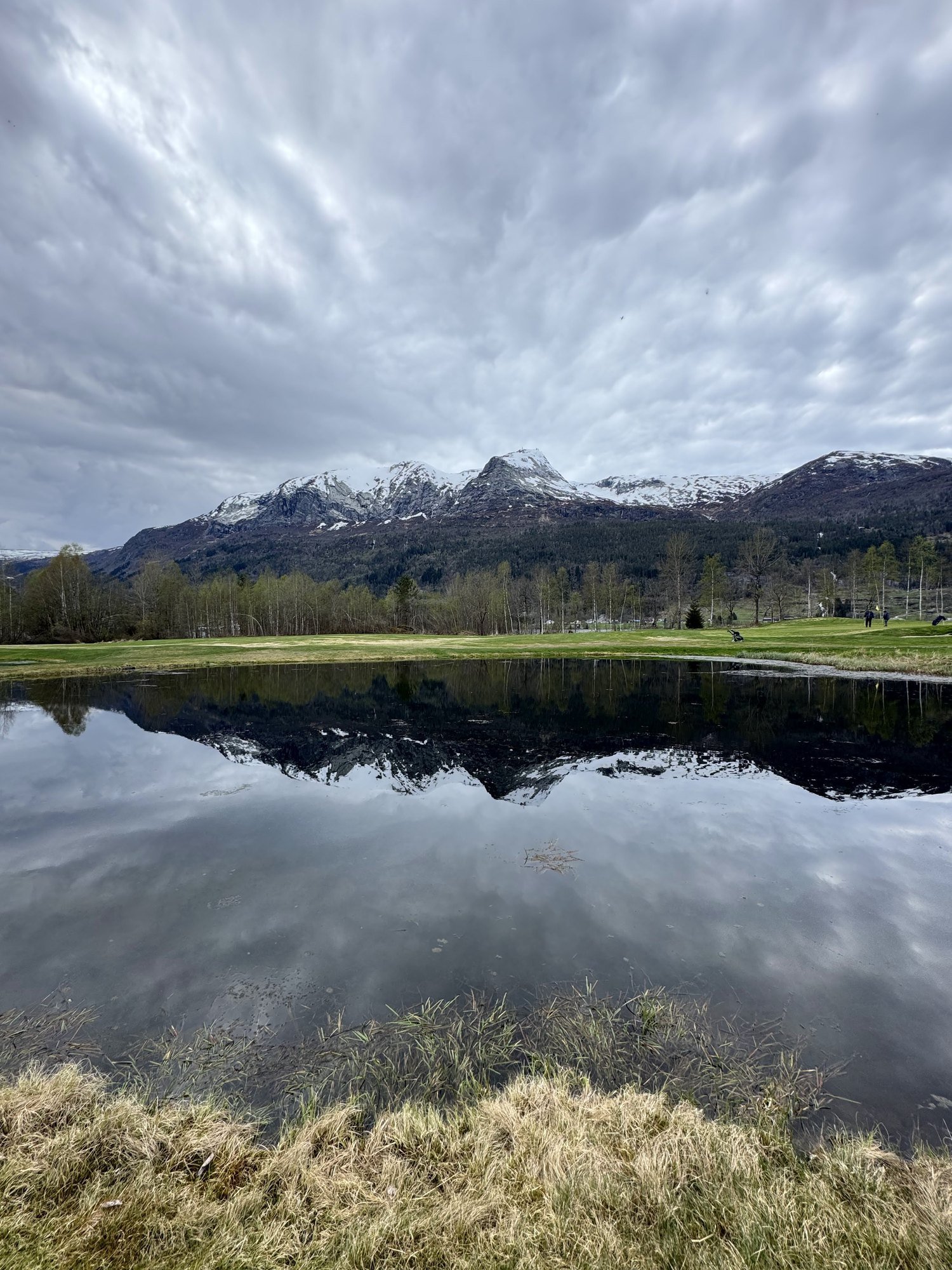
Food and drink
- Brunost: Sweet brown goat cheese. Slice it thin, on bread or waffles. In Undredal, by the Nærøyfjord, they still make goat cheese.
- Fårikål: Mutton and cabbage stew, the national dish, eaten in autumn.
- Vafler: Heart-shaped waffles with sour cream and jam.
- Raspeballer: Potato dumplings, a west coast dish.
- Salmon and cod: Norway is the world’s largest producer of farmed salmon. Winter cod, skrei, is a seasonal treat.
- Hardanger cider: Try it at the farms in Ulvik.
Alcohol rules
- In shops: Beer and other drinks up to 4.7 percent. Sales stop at 20:00 on weekdays and 18:00 on Saturdays. No sales on Sundays.
- Stronger drinks: Only at Vinmonopolet, the state shop.
- Age limits: 18 for beer and wine, 20 for spirits.
Health and safety
Norway is a safe country. The biggest risks are the weather and the mountains.
- Before a hike: Tell someone your route and check the forecast on yr.no, the Norwegian weather service.
- Mountain weather: It changes fast, even in July.
- Cold water: Fjords and lakes are cold, even in summer.
- Ticks: Check your skin after walks in grass, mostly in the south and west.
- Emergencies: Call 113 for an ambulance and 112 for the police.
- LGBTQ travelers: Same-sex marriage has been legal in Norway since 2009. Oslo Pride takes place in June.
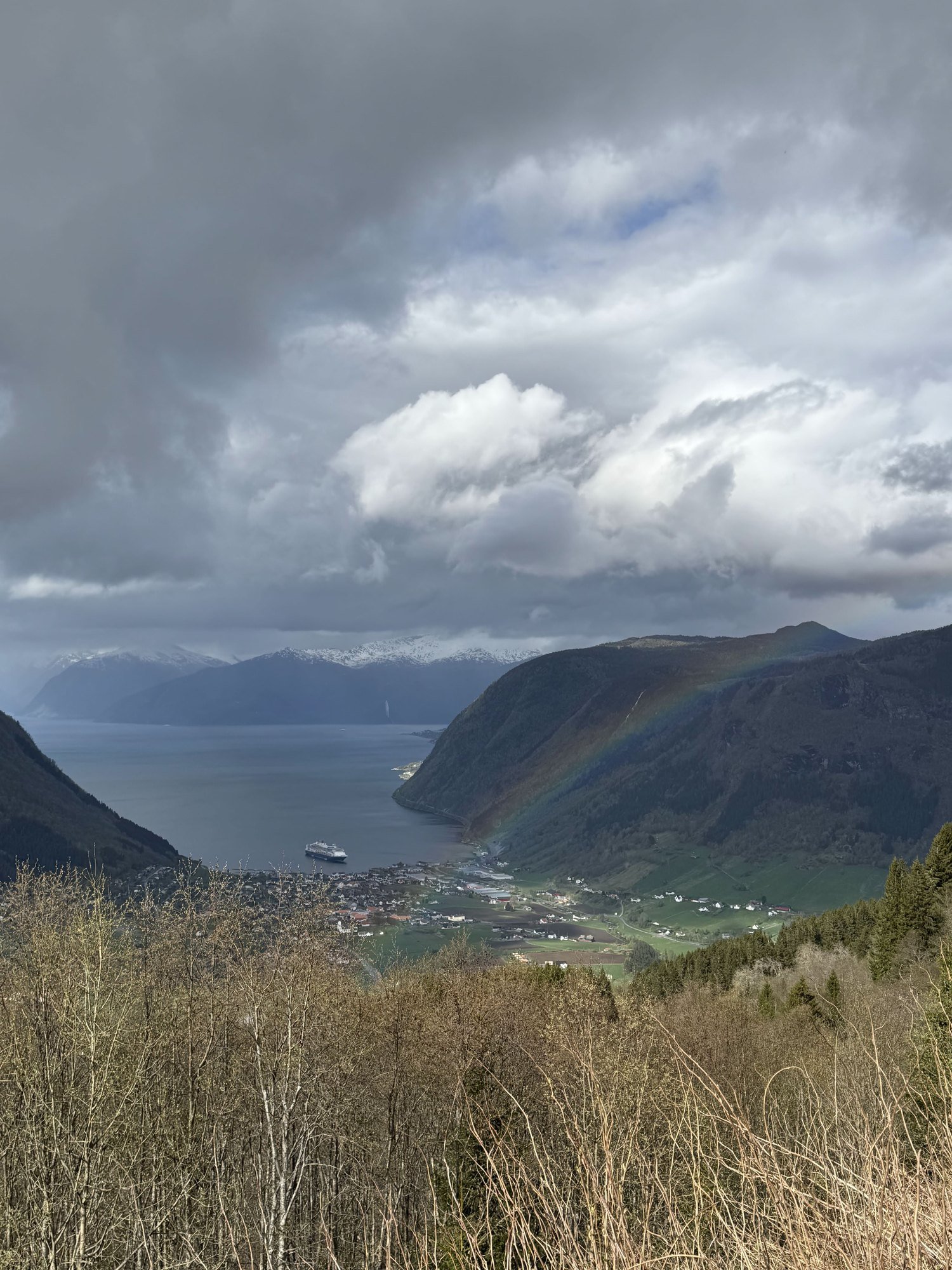
Mistakes I see visitors make
- Seeing the fjords in one day from a bus.
- Packing for the calendar, not for the weather.
- Driving to a mountain pass that is still closed in May.
- Booking summer ferries, hotels and Lofoten too late.
- Expecting the northern lights in Oslo.
- Walking off the trail or leaving rubbish.
- Paying for tours to views you can reach by bus and on foot.
Questions visitors ask me
Is Norway expensive?
Yes. It is one of the most expensive countries in Europe. Cook your own meals and enjoy the free nature.
Can I see the northern lights in Oslo?
Rarely. Go north, to Tromsø or Finnmark, between September and March.
When is the best time to visit the fjords?
June for long days and good weather. May and September for fewer people.
How many days do I need in Norway?
Five days for Oslo, the Flåm Railway, the Nærøyfjord and Bergen. Ten days or more if you add Stavanger or the Arctic.
Do I need cash in Norway?
No. Cards work almost everywhere.
Why is Norway so rich?
Oil and gas. Norway put the profits into a fund for the future instead of spending them. The government may only use the expected return, about 3 percent a year.
One last thing
Norway rewards the slow traveler. Take the ferry instead of the tunnel. Stay one more night in the valley. Walk up the mountain behind the village.
When you stand at the top, you will understand why Norwegians go quiet.
God tur.
Facts about Norway
Numbers from 2025–2026
For the curious. I checked every number against official sources in September 2026. Numbers change, so the year is next to each one.
People
- Population
- 5,627,400 (1 January 2026), up 33,060 during 2025
- Births
- 55,401 in 2025. On average 1.48 children per woman, up from 1.44 in 2024.
- Immigrant background
- 17.5 percent are immigrants, and 4.2 percent were born in Norway to immigrant parents (1 January 2026)
- Largest immigrant groups
- From Poland (111,740), Ukraine (85,461), Lithuania (43,065), Syria (42,040) and Sweden (37,732), 1 January 2026
Travel and tourism
- Overnight stays
- 40.6 million in 2025, a record, up 5.2 percent
- From abroad
- 14.2 million overnight stays in 2025, up 14 percent
- Top countries
- Germany (about 2.6 million), Sweden (1.3 million), the Netherlands (985,000), the United Kingdom (977,000) and Denmark (896,000), all 2025
Work and money
- Unemployment
- 4.5 percent in 2025, up from 4.0 percent in 2024
- Employment
- 69.6 percent of people aged 15–74 (2025)
- Public sector
- About one in three jobs, 33.5 percent, are in public administration (second quarter of 2025)
- Large companies
- Equinor (Stavanger), Norsk Hydro, Yara, DNB and Telenor
- VAT
- 25 percent as standard, 15 percent on food, 12 percent on transport, hotels, cinemas and museums. Books and newspapers: 0 percent (2026).
The oil fund
- Value
- 22,683 billion NOK (30 June 2026)
- Ownership
- On average, 1.5 percent of all listed companies in the world
- Spending rule
- The government may spend the expected return, about 3 percent a year.
Family and society
- The Nordic model
- A market economy with a strong welfare state, paid for by high taxes
- Healthcare
- Public healthcare for residents, with small user fees. After 3,278 NOK in fees in one year, most care is free (2026). Children under 18 pay no fees.
- Parental leave
- 49 weeks at full pay, or 61 weeks at 80 percent. 15 weeks (at full pay) are reserved for each parent (2026).
- University
- Free for EU and EEA students. Since 2023, students from outside the EU and EEA pay tuition.
Norway in Europe and the world
- European Union
- Not a member. Norwegians voted no in 1972 and 1994.
- EEA
- Member since 1994
- Schengen
- Part of the Schengen Area since 2001
- NATO
- Founding member, 1949
- History
- Norway got its constitution on 17 May 1814. The union with Sweden ended in 1905.
National symbols
- Coat of arms
- A lion with an axe
- National bird
- The white-throated dipper (fossekall)
- National flower
- Heather (røsslyng)
- National dish
- Fårikål
Curious facts
- A penguin in the King’s Guard: Sir Nils Olav III, a king penguin at Edinburgh Zoo, is an honorary Major General of the Norwegian King’s Guard.
- The cheese slicer (ostehøvel) was invented in Norway in 1925.
- Slow TV: In 2009, NRK showed the whole Bergen Railway trip, minute by minute. People watched it.
- The Nobel Peace Prize is awarded in Oslo. The other Nobel prizes are awarded in Stockholm.
Read next
All photos on this page were taken by Zayera Khan. Zayera Khan is the photographer and copyright owner. Please do not reuse them without permission.
Sources: Statistics Norway, population; Statistics Norway, largest municipalities; Statistics Norway, immigrants; Statistics Norway, overnight stays 2025; Statistics Norway, unemployment 2025; Norges Bank Investment Management, the fund’s value; Store norske leksikon, national parks; Av-og-til, beer sales hours; Ruter, 24-hour ticket; Kartverket, the size of Norway; Statistics Norway, largest immigrant groups; Statistics Norway, Labour Force Survey; Statistics Norway, jobs in public administration; Helsenorge, exemption card; Norwegian Public Roads Administration, Lærdal Tunnel; Norwegian Public Roads Administration, Hardanger Bridge; Fleischer’s Hotel, history.