
The Devil’s Bible in Stockholm: Codex Gigas and the Question of War Booty
The largest medieval manuscript in the world was taken as loot in Prague in 1648. It is still in Stockholm.
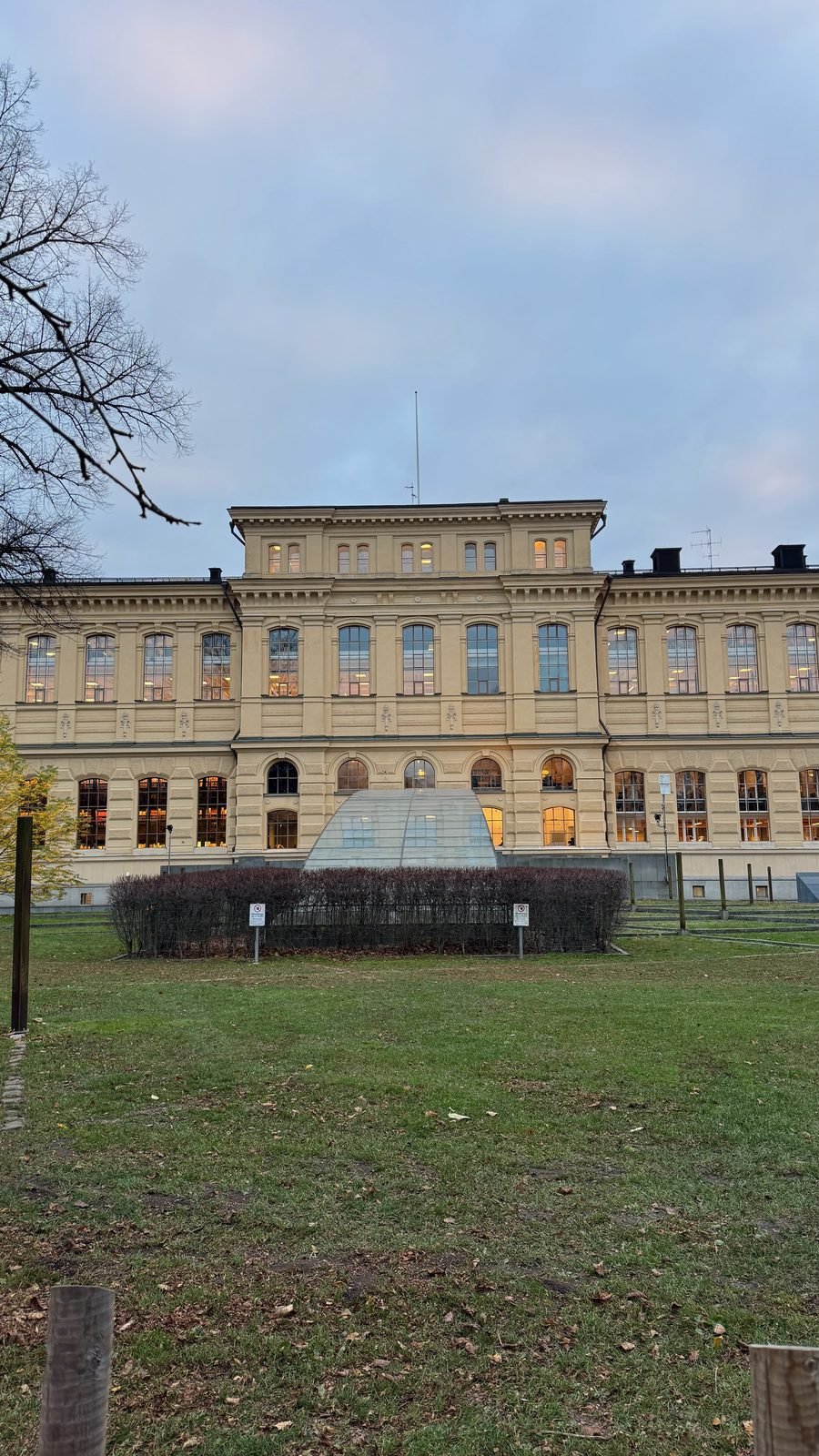
I went to see the Devil’s Bible on 10 November 2026. It is kept at Kungliga biblioteket, the National Library of Sweden, in the park Humlegården in central Stockholm.
It’s a big book. I was surprised by the size of it.
The room is small. It is big enough for a few people at a time to look at the book, use the screen where you turn the pages, and watch the videos. I stayed for a while. I looked at the videos, searched the digital images and watched a bit of the film that plays in the room.
Codex Gigas in short
- What is it?
- A handwritten Latin manuscript from the early 1200s. KB says it is probably the largest medieval manuscript that still exists.
- Why is it called the Devil’s Bible?
- It has a full-page portrait of the devil.
- Where was it made?
- In the Kingdom of Bohemia, which is now the western part of the Czech Republic, between 1204 and 1230.
- How did it come to Sweden?
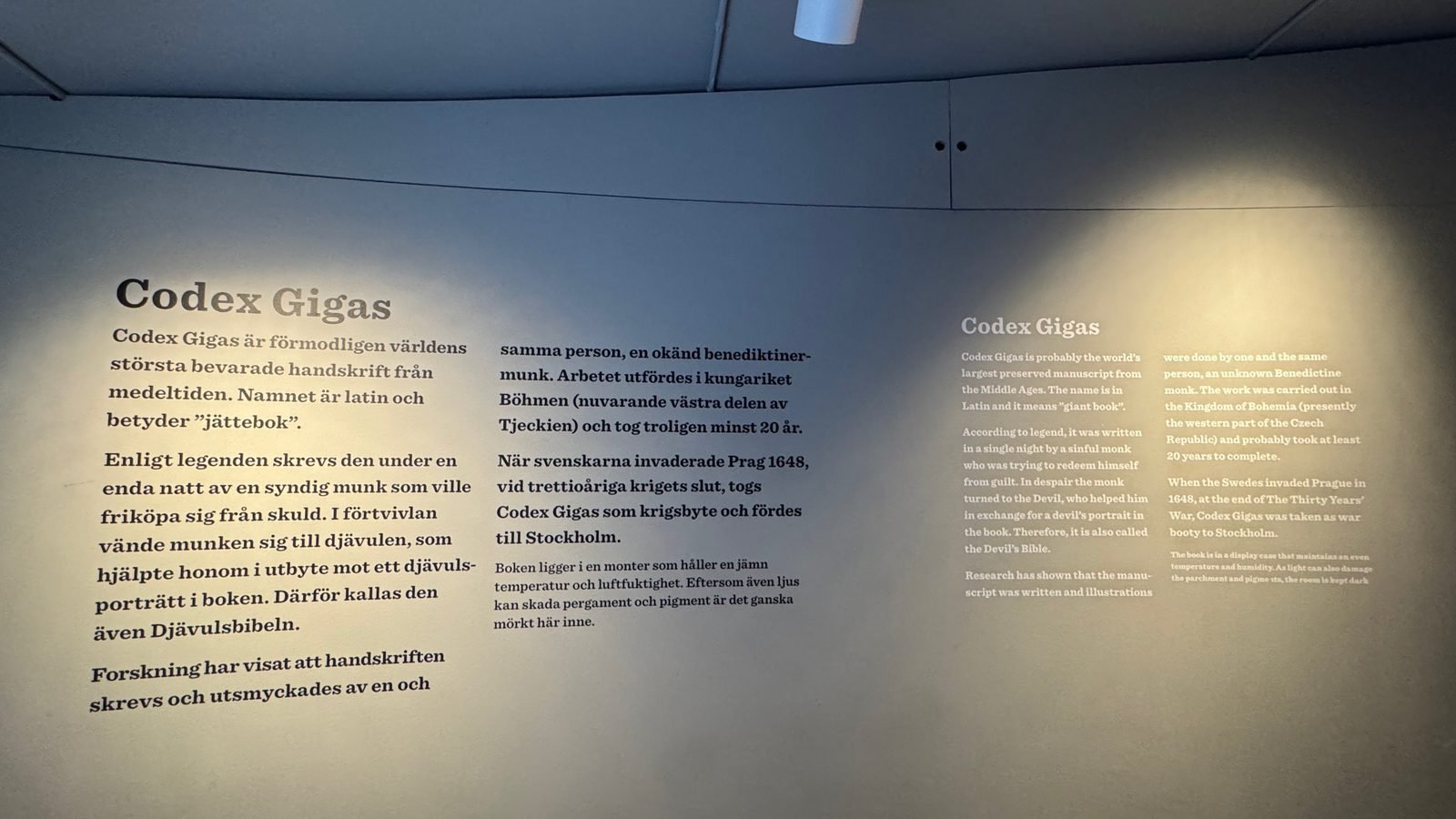
- The Swedish army took it as war booty when it plundered Prague in 1648.
- Where can you see it?
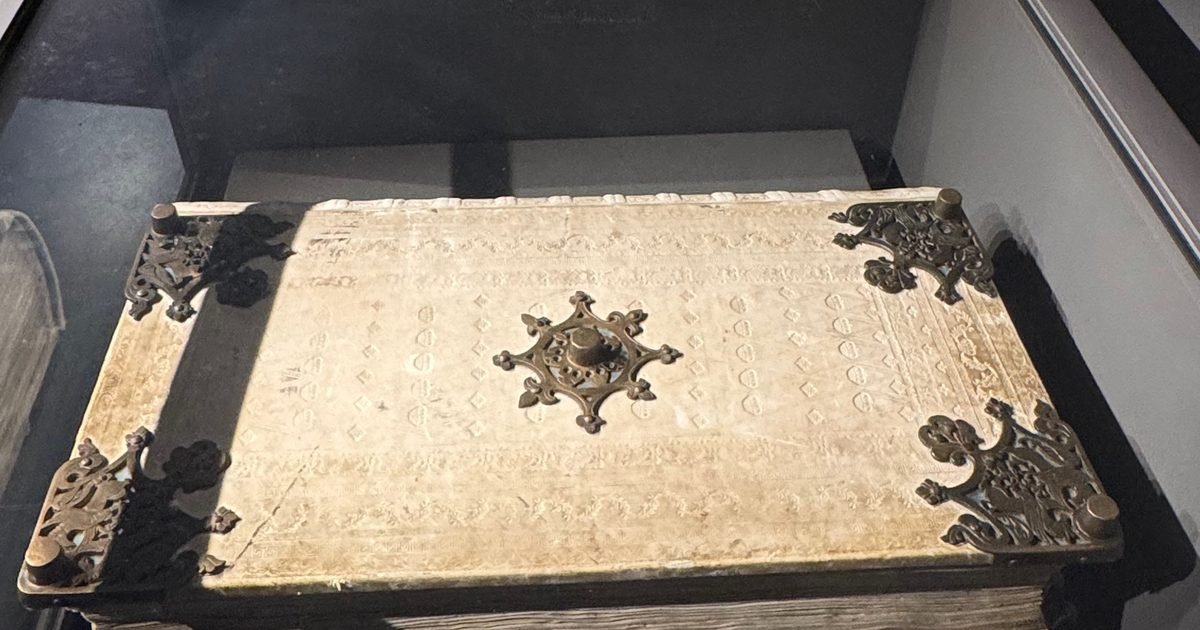
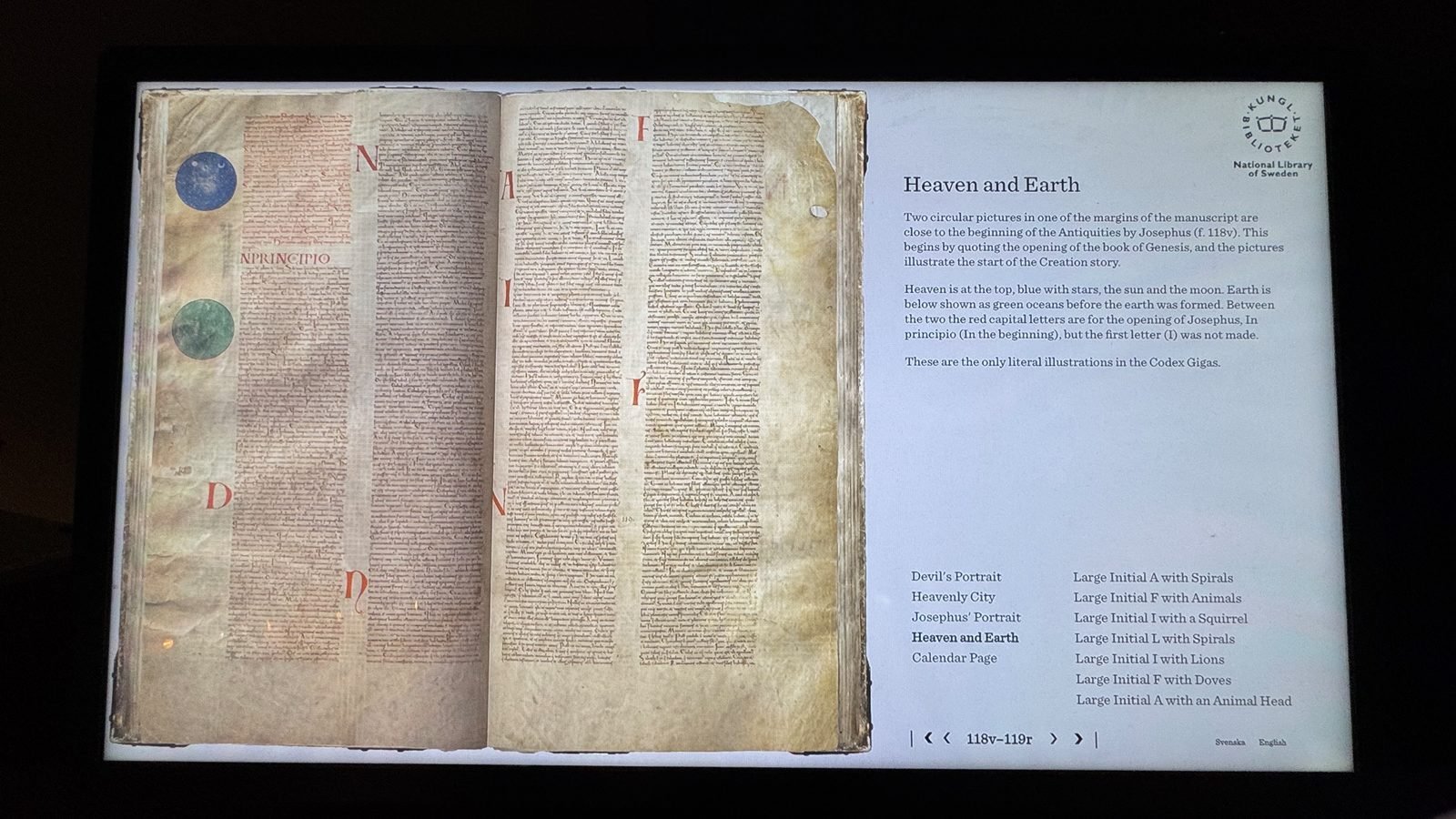
- In the Treasury Room at KB in Stockholm. Entry is free. The book lies closed. You can turn its pages on a digital screen next to the case.
- Will Sweden return it?
- No law makes Sweden return it. Sweden lent it to Prague in 2007–2008.
What is inside the giant book
Codex Gigas is Latin for “giant book”. KB says it weighs 75 kilos. It has 310 parchment leaves, probably made of calfskin. Each leaf is 89 cm high and 49 cm wide.
Nobody printed it. A person wrote every letter by hand, more than 200 years before printing came to Europe.
About half of the book is the Old and New Testament. The other texts were chosen to support the Bible:
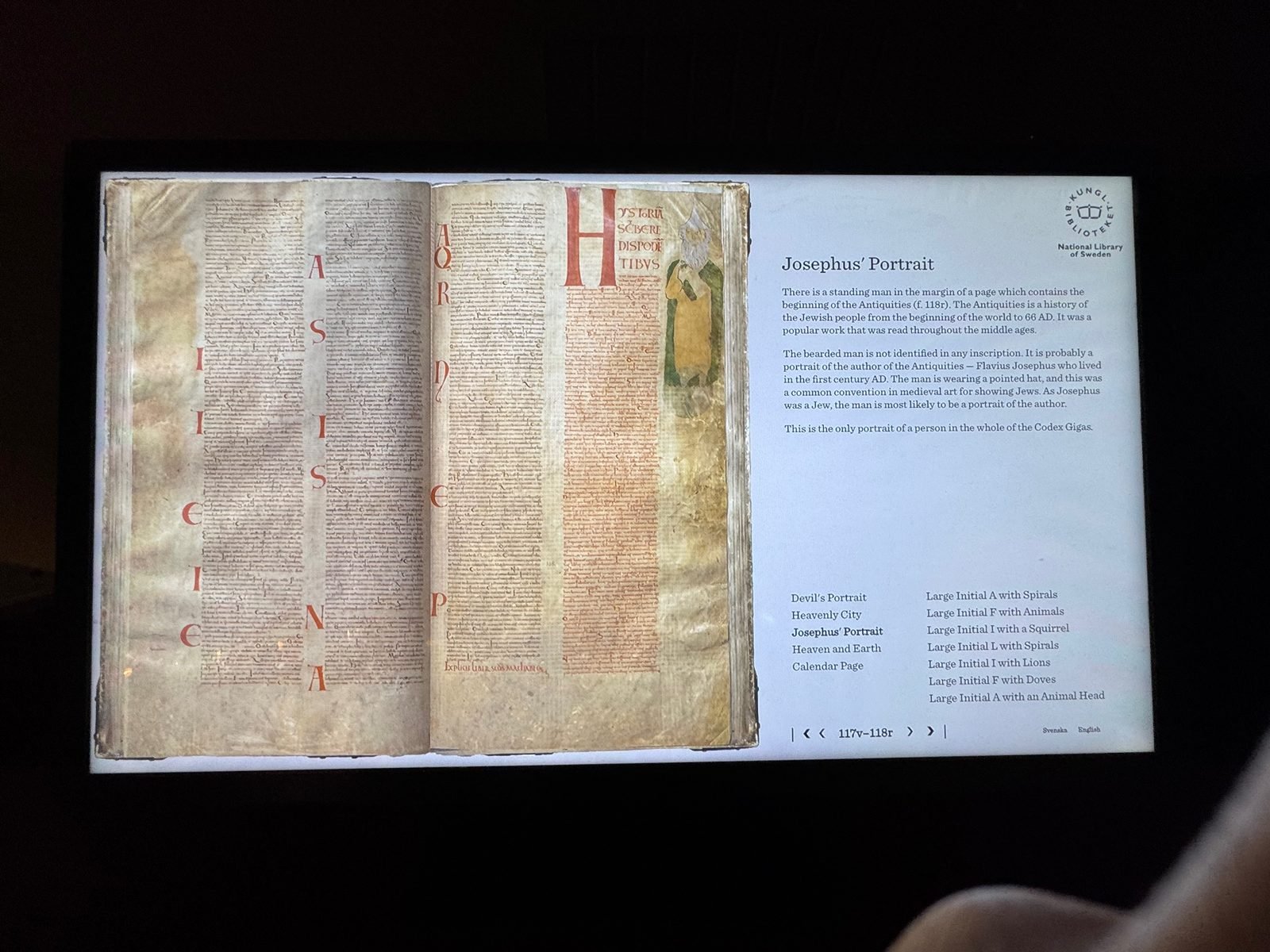
- Two books by the Jewish historian Josephus Flavius: Jewish Antiquities and The Jewish War.
- Etymologiae, an encyclopedia by Isidore of Seville. It was the most popular encyclopedia of the Middle Ages.
- Medica, medical texts used to teach medicine across medieval Europe. They include the Aphorisms of Hippocrates, which start with the famous line “Life is short, art is long.”
- The Chronicle of Cosmas of Prague, the first history of Bohemia. It normally fills more than 200 pages. In Codex Gigas it fits on eleven leaves.
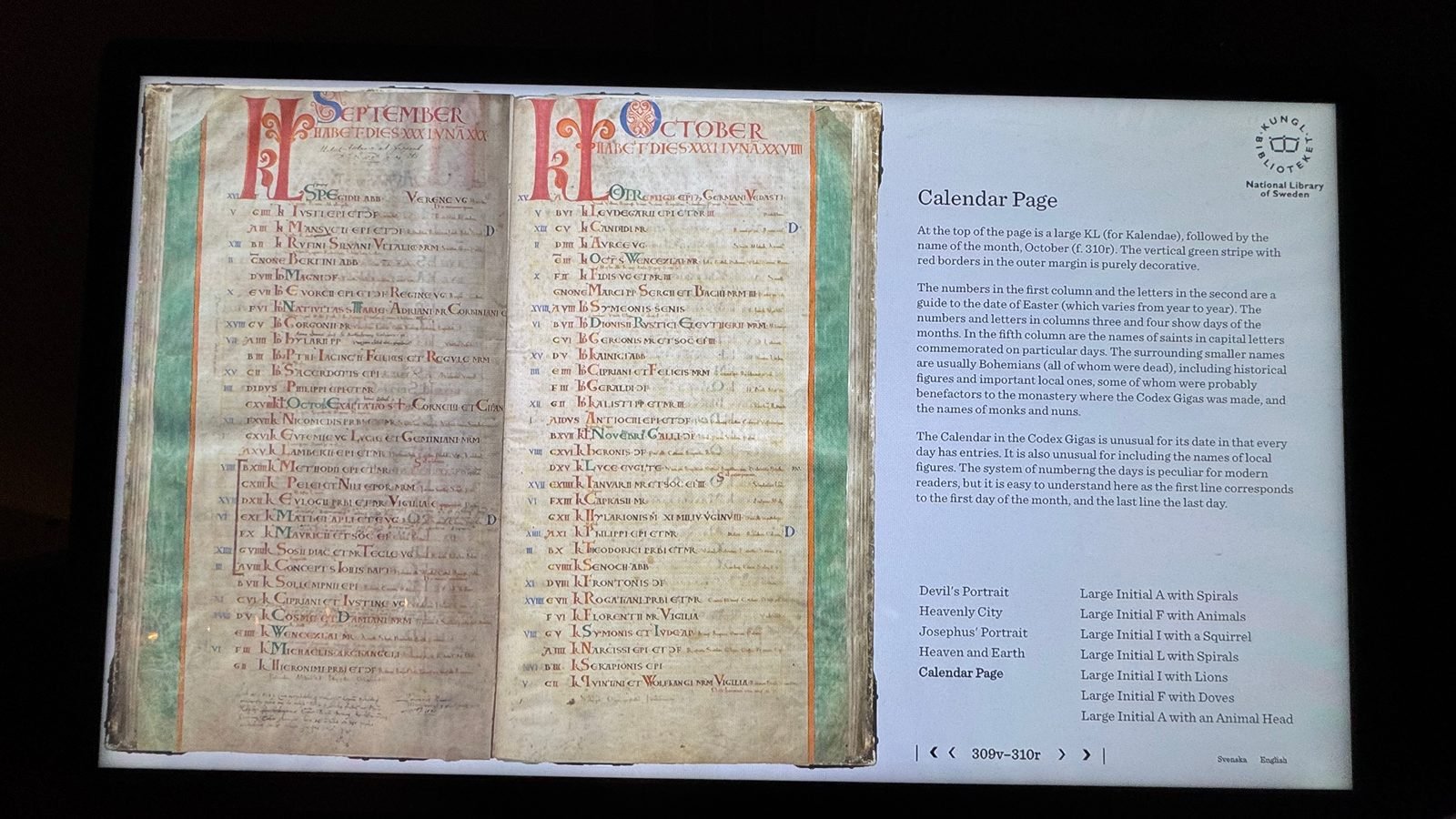
There are also shorter texts. One is a five-page confession of sins. Others are spells against fever and formulas for catching thieves. A calendar lists saints’ days and the dates when people in Bohemia died. KB counts 1,539 death notes, and only 2.5 percent of these people have been identified.
People also wrote in the book. KB counts more than fifty added notes. Many say, in effect, “I was here.” Two Czech researchers wrote their names in it as late as the 1800s.
One text is missing. Someone cut out the Rule of Saint Benedict, a guide to monastery life from the 500s.
The cover we see today is from 1819. A Stockholm bookbinder named Samuel Sandman was paid 78 riksdaler for it. At that time a cow cost 45 riksdaler.
Where and when it was made
KB says it is not clear exactly how the book was made. We know that it was written in the Kingdom of Bohemia between 1204 and 1230.
The wall text in the exhibition says research shows that one and the same person wrote and illustrated the whole book. That person was an unknown Benedictine monk, and the work probably took at least 20 years. KB’s main page says it may have taken one lifetime.
A note on the first page names the first known owner: the monastery of Podlažice. KB thinks the book was probably not made there, because that monastery was too small and too poor for such a project.
In 1295 the monks of Podlažice pawned the book to the monastery of Sedlec. The same year, the Benedictine monastery of Břevnov bought it back. By then people called it one of the wonders of the world.
The devil and the legend
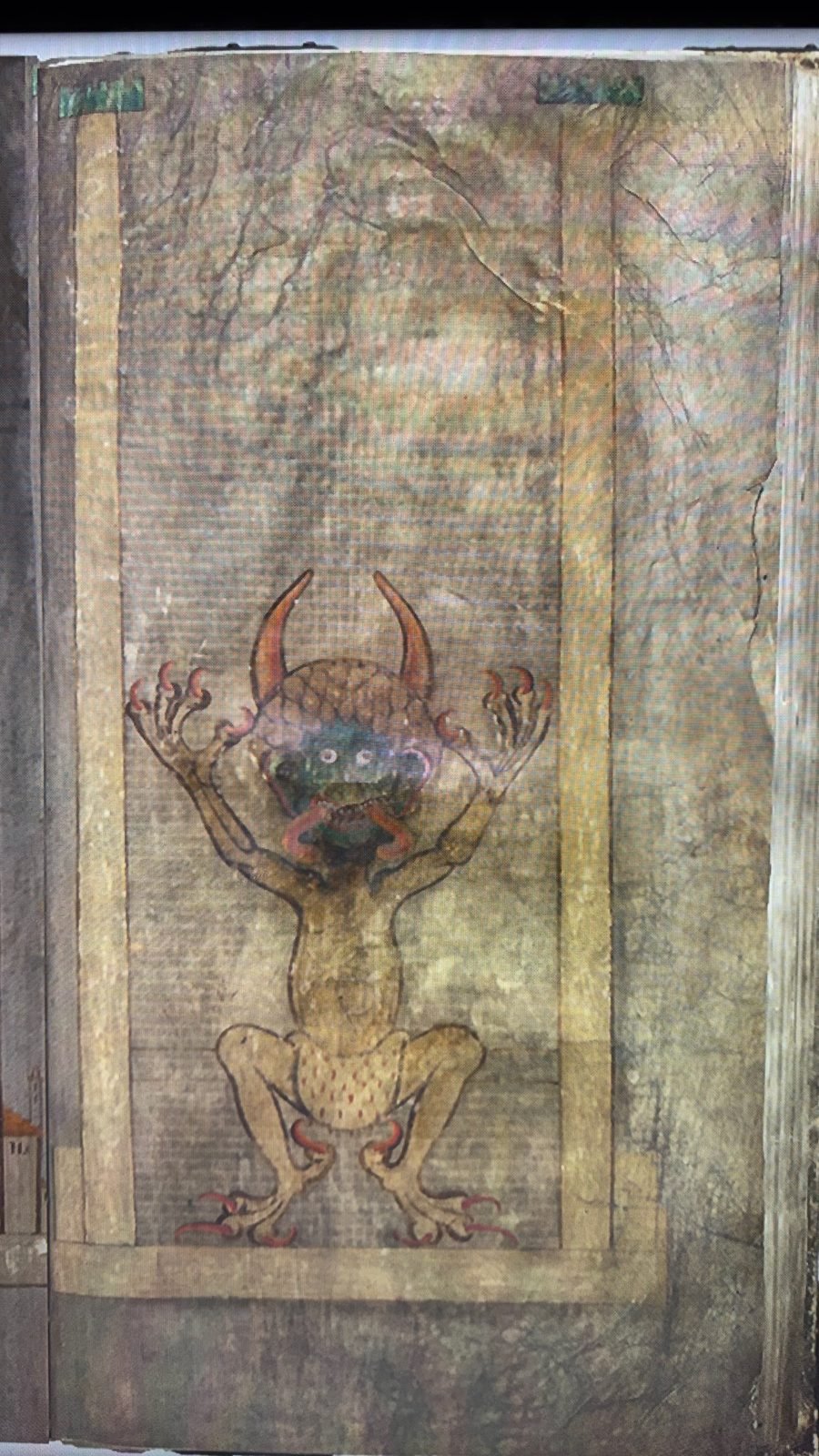
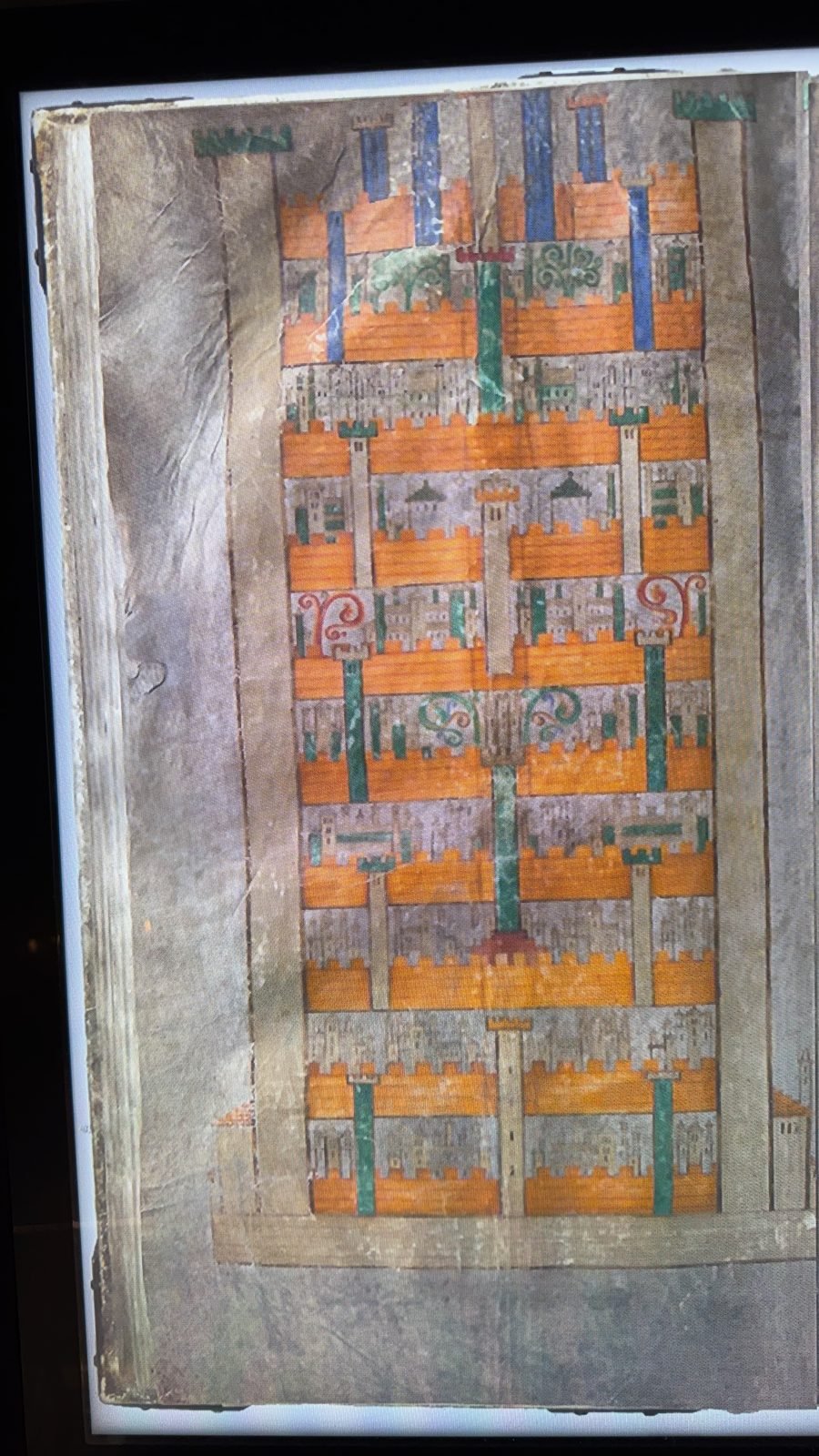
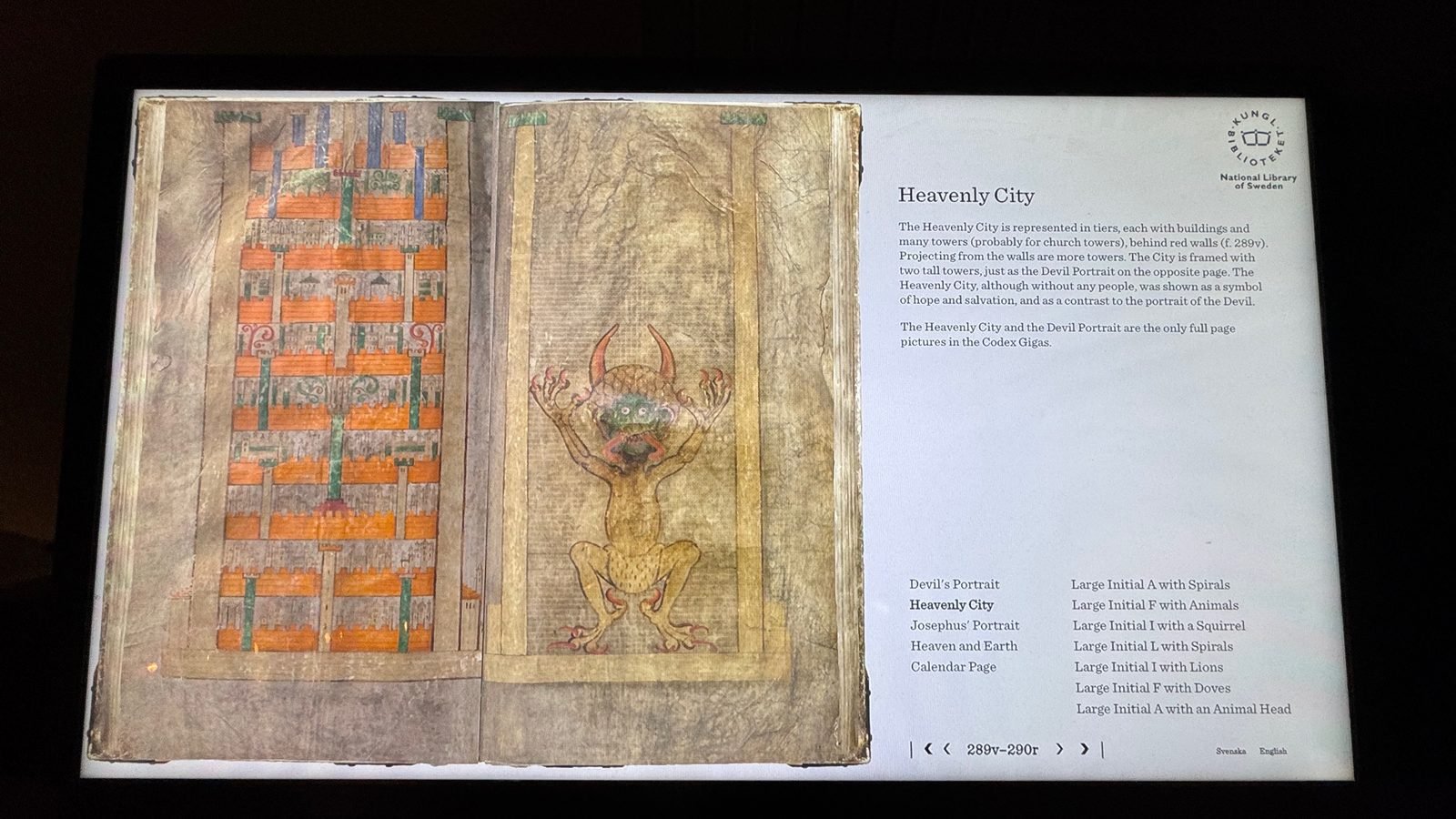
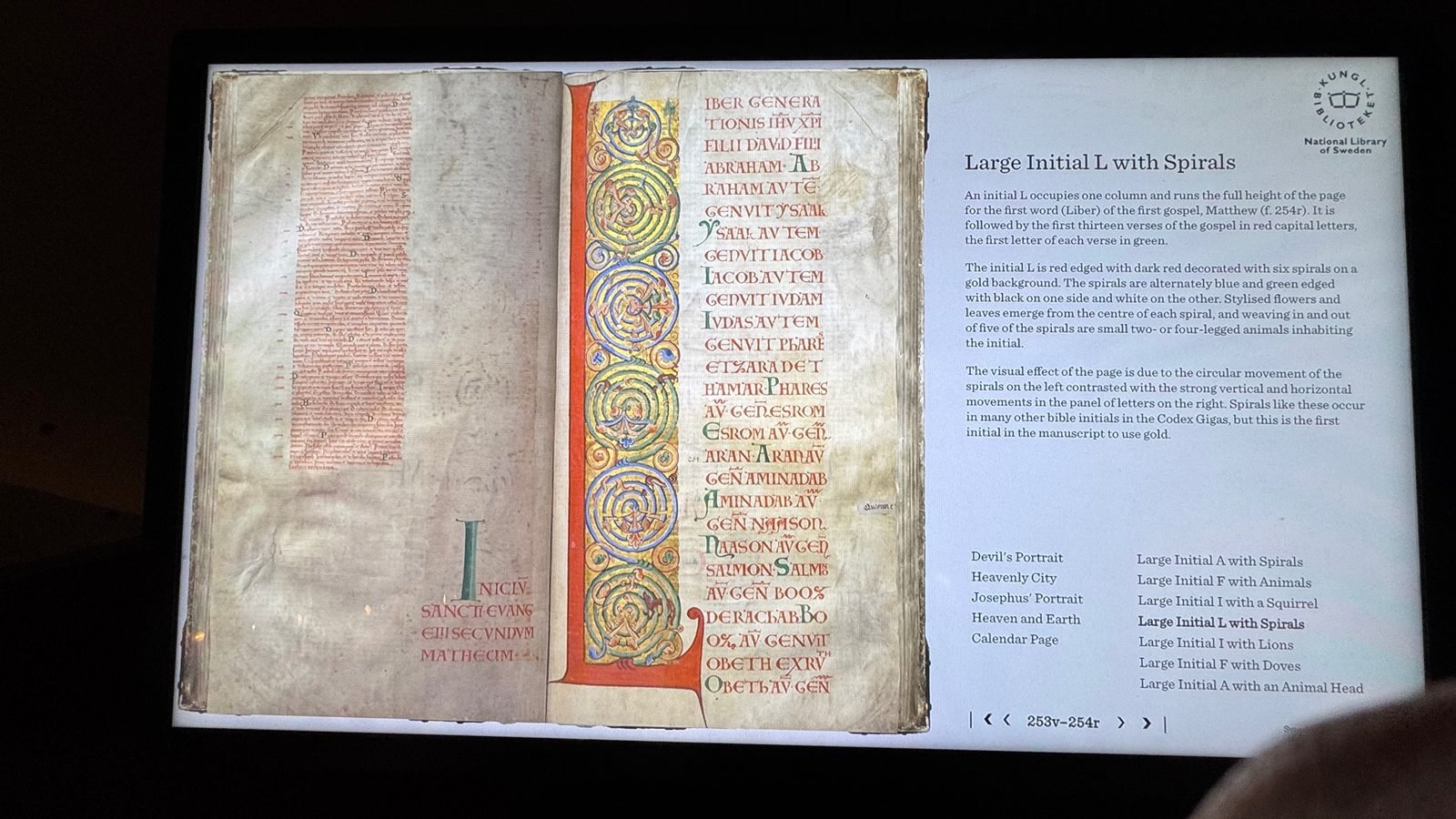
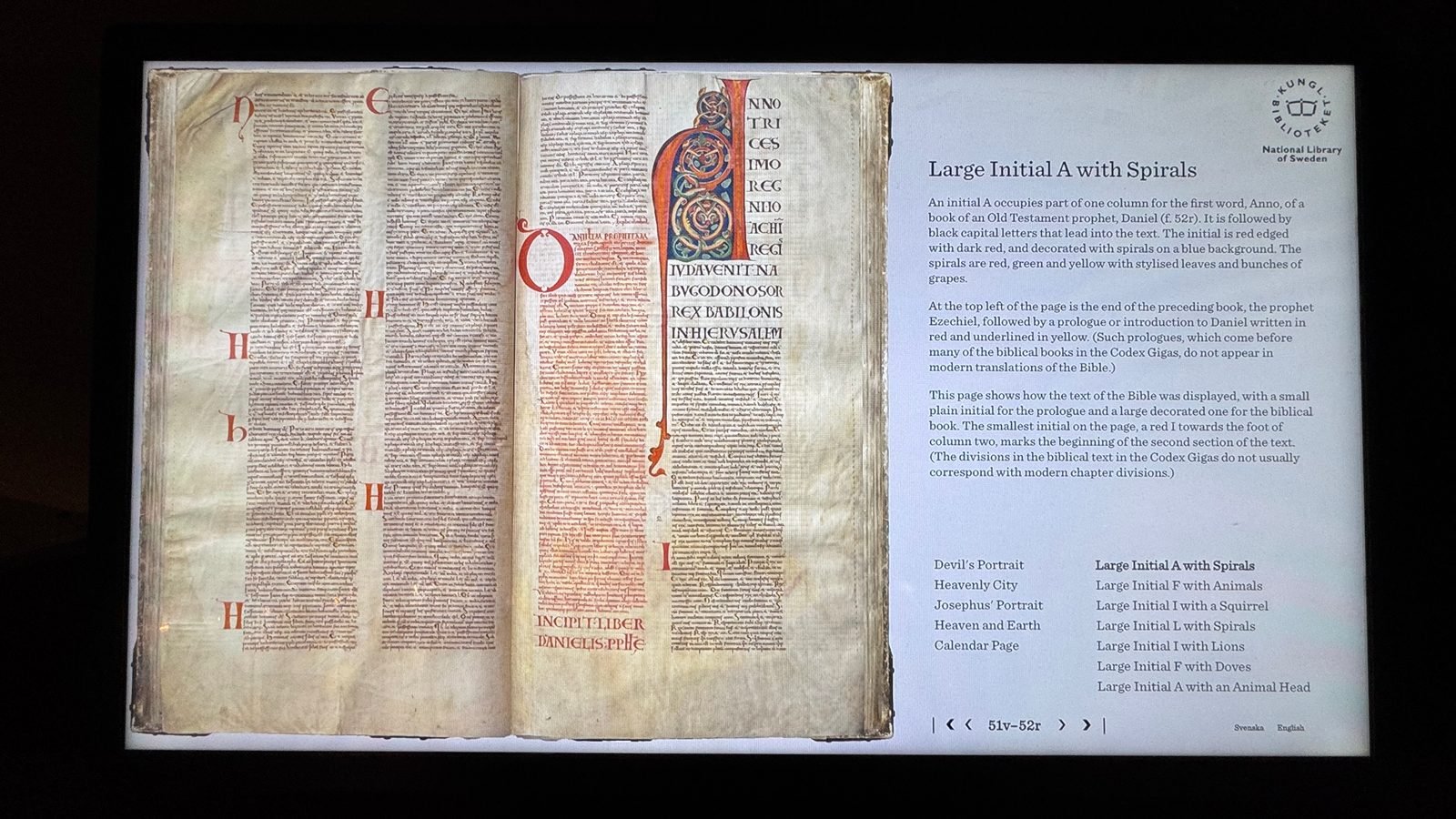
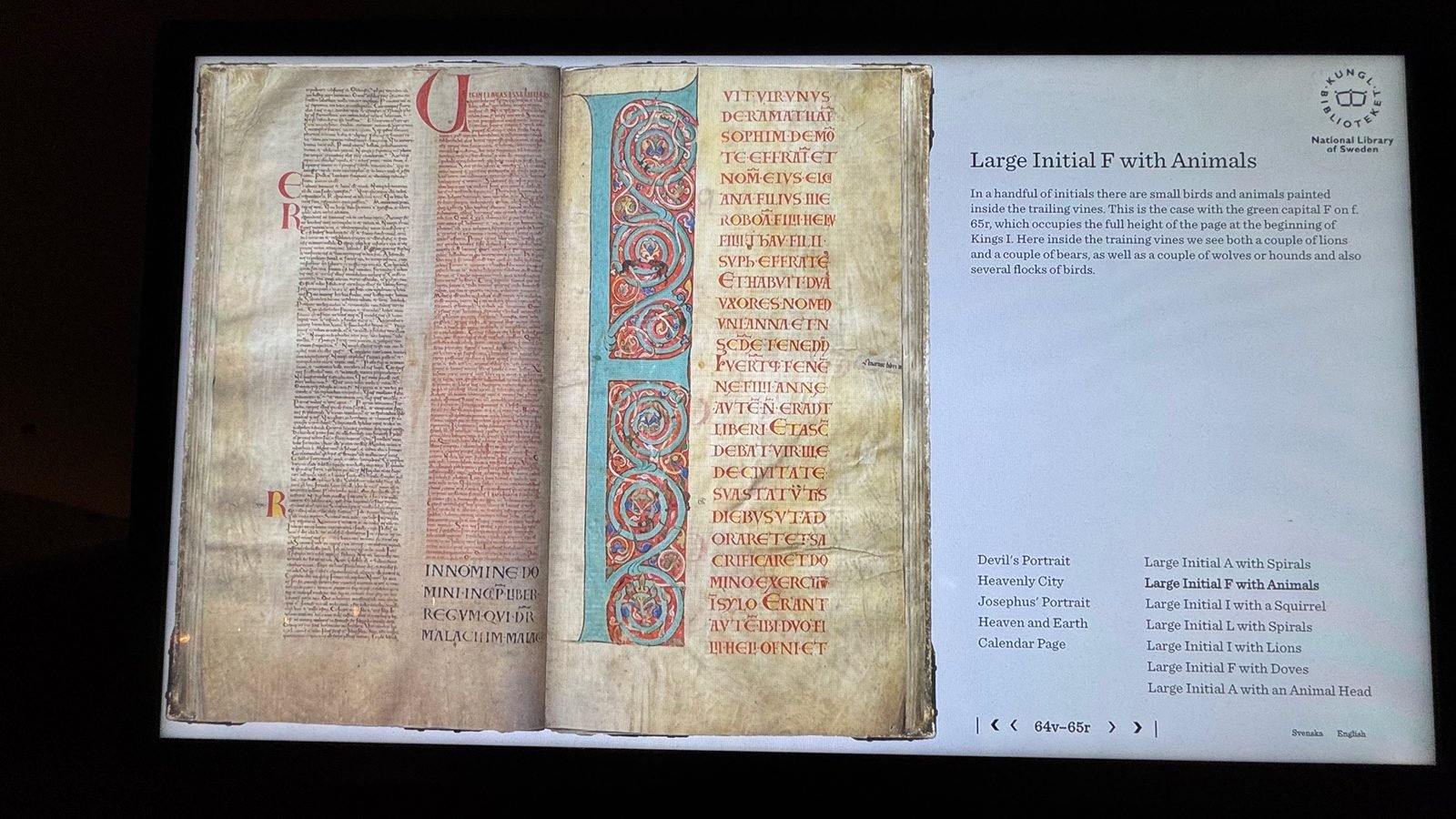
The book has five pictures and 77 colorful decorated initials. The two most famous pictures face each other near the end of the book. On the left is the Heavenly Jerusalem, a city full of buildings. On the right is the devil.
He squats with his arms in the air. He has four fingers and four toes. He wears a loincloth of ermine, a fur often linked to kings. KB thinks the ermine shows him as the Prince of Darkness. Two red tongues come out of his mouth. A forked tongue points to snakes, and to people who lie.
The city of God is full. Hell is empty except for its ruler. KB says the two pages show the reward for a good life and the cost of a bad one.
The legend says a monk had sinned and wanted to pay for his guilt. He promised to write the whole book in one night. When he saw that he could not do it, he asked the devil for help, and he drew the devil’s portrait in return.
KB says the legend has no basis in fact. What it does show is how much the size of the book impressed people. They wanted a supernatural reason for it.
On the next spread after the devil are the spells and formulas. KB suggests they may have been placed there as protection against the picture.
From Bohemia to Stockholm
In 1594 Emperor Rudolf II “borrowed” the book and took it to his castle in Prague. KB says he probably never meant to give it back. Rudolf collected animals (both living and dead), paintings, sculptures and curiosities. The devil picture fed his interest in the occult.
Early on 16 July 1648, in the last stage of the Thirty Years’ War, one hundred Swedish soldiers climbed the walls of Prague. About 3,000 more soldiers soon joined them. They plundered the city for two days, and they followed a detailed plan. Their inventory listed hundreds of books. Among them were Codex Gigas and Codex Argenteus, the Silver Bible, which is now at Uppsala University Library.
The book came to Stockholm in 1649. It went into Queen Kristina’s collections, in the library of Tre Kronor, the royal castle. Kristina gave up the throne in 1654 and took many books and manuscripts with her to Rome. She left Codex Gigas behind. I wrote more about her in my article on Queen Christina at 400.
On 7 May 1697, Tre Kronor burned. Someone threw the Devil’s Bible out of a window to save it. The story says it landed on a person below and hurt them. KB writes that you can doubt this story. What is certain is that the binding was badly damaged. Of 24,500 books and 1,400 manuscripts in the library, only 6,000 books and 300 manuscripts were saved. You can see what is left of the castle in my article on Museum Tre Kronor.
In 1768 the library and the book moved into the new Royal Palace, in the wing where the Bernadotte Library is today.
On New Year’s Day 1878 the library moved to its new building in Humlegården. The chief librarian, Gustaf Klemming, walked from the palace to the park in front of a janitor who pulled the Devil’s Bible behind him on a sled.
The book left Sweden for Prague once more, as a loan, from September 2007 to January 2008. It was shown at the National Library of the Czech Republic. Since 2018 it has been on display in KB’s Treasury Room.
Looted goods: what Swedish armies took
Codex Gigas is not the only one. Uppsala University Library says the first large book booty approved by the Swedish state was taken when Sweden occupied Riga in 1621.
KB says most of the books from Prague went to the royal library. Later, much of what stayed in Sweden was destroyed in fires or sold at book auctions in the 1700s. The books that survive are mainly at KB and at the university libraries in Uppsala and Lund.
A painting of Rudolf II was taken in the same plunder as Codex Gigas. KB credits Skoklosters slott as the source of its image of that painting.
Poland lost more. In a question to the Swedish government, a Swedish MP cited an estimate that Swedish armies took 67 libraries and 16 archives from Poland in the 1600s and early 1700s. The Poles call the war of 1655–1660 “the Deluge”. One Polish magazine says the peace treaty of Oliva in 1660 promised to return part of the stolen property, and that this never happened.* Polish media say a tent from that war is still at Skokloster, from the collection of Field Marshal Carl Gustaf Wrangel.* I wrote about the castle in my article on Skoklosters slott.
In Swedish this property is called krigsbyte, “war booty”. The word sounds neutral. KB’s own Swedish timeline is more direct: it says the Swedes plundered Prague and that the army robbed the book.
What does this mean? Many of Sweden’s best-known treasures came here by force. Sweden’s age as a great power is also a story of taking.
Should Sweden give it back? The ethics
There are two main views.
The legal view
KB says an act must be judged by the law that was in force when it happened. In the 1600s, taking booty in war was legal. KB says that returning the spoils of old wars would cause chaos, with legal effects nobody can predict. It calls these objects our common cultural heritage, and it says the duty now is to care for them and make them available.
The historian Dick Harrison makes a similar point. He told SVT that taking land, people and objects was part of the rules of war at the time. He sees a big difference between this and objects stolen from colonized peoples in the 1800s and 1900s, or during the Second World War. He also says that if you push the argument all the way, Sweden would have to give Skåne back to Denmark.
The moral view
Codex Gigas was made in Bohemia, for life in a monastery there. It holds the first history of Bohemia. Its calendar names Bohemian people and their dates of death. The text is Latin, but the memory in it is Czech.
Czech leaders have asked. The French news agency AFP reported that President Václav Havel tried in the early 1990s to get some objects linked to Bohemia returned, without success. When the Czech prime minister raised the 2007 exhibition in 2005, he was careful to call it a loan, not a return.
Sweden has made one exception. In 1974 Prime Minister Olof Palme returned the “Stockholm Roll” to the Royal Castle in Warsaw. It is a long painting of a royal wedding procession, taken by the Swedish army in the 1650s. Poland has since asked for other objects, among them Łaski’s Statute from 1505. Uppsala University Library thinks that copy was a gift to King Gustav II Adolf, not booty. In 2026 a Polish deputy foreign minister said the two countries had talked about returning some objects, possibly as a long-term deposit.* In a deposit, Sweden would keep ownership.
In Sweden, the government says that experts at the museums should judge each request for a return. Swedish law also controls the export of old cultural objects. An object that has been in Sweden for at least 75 years and may be of great importance to Swedish heritage needs a special licence to leave the country.
The question of care
KB says many objects taken in war survived longer in their new homes. That is partly true. But Codex Gigas almost burned in Stockholm in 1697, and much of the booty in Sweden was lost in fires.
The middle path
KB has digitized the whole book. Anyone can view the digitized Codex Gigas online, and anyone can use the images if they credit the photographer and the library. Other options are loans like the one in 2007, long-term deposits and shared research. A Czech book historian told Rare Book Monthly that she sees the Swedish booty as shared heritage, not as a claim. She also said the books have now spent more of their lives in Sweden than in Bohemia.
What does UNESCO say?
UNESCO, the UN body for culture and education, has rules on cultural property. None of them forces Sweden to return Codex Gigas.
The 1970 Convention. This is UNESCO’s main treaty against the illegal trade in cultural objects. It came into force in 1972, and Sweden ratified it in 2003. It does not apply to the past. It does not cover 1648.
The 1954 Hague Convention. This UNESCO treaty protects cultural property during war. It also looks forward, not back.*
The Return and Restitution Committee. In 1978 UNESCO created an intergovernmental committee for objects that the 1970 Convention does not cover. A state must first try to negotiate directly with the state that has the object. Only if those talks fail can it bring the case to the committee. The committee helps the two sides talk. Its advice is not legally binding.
The same year, on 7 June 1978, UNESCO’s Director-General appealed to the world to return irreplaceable cultural heritage to the people who created it.
So UNESCO gives no legal answer for war booty from the 1600s. It gives a direction: talk, cooperate, and think about what an object means to the people it came from.
I found no UNESCO statement about Codex Gigas itself. That does not prove there is none.
See it yourself
You find KB at Humlegårdsgatan 26. Codex Gigas is in the Treasury Room (Skattkammaren), on level 2 of the glass Annex. Entry is free. The book lies closed, because it was damaged by lying open on display for many years. Next to the case, a large screen lets you turn the pages and see the devil up close.
A 15-minute film tells the story of the book. It has Swedish speech and English subtitles.
Opening hours: Monday to Thursday 09–19, Friday 09–18, Saturday 11–15. Closed on Sunday. From 12 to 16 November 2026 the library is open but without service.
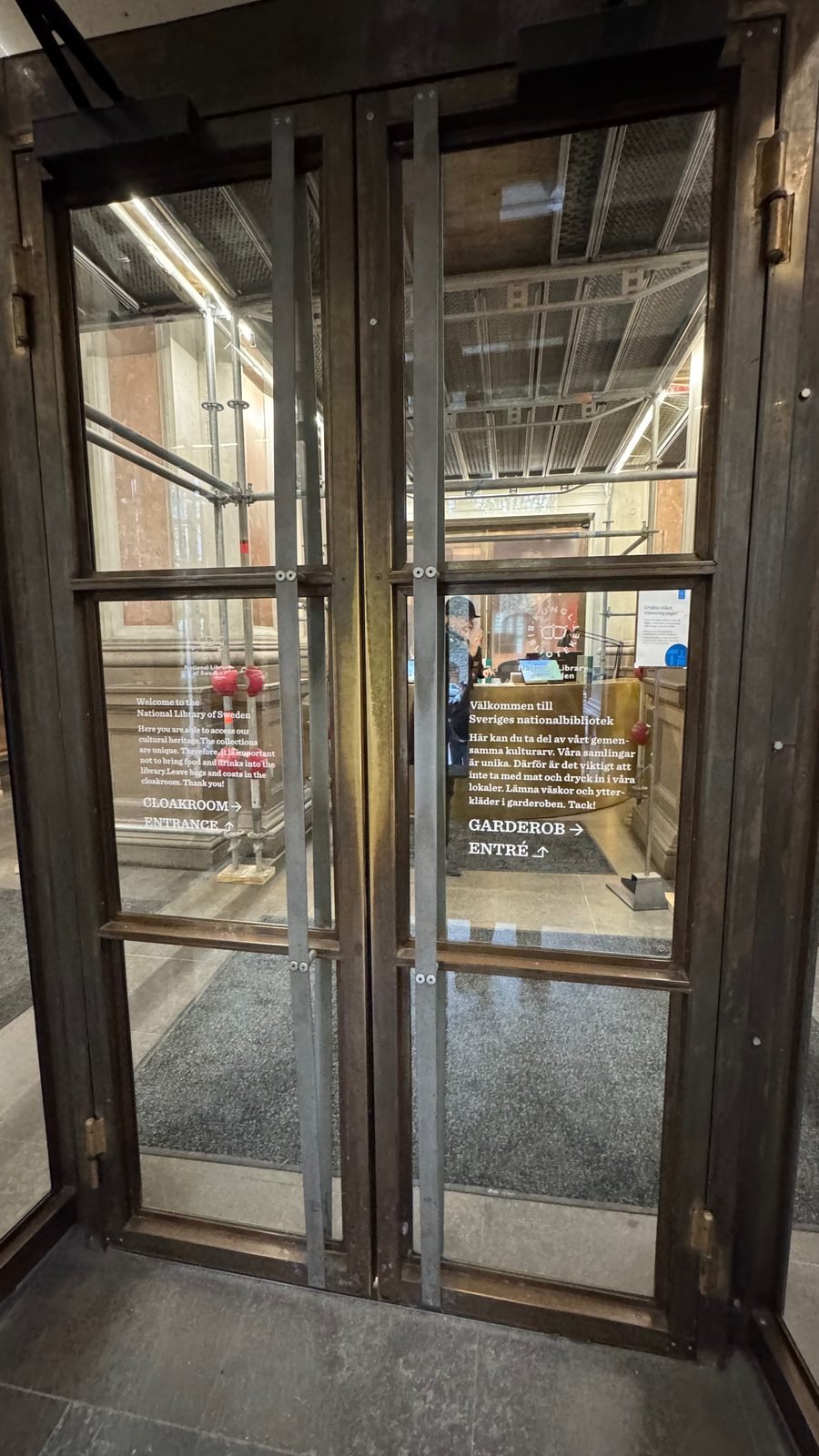
Practical: You cannot take bags, food or drink inside. There are free lockers. Small items can go in a clear plastic bag from the lockers. There is a café by the entrance and a lunch restaurant one floor down.
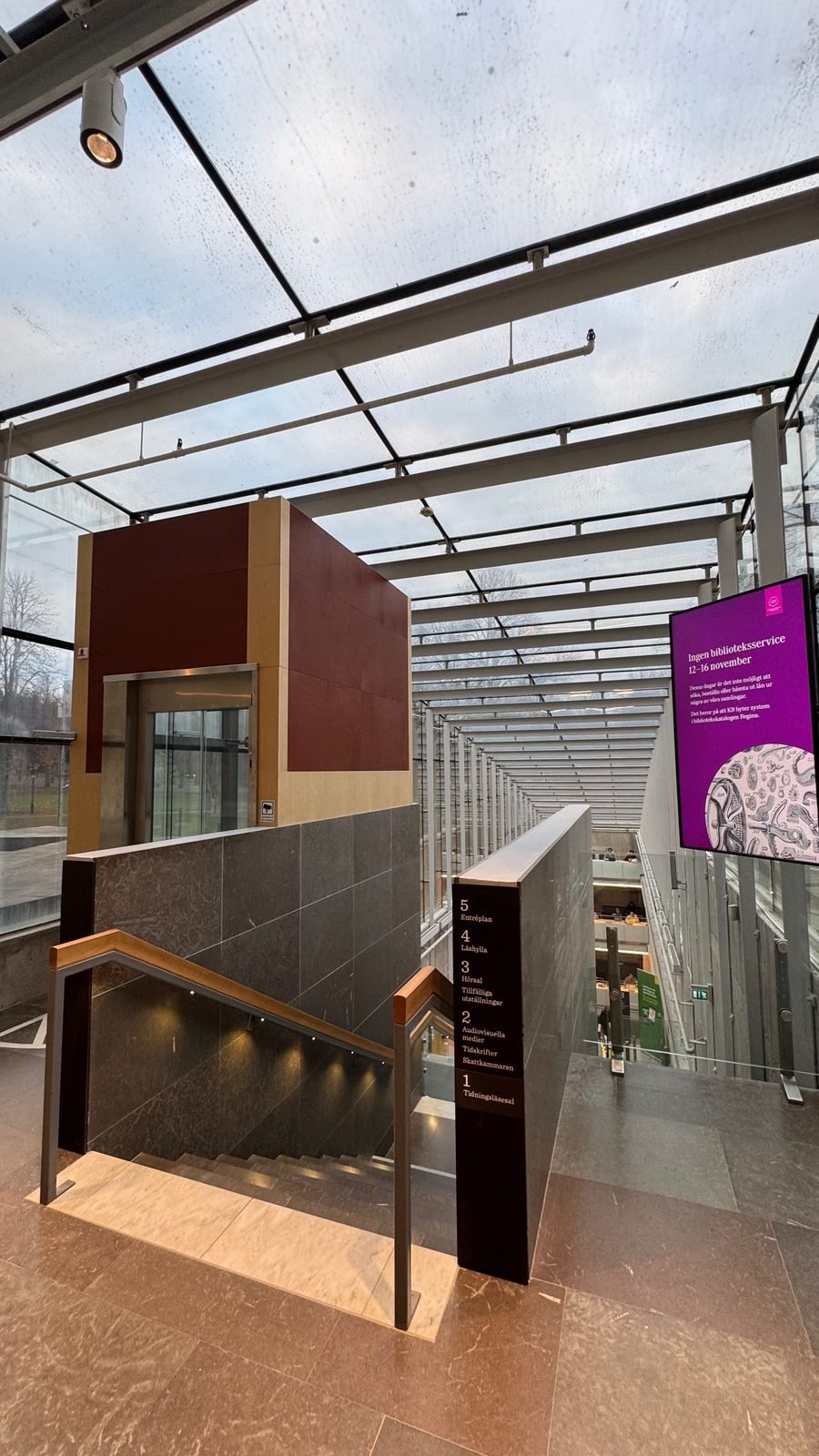
Accessibility: A gravel path about 60 meters long leads from the street to the main entrance. To the right of the main stairs is a ground-level door with a door opener and a lift to the entrance hall. A lift in the Annex goes to levels 1, 2 and 3.
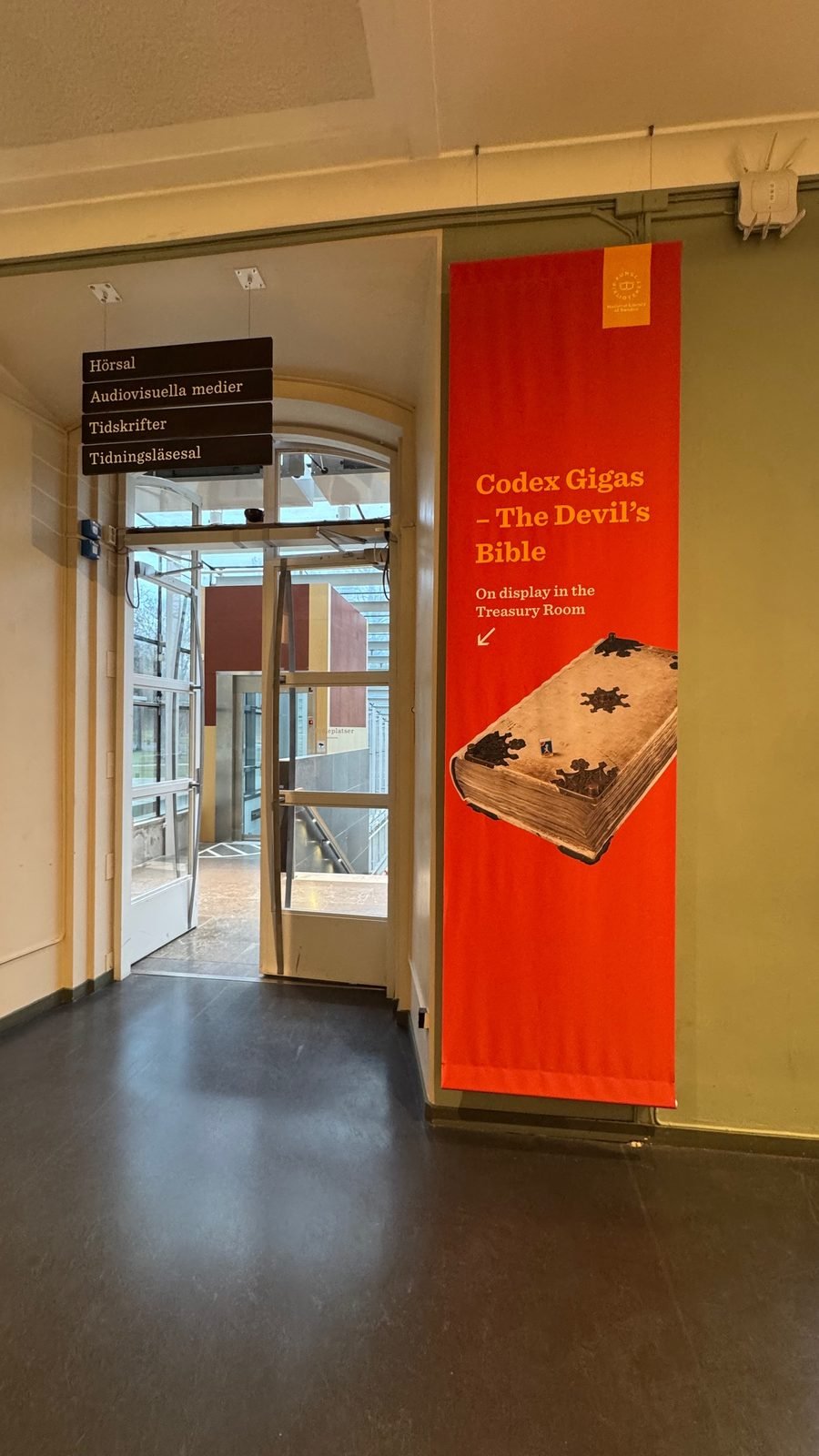
Photo gallery
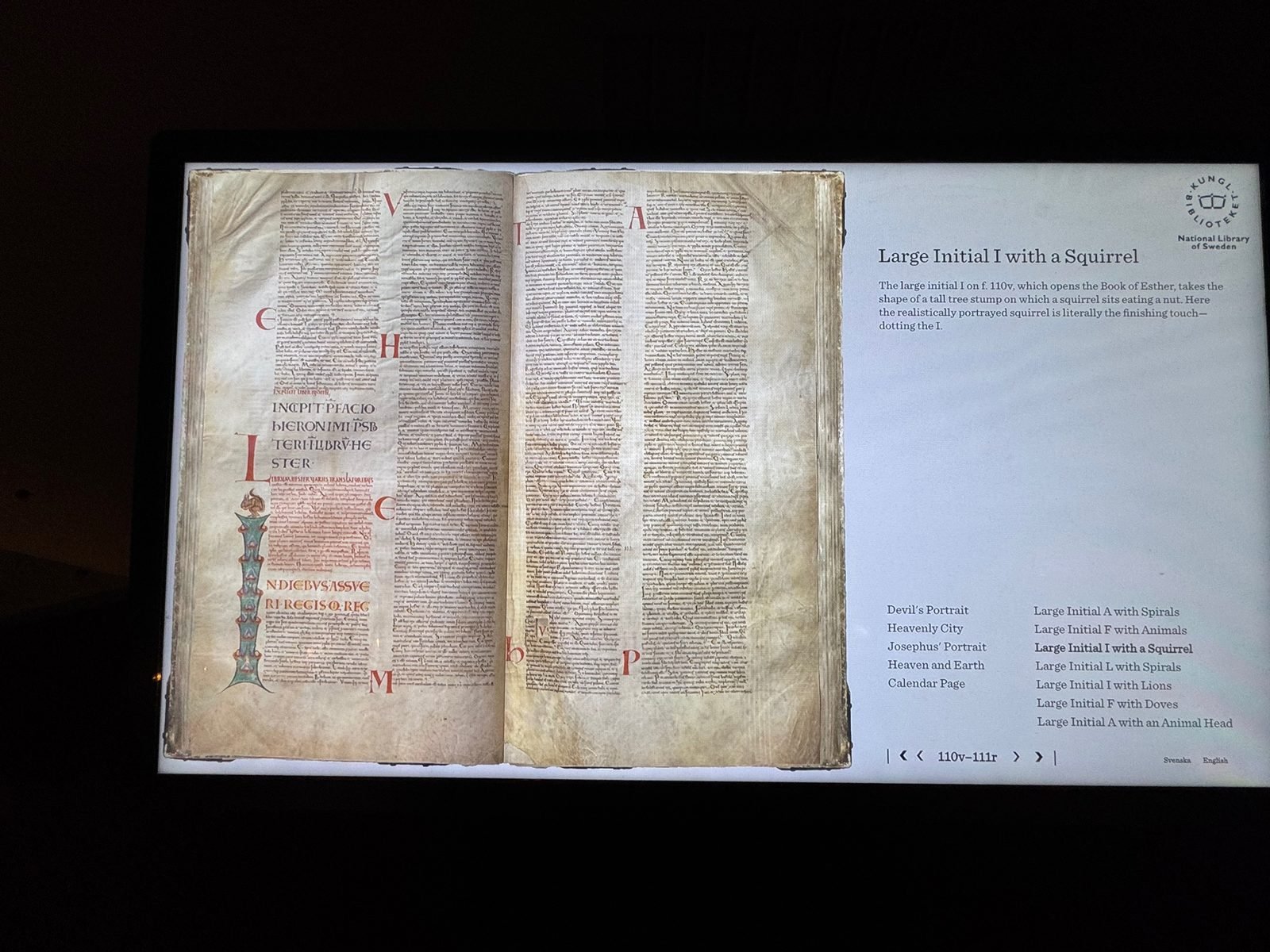
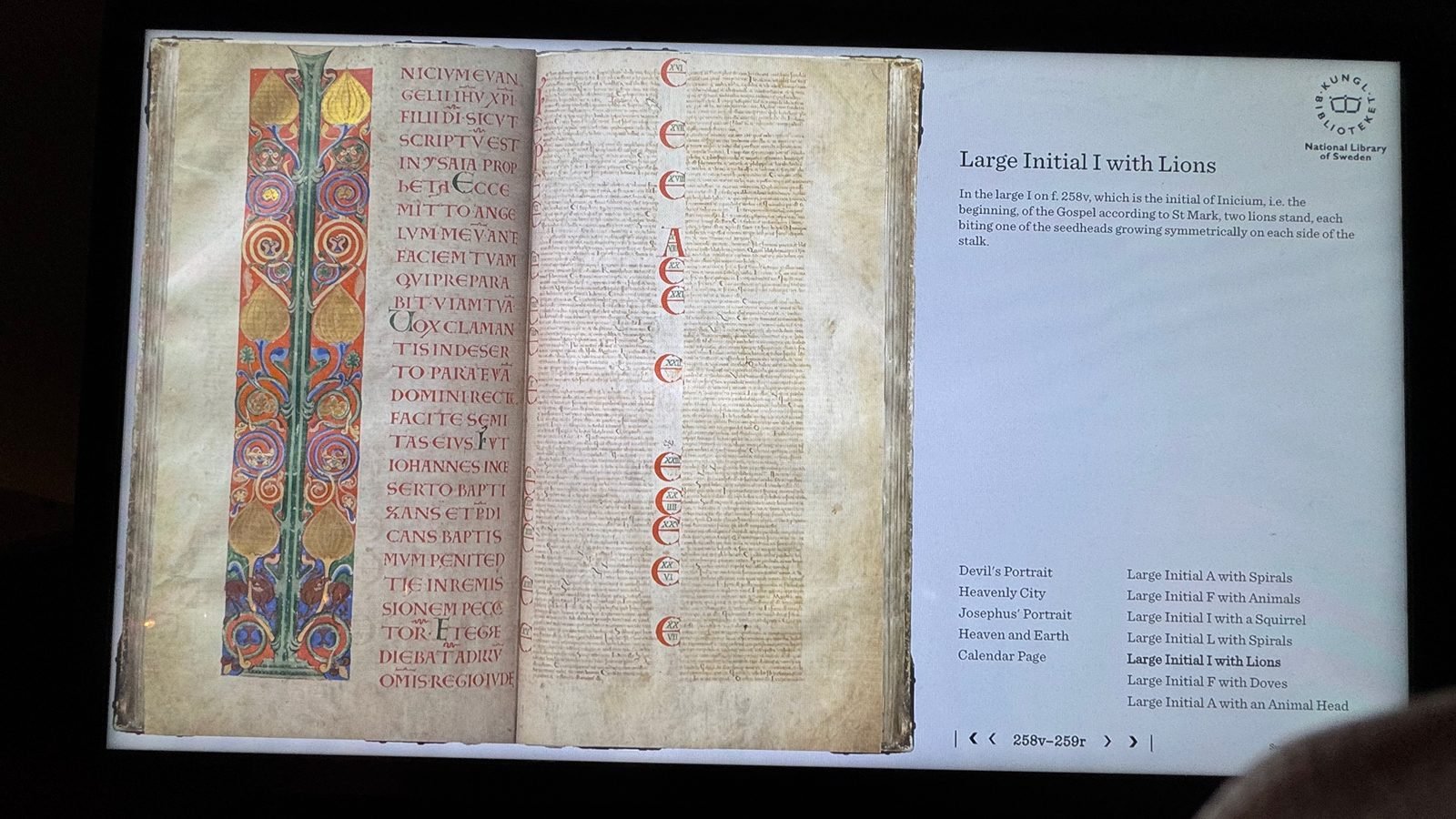
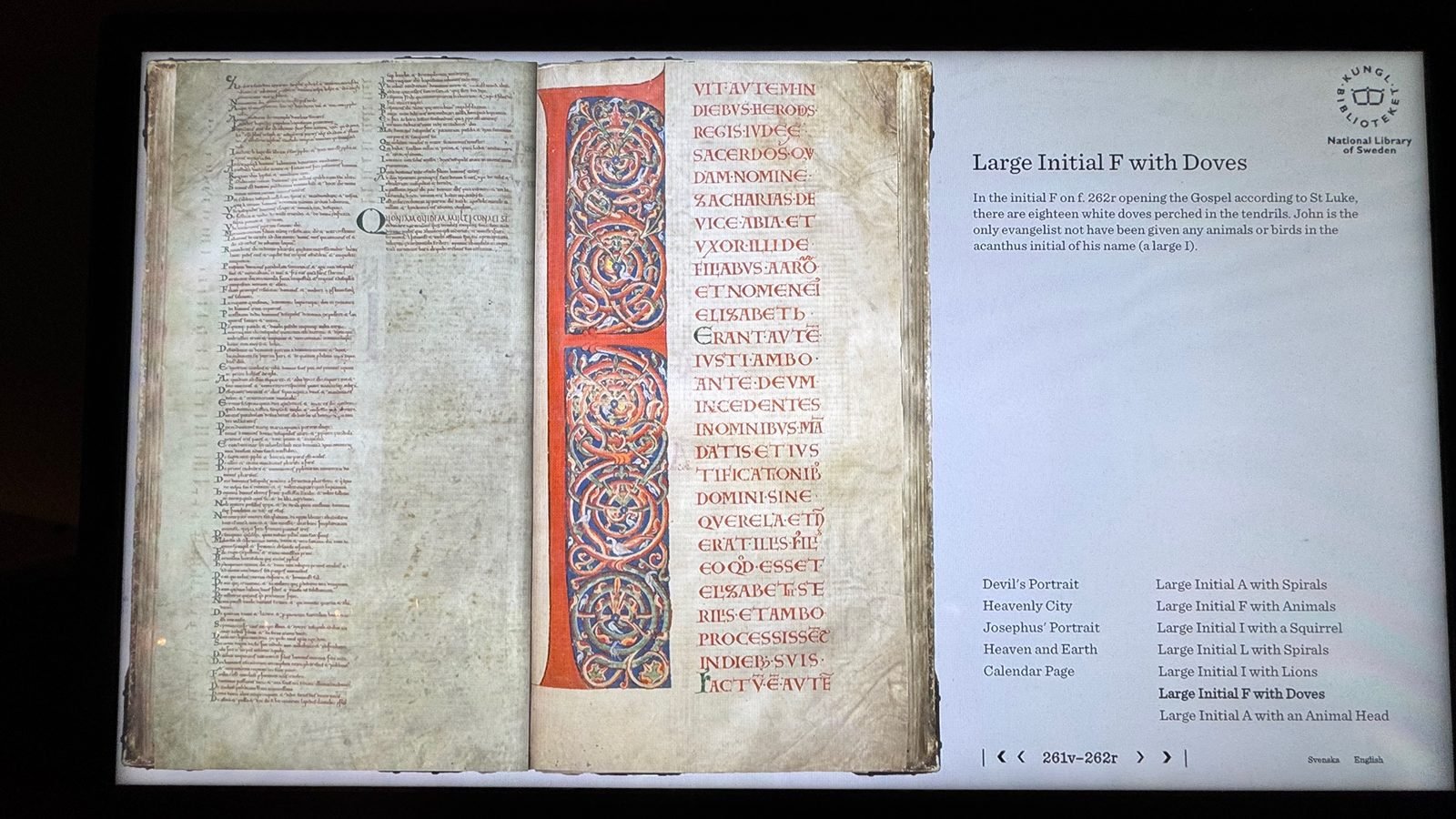
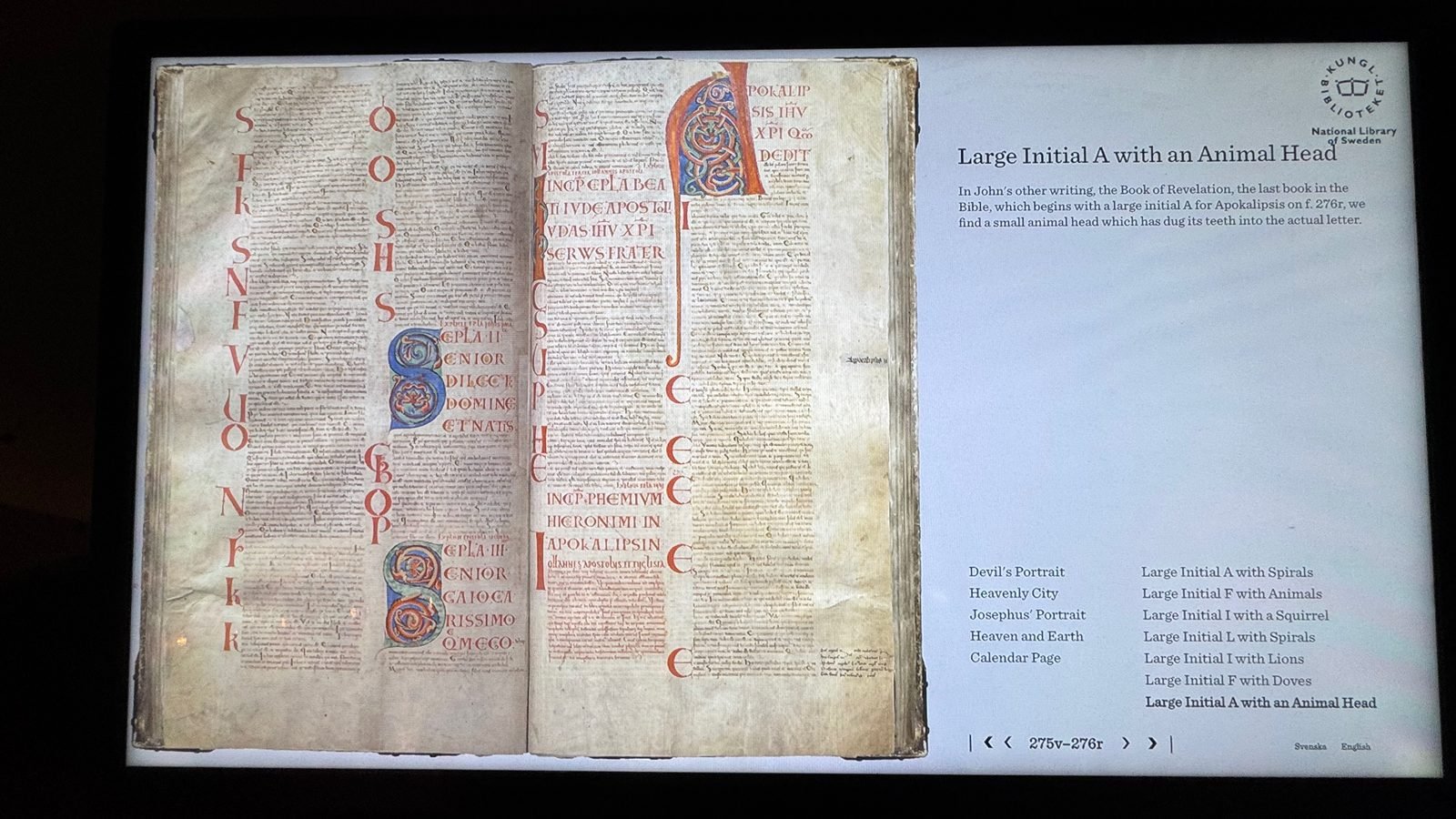
All photographs on this page were taken by Zayera Khan at Kungliga biblioteket on 10 November 2026. Screen images of Codex Gigas: Per B. Adolphson, Kungliga biblioteket, HS A 148 (CC BY 4.0 license).
Sources
* Facts marked with an asterisk come from one source only. I have not found a second source for them.
Kungliga biblioteket
- KB: Codex Gigas
- KB: Codex Gigas historia
- KB: Codex Gigas utseende
- KB: Utsmyckning i Codex Gigas
- KB: Codex Gigas innehåll
- KB: Historia och medicin
- KB: Magi och klotter
- KB: From Prague to Stockholm
- KB: Skattkammaren med Codex Gigas
- KB: Film om Codex Gigas
- KB: Öppettider
- KB: Tillgänglighet
UNESCO
- UNESCO: The 1970 Convention
- UNESCO: Return and Restitution Committee
- UNESCO: Statutes of the committee, 1978 (PDF)
- Cyprus National Commission for UNESCO: the committee’s role
- UN General Assembly record A/34/PV.51 (the 1978 appeal)
Sweden
- Swedish National Heritage Board: the 1970 Convention
- Riksdagen: Fråga 2022/23:40
- Riksdagen: Fråga 2022/23:370
- Kulturgutschutz Deutschland: Swedish export rules
News and other sources
- SVT: Dick Harrison on returns to Poland (2021)
- AFP in Taipei Times: the Devil’s Bible to be shown in Prague (2005)
- Rare Book Monthly: books looted almost four centuries ago (2019)
- Notes from Poland: Łaski’s Statute (2023)
- Whitemad: treasures looted by Sweden (2026)
- Poland Weekly: the legacy of Charles X Gustav
- Library of Congress: digitized Codex Gigas