
Queen Kristina (Christina) of Sweden at 400: The Girl Who Was Crowned King*
She was crowned king, gave up the crown, changed her faith and moved to Rome. Four hundred years later, Sweden still argues about her.
In my article about Margareta I, the queen who united the North, I promised to write about Queen Kristina. This is that article.
The timing is right. On 8 December 2026, it is 400 years since Kristina was born in the palace of Tre Kronor in Stockholm. Museums, churches and libraries celebrate her all year. Few people in Swedish history cause as many feelings. Livrustkammaren, the Royal Armoury, calls her “hailed and hated.”
She was the child who never got to be a child. She was the Protestant who became a Catholic. She was the woman crowned king, and the queen who left her throne.
In English she is usually called Christina. In Swedish, and in this article, she is Kristina.
1. Quick facts
- Born: 8 December 1626, at the palace of Tre Kronor in Stockholm. Sweden still used the old Julian calendar. In today’s calendar, the date is 18 December. One page of the Royal Palaces gives 7 December.
- Parents: King Gustav II Adolf and Queen Maria Eleonora of Brandenburg.
- Reigned: 1632–1654. A regency ruled for her until 1644.
- Crowned: 20 October 1650, in Storkyrkan, Stockholm.
- Abdicated: 6 June 1654, at Uppsala Castle.
- Died: 19 April 1689, in Rome. She is buried in St Peter’s Basilica.
- Motto: Sapientia columna regni, “Wisdom is the pillar of the kingdom.”
- Firsts and lasts: she was one of only three reigning queens in Swedish history, and the last ruler of the Vasa house.
2. Born at Tre Kronor
Kristina was born in the palace that stood where the Royal Palace stands today. Tre Kronor burned in 1697. A model of it from 1663 can be seen in Museum Tre Kronor, the museum built inside the old walls under the present palace. Read my article about Museum Tre Kronor.
Her father wanted a son. According to the Royal Palaces, Gustav II Adolf said: “Let us thank God. I hope this girl will be as good to me as a boy.”
She would have to be.
3. A girl raised as a prince
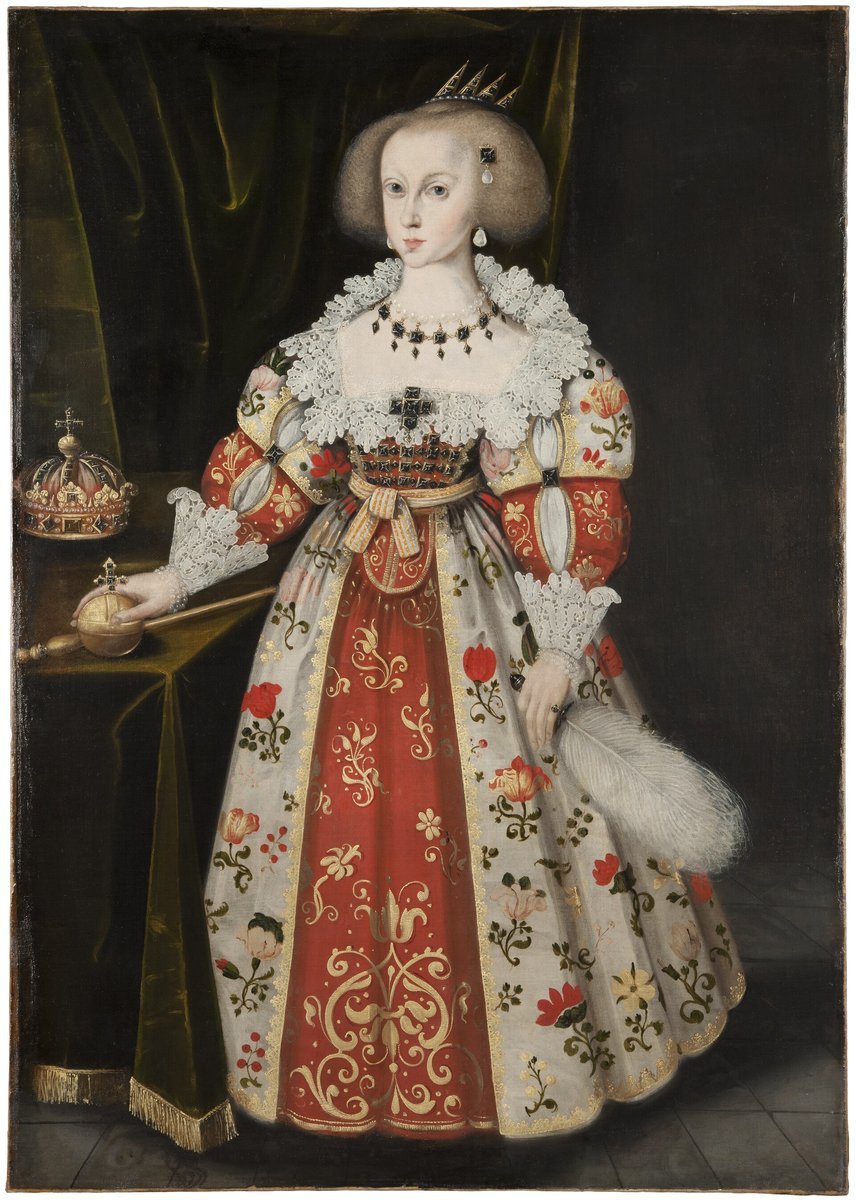
On 6 November 1632, Gustav II Adolf fell at the battle of Lützen in Germany. Kristina was five, almost six. Livrustkammaren and a label at Ulriksdal Palace say six. Svenskt kvinnobiografiskt lexikon (SKBL) and Nationalmuseum say five.
She was now queen. A child cannot rule, so a regency ruled for her. Its leader was the chancellor, Axel Oxenstierna.
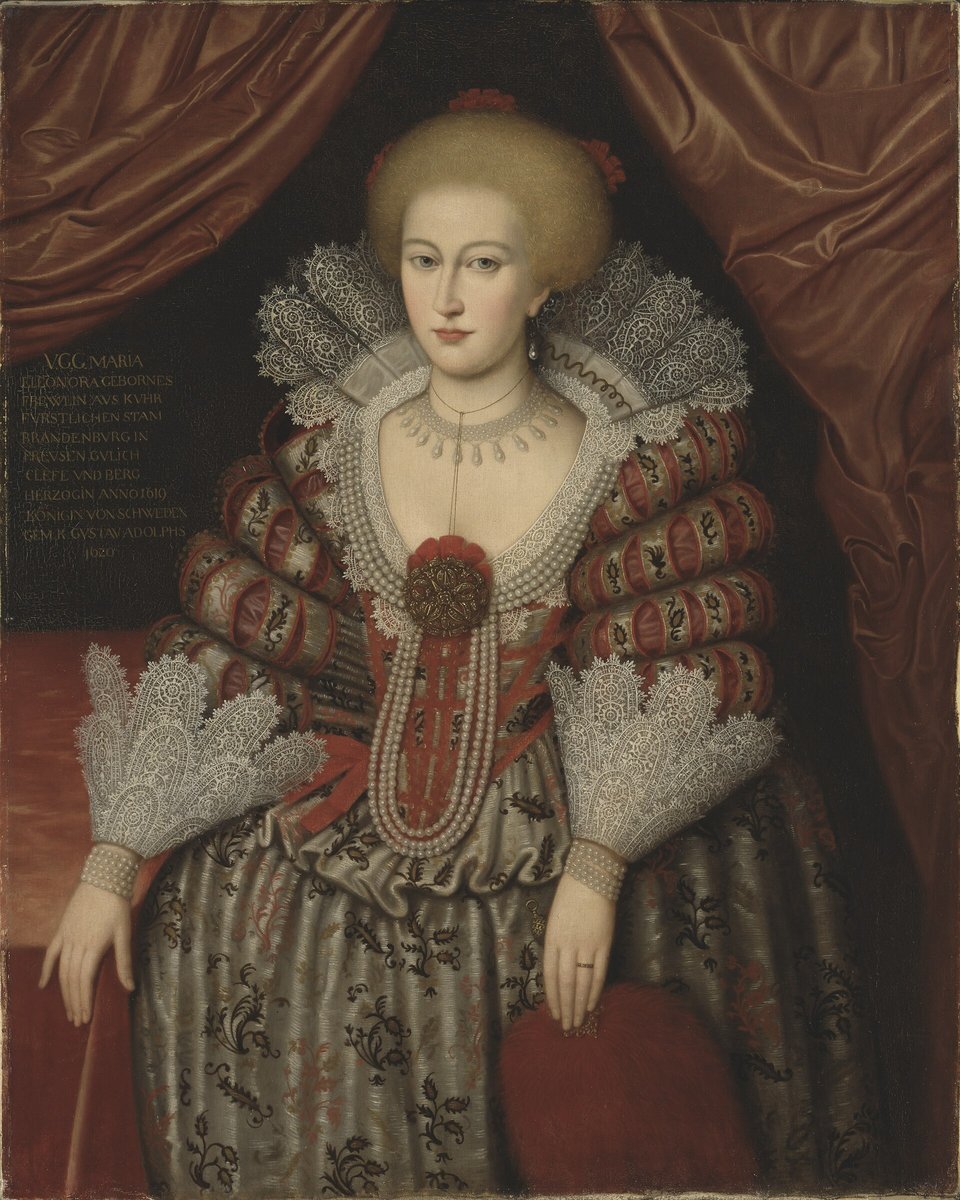
Her mother, Maria Eleonora, mourned deeply. According to SKBL, she kept her rooms in black and delayed the king’s burial until 1634. The council called her grief exaggerated. SKBL says this kind of mourning was customary for a widowed queen.
For three years, Kristina lived with her mother. In August 1636, the council judged the mother “a damaging influence” and took the child from her. Kristina’s aunt, Katarina of Zweibrücken, took over her care. In 1640, Maria Eleonora left Sweden for Denmark and Brandenburg. Kristina asked her to come back, and she returned in 1648.
Here a woman from the household deserves her name. Livrustkammaren keeps a small bodice that Kristina wore at about two, and a small white shirt with lace. They survive because a lady’s maid, Sara Larsdotter Stiernflycht, took them with her when she left Tre Kronor in 1632. Her family kept them until the late 1800s.
Kristina got the education of a future king. She learned languages, law, money, taxes and war. She also learned to ride, to fence and to dance. Her most important teacher was Johannes Matthiae Gothus. From 1636, Axel Oxenstierna himself taught her politics for three or four hours a day.
4. Queen at eighteen
In 1644, Kristina came of age and began to rule herself. The Royal Palaces quote the council’s decision: since “Her Majesty is a king,” she must be respected manligen, as a man.
Sweden was at war. The Thirty Years’ War had gone on since 1618. Kristina wanted peace. In October 1648, the Peace of Westphalia ended the war, and she was hailed as a peacemaker.
In what I wrote about queens and war in the Margareta I article, I looked at research showing that queens did not go to war less often than kings. Kristina does not prove the opposite. She was one ruler, at the end of a long and costly war.
5. Peace, plunder and a cabinet of wonders
Peace came with plunder. In June and July 1648, just before the war ended, Swedish troops took what was left of Emperor Rudolf II’s famous art collection in Prague. Crates of books and art were sent to Stockholm, to Kristina. Historian Susanna Åkerman counts thirty chests.
Rudolf’s collection was a Kunstkammer, a cabinet of wonders. In a collection like this, a fossil or an uncut gemstone had the same place as a silver cup. The aim was to hold the whole world in a few rooms.
In the Royal Palaces’ podcast Slott & Krona, curator Alexander Holm explains how Kristina’s collection grew. Her father laid the foundation. Troops took a first collection in Munich in 1632. Then Prague arrived. Kristina also had agents and diplomats who bought for her across Europe.
Her inventory of 1652 lists items “partly from Prague, partly bought, partly received as gifts.” According to Holm, it lists more than a thousand items, paintings included. For ivory alone, it has about 170 entries. About 60 remain in Stockholm today.
Where did the rest go? Kristina took a large part with her when she left Sweden. Other pieces were given away, and some burned with Tre Kronor in 1697. Holm adds a twist. Many of the pieces we can still see survived because a later queen, Hedvig Eleonora, had moved them to Ulriksdal Palace.
One object shows how these collections travelled. It is an ivory salt cellar showing the Triumph of Venus. Georg Petel made it in Antwerp in 1627–28, after sketches by Rubens. After Rubens died, his widow, Helena Fourment, sold much of his collection. According to Holm, she fought to keep this piece but sold it in the end. In 1649, Kristina’s art agent, Michel Le Blon, bought it at auction in Antwerp. Kristina then gave it to her friend Magnus Gabriel De la Gardie. It probably came back after her abdication. Today it is in the Royal Palace.
Holm also offers a thought. A ruler could gain glory in two ways: by winning wars, or by gathering knowledge, art and science. Many people then thought the second way was the wiser one. Kristina chose it.
6. A court of philosophers
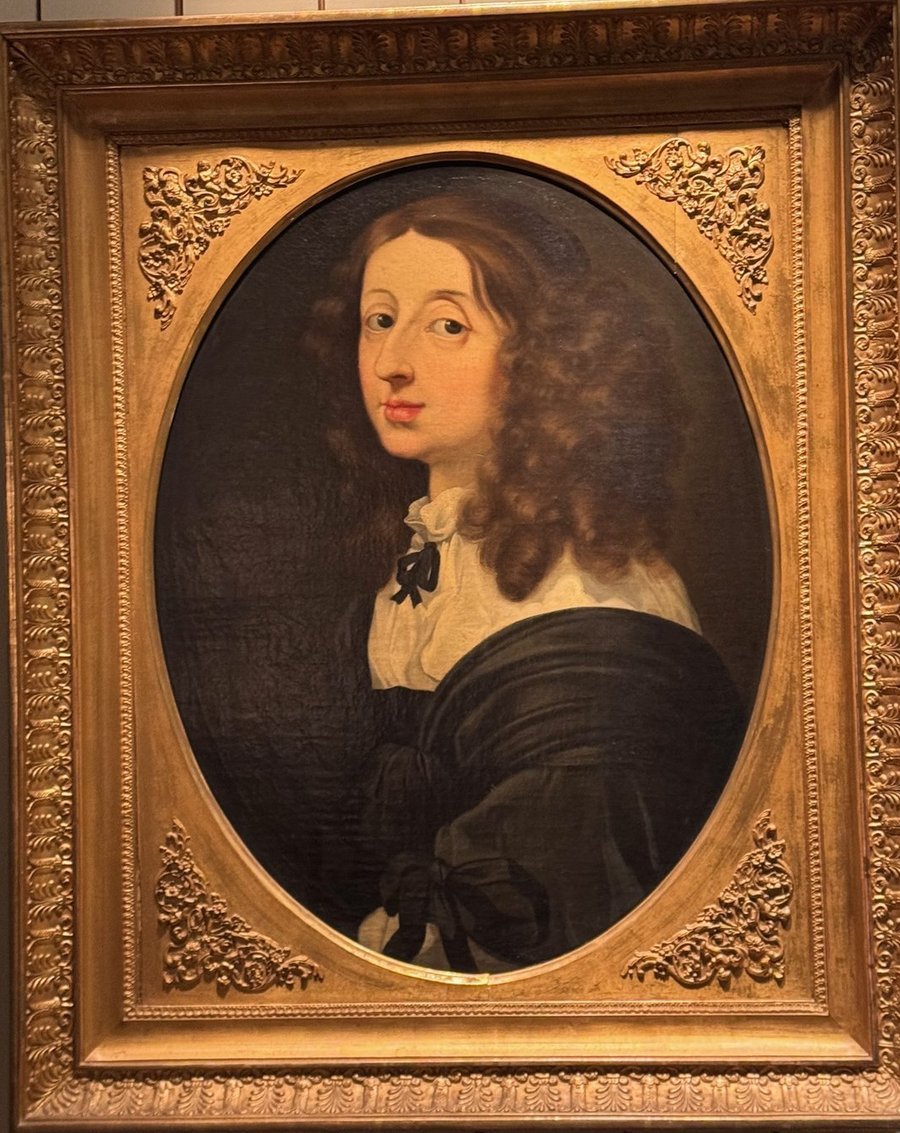
The label beside this portrait at Ulriksdal says that the rumor of the learned queen spread around the world. People said that what the needle and the spindle were to other women, science was to her.
Kristina brought scholars to Stockholm. She held regular learned meetings at the palace. The Dutch scholar Isaac Vossius led them first. From 1652, the French doctor Pierre Bourdelot led them. She read the Roman poet Lucretius and tried to bring the philosopher Pierre Gassendi to Stockholm. He said no.
Descartes in Stockholm
Kristina’s most famous guest was the French philosopher René Descartes. He is best known for one sentence: “I think, therefore I am.” He started by doubting everything he could doubt. The one thing he could not doubt was that he himself was thinking. From there, he tried to build all knowledge on firm ground.
Descartes is one of my favorite philosophers. I like his idea of doubt as a way to prove that he exists.
He also argued that mind and body are two different things. Philosophers still discuss that question today, as the mind–body problem. Descartes was a leading mathematician too. He developed the methods that join algebra and geometry. His view of nature as matter that follows universal laws shaped modern physics.
His main works are Discourse on the Method (1637), Meditations on First Philosophy (1641), Principles of Philosophy (1644) and The Passions of the Soul (1649). The last one came out the year he travelled to Stockholm.
His reputation has changed over time. The Stanford Encyclopedia of Philosophy writes that “he has been variously seen as a hero and a villain.” Some later critics blamed his ideas for a cold, calculating view of human beings.
Before he came to Sweden, he and Kristina wrote to each other through the French envoy in Stockholm, Pierre Chanut. Kristina sent Descartes two questions. What is infinity? And which is worse, love misused or hate? Descartes answered that misused love is worse, because it can lead to worse results.
Kristina invited him to her court, and he arrived in Stockholm in October 1649. At first, he was impressed. That month, he wrote to Princess Elisabeth of Bohemia that he already knew the queen well enough to speak of her merit. In December, he wrote to his friend Constantijn Huygens:
“I admire and revere her more every day.”
Stockholm was harder. On 15 January 1650, he wrote to his friend Brégy:
“I am not in my element here, and I desire only tranquility and rest.”
He wrote that his wish to return to his quiet retreat grew every day. In a letter from Stockholm, he also wrote that here thoughts seem to freeze in winter, just like the water.
The story of their lessons has two versions. One modern article says Kristina called him to the palace at five in the morning, and that by mid-January he had met her only four or five times. The historian Ingemar Oscarsson, writing in the Swedish journal Lychnos, says the early-morning meetings belong to popular myth. They appear in a Swedish novel from 1840.
Descartes also worked for the court’s entertainment. According to Åkerman, the poet Georg Stiernhielm translated the French ballet La Naissance de la Paix, “The Birth of Peace.” Its text may have been written by Descartes.
Where did he live? For his whole stay, Descartes lived with his friend Chanut, the French envoy. His early biographer, Adrien Baillet, wrote that Descartes was pleased with his rooms and felt almost as if he were in Paris, not Stockholm.
Where the house stood is less clear. A plaque at Kornhamnstorg in Gamla stan says he lived there. Oscarsson finds no support for this tradition. In 1647, Chanut wrote that he lived “in a fairly remote place in a suburb.” Oscarsson suggests a house on Norrmalm, owned by Jöran Jeske. He presents it as a hypothesis, not a fact.
He never left Sweden. On 1 February 1650, Chanut fell ill. Descartes fell ill the next day. After about ten days of fever, probably pneumonia, he died on 11 February 1650. He had been in Sweden for about four months.
One researcher, Theodor Ebert, argues that Descartes was poisoned with arsenic. Other researchers disagree. It remains a theory.
Descartes was buried in the churchyard of what is now Adolf Fredrik Church, at Kammakargatan 30 in central Stockholm. In 1666, his remains were taken back to France. Inside Adolf Fredrik Church today, a monument by the sculptor Johan Tobias Sergel honors him under his Latin name, Cartesius.
Åkerman notes something else from these years. Kristina found the foreign diplomats more lively in mind than the Swedes around her. Slowly, an idea grew: to change her faith and leave Sweden.
7. October 1650: the grandest coronation
Kristina’s coronation was the most expensive and most talked-about in Swedish history. The planning began in 1648, and large orders went to Paris years in advance. The party went on for months.
From Jakobsdal to Tre Kronor
The procession began at a palace north of Stockholm. Today it is Ulriksdal Palace. In 1650 it was called Jakobsdal, after the man who built it, Field Marshal Jacob De la Gardie. He sat in the regency that ruled for the child queen. Kristina was a frequent guest there. At one masquerade, she is said to have been a great success dressed as Diana, the goddess of hunting.
On 17 October 1650, three days before the coronation, the queen made her formal entry into Stockholm. The Royal Palaces call it the grandest procession in Swedish history.
A royal herald, Nils Nilsson Lindegren, rode first. Kettledrums and trumpets followed him. Signs at Ulriksdal say the musicians wore blue with silver braid and played silver trumpets. About 700 people rode on horseback. Livrustkammaren counts about 1,500 horses in all. Noblemen, foreign envoys and the queen’s relatives followed. The ladies-in-waiting rode in coaches. After them came mules and camels.
People said the procession was so long that when the first riders reached Tre Kronor, the last ones had not yet left Jakobsdal. One sign at Ulriksdal names a more exact starting point: the village of Överjärva, just west of the palace.
The route went through Norrtull and over today’s Gustav Adolfs torg. Outside the city gate, the three estates that were not noble greeted the queen as she formally took her capital. Forty warships fired a salute on the water. Fireworks from Skeppsholmen went on for more than an hour.
At Tre Kronor, someone was waiting. A label at Ulriksdal says that the queen dowager received her daughter in the palace courtyard. The queen dowager was Maria Eleonora, the mother who had lost custody of her child fourteen years earlier.
A carriage instead of a horse
Until then, Swedish kings were usually crowned in Uppsala. They rode there on a white coronation horse and held the reins of the kingdom in their hands, as a symbol.
Kristina broke this tradition twice. She was crowned in Stockholm, not in Uppsala. And she rode in a coach. The signs at Ulriksdal say she was the first Swedish ruler to ride to her coronation in a coach.
She did not give up the white horses. She had a white coronation horse and white horses to pull her coach. She was also a skilled rider. A sign at Ulriksdal says that even on a side-saddle, she handled her horse so well “that one could take her for a cavalier.” In 1648, Cardinal Mazarin of France gave her an Italian stallion “white as snow.” It was probably this horse that carried the coronation saddle.
The coach that survived
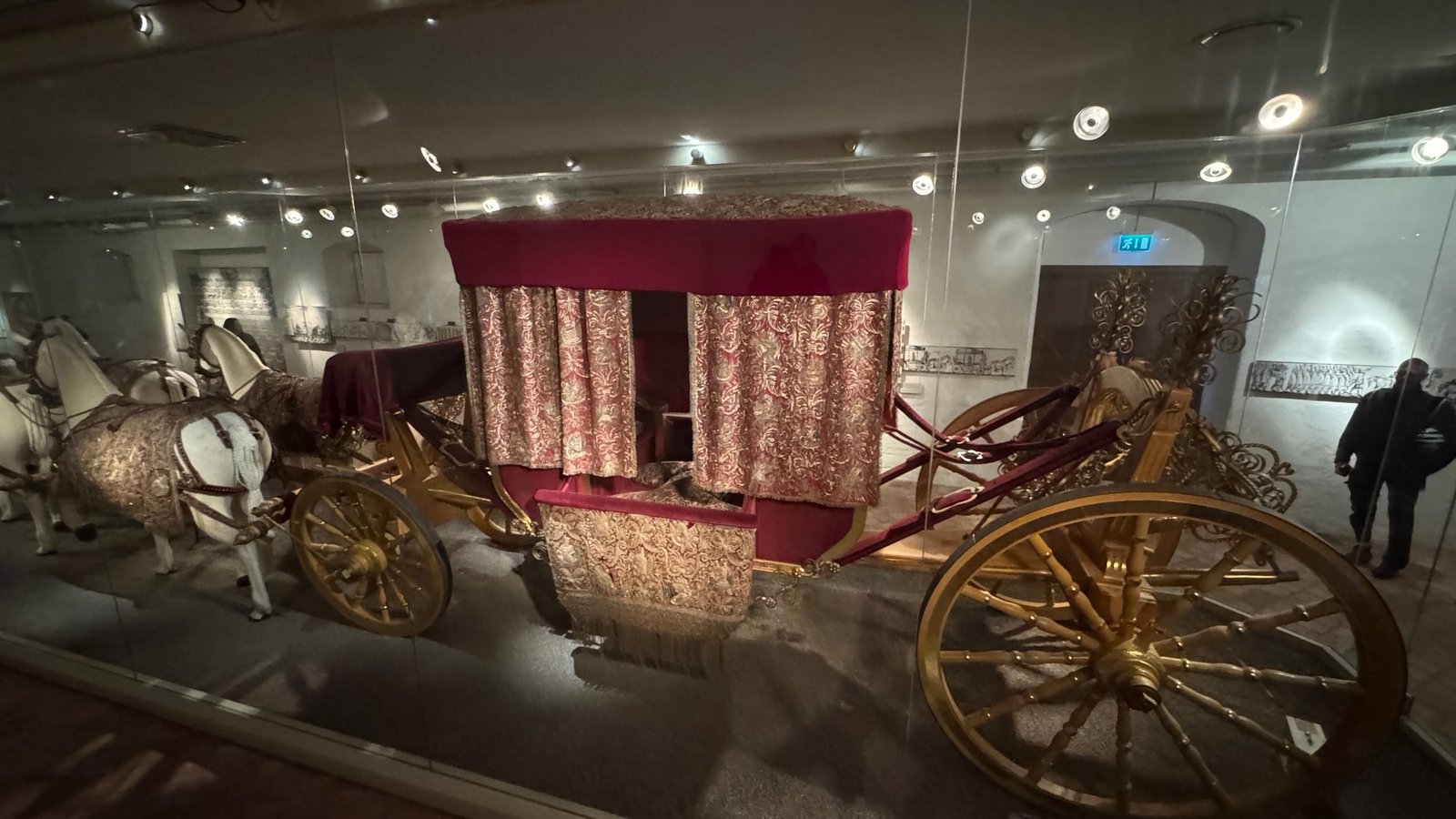
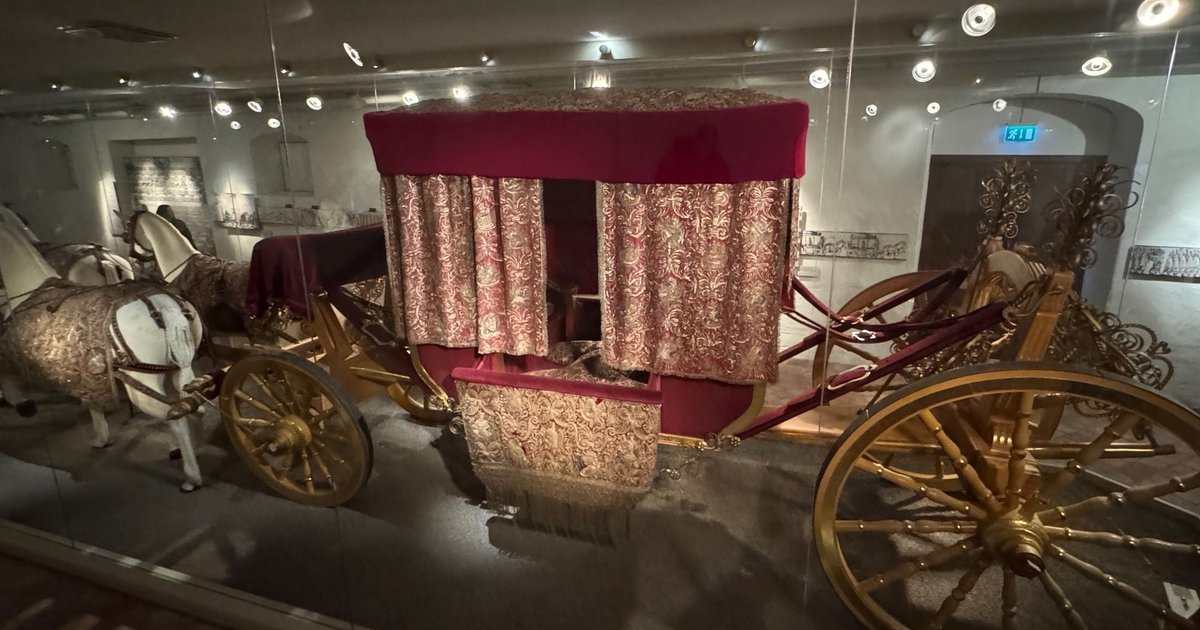
The coach was made in Paris. It was a gift from her cousin and heir, Karl Gustav. It is called the “trophy coach” after the motifs in its embroidery, made in gold, silver and colored silk on crimson velvet and silk.
The body of the coach was lost in the early 1700s. The textiles survived. For more than 300 years, they lay in storage at Livrustkammaren. A reconstruction began in the 1980s. In 1989, the full coach with six white horses was shown at the Royal Academy of Arts in London. It was the first time it had been shown complete since the 1600s.
Since 1990, the coach has stood in the old stable at Ulriksdal. The original textiles are mounted on a simplified reconstruction. The harness and the saddle cloths are original too.
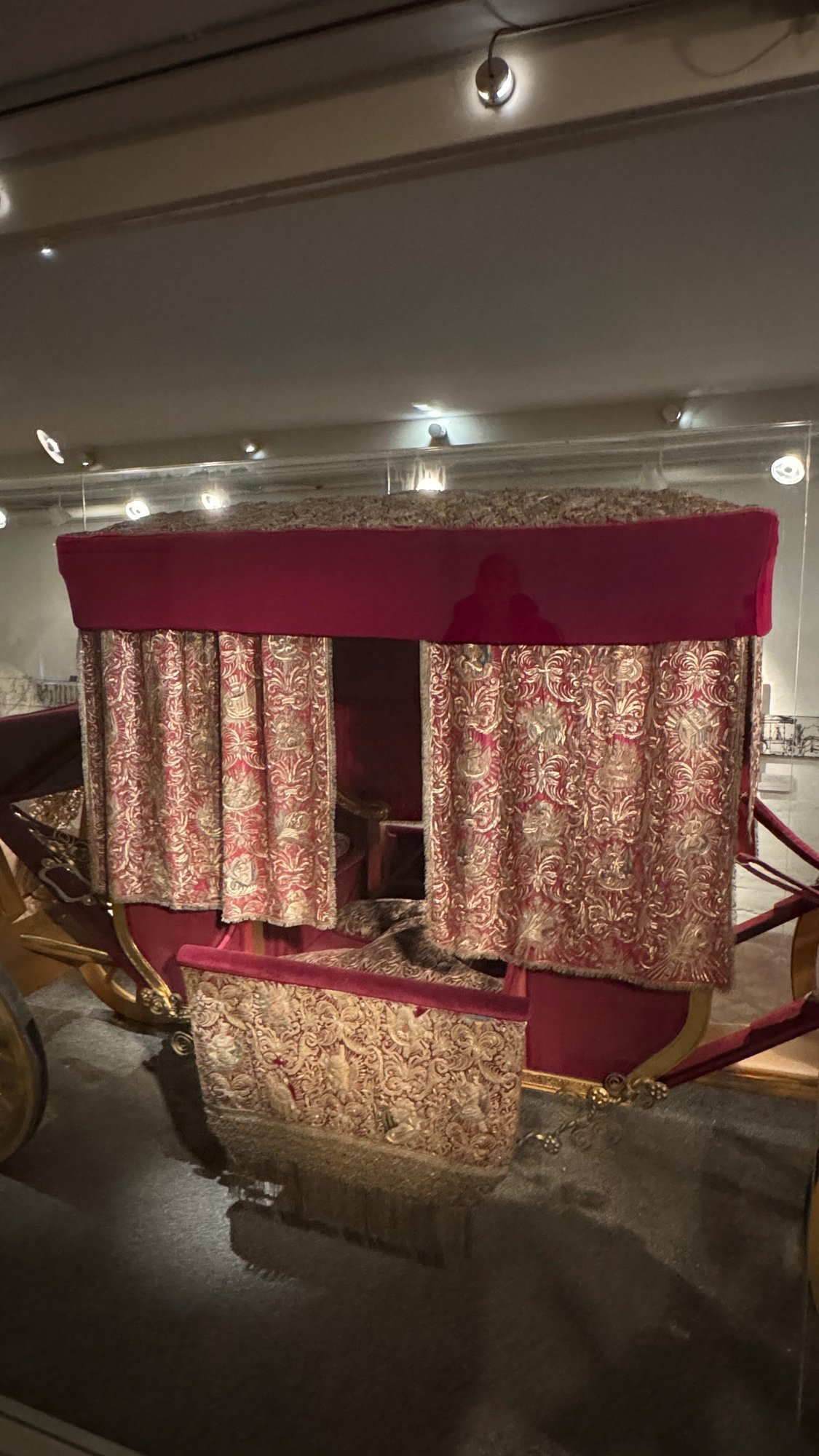
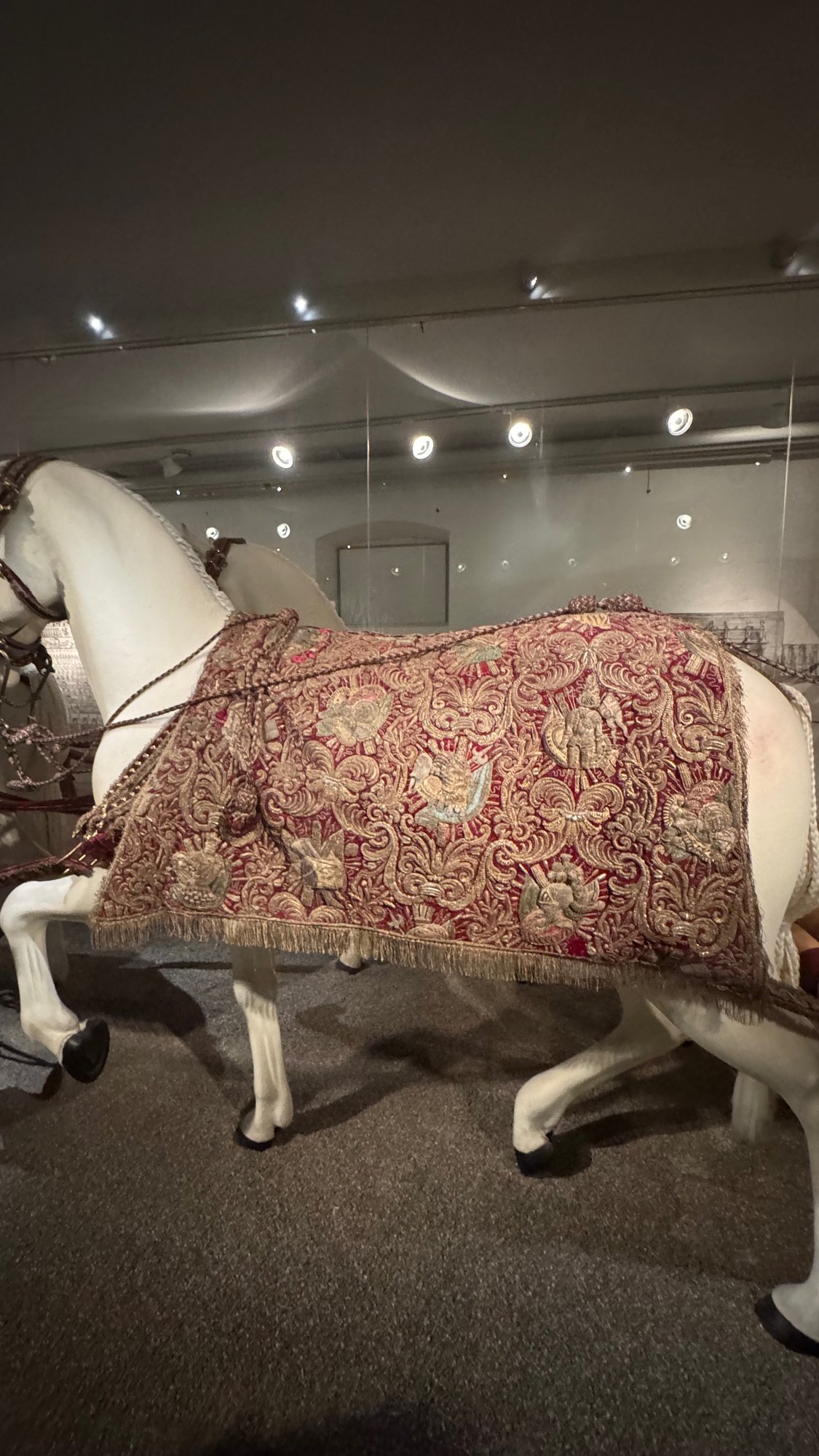
I photographed the coach at Ulriksdal on 24 October 2026, when the stable opened to all visitors for the anniversary.
20 October in Storkyrkan
On coronation day, the procession went from Tre Kronor through a triumphal arch to Storkyrkan, the cathedral. The arch stood on today’s Gustav Adolfs torg. It was made of wood and painted cloth, so that it looked like stone. Its model was the Arch of Constantine in Rome.
The ceremony lasted four hours. Just before it, Kristina made a choice that surprised everyone. A queen’s crown had been remade for her. She refused it. She chose the king’s crown her father had used, the crown of Erik XIV from 1561. It is now in the Treasury at the Royal Palace.
She wore a mantle of purple velvet, almost four meters long, ordered from France. Livrustkammaren keeps parts of it. It once carried 764 small gold crowns. One page of the museum’s text says 764 and a half. Most of the crowns were cut off in the 1700s.
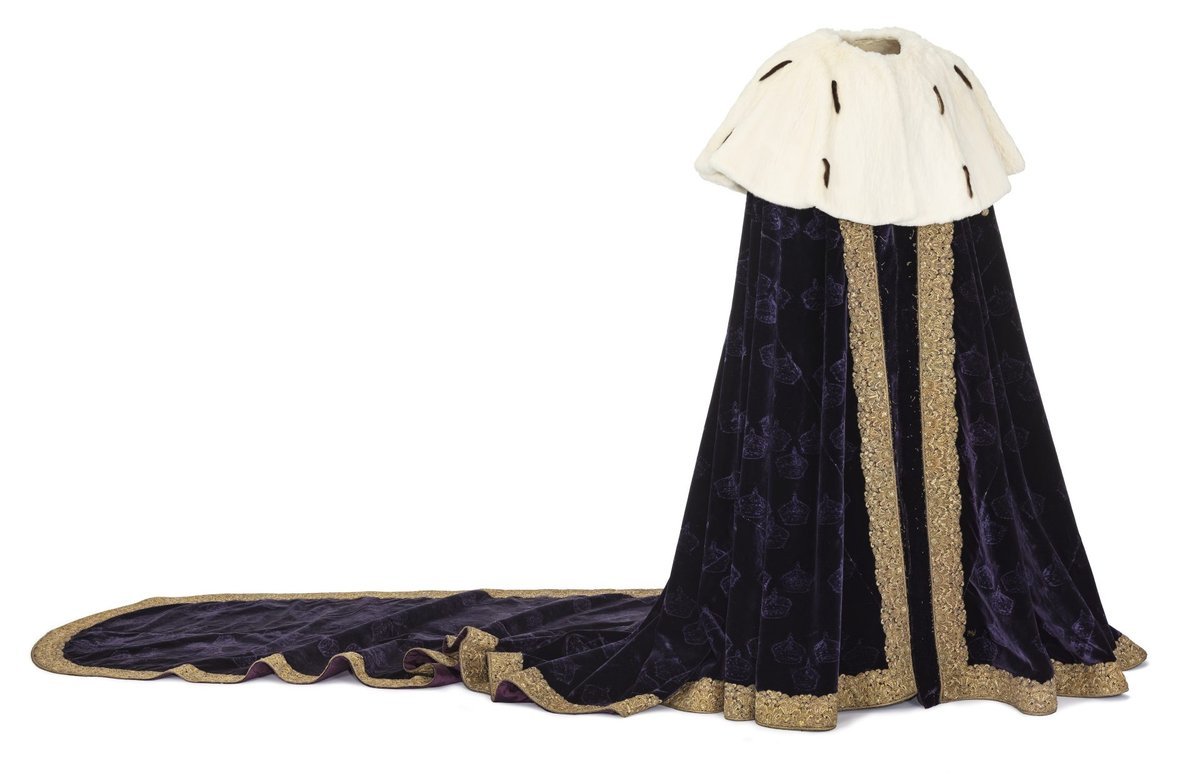
Then came the words that make this coronation famous. According to the Royal Palaces, the herald called out:
“Now Queen Christina is crowned King of the lands of the Swedes and the Goths, and no other.”
“Nu är drottning Christina Crönter Konung öfuer Swea och Götha Landom och dess Underliggiande Provincier, och ingen annan”
King, not queen.
The party in the palace went on until four in the morning. On Stortorget, the square outside the cathedral, an ox was roasted whole, filled with chickens and turkeys. A fountain ran with wine for three days.
Storkyrkan and Stortorget stand where they stood in 1650. They are both stops on my private Gamla Stan walking tour.
8. The queen who would not marry
Everyone expected Kristina to marry and give Sweden an heir. In 1647–48, the candidates included Frederick William of Brandenburg, the Duke of Saxony and her cousin Karl Gustav. She delayed.
In 1649, a year before the coronation, she gave the council her answer. The Royal Palaces quote her:
“I say it plainly, that it is impossible for me to marry. That is how the matter stands. I keep my reasons to myself. I have prayed to God that I might get the mind for it, but I have never been able to.”
She solved the problem in another way. In 1649 she named Karl Gustav as her successor. On 9 October 1650, eleven days before her coronation, a decision made him and his sons heirs to the throne. The dates differ slightly between sources: the Danish encyclopedia lex.dk gives 1649, and SKBL gives 9 October 1650 for the right of inheritance.
The Royal Palaces write that she had probably already decided to change her faith and give up the throne before she sat down on her silver throne in 1650.
9. Ebba Sparre, “Belle”
One woman stands out in Kristina’s life: Ebba Sparre.
Ebba Larsdotter Sparre was born around 1626. Some sources say 1629. Her parents were Lars Eriksson Sparre and Märta Banér. In 1644 or 1645, sources differ, she became a maid of honor to the queen. People called her la belle comtesse, “the beautiful countess.” Kristina called her “Belle.” She often played Venus in the court ballets.
Kristina spent much of her free time with her. When the English ambassador Bulstrode Whitelocke came to Stockholm in 1653, Kristina introduced Ebba to him as her “bedfellow.” She told him that Ebba’s mind was as beautiful as her body.
Ebba was engaged to Bengt Oxenstierna, but the engagement ended. The sources disagree on why. One says Ebba broke it off while he was abroad. Two others say Kristina wanted it ended.
On 29 December 1651, Ebba was engaged to Count Jakob Kasimir De la Gardie at the palace in Stockholm. They married in January 1653. One source says Kristina herself led the ceremony. The wedding feast was a “Feast of the Gods.” According to Wikipedia, it led to the founding of the Order of the Amaranth, Kristina’s own order. The marriage is described as unhappy. Their three children all died young. Jakob Kasimir was killed at the siege of Copenhagen in 1658.
The painter Sébastien Bourdon, who also painted Kristina, painted Ebba’s portrait in 1652 or 1653, probably for Kristina. It is now in the National Gallery of Art in Washington.
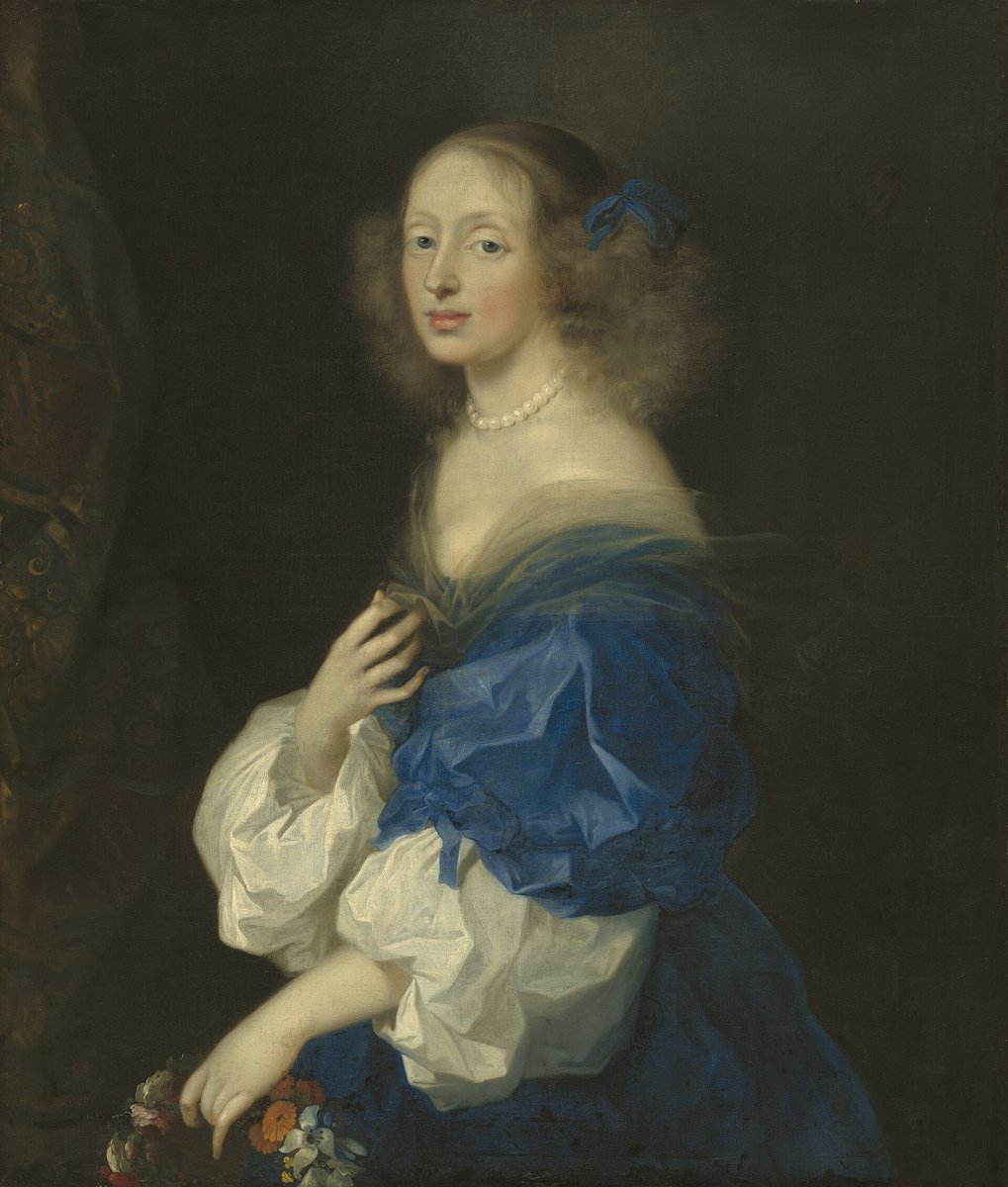
After Kristina left Sweden in 1654, she kept writing to Ebba. Copies of a farewell letter from Brussels in 1655 are kept at Riksarkivet, the Swedish National Archives. In it, Kristina promises to keep Ebba’s memory and asks not to be forgotten. On 6 January 1656, from Rome, she wrote:
“How happy I would be if I were allowed to see you, Belle.”
She signed it “Christine Alessandre.” In 1657, she asked Ebba to join her in Italy.
In 1660, Kristina visited Sweden and wanted to see Ebba. It did not happen. Wikipedia says Ebba’s family stopped it, probably her brother-in-law Magnus Gabriel De la Gardie. Ebba’s poor health may also have played a part. In 1661, Kristina invited her to Hamburg.
Ebba Sparre died of fever on 19 March 1662, aged about 35.
Were they lovers? Nobody knows. Many historians read the warmth of the letters as love. Others are not sure. In Kristina’s lifetime, most of the gossip came from her enemies in France. A collection of “secret letters” printed in 1761, with suggestive letters to Ebba, is a forgery. In 1930, the biographer Margaret Goldsmith wrote that Kristina was a lesbian. The novelist Sarah Waters later criticized her for choosing only the evidence that fit.
About the sources for this section: I did not find an article on Ebba Sparre in Svenskt kvinnobiografiskt lexikon. The facts here come from the English Wikipedia article on Ebba Sparre, from the blog The World of King Kristina, which quotes the letters from the archives, and from the website Queerplaces. Where they disagree, I give both versions.
10. 1654: she gives up the crown
In 1651, Kristina told the council for the first time that she planned to abdicate. They talked her out of it.
On 6 June 1654, at Uppsala Castle, she gave up the crown. Karl Gustav became King Karl X Gustav. Kristina gave him her coronation saddle, and he had it remade for his own coronation. He also took over her coronation mantle.
She was 27 years old and had ruled on her own for ten years. She left Sweden almost at once.
11. From Protestant to Catholic
Sweden was a Lutheran country. Catholicism was forbidden. The ruler had to be Lutheran.
According to Åkerman, Kristina began secret talks with two Jesuits, Malines and Casati, as early as 1649. They convinced her that the Catholic Church was universal and built on tradition, while Protestantism led to division.
After she left Sweden, she placed herself under the protection of King Philip IV of Spain. On Christmas Eve 1654, she became a Catholic in a private ceremony in Brussels. In November 1655, she repeated it in public in Innsbruck. According to lex.dk, she took the name Christina Alexandra. Lex.dk places the conversion in Innsbruck at Christmas 1654. SKBL separates the two ceremonies, and this article follows SKBL.
Livrustkammaren describes the reaction. Protestant Europe was shocked. The Pope saw it as a great victory.
12. Paris, Naples and a death at Fontainebleau
Kristina arrived in Rome just before Christmas 1655. She did not stay quiet for long.
In 1656 she travelled to Paris. Officially, she was on her way to Sweden to negotiate her income. According to Nationalmuseum, the real aim was secret. She met Cardinal Mazarin, France’s leader, to plan a war against southern Italy that would make her Queen of Naples. The eighteen-year-old Louis XIV knew about the plan. He ordered that she be received as a reigning prince.
On 8 September 1656, she entered Paris in a grand procession. Crowds filled the streets. A drawing by François Chauveau in Nationalmuseum shows her riding side-saddle with a cane in her hand. Four officials carry a canopy in front of her. The canopy was meant to be held over her, but according to the newspaper La Gazette, her horse became nervous. The horse’s name was Licorne, “Unicorn.”
The ladies of the French court wrote letters about her. According to Åkerman, they noted that she put her feet up on a chair. They compared her to two famous clowns.
The Naples plan failed. A little over a year after the Paris entry, at the palace of Fontainebleau, Kristina had her master of the horse, Monaldesco, executed. Nationalmuseum writes that he had betrayed the plan. France’s admiration turned to anger and hate.
Livrustkammaren adds one more plan. Later, she was a candidate for the throne of Poland. That plan failed too.
13. Rome
Kristina lived in Rome for the rest of her life, apart from short trips to Sweden and France. She lived in the Palazzo Riario, filled it with classical sculpture and held concerts.
In 1674, she founded her own academy, the Accademia Reale. According to Åkerman, its members discussed philosophy and the art of living well. One question they asked was who had chosen right: Heraclitus, who wept, or Diogenes, who laughed?
She wrote maxims, short sharp sayings, collected in L’Ouvrage de Loisir and Les Sentiments Héroïques. Many are about life at court. The Swedish writer Sven Stolpe saw a path in them, from Stoic philosophy to mysticism.
In Rome she was close to Cardinal Decio Azzolino. SKBL calls it a lifelong “romantic friendship.” She made him her heir. He died a few weeks after her.
14. Death and burial
Kristina died in Rome on 19 April 1689, aged 62. She was buried in St Peter’s Basilica in the Vatican, among popes and church leaders. Livrustkammaren notes that she is one of very few women buried there.
Her mother, Maria Eleonora, died in 1655, a year after her daughter left Sweden. She is buried beside her husband in Riddarholmskyrkan in Stockholm.
15. 400 years: how Sweden celebrates
Livrustkammaren coordinates the anniversary program, together with many other organizations. The list below covers the rest of 2026. Check each organizer’s website before you go, as programs can change.
November
- 5 November, Uppsala Castle: lecture by historian Erik Petersson, “Maktspelerskan utan land.”
- 8 November, Storkyrkan: lecture by Ulla Gudmundson, “Vad är historia?”, at Katedralakademin.
- 11 and 25 November, 18.00–19.00, Royal Palace: themed tour “Queen Kristina’s collections,” with the silver throne and parts of the coronation tapestries. Price 220 kronor. The tour takes place in the Hall of State, which has no lift.
- 12 November, Kristinehamn: lecture by Manne Hedén at Humanistiska förbundet.
- 19 November, KTH Royal Institute of Technology: seminar with Livrustkammaren’s museum director, Malin Grundberg.
- 21–22 November, Livrustkammaren: interactive children’s show “Drottningen dansar.”
- 24 November, Italian Cultural Institute, Stockholm: lecture “Queen Christina: a reader, a collector.”
- 28 November, Kristinehamns Historiska: guided tour.
December
- 2 December, Riksarkivet, Marieberg: small exhibition about Kristina’s life, based on the archives.
- 2 December, Uppsala Art Museum: concert “Drottningens virtuoser” with mezzo-soprano Anna-Stina Malm.
- 4 December, 13.00–16.30, Nationalmuseum: free seminar in English, “Queen Christina 400 years,” with the new anthology Christina of Sweden in Context. Organized with Christina-Akademien.
- 6 December, Jäders kyrka: musical birthday celebration.
- 8 December, Vasa Museum: birthday banquet in 1600s style, with Christina-Akademien and Livrustkammaren.
- 8 December, Postmuseum: tour “Queen Kristina as a letter writer.” Read my article about Postmuseum.
- 8 December 2026–10 January 2027, Livrustkammaren: art exhibition “Sempre Mia” by Per Josephson.
- 11 December, Livrustkammaren: embroidery exhibition inspired by Kristina’s maxims, by Skapande Broderi Stockholm.
Christina-Akademien, founded in 2015 by the researchers Stefano Fogelberg Rota and Camilla Kandare, brings scholars, artists and the public together around Kristina. Each year on her birthday, it holds an evening of short lectures, dance, music, theater and food from the 1600s.
16. In her footsteps
Stockholm
- The Royal Palace: the silver throne in the Hall of State. The crown of Erik XIV in the Treasury. Items from her collections, shown in the palace’s state apartments.
- Museum Tre Kronor: under the Royal Palace, with a model of the palace where she was born.
- Livrustkammaren: parts of her coronation mantle, her coronation saddle, and the bodice and shirt from her childhood.
- Storkyrkan and Stortorget: where she was crowned king and where the ox was roasted.
- Gustav Adolfs torg: where the triumphal arch stood in 1650.
- Riddarholmskyrkan: where her parents are buried. According to one source, Ebba Sparre is buried here too.
- Adolf Fredrik Church, Kammakargatan 30: Sergel’s monument to Descartes. He was buried in the churchyard from 1650 to 1666.
- Kornhamnstorg, Gamla stan: a plaque says Descartes lived here. Researchers doubt it.
- Nationalmuseum: portraits of Kristina, and the drawing of her entry into Paris.
Outside Stockholm
- Ulriksdal Palace, Solna: the coronation coach in the 1765 stable. The stable is not open on its own. Groups can see the coach with a pre-booked guided tour of the palace or the Orangery, for an extra fee. Tours take up to 30 people and run in Swedish or English.
- Uppsala Castle: where she gave up the crown on 6 June 1654.
- Gripsholm Castle, Mariefred: according to the Royal Palaces, Elbfas’s portrait of her as a child can be seen there.
- St Peter’s Basilica, Rome: her grave.
From home
- The National Library of Sweden: Queen Kristina’s manuscripts, digitized by the National Library of Sweden (KB).
17. The controversy
Kristina left more questions than answers. Some of them, no source can answer.
Why did she give up the crown? The sources give several reasons. She could not rule Lutheran Sweden as a Catholic. She refused to marry and give the country an heir. Åkerman writes that she found life abroad more lively in mind than life in Stockholm. The Royal Palaces believe she had decided before her coronation in 1650.
When she refused to marry, she told the council: “I keep my reasons to myself.” She kept them. We will never know her final reasons.
The queen who loved a party. As a young queen, Kristina filled Stockholm with feasts, ballets and masquerades. The coronation celebrations went on for months, with ballets such as Parnassus triumphans. At Jakobsdal she went to a masquerade dressed as Diana, the goddess of hunting. At Ebba Sparre’s wedding she held a “Feast of the Gods.” In Paris in 1656, the ladies of the court were shocked when she put her feet up on a chair.
Whom did she love? We do not know. Her letters to Ebba Sparre are full of longing. In Rome, she was close to Cardinal Decio Azzolino all her life, and SKBL calls it a “romantic friendship.” She made him her heir. Letters show feelings. They do not show what happened behind closed doors. Most of the rumors in her lifetime came from her enemies.
King or queen? The Royal Palaces write that she was crowned queen. The herald called her king. Nationalmuseum, in a text for children, says it might be more correct to call her King Kristina.
Traitor or European? According to SKBL, earlier historians saw her as a national traitor because she left the throne and changed her faith. Researchers today see her as a European who crossed national and cultural borders.
Her body. In the 1930s, writers put forward theories that Kristina was not fully a biological woman. In 1965, her grave in St Peter’s was opened, led by the anatomy professor Carl-Herman Hjortsjö. Livrustkammaren writes that the stated aim was to make a cast of the silver mask over her face. Her skeleton and pelvis were also examined, to find out “whether she really had been a biological woman.” Livrustkammaren does not state a result.
Fifty-five textile fragments and a lock of her hair came to Livrustkammaren from the grave. They are kept in a case filled with nitrogen.
Imagine a male king whose grave was opened to check that he was a man.
In her own words. Kristina wrote letters all her life. Some are kept at Riksarkivet. The National Library of Sweden has digitized her manuscripts, so you can read Queen Kristina’s handwriting online at KB.
She gave up the most powerful job in Sweden at 27 and never asked for it back. Next time a guide calls her the queen who left, will you ask what she was leaving?
More on women in Nordic royal history: One Big Family? How Swedish Royal Houses Are Linked Through Women · Margareta I: The Queen Who United the North · Kristina Gyllenstierna: Why She Surrendered Stockholm · my Medium essay Which Women Made An Impact On You?
18. Sources
Official and scholarly sources
- Livrustkammaren: Drottning Kristina 400 år
- Livrustkammaren: Drottning Kristina (Swedish monarchs)
- De Kungliga Slotten: Drottning Kristina 400 år (Royal Palaces)
- De Kungliga Slotten: Historiens pampigaste kröningståg
- De Kungliga Slotten: Ur historien – Ulriksdals slott
- De Kungliga Slotten: Temavisning: Drottning Kristinas samlingar
- De Kungliga Slotten: Ulriksdal – group visits
- De Kungliga Slotten: Queen Kristina (list of Swedish monarchs)
- Marie-Louise Rodén: Kristina, drottning, Svenskt kvinnobiografiskt lexikon
- Karin Tegenborg Falkdalen: Maria Eleonora, drottning, Svenskt kvinnobiografiskt lexikon
- Michael Linton: Kristina (svensk dronning 1644–1654), lex.dk
- Susanna Åkerman: Drottning Kristina – en levnadsteckning, Stockholms domkyrkoförsamling
- Nationalmuseum: Drottning Kristina som barn
- Nationalmuseum: Drottning Kristinas intåg i Paris 1656
- Nationalmuseum: Konsthistoriskt seminarium: Drottning Kristina 400 år
- Uppsala slottshistoriska: About the castle
- Christina-Akademien: Om Christina-Akademien
- Kungliga biblioteket: Drottning Kristinas handskrifter blir digitalt tillgängliga
- Museum signs and labels at Ulriksdal Palace, photographed by the author, 24 October 2026
Descartes
- Gary Hatfield: René Descartes, Stanford Encyclopedia of Philosophy, revised 2023
- Ingemar Oscarsson: Filosofen i burspråket: Kring traditionen rörande Descartes sista bostad, Lychnos
- Howard Fischer: René Descartes found that Sweden was hazardous to his health, Hektoen International, 2024
- De Gids, volume 113 (Descartes’s letters from Stockholm), DBNL
- Svenska kyrkan: The church of Adolf Fredrik
Ebba Sparre
- Wikipedia: Ebba Sparre (English)
- The World of King Kristina: Kristina’s love Ebba Sparre and her life and legacy
- The World of King Kristina: Kristina’s letter to Ebba Sparre
- Queerplaces: Ebba Sparre (Queerplaces)
Images
- Nationalmuseum via Wikimedia Commons: Queen Kristina as a Child (Nationalmuseum 23742)
- Nationalmuseum via Wikimedia Commons: Maria Eleonora of Brandenburg (Nationalmuseum 35091)
- National Gallery of Art via Wikimedia Commons: Countess Ebba Sparre by Sébastien Bourdon
- Livrustkammaren: coronation mantle, photo Helena Bonnevier, under the Creative Commons Attribution 4.0 license
Podcast
- De Kungliga Slotten, Slott & Krona podcast: episode 8, “Ulriksdals slott”, and episode 34, “Skattkammarsamlingen”, with curator Alexander Holm. Episode 33, “Drottning Kristina”, and episode 35, “Drottning Kristinas kröning”, are further listening.
All photos marked “Photo: Zayera Khan” are the author’s own. Copyright Zayera Khan.