
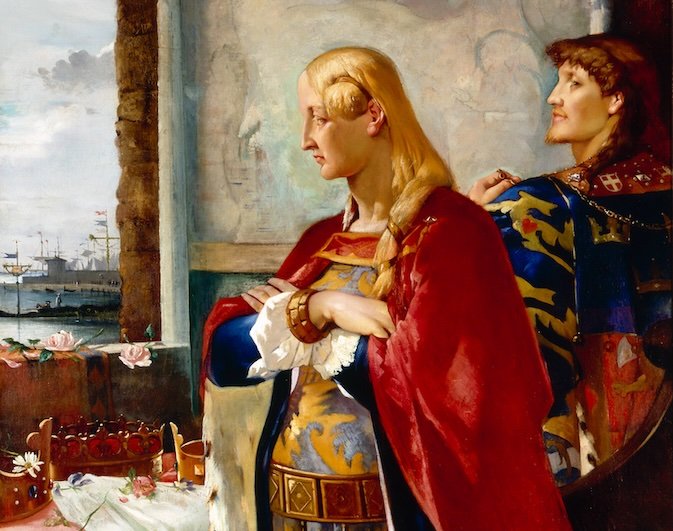
Margareta I: The Queen Who United the North
She had no crown of her own, three kingdoms to hold, and a world that measured power in men. She ruled anyway.
Every country has a favorite king. My favorite Nordic regent is a queen. She never had the title she deserved.
Her name was Margareta Valdemarsdotter. In Denmark she is Margrete I. In English she is Margaret I of Denmark. In 1397 she brought Denmark, Norway and Sweden under one king. We now call this the Kalmar Union. It was an early idea of Nordic unity, centuries before the EU.
I live in Stockholm. Here, Gustav Vasa gets the statues and the national day, and he is the man who left her union. She deserves more than a footnote. Here is her story, with the facts the sources confirm and clear notes where the sources disagree.
Quick facts
- Name: Margareta Valdemarsdotter (Margrete I in Danish, Margaret I in English)
- Born: 1353, probably at Søborg Castle in North Zealand. Nobody knows the exact date or place. She was baptized in Roskilde.
- Parents: King Valdemar Atterdag of Denmark and Queen Helvig of Schleswig. She was their youngest child.
- Married: 9 April 1363, at about 10, to King Håkon VI of Norway
- Child: Olof (Oluf in Danish), born December 1370, died 3 August 1387
- Formal position: regent, never crowned queen of Denmark. She held a similar title in all three kingdoms. In Denmark it was fuldmægtig frue og husbond, “sovereign lady and master”, and guardian of the realm.
- Union: Kalmar, 1397
- Died: the night of 27–28 October 1412, on a ship off Flensburg, aged 58 or 59, probably of plague
- Grave: Roskilde Cathedral, Denmark
A princess with no brothers left
Margareta was the youngest child of King Valdemar and Queen Helvig. On paper, she was the least important child. Medieval kingdoms wanted sons.
Then the family got smaller. Her brother Kristofer, the crown prince, died in 1363. Her sister Ingeborg died around 1370. Other siblings died as small children. When her father died, Margareta was the only one of his children still alive.
SKBL, the Swedish women’s biographical dictionary, calls this decisive for her life. It was also decisive for the whole North.
1375: the king dies at Gurre
Valdemar Atterdag died on 24 October 1375 at Gurre Castle in North Zealand, near Helsingør. He liked the place and stayed there often in his last years. The sources do not say what he died of.
He was first buried at Vordingborg, his favorite castle. A few years later, Margareta had him reburied at Sorø Abbey Church.
Valdemar was a hard man. He rebuilt a Danish kingdom that earlier kings had mortgaged away, piece by piece. He also took Gotland from Sweden in 1361. Nobody knows for sure what “Atterdag” means. Lex.dk says it probably comes from the Low German ter dages, “what days”. In Sweden he had a less kind name: Valdemar the Evil.
A Danish legend says that he loved Gurre so much that he told God to keep heaven, as long as he could keep Gurre. As punishment, he still rides a wild hunt through the forest at night. If you visit the ruin after dark, you now know what the noise is.
Another legend, retold by the historian Vivian Etting, is about Valdemar’s dream of uniting the North. A prisoner must guess what the king was thinking. A little manikin under a stone gives him the answer: “This might well happen, but it will be his daughter who will achieve this.”
His death opened a fight. Margareta’s son Olof was not the obvious next king. The strongest rival was her sister Ingeborg’s son, Albrekt of Mecklenburg. Margareta needed allies, and her father’s old drost, his highest official, Henning Podebusk, supported her. Olof became king of Denmark in 1376, and from then on she lived mostly in Denmark to protect his interests.
Raised by a saint’s daughter
At 10, Margareta married Håkon VI of Norway. She became queen of Norway, a girl at a foreign court. Not everyone liked the match. Saint Birgitta called the engagement a game with dolls, “because worldly honour is sought hereby and not Christian law.”
Margareta was raised by Märta Ulfsdotter, Birgitta’s daughter. The historian Grethe Jacobsen notes that Birgitta had played a prominent role at the Swedish court of Margareta’s in-laws before she left for Rome. Märta raised Margareta together with her own daughter Ingegerd. According to the records of Vadstena Abbey, the two girls “were often whipped with the same rod.”
So the future ruler of the North learned court life from a woman whose mother would become one of Europe’s best-known saints.
SKBL says Margareta probably lived mostly at the royal castles of Akershus in Oslo and Bohus, which is in Kungälv in Sweden today. Only two of her personal letters survive. The first was written at Akershus on 18 October 1370, when she was 17:
“You shall know, my dear Lord, that I and my servants suffer great need for food and drink, so that neither they nor I get what we want.”
She asked Håkon to write to a German merchant called Westfal, so that he would lend her what she needed. The most powerful woman in Nordic history started out as a young wife who could not pay for dinner.
Power without a crown
Håkon died in 1380. Margareta was a widow at 27 and never married again. Olof was now king of Denmark and Norway.
In the summer of 1387, Olof travelled to Falsterbohus in Skåne, while his mother stayed in Ystad. Shortly after he arrived, he fell seriously ill. He died a few days later, on 3 August 1387, in the arms of his chamberlain. He was 16. Nobody knows the cause.
Margareta now had no husband, no son and no brother. In medieval logic, she had no claim to rule.
She acted fast. On 10 August 1387, a week after Olof’s death, she was chosen as ruler in Lund Cathedral, and later the same day at the assembly of Skåne in Lund. Other regional assemblies in Denmark did the same after that. The historian Vivian Etting calls it “a coup d’état, which had no basis in law or the constitution.” The Annals of Scania gave another reason: she was chosen “because of the great wisdom which God has given her.” On 2 February 1388, Norway made her regent for life.
Here is a detail many articles get wrong. Margareta was never crowned or elected queen of Denmark. She was queen of Norway only as Håkon’s wife. As ruler, her formal position was regent. She held a similar title in all three kingdoms. In Denmark it was fuldmægtig frue og husbond, roughly “sovereign lady and master”, and guardian of the whole realm. The Norwegian and Swedish forms add the word “rightful”: rett husbonde and rätt husbonde. She herself liked to call herself “rightful heir”. The Hanseatic merchants sometimes called her “the lady king”. We call her Queen Margareta today because it is the usual name, not because it was her title.
A husbond is the head of a household, and in old usage also the husband. Jacobsen calls it a double-gendered title: it gave her the authority of a lady, of a lord and of a guardian at the same time. A kingdom with no king had found its master, and the master was a woman.
Why the North needed a union
Sweden had a king in 1388, Albrekt of Mecklenburg. The leading Swedish nobles were in conflict with him. They fought mostly over the castles and lands left by the powerful drots Bo Jonsson Grip, who died in 1386.
German princes and the Hanseatic towns had strong economic and political power in the Baltic region. Three small kingdoms that fought each other were easy to divide. One union could stand up to them. Whether Margareta thought in “Nordic” terms, or only in terms of her own power, historians still discuss. Probably both.
The road to Kalmar
1388, Dalaborg. In March 1388, at Dalaborg, a fortress on Lake Vänern in Dalsland, Swedish nobles accepted Margareta as “the almighty lady and true husband of Sweden”. They also gave her the right to choose the next king. Some sources give 1389 for Sweden. That is the year of the battle and of her formal installation.
1389, Åsle. On 24 February 1389, her army beat King Albrekt near Falköping in Västergötland, at the battle of Åsle. In an ironic choice, her commander was a Mecklenburg nobleman, Henrik Parow. He won the battle but died in it. Albrekt and his son were taken prisoner. The Annals of Scania thanked God, “who granted an unexpected victory in the hands of a woman.” During the battle, Margareta waited at Varberg in Halland. She then rode to Bohus to receive the prisoners.
1389–1395, Lindholmen. Albrekt and his son were held prisoner at Lindholmen Castle in Skåne. The war went on, mostly at sea. Peace came only with the Treaty of Lindholmen in June 1395, sealed with 90 seals. Albrekt was set free against a promise to pay 60,000 silver marks within three years, or give up Stockholm.
The heir. In 1389, Margareta had a boy from Pomerania chosen as king of Norway. Why him? That story needs its own section.
Why a boy from Pomerania?
He was born around 1382 at Rügenwalde Castle, now Darłowo in Poland. His name was Bugislav, also written Bogislav. He was Margareta’s great-nephew, her sister’s grandson, not her nephew as many texts say. He was six years old and lived far from the North. Margareta could have chosen a grown man. She chose a child. The sources give several reasons, and some of them are interpretations of the facts.
He had the right blood. Bugislav’s mother, Maria of Mecklenburg, was the daughter of Margareta’s sister Ingeborg. This made him a great-grandson of Valdemar Atterdag. The plan was a king who was related to the old royal families of all three kingdoms.
He came from the enemy’s family. Maria of Mecklenburg was the sister of the Albrekt who had competed with Olof for the Danish crown in 1375. By choosing a child with Mecklenburg blood, Margareta took part of the rival family’s claim and put it under her own control. No source says this directly. It follows from the facts.
A child cannot rule. A boy of six needed a regent for many years. The Swedish nobles even told her they were content to do without a king for her whole lifetime, and they hoped it would be long. A young heir gave Margareta the time she needed.
He had no power base in the North. A Pomeranian boy had no army, no castles and no network of nobles in the three kingdoms. Everything he had came from her. This is also an interpretation, not a quote.
A good name helps. He received the name Erik. It was an old Swedish royal name, and Saint Erik was Sweden’s national saint. A foreign boy with a Swedish saint’s name was easier to accept in Stockholm.
Etting writes that Margareta “adopted him as her foster son”. She also took in his sister Katarina, who at six was received into Saint Birgitta’s order at Vadstena. Jacobsen points out what this meant: the claim to the crown passed through women, from Margareta’s sister to her niece to the children. Margareta had lost her only child. Now she had two, chosen for politics and raised for power. I wrote more about this pattern in One Big Family? How Swedish Royal Houses Are Linked Through Women.
Kalmar, 1397
In June 1397, the councils of the three kingdoms met at the royal castle of Kalmar. On 17 June, Trinity Sunday, the archbishops of Lund and Uppsala crowned Erik king of Denmark, Norway and Sweden. After the ceremony, the new king knighted 133 men. The Norwegian encyclopedia SNL says it was the only joint Nordic coronation in the whole union period.
The meeting produced two documents. The first was the coronation letter, dated 13 July and sealed by 67 men. It thanked Margareta with these words:
“God reward our dear lady Queen Margrete for all her good deeds… that all we who live and reside in these kingdoms cannot reproach her for anything.”
The second was the famous union letter, dated July 1397. It says that “one king and no others should be elected to govern all three kingdoms, and thus the kingdoms will never be parted again.” It also says that each kingdom keeps its own laws, and that the kingdoms must help each other in war. The union covered Denmark, Norway and Sweden, and with them Iceland, the Faroe Islands, Greenland and Finland.
There is a small problem. The union letter is written on paper, not on parchment like other important documents. It has corrections, and only 10 of the 17 councillors put their seals on it. It is not a signed treaty. Historians have disagreed since the 1770s about whether it was ever legally binding. Etting writes that it “cannot be seen as a legal treaty”, and calls the meeting “an indirect victory for Queen Margrete”. The founding document of the union is still a subject for debate. Some would call that very Nordic.
Erik was king in name. Margareta ruled in practice until her death.
How she ruled
SKBL describes her as a skilled and tough negotiator. She avoided written promises that could tie her hands. That was a useful skill in a union whose founding letter nobody agrees on.
- Her own people in key places. She put trusted men in charge of castles and moved important positions out of the nobles’ hands. She did not appoint a new drost after Henning Podebusk died around New Year 1388. In 1386 the Lübeck chronicler Detmar wrote that she moved her officials around “just as a prior sends his monks from one monastery to another.”
- Land back to the crown. In Sweden, after an agreement in 1396, she carried out a räfst, a reduction. Land that had passed to the nobility went back to the crown. In one district of Västerås alone, the crown took more than 500 farms.
- Forged papers. Historians have found forged letters and forged witness statements that her government used to take land in Sweden. Etting describes five forgeries from around 1400, made on older documents with the old seals kept.
- Money for support. She promised the Swedish Church 10,000 silver marks. Etting calls it “the price of the Church’s support.”
- Taxes, and a retreat. She put a heavy tax on Sweden. There were so many complaints that it was cancelled in 1403, probably from fear of revolt. She knew when to step back.
- Gotland: war first, then money. The Teutonic Order took Gotland in 1398. In 1399 the exiled King Albrekt pawned the island to the Order for 10,000 nobles. In November 1403 Margareta sent an army, but in March 1404, 1,500 Teutonic knights arrived. Her fleet was surprised: more than 100 ships were taken and more than 60 burned. She then changed method. In 1405 she bought Albrekt’s rights to Gotland for 8,000 marks. In 1407 the Order agreed to leave for 9,000 English gold coins, called nobles, and the island came back in 1408. In Etting’s words, “the price was high.”
The false Olof. Years after Olof’s death, a man in Prussia said that he was the dead king, and that his power-hungry mother had driven him away. Margareta demanded that the Teutonic Order hand him over. In Kalmar he confessed that he was the son of a man called Wolff, from a village near Eger. He was burned at the stake in Skåne in 1402, probably at the great herring market, where merchants from many countries could see it. It is a hard story, and it shows the other side of her rule: she negotiated where she could, and she was merciless where she felt her power was in danger.
Instructions for a young king
Only two of Margareta’s personal letters survive. The first is her complaint about the empty food store at Akershus. The second is from early 1405, when Erik was about 23 and about to tour Norway alone for the first time.
The letter is a small paper book of eight pages, in Danish, with 54 sections. Etting thinks the queen probably wrote it herself. It opens with an order:
“You shall maintain peace everywhere you go.”
Some advice is about manners: “If any man or woman, young or old, wants to give you anything, you must receive it kindly.” Some is about power. If anyone asked for privileges, Erik had to delay:
“You must lay it upon me… because I know more about it than you.”
And some is about his temper: “You shall guard your words and not say anything, either in anger or at any other time, which can harm you or others.” When he could not delay any longer, he had to say that he would decide “as soon as your mother comes… if we both agree.”
The letter shows one thing clearly. Erik was officially of age in 1401, and four years later his great-aunt still wrote his instructions. Erik had the title. Margareta had the pen. Etting adds that she seems to have had a warm relationship with him, and that Erik always remembered her with great affection.
Her advice did not stay with him. After her death, Erik went to war with Holstein and the Hansa, and his taxes and foreign castle lords caused anger in Sweden. SNL says the reactions were strongest there. He lost Sweden and Denmark in 1439 and Norway in 1442. He spent his last years on Gotland and later at Rügenwalde, where he was born. Some writers call him the king who became a pirate. The best student of the best teacher in the North failed the exam.
Filippa: the English girl who defended Copenhagen
Margareta also chose Erik’s wife. In 1402 she negotiated with King Henry IV of England about a double marriage. Erik would marry Henry’s daughter Philippa, and Henry’s son, the future Henry V, would marry Erik’s sister Katarina.
England wanted the marriages to seal a military alliance. Etting writes that Margareta “firmly declined any kind of alliance directed against France or any other nation.” The English also asked for a promise that women could inherit the Nordic crowns, “as in England”. The Nordic side ignored it. In the end there was one wedding and a defensive alliance only.
Who was Filippa? SKBL says she was born in 1394, probably at the beginning of July, at Peterborough Castle in England. Other sources give 4 June. Her father was Henry Bolingbroke, later King Henry IV. Her mother, Mary de Bohun, is said to have died when Filippa was born. Her brother became Henry V of England.
A wedding without a groom. On 8 December 1405, at 11, Filippa was married by proxy in Westminster Abbey. A Swedish knight, Ture Bengtsson Bielke, stood in for the absent king. On 26 October 1406 she married Erik in person in Lund Cathedral and was crowned. SNL says Margareta was present. Filippa was 12. Erik was about 24. Over her wedding gown she wore a cloak “with a long train of white satin and velvet”. Margareta gave her a mistress of the household she trusted: Katarina, Saint Birgitta’s granddaughter and Margareta’s foster-sister from Akershus.
More than a queen consort. Filippa did much more than smile at feasts:
- She supported the Bridgettine order and Vadstena Abbey with money and politics. She became a lay member of the order, probably in 1415.
- She ruled as regent while Erik was on a pilgrimage from 1423 to 1425.
- In 1428 the Hanseatic League attacked Copenhagen. Erik was away. SKBL says Filippa led the defense of the city.
- A 1911 history of the Swedish church says her links to Vadstena helped bring the Bridgettines to England.
A short life. In late 1429 she travelled to Vadstena. One source says she gave birth to a stillborn son there. She died on the night of 5–6 January 1430, about 35 years old. She was buried in the chancel that she had paid for in the Vadstena Abbey church. Erik gave both their crowns from 1406 to the abbey. Years later, the crowns were pawned in Lübeck and disappeared.
Margareta trained Erik for 20 years. When the Hansa came to Copenhagen, the person who held the city was a woman nobody had trained for war, born in England. Margareta would probably have liked her.
Friends, allies and enemies
Margareta did not rule alone, but she chose her people with care.
The women closest to her
- Märta Ulfsdotter, her teacher at Akershus and daughter of Saint Birgitta.
- Ingegerd Knutsdotter, Märta’s daughter. She became the first abbess of Vadstena in 1384. Etting writes that “Margrete and Ingegerd remained friends all their lives.”
- Katarina, Märta’s other daughter. She later served Queen Filippa.
The men she trusted
- Henning Podebusk, her father’s drost. His support was decisive in 1375 and in 1387. He died around New Year 1388.
- Peder Jensen Lodehat, one of her closest advisers. In 1382 she had him made bishop of Växjö in Sweden, against the wish of the cathedral’s own clergy. He later became bishop of Roskilde. After her death, he moved her body to Roskilde Cathedral.
- Birger Ulfsson, Saint Birgitta’s son and Märta’s brother. Wikipedia says he led the Swedish nobles who rebelled against King Albrekt and invited Margareta in.
- Henrik Parow, a Mecklenburg commander who fought for her. He won the battle of Åsle and died in it.
- Abraham Brodersson, a rich nobleman who led her army at Stockholm and on Gotland. Some writers suspected that his daughter Brita was in fact Margareta’s child. This is not proven. In 1410 he was accused of rape, and on 27 August Erik had him beheaded near Sønderborg. Etting calls the charge “a convenient opportunity” to remove a man who had become too powerful. In 1411 Margareta founded two chapels, in Roskilde and Lund cathedrals, for his soul. Etting suggests “a touch of bad conscience.”
- Civil servants instead of nobles. The historian Thomas Derry says she ruled through officials she chose herself, often men from outside the country where they served. She put Danes into Swedish and Norwegian bishoprics. Critics say she favored Denmark. Derry says she simply wanted loyal people.
Allies from outside
- The Church. Pope Boniface IX called her queen of Denmark, Sweden and Norway in a letter in 1390. Margareta supported the campaign to make Birgitta a saint and helped Vadstena grow.
- England. In 1393 King Richard II offered three warships to “his dear sister, the Queen of Norway, Sweden and Denmark”. Later came Filippa and a defensive alliance only.
- John, Count Palatine of Neumarkt, who married Erik’s sister Katarina. This gave Margareta a South German ally to balance the North German princes.
Her enemies
- King Albrekt of Mecklenburg and the Mecklenburg princes.
- The counts of Holstein, who held Schleswig.
- The Victual Brothers, privateers who supported Albrekt’s side and attacked ships across the Baltic.
- Powerful nobles in all three kingdoms, whose land and influence she took back.
The Hansa, the Germans and the great powers
The Hanseatic League
The Hansa was a league of German trading towns, led by Lübeck. It controlled much of the trade in the Baltic and the North Sea. Margareta’s relationship with it was complicated from the start.
As a young queen at Akershus, she needed credit from the merchant Westfal so that she and her servants could eat. The woman who later built a union to stand against German power first needed a German merchant to pay for dinner.
As regent, her first big problem was that the Hanseatic towns held castles in Skåne after her father’s lost war. Older histories, including Etting’s book, say she used privateers to pressure the towns. Etting writes that the pirates “seemed to be in the pay of the Danish queen.” Newer research argues that the towns kept the castles because Denmark did not stop the piracy. Lex.dk presents both views. Either way, the Hansa returned the castles in 1385 and got no compensation. Detmar wrote: “This she accomplished with great skill.” Etting describes her method as “hiding severe pressure behind an apparently mild and indulgent attitude.”
When she fought King Albrekt, the Hansa became the referee. The Hansa helped arrange the peace at Lindholmen in 1395. It held Stockholm as security, and on 29 September 1398 handed the city to Margareta.
She did not destroy the Hansa. She negotiated with it, paid it when she had to and used it when she could.
The German princes
Mecklenburg and Holstein were her real rivals. In 1386, in the Treaty of Nyborg, she gave Schleswig to the counts of Holstein as a hereditary fief. Most historians see this as a concession: it gave her peace in the south while she turned to Sweden. In her last years she tried to take Schleswig back, and she died in the middle of that conflict.
The great powers
Etting writes that she “had avoided any involvement in the great European conflicts.” She stayed out of the Hundred Years’ War between England and France. Her father had loved war. Margareta preferred to buy land, negotiate and wait.
Who did she fear, and who did she respect?
The sources do not say what she feared. Her actions give some clues. She seems to have feared three things: German princes taking the North piece by piece, nobles who were stronger than the crown, and wars that cost more than they gave. She respected money, the Church and the Hansa’s power at sea. She did not like the Hansa, but she took it seriously. In 1386 Detmar wrote that “all the nobility of Denmark feared the wisdom and power of this queen.”
A woman in a man’s job
SKBL is clear: in medieval society, power was understood in male terms. The ideal kingdom had a male king. Women ruled mostly when men were absent. Ruling queens were not rare in Europe at the time, but they needed a reason to be there.
Margareta had every reason at once. She was the only surviving child of one king, the widow of another and the mother of a third. Later she was the guardian of a fourth. SKBL says she did not only give power legitimacy. She used it.
She also stayed single. Etting explains why: “She could only keep her political position if she remained unmarried.”
Her enemies noticed her sex. In 1384 her army chased the Swedes away at Laholm. The Annals of Scania called their flight “shameful for them since they had not expected that a woman would dare to come to the royal camp.” Later legends say King Albrekt called her “King Breechless”, a king without trousers, and sent her a whetstone to sharpen her sewing needles. A whetstone like this was later shown in Roskilde Cathedral, and it is now in Uppsala. A Danish ballad, written down around 1540, also gave her the insulting name “Monklover”, from a later story about an affair with an abbot.
The same ballad gives her the last laugh. Albrekt swears that he will not wear a hood until he has beaten her: “For no man shall say, That I fear a woman.” After the battle, the queen answers: “Fetch me thirty feet of frieze, And cut a hood for the gentleman.” This is where the story of the fool’s cap comes from. It is a story, not a fact. The prison is a fact: Albrekt and his son were held at Lindholmen from 1389 to 1395.
Women’s peace
Margareta used her power for other women, in a way few medieval rulers did.
Kvindefred, 1396. On 24 January 1396 she issued a law to strengthen the peace around churches, houses, farms, legal assemblies and workers in the fields, and around women. She used the word kvindefred, “women’s peace”. Etting writes that “as far as I know this is the first and only time such a term is used in Danish law”, and that “it seems likely that Queen Margrete as a woman underlined this point.” Jacobsen agrees. Rape was already a crime, but Margareta placed the protection of women next to the peace of the Church.
Money for the women, 1411. A year before her death, at Kalundborg Castle, Margareta issued three gift letters. One gift honored 24 February, the day of the battle of Åsle. A sum was to be shared among the women and girls who had been “violated and debased” in that war, and spent on masses for the souls of all who died in it, “whether they fought for or against the kingdom.” Etting gives the total as 1,000 German marks. Jacobsen gives the women’s part as 500 marks.
The original text, in Old Danish, reads:
“…sculæ wii skifte en deells i bland quinnor og møør, som man kan spørghe oc fa at wide at krænchte og nethræthe ære wordne i thisse orløgh i thisse thry righe østen Øressund”
In plain English: we shall share a part among the women and maidens who, by asking, can be found to have been violated and debased in this war, in these three kingdoms, east of Øresund.
East of Øresund probably means Skåne, which was Danish land at the time. Look at the words “by asking”. Someone had to go out, find these women and listen to them.
For scale: King Albrekt’s ransom was 60,000 marks. The two sums may not use the same kind of mark, but the gap still says something about whose suffering counted in the 1300s.
Was it compassion, politics or a gift for her own soul? Probably all three. Still, she did something rare. She admitted that her war had victims who were not soldiers, and she named them. She even paid for masses for her enemies’ dead.
The clerk who knew better
Around 1420, a town clerk in Malmö wrote a poem in the town book that celebrated Margareta’s victory over King Albrekt. Jacobsen found that the same book also contains this line in Latin:
“A mulieribus male regitur civitas.”
(Women govern the state poorly.)
The clerk thought it came from Aristotle. Jacobsen shows that he remembered the quote wrongly, and that the idea comes from Thomas Aquinas’s commentary on Aristotle. The clerk had lived through Margareta’s rule, and he wrote it anyway.
Two centuries later, the Danish historian Arild Huitfeldt praised her, but in a strange way: “Her father said that Nature had dealt wrongly with her. She should have been a man, but was born a woman.” In 1745 the writer Ludvig Holberg went further. Any government is good, he wrote, if its rulers are “virtuous and skilled”, whether men or women. “Denmark has never been as highly estimated as under Margrete.”
Jacobsen also points to the hard ending. After Margareta died, Danish law showed no trace that a woman had ever been “sovereign lady and master”. Her power belonged to her person, not to women as a group. The next woman to rule Denmark in her own right was Margrethe II, in 1972. Denmark counts Margareta as Margrete I, which is why the modern queen is “the Second”, even though Margrete I was never formally crowned. Six hundred years later, Denmark gave her the title after all.
Diplomacy instead of glory: a feminist look at war
Margareta’s father invaded Gotland, fought the Hansa, lost, and had to sign the Treaty of Stralsund in 1370. Her heir Erik went to war with Holstein and the Hansa and lost his three crowns. Between these two men stands Margareta. She bought land, married off relatives and waited out her enemies.
What she did instead of fighting
- She tried to take Gotland by force in 1403 and failed. Then she did what she did best: she negotiated and paid, first Albrekt and then the Teutonic Order.
- In Schleswig, the Holstein chronicle says she asked her councillors whether to use armed force or to win the duchy slowly “through money and gifts. The latter method was chosen.”
- She let the Hansa arrange the peace at Lindholmen in 1395, and got Stockholm without taking it by storm.
- She stayed out of the Hundred Years’ War and refused England’s offer of a military alliance.
- She dropped an unpopular tax in Sweden in 1403 to avoid a revolt.
- She gave money to women who had been raped in her own war.
But she was no pacifist. She won Sweden in a battle at Åsle. Older histories say she used privateers against Hanseatic ships, although newer research questions this. She kept King Albrekt in prison for six years. She had the false Olof burned. After Flensburg surrendered to her in 1412, the Lübeck chronicle says that alleged traitors were “beheaded, while others were broken on the wheel or hanged.” The fair picture is a ruler who used war as the last tool, not the first.
Gotland shows her method clearly. When war failed, she did not try again with a bigger army. She opened her purse.
Historians agree on this. The historian Henrik O. Lunde calls her “the most far-sighted ruler in Scandinavia in the pre-Vasa period”. The Swedish writer Vilhelm Moberg, a republican who did not admire kings, called her the greatest monarch the North ever had, and praised her because she did not love war. The historian Erik Petersson writes about this in Drottning Margaretas dröm (2023).
Why kings went to war
For a medieval or early modern king, battle was part of the job description. A king was expected to lead his men, show courage and win land and honor. Many did so in person. Gustav II Adolf, Sweden’s warrior king, died on the battlefield at Lützen in 1632, leading his cavalry. A king who avoided war could look weak.
A queen could not prove herself this way. Nobody expected her to ride into battle. Margareta had to use other tools: money, marriages, negotiation, patience and loyal officials. In a way, the limit on her role pushed her toward a different style of power.
Some observers saw her differently. An English monk at St Albans wrote that she had been dangerous to many nations by “refusing female effeminacy and dressing in the armour of a warrior.” He was wrong about the armor. She won with letters, not swords.
What the research says, and why it is complicated
It would be nice to say that women rule more peacefully. The research does not say that.
In 2020, the economists Oeindrila Dube and S. P. Harish published a study called Queens in the Journal of Political Economy. They examined European states from 1480 to 1913. Their finding: states led by queens were more likely to be at war than states led by kings.
The reasons are a feminist story in themselves:
- Unmarried queens were attacked more often. Their enemies saw a woman on the throne as a weak target.
- Married queens attacked more often than kings. The authors think a married queen could share the work of ruling with her husband, who often managed the military side. Married kings seldom shared power with their wives this way.
So gender did matter, but not because women are naturally peaceful. It mattered because of how other people treated women in power, and how power was divided in a marriage.
Many feminist scholars, such as Cynthia Enloe and J. Ann Tickner, also reject the idea that women are “born peaceful”. They see war as linked to ideas of masculinity, honor and strength that both men and women can follow. A woman who wants respect in a system built on these ideas may have to fight to prove she is not weak. Think of Margaret Thatcher in the Falklands War in 1982, or Indira Gandhi in the war of 1971.
Margareta is interesting because she did not need to prove anything with a sword. She had already won the battles that mattered. After that, she chose the slow road.
Why this still matters today
Today, wars are again part of European life and of the news. The question of who sits at the table is not old history.
- Women in peace talks. In 2000, the UN Security Council adopted Resolution 1325 on women, peace and security. UN Women reports that when women take part in peace processes, an agreement is 20 percent more likely to last at least two years and 35 percent more likely to last 15 years. This figure comes from a 2015 study, and it is the most quoted number in the field.
- Few women at the table. According to the Council on Foreign Relations, women were only 16 percent of negotiators in UN-led peace processes in 2022.
- Equality and peace. The Council on Foreign Relations also summarizes research that shows that countries with more gender equality are less likely to use military force in international disputes.
The lesson from Margareta is not “women make peace and men make war”. It is that a ruler who does not need to prove her strength in battle can choose other tools. Maybe the real question is not who rules, but what we expect from a ruler before we call them strong.
Side note: Queen Kristina, another queen who wanted peace
Margareta is not the only Nordic queen who chose the negotiating table over the battlefield.
Queen Kristina of Sweden came of age in 1644, in the middle of the Thirty Years’ War. Her father was Gustav II Adolf, the king who died at Lützen. SKBL says her rule began just as the peace talks in Münster and Osnabrück started. Several historians say that she pushed for an end to the war, against the more cautious Chancellor Axel Oxenstierna. The Peace of Westphalia was signed in October 1648, and one encyclopedia calls it a victory for Kristina.
The daughter of the warrior king ended her father’s war. Then she gave up the throne and moved to Rome. She deserves her own article, and I will write one.
How she died
In October 1412, Margareta was at Flensburg. She was 58 or 59 and still at work. She had come to win back Southern Jutland, Sønderjylland, from the counts of Holstein. On 24 October the citizens of Flensburg paid homage to her. It was her last victory.
She returned to her ship to leave the port, and then a sudden and violent illness hit her. She seems to have known that the end was near. She ordered 37 marks to be paid to the nearby monastery of Campen (Kampen) for a mass for her soul, to be said forever. She died on board during the night of 27–28 October 1412.
She probably died of plague, but this is not certain. Etting writes that she “may have been infected by the plague epidemic sweeping Flensborg.” Her enemies told other stories. The Holstein chronicle says that she had “not a single piece of land in all her kingdoms where she was allowed to die”, and that her soul left her body “during a great and strange storm of thunder and lightning.” The Lübeck chronicle says that a priest she had sent to the gallows cursed her to follow him within three days. Etting doubts this story. Older writers also suggested shock after the execution of Abraham Brodersson, but he died on 27 August 1410, more than two years earlier. Some even suggested poison from Erik. There is no evidence for poison.
The ruler who preferred negotiation to war died in the middle of a negotiation. In a way, that fits.
What she left behind
Margareta wanted to be buried at Sorø, next to her father and her son, and she was first buried there. The next summer, Bishop Peder Lodehat moved her body to Roskilde Cathedral, with King Erik’s approval. The monks of Sorø said that it was done by force. On 4 July 1413 she was entombed in Roskilde, with masses at 50 altars. Each altar received a gilded chalice. One of them, now at the National Museum of Denmark, carries the words “Pray for her.”
In 1423 King Erik paid for her sarcophagus. Who made it is not certain. Some sources attribute it to the Lübeck sculptor Johannes Junge. Etting writes that “we do not know the artist”, perhaps a master from the Netherlands. Only the chest and most of the figure on the lid are original. The rest was rebuilt between 1862 and 1912. The inscription calls her “formerly queen of the kingdoms of Denmark, Sweden and Norway” and adds: “Since all posterity will not be able to honour her as she deserves, this monument has been erected to her memory.” A sculpted head in Lübeck is sometimes called a portrait of her. Etting does not agree.
A myth to avoid. Uppsala Cathedral keeps a gold dress made of gold brocade on purple silk, probably woven in Lucca in Italy. It is often called Margareta’s wedding dress. It stood next to her sarcophagus in Roskilde until the Swedish army took it in 1659. Carbon dating puts it between 1403 and 1439, long after her wedding in 1363. It cannot be her wedding dress, but it may still have been hers. Lex.dk notes, a little dryly, that one could settle the question by opening the sarcophagus and checking whether she would fit the dress.
The union outlived her, but not happily. Erik lost the Danish and Swedish thrones in 1439. Sweden left for good in 1523, when Gustav Vasa became king. Denmark and Norway stayed together until 1814.
Later generations judged her in different ways. The Lübeck chronicle wrote that she ruled “three kingdoms for 30 years… in peace and with wisdom.” In 1420 the clergy of Roskilde carved into their choir stalls that during her reign “prosperity and happiness were enjoyed by all the inhabitants of the kingdoms.” A Swedish chronicle from around 1440 was less happy:
“Very seldom is such a woman born.
I don’t think that the Swedes were wise,
When they chose her as their leader.”
The monks at Vadstena wrote only that she was very successful in worldly matters. For a monastery, that is almost a compliment.
Older histories show her as a selfless mother of the nation. In the 19th century, the Scandinavism movement made her a model for Nordic cooperation. Modern historians stress her ambition and her political skill. In 1882 the Danish historian Kristian Erslev called her union “a Danish kingdom which covered the whole of Scandinavia—in other words something quite different from a union.” Several pictures can be true at once. Kind people rarely unite three kingdoms.
An early idea of Nordic unity, centuries before the EU
The Kalmar Union was not “the first EU”.
What looks similar
- Three countries shared one foreign policy and promised to defend each other.
- Each country kept its own laws and its own council.
- Its founders wanted the region to stand stronger together against bigger powers.
What was very different
- It was a personal union under one monarch, not a union of states.
- Nobody voted. Kings, nobles and bishops decided.
- Its founding letter was never fully sealed and may never have been legally binding. The EU has a lot of paperwork, but at least it was all signed.
Still, the basic idea is there: small neighbors are stronger together than apart. A Danish chronicle from around 1470 puts it in Margareta’s mouth: “The cord which is braided with three strands / Will rarely break.” That idea came back many times. The Nordic Council started in 1952. Nordic citizens can travel, live and work in each other’s countries without passports. Since 2024, all five Nordic countries are members of NATO.
What if the North had stayed together?
Imagine that Gustav Vasa never broke away, and the union of Denmark, Norway, Sweden, Finland, Iceland, the Faroe Islands and Greenland still existed today.
The numbers
- People: about 28 million in 2025, according to the Nordic Council of Ministers. More than a third live in Sweden.
- Economy: roughly 2 trillion US dollars together. That would put the union somewhere among the world’s 15 largest economies. Norway alone had a GDP of about 531 billion dollars in 2025, according to the World Bank.
- Wealth per person: all five countries are in the top group in Europe for GDP per person.
- Size: with Greenland, about 3.5 million square kilometers. That is larger than India. Most of it is ice, and most of the ice is in Greenland.
The power
A union of 28 million rich people would have the Arctic, the North Atlantic, oil and gas, a lot of hydropower, and Norway’s state oil fund in one pocket. In Brussels, Washington and Beijing, this voice would be hard to ignore. On the other hand, each of the five would lose its own seat at the table.
The language question
Which language would we speak? In the real union, official texts used Danish, Swedish and Latin. On the docks and in the trading towns, many people spoke Middle Low German, the language of the Hanseatic merchants. Margareta’s union tried to limit their power, and still spoke their language at the market.
Copenhagen became the royal residence in 1443, so from the 1440s Danish would probably win at court. Danes, Swedes and Norwegians can mostly understand each other today, with some effort. The real test would be the Danish numbers: 90 is halvfems, roughly “half-fifth times twenty”. Finns and Icelanders would have the hardest time, because their languages are not close to the others.
My guess? The union might have run in German or Danish. Danish was the language of the court and of Copenhagen. Low German was the language of trade, money and the Hanseatic towns. Stockholm itself had a strong German population in Margareta’s time. A union that tried to keep the Germans out could still have ended up speaking their language. Margareta would not approve.
The capital question
Copenhagen, Stockholm or Oslo? Each city would say “obviously us”. My bet would be Kalmar. It is where it all started. It sits on the old border between Denmark and Sweden, and it is the only city where a king of all three kingdoms was ever crowned together. A neutral small town in Småland as the capital of a Nordic power. Margareta liked compromises she controlled.
The real risk
The union did not end because of language. It ended because Swedes felt that Danes decided too much. That ended in war and in the Stockholm Bloodbath of 1520. A modern union would face the same question: who decides for whom? Today, Norway and Iceland are outside the EU, and Finland is the only Nordic country that uses the euro. Five countries cooperate closely without a crown, and maybe that is the version Margareta could not imagine.
In her footsteps: places to visit
You can follow Margareta’s life across five countries.
Sweden
- Kalmar Castle and the old town, Kalmar. The union was created here in 1397.
- Bohus Fortress, Kungälv. She spent part of her youth here, and received King Albrekt as her prisoner here in 1389.
- Varberg Fortress, Halland. She waited here during the battle of Åsle.
- Lund Cathedral, Lund. She was chosen as ruler here on 10 August 1387, a week after her son died. Filippa married Erik here in 1406.
- Falsterbo, Skåne. Her son Olof died at Falsterbohus in 1387.
- Lindholmen castle ruin, near Svedala. King Albrekt was held prisoner here from 1389 to 1395, and the peace was made here in 1395.
- Dalaborg ruin, Dalsland. The Swedish nobles accepted her here in 1388.
- Åsle, near Falköping. The battle site of 1389.
- Söderköping. The meeting that confirmed her as regent in 1389.
- Vadstena Abbey. Founded by Saint Birgitta, where Margareta’s friend Ingegerd was the first abbess. Queen Filippa is buried here.
- Uppsala Cathedral. The famous gold dress is kept here. It is not her wedding dress, but it may have been hers.
Norway
- Akershus Fortress, Oslo. She wrote her letter about the empty food store from here.
Denmark
- Roskilde Cathedral. Her sarcophagus stands behind the high altar. The cathedral is a UNESCO World Heritage Site.
- Sorø Abbey Church. Her father’s and her son’s graves, and the place where she wanted to be buried.
- Søborg castle ruin, North Zealand. Probably her birthplace.
- Gurre castle ruin, near Helsingør. The place where her father died, and where his ghost hunts at night.
- Vordingborg and the Goose Tower. Her father’s favorite castle.
- Odense Cathedral. The people of Funen paid homage to her here in 1387.
- National Museum of Denmark, Copenhagen. One of her chalices, with the words “Pray for her”, is kept here.
Germany
- Flensburg. She died on a ship off the town. She and Erik built the Duburg castle here, finished in 1411. Only the site remains, but Flensborghus on Norderstraße 76 was built with stones from its ruin.
- Lübeck. A sculpted head kept at St. Anne’s Museum is sometimes linked to her.
A bonus in Poland
- Darłowo Castle. King Erik was born here as Bugislav, and he died here in 1459.
Margareta’s story begins and ends with women whose names few people know: Helvig, Ingeborg, Märta, Ingegerd, Maria, Filippa. Next time a guide tells you that Gustav Vasa built Sweden, will you ask who built the union he left?
Sources
Books and research
- Etting, Vivian: Queen Margrete I (1353–1412) and the Founding of the Nordic Union. The Northern World 9. Brill, 2004. ISBN 9789004136526. The main source for this article.
- Jacobsen, Grethe: Less Favored – More Favored: Queenship and the Special Case of Margrete of Denmark (PDF, Det Kgl. Bibliotek)
- Harrison, Dick: Kalmarunionen. Historiska Media, 2020.
- Petersson, Erik: Drottning Margaretas dröm. 2023.
- Geijer, A., Franzén, A. M. and Nockert, M.: Drottning Margaretas gyllene kjortel i Uppsala domkyrka. Stockholm, 1985.
- Olesen, Jens E.: Erik af Pommern og striden om Gotland 1435–1449 (Mirator, 2025)
- Scandia: 1397 års unionsbrev och dess rättsgiltighet
- Dube, Oeindrila and Harish, S. P.: Queens (NBER Working Paper, published in Journal of Political Economy 2020)
- Geijer, Erik Gustaf: The History of the Swedes (1845), Project Runeberg
- Wordsworth, John: The National Church of Sweden (1911), Project Runeberg
Primary sources online (Danmarkshistorien, Aarhus University)
- The election letter of 10 August 1387
- The ordinance of 24 January 1396
- The union letter of 1397
- Erik’s coronation letter, 13 July 1397
- The instructions to Erik, 1405
- The gift letters of 1411
Reference works
- lex.dk: Margrete 1.
- lex.dk: Valdemar Atterdag
- lex.dk: Gurre
- Store norske leksikon: Margrete Valdemarsdatter
- Store norske leksikon: Erik av Pommern
- Store norske leksikon: Filippa av England
- Store norske leksikon: Roskilde domkirke
- SKBL: Margareta, drottning
- SKBL: Filippa, drottning
- SKBL: Kristina, drottning
Organizations and data
- UN Women: Conflict resolution and peacebuilding
- Council on Foreign Relations: Women’s Participation in Peace Processes
- Nordic Council of Ministers: Nordic population 2025
- World Bank data via georank.org: Norway GDP
- Historical Marker Database: Duburg, Flensburg
- SSF: Visit Flensborghus
Further reading and listening
- Historia Nu, episode 284: Margareta Valdemarsdotter – realpolitikern som enade Norden
- SO-rummet: Margareta – drottning och politiskt geni (Stefan Högberg)
- SO-rummet: Margareta I av Danmark (Gunnar Åselius)