
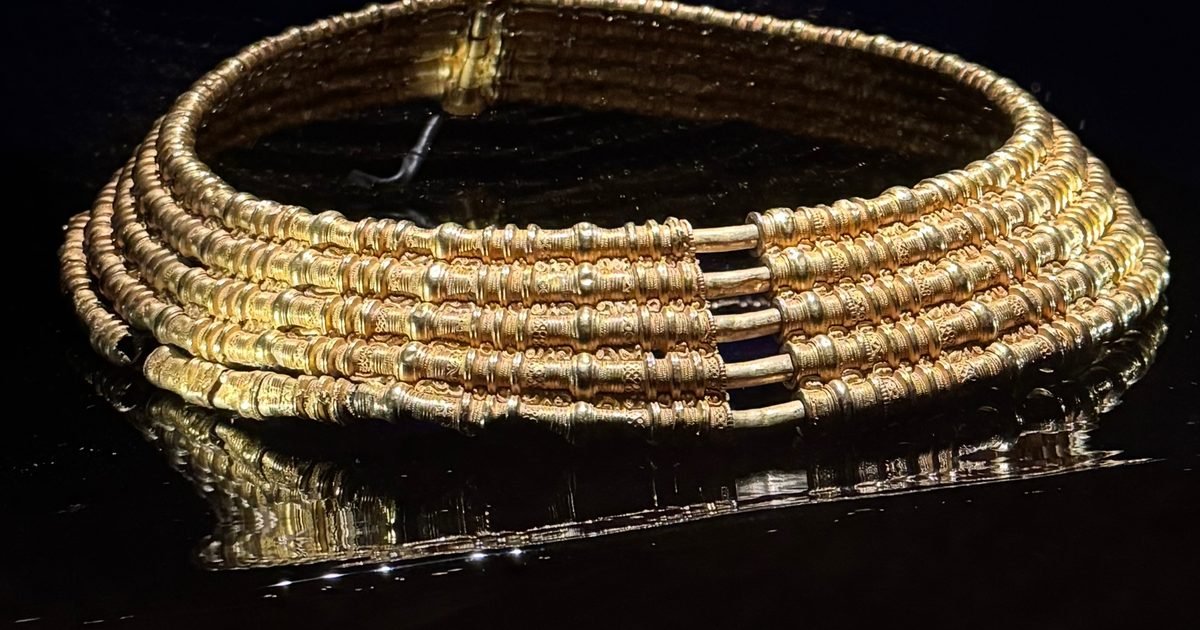
The Gold Collars of Ålleberg, Färjestaden and Möne
Three Swedish gold collars, 1,500 years old, full of tiny animals and people nobody can name.
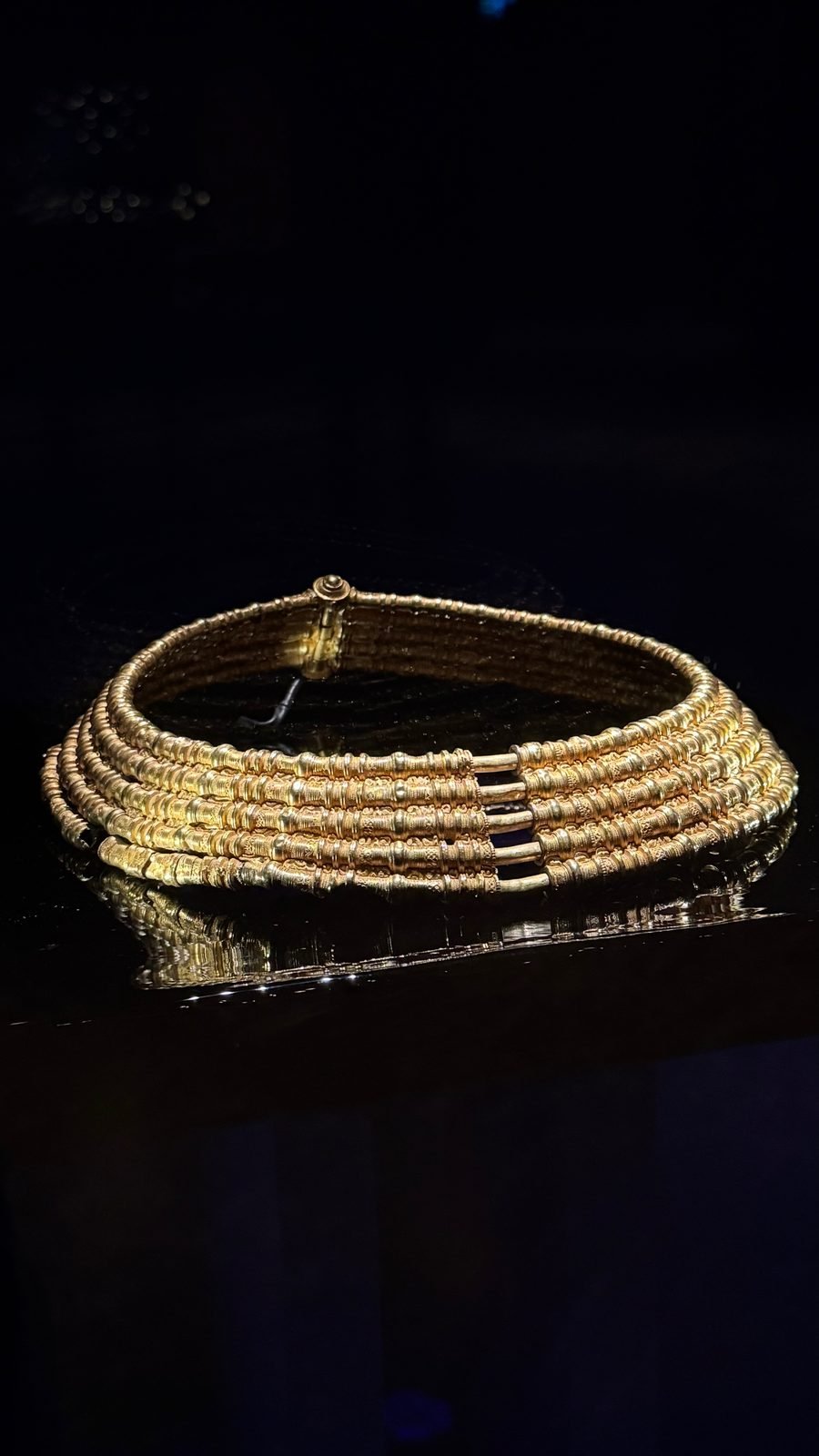
When I visited Guldrummet at Historiska museet in November 2026, I was amazed by the amount of gold that has been found. Three objects stand out. They are three gold collars from the 400s and 500s. Each one is made of thick gold rings, stacked on top of each other. Between the rings sit hundreds of tiny animals and people.
The museum calls them unique. Only three are known in the world, and all three were found in Sweden.
Three collars, three themes
The museum does not show the three collars side by side. Each one sits in its own display, under its own theme:
- Religion has the collar from Ålleberg in Västergötland.
- Royal power (Kungamakt) has the collar from Färjestaden on Öland.
- Magnates (Stormän) has the collar from Möne in Västergötland.
The signs give one shared explanation. The collars may have been marks of rank for worldly and religious leaders. The goldsmiths who made them 1,500 years ago knew techniques, and had a skill, that hardly exist today.
How they were found
Ålleberg, 1827. The first collar was found at the foot of Ålleberg, a flat-topped hill near Falköping. Swedish Wikipedia on Ållebergskragen says two men were looking for a good stone to use as a hearth: Lars Helgesson, a former soldier, and Gustav Sandsjö, a farmer’s son. At first, experts thought the collar was made in Asia, because the work was so fine. Later they decided it was made in the North.
Färjestaden, 1860. The second collar was found on Öland.
Möne, 1863. The third and largest collar was found at Möne in Västergötland. One source gives the year as 1864.
A German study of the collars, led by Alexandra Pesch, says they were all single finds, with no grave or settlement around them. Nobody knows who hid them, or why.
Three, five and seven rings
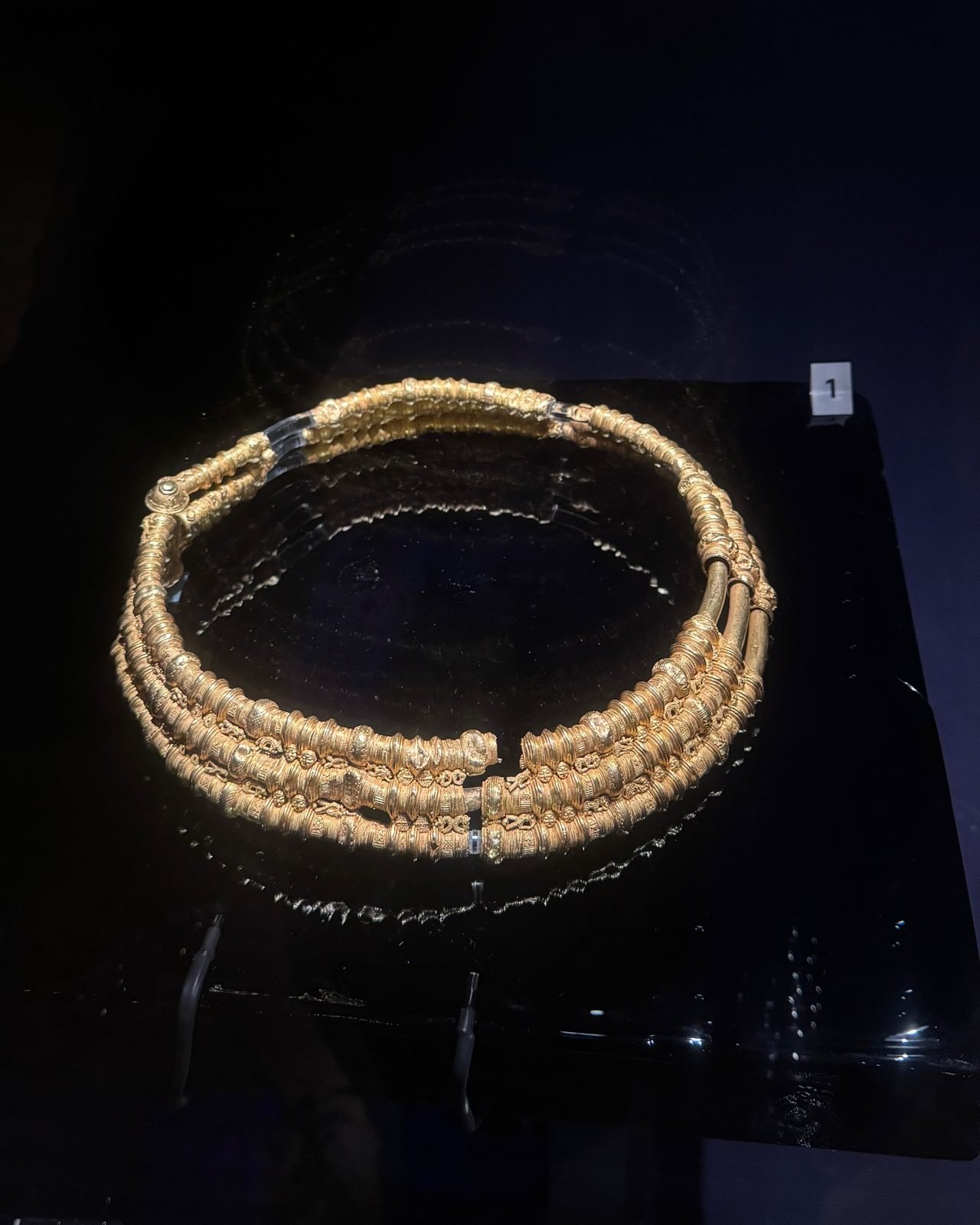
The collars grow with time. The oldest has three rings, the next has five and the youngest has seven.
| Collar | Rings | Weight | Figures | Dating |
|---|---|---|---|---|
| Ålleberg | 3 | 612–633 g | 105–137 | about 450–480 AD |
| Färjestaden | 5 | 707–713 g | 274–362 | late 400s or early 500s |
| Möne | 7 | 821–823 g | 458 | about 500–550 |
The sources give different weights and figure counts, so the table shows the lowest and highest numbers. The dating comes from Pesch. The museum signs give 400–550 AD for all three.
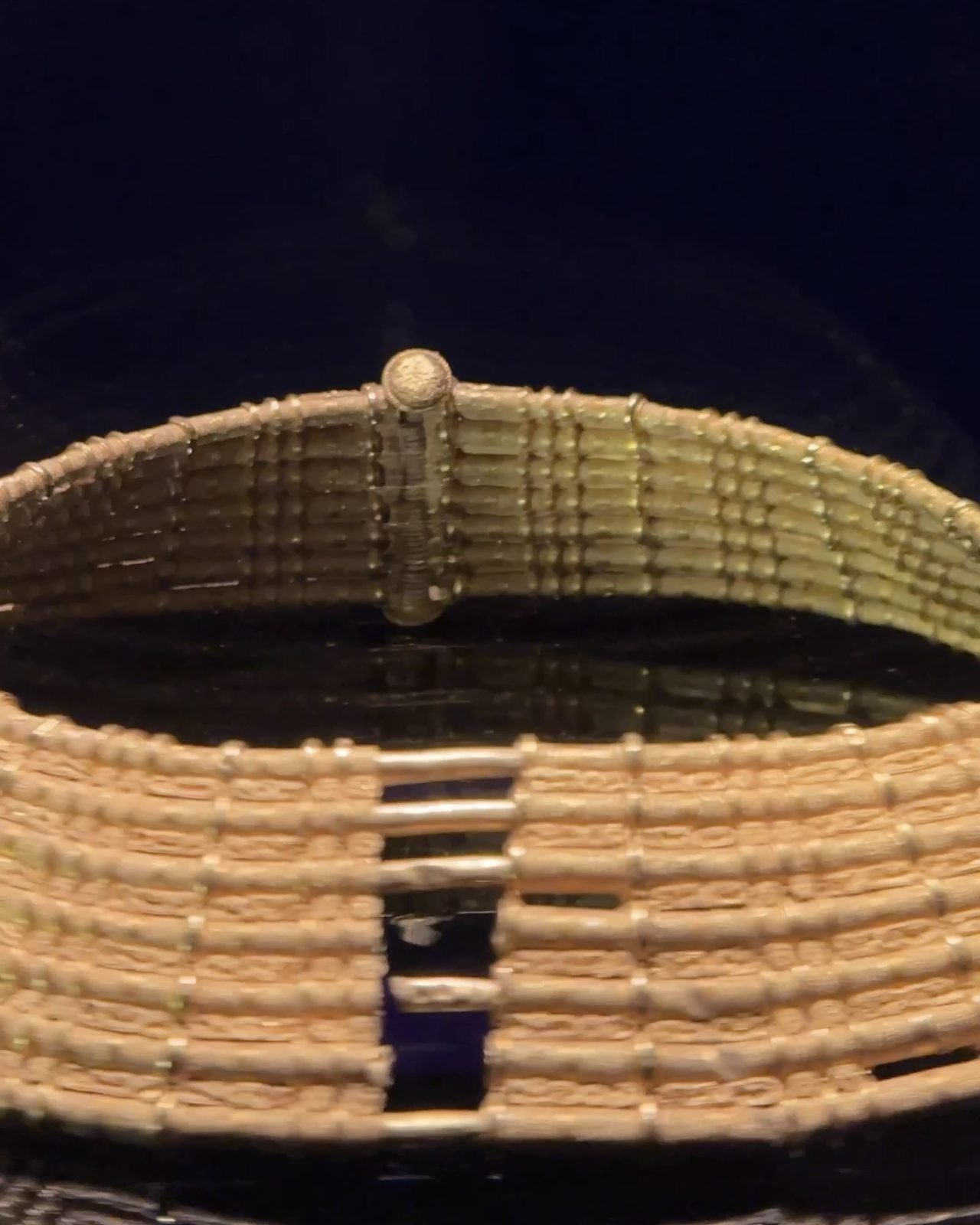
Each ring is a hollow tube of thin sheet gold. Gold wire is wrapped around the tubes. The collar has a hinge at the back and closes at the front. Swedish Wikipedia gives the Ålleberg collar 22-carat gold.
The tiny figures
Look closely between the rings. Pesch reads the Ålleberg figures as horses, boars, deer, birds, snakes and dragons. In the middle sits a human figure facing forward. Pesch suggests it may be the god Odin.
The Färjestaden figures are harder to identify: animals that look backward, water birds and sea creatures. The Möne collar repeats coiled animals or snakes, and many small faces, like masks.
The sign by the Färjestaden collar says the figures probably belonged to stories and myths that are forgotten now. The stories were told in gold. Nobody can read them anymore.
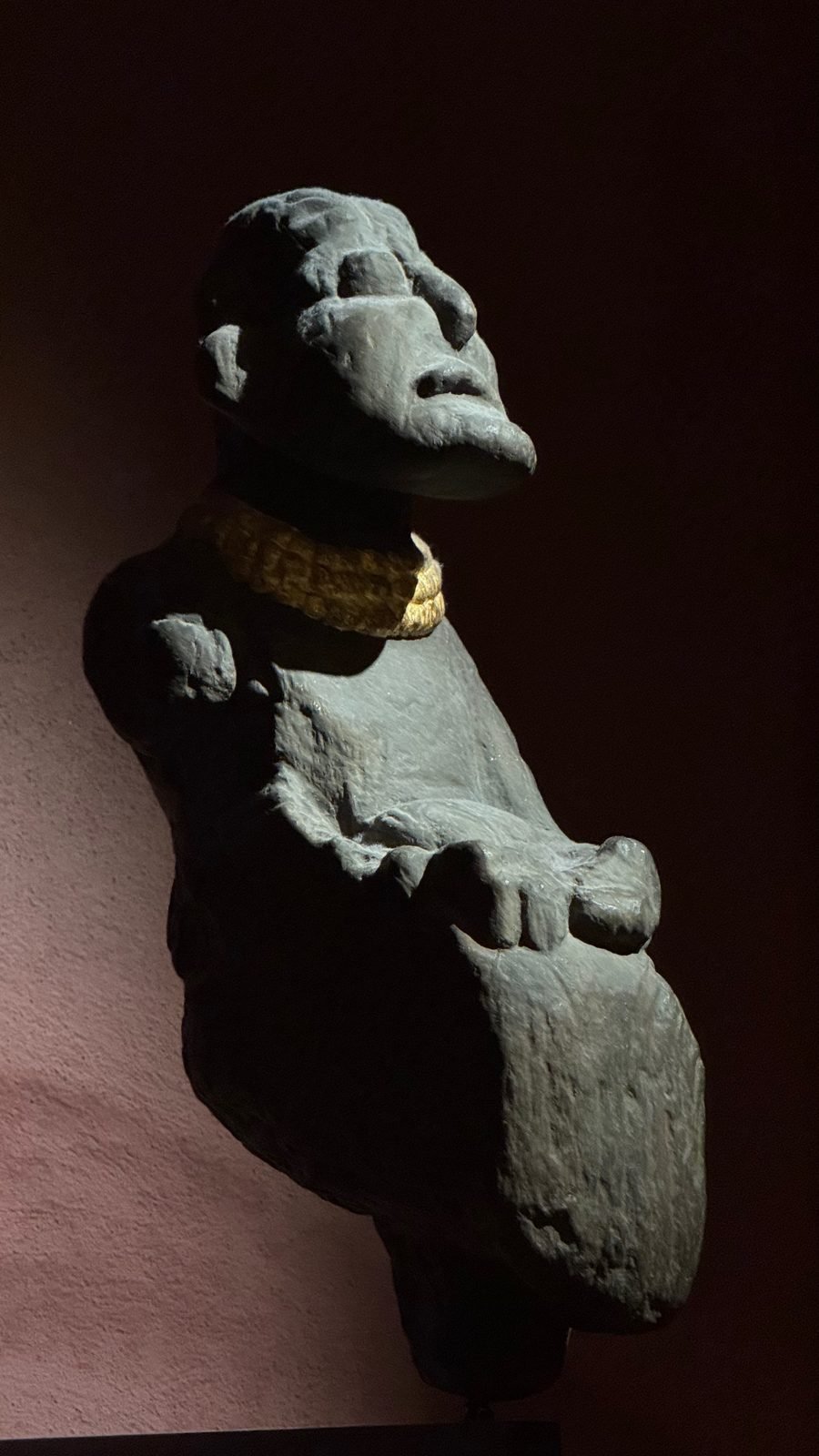
One showcase holds a clue. It is a copy of a seated wooden figure, found in a bog at Rude Eskildstrup on Zealand, Denmark, from about 400–550 AD. The figure wears the same kind of collar. The sign asks: is it a god, or a powerful leader waiting to be honored?
Who made them, and from what?
Pesch thinks all three collars came from the same workshop, probably a large, permanent one in the region. That workshop has never been found. The makers were trained goldsmiths who knew what the motifs meant.
The gold itself probably came from far away. Other signs in Guldrummet explain that gold came to the North as Roman coins, through trade, loot or pay for soldiers. Smiths melted them down. Next to the Färjestaden collar lie 36 Roman gold coins, solidi, found at Björnhovda on Öland, from the same period.
One more idea: Pesch mentions that the collars may have been Sweden’s oldest royal regalia. It is a theory, not a fact.
Who wore them?
This is the part I find most interesting. It is fun to imagine who wore a collar like this. Was it a chieftain? A queen? A regent? Or was it only worn at ceremonies?
We do not know. Nothing tells us how the collars were worn, or by whom. The signs only say they may have marked leaders, worldly or religious. All we have is the evidence that they exist: three collars of gold, and hundreds of small figures that keep their stories to themselves.
See them yourself
All three collars are in Guldrummet, the Gold Room, in the basement of Historiska museet in Stockholm. Bring time, and look at the figures up close. The museum has put loose figures from the Ålleberg collar under a magnifying glass. Read more in my article on Historiska museet.
Who do you think wore them?
Sources
- Signs at Historiska museet, Guldrummet, displays 13, 16 and 19, and the sign for the Rude Eskildstrup figure, November 2026.
- Alexandra Pesch, Migration Period Gold Collars and the Fundamentals of Germanic Art, English summary (Römisch-Germanisches Zentralmuseum, Propylaeum)
- Swedish Wikipedia: Ållebergskragen