
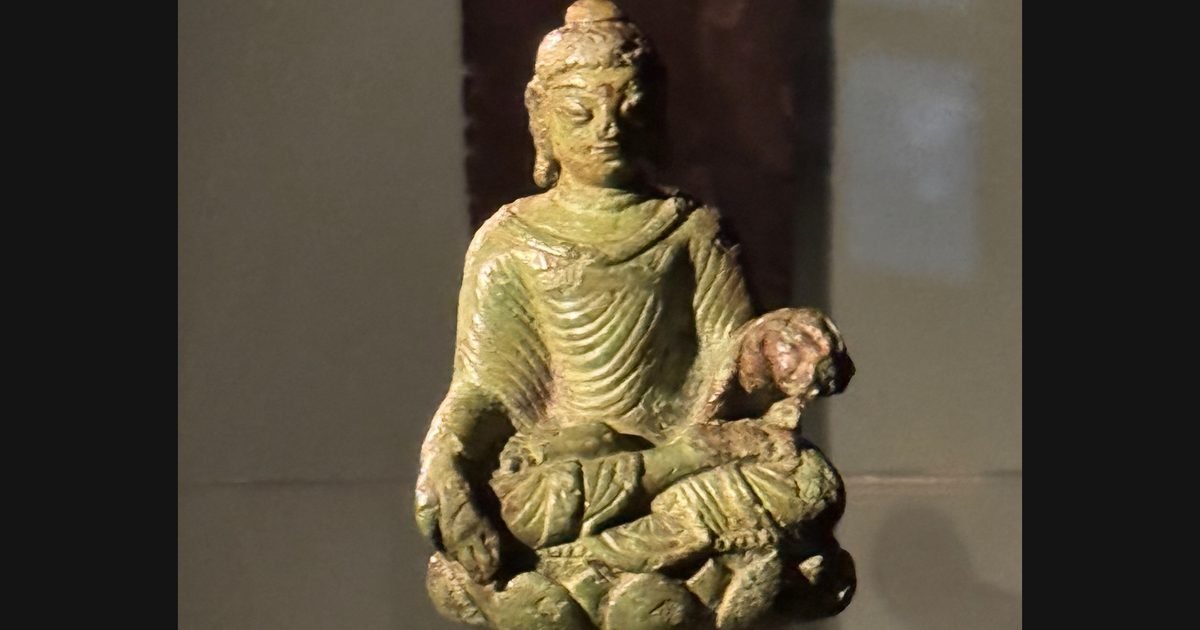
A Buddha from Pakistan on a Viking Island
A small bronze Buddha, made 1,500 years ago in the land of my ancestors, found on an island in Lake Mälaren.
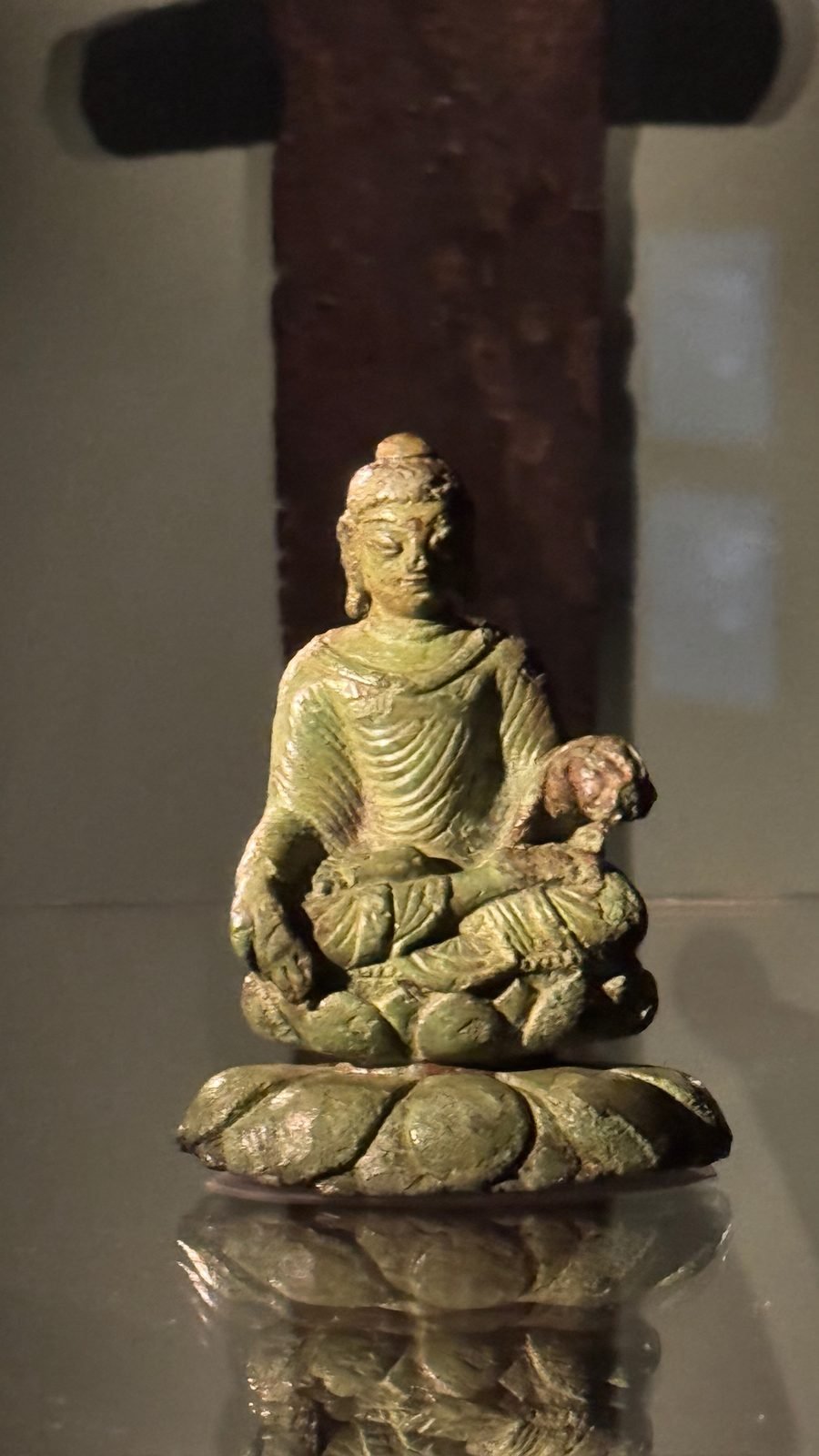
In the dark rooms of Vikingarnas värld at Historiska museet, between swords and rune stones, sits a small Buddha. He is calm, with crossed legs, on a lotus throne. He was made in the Swat Valley, in the land of my ancestors. I have relatives who live in northern Pakistan today.
So how did he end up in Sweden? Out of curiosity? Or did Buddhists come to Sweden over 1,000 years ago?
What the Buddha looks like
The figure is bronze and only about 8.4 cm tall. The Buddha sits on a throne shaped like a double lotus flower. A third eye is shown on his forehead. Swedish Wikipedia adds that the mark on the forehead is gold. The forehead, eyebrows and mouth have dark metal, probably silver or niello.
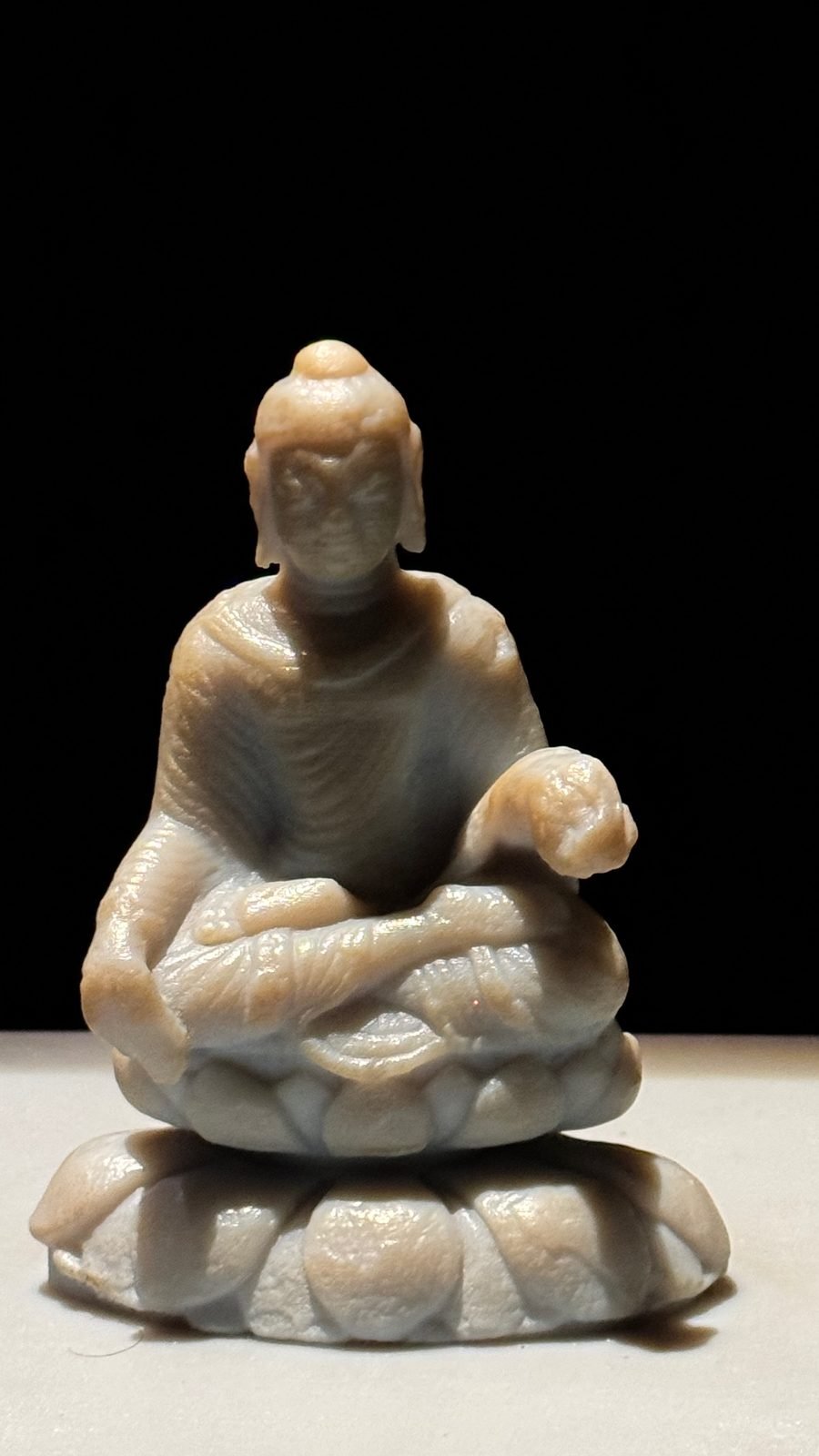
The museum shows two figures. One is a white 3D copy that visitors can touch, with a braille label. That is a good idea for visitors who cannot see the original well, or cannot see it at all.
Made in the Swat Valley
The museum says the Buddha was made in the late 400s or early 500s, most likely in the Swat Valley, on the border of present-day Afghanistan and Pakistan.
Today the Swat Valley is in the north of Pakistan. The figure is older than the Viking Age by several hundred years.
A personal connection
I believe that my ancestors were Buddhists 2,000 years ago. Northern Pakistan, India and Afghanistan were main sites of Buddhism and Jainism. I think Buddhism was as strong in that region then as Islam is there today.
My ancestors probably converted to Islam about 1,000 years ago. Still, I feel some kind of connection with Buddhism.
Buddhism and Jainism in the land of my ancestors
I visited Taxila as a teenager in 1990. Taxila is an ancient city near Islamabad, and it shows how two religions lived side by side.
About 2,000 years ago, Buddhism and Jainism existed at the same time in the region of today’s Pakistan. They shared the same cities, the same trade routes and the support of the same rulers. Buddhism was much larger.
Buddhism. Taxila and the wider Gandhara region were major centers of Buddhist learning and art. In the 3rd century BCE, Emperor Ashoka built the Dharmarajika Stupa in Taxila, over relics of the Buddha. About 2,000 years ago, under Indo-Greek, Scythian and early Kushan rulers, Buddhist monasteries and stupas were common across Taxila, the Peshawar basin and the Swat Valley, where the Helgö Buddha was most likely made.
Jainism. At Sirkap, one of the ancient cities of Taxila, archaeologists found the ruins of a Jain temple and a Jain stupa, about 2,000 years old, next to Buddhist and Hindu buildings. Sir John Marshall, who led the excavations, believed Taxila had a large number of Jain buildings. In January 2026, archaeologists at Bhir Mound, the oldest city of Taxila, reported a 2,300-year-old terracotta figure of a dancing woman, which may be linked to early Jain presence. Jain tradition also links Taxila to Bahubali, a son of the first Jain teacher.
Buddhism stayed the main religion of the region for several centuries. Jain communities lived on along the trade routes in Punjab and Sindh.
Helgö, the trading island
The Buddha was found on Helgö, an island in Lake Mälaren, in Ekerö municipality near Stockholm. A trading town grew there from about the year 200, about 500 years before Birka.
The museum dates the find to 1956. Other sources say 1954. Archaeologists found the Buddha in the remains of a house.
The Buddha was not alone. Helgö also gave an Irish crozier, the head of a bishop’s staff from around 700–800, and a ladle from the eastern Mediterranean. Together they are called the Helgö relics. A Christian staff, a Buddha and a ladle from the other side of Europe, all on one small island in Mälaren.
How did it end up in Sweden?
The honest answer is that nobody knows. The museum writes that it is uncertain how the figure reached Scandinavia.
There are theories. The Swedish researcher Gyllensvärd suggested that a craftsman who worked with metal casting owned it. He may have been interested in how it was made, not in what it meant. Remains of leather straps were found on the figure. Gyllensvärd thought the owner may have hung it around his neck, or on a nail.
Helgö was a place for metalworkers and traders. Objects traveled along trade routes over many hands: as goods, gifts or loot. The Buddha may have passed through many owners before it reached Mälaren.
Were there Buddhists in Sweden 1,000 years ago?
I asked myself this question. The sources I read show no evidence of Buddhists in Sweden at that time. The figure arrived. We do not know if anyone who knew its meaning came with it.
That does not prove that no one did. It only means we have no evidence. What we have is a small Buddha who traveled from the mountains of northern Pakistan to a Swedish lake. Maybe it was valued for the metal, maybe for its beauty, maybe as something strange and foreign.
See it yourself
The Buddha is in Vikingarnas värld, display 07, on the ground floor of Historiska museet in Stockholm. Read more in my article on Historiska museet, and in my post on the gold collars in Guldrummet.
Who do you think carried him all the way to Mälaren?
Sources
- Historiska museet: See real Viking objects
- Historiska museet: Norse religion in the Viking Age
- Historiska museet collection database: Helgöbuddhan
- Swedish Wikipedia: Helgö-buddhan
- English Wikipedia: Helgö
- Brent Nongbri: The Helgö Buddha (2023), quoting Gyllensvärd
- Wikipedia: Dharmarajika Stupa
- Wikipedia: Sirkap
- Wikipedia: Jainism in Punjab
- Arkeonews: 2300-year-old dancing terracotta figurine, 19 January 2026
- National Geographic: Taxila
- The 3D copy label at Historiska museet, November 2026.