
Ulriksdal Palace
A 1640s palace by the water, north of Stockholm. Each royal owner changed the rooms to fit their time, and Queen Kristina’s coronation started here.
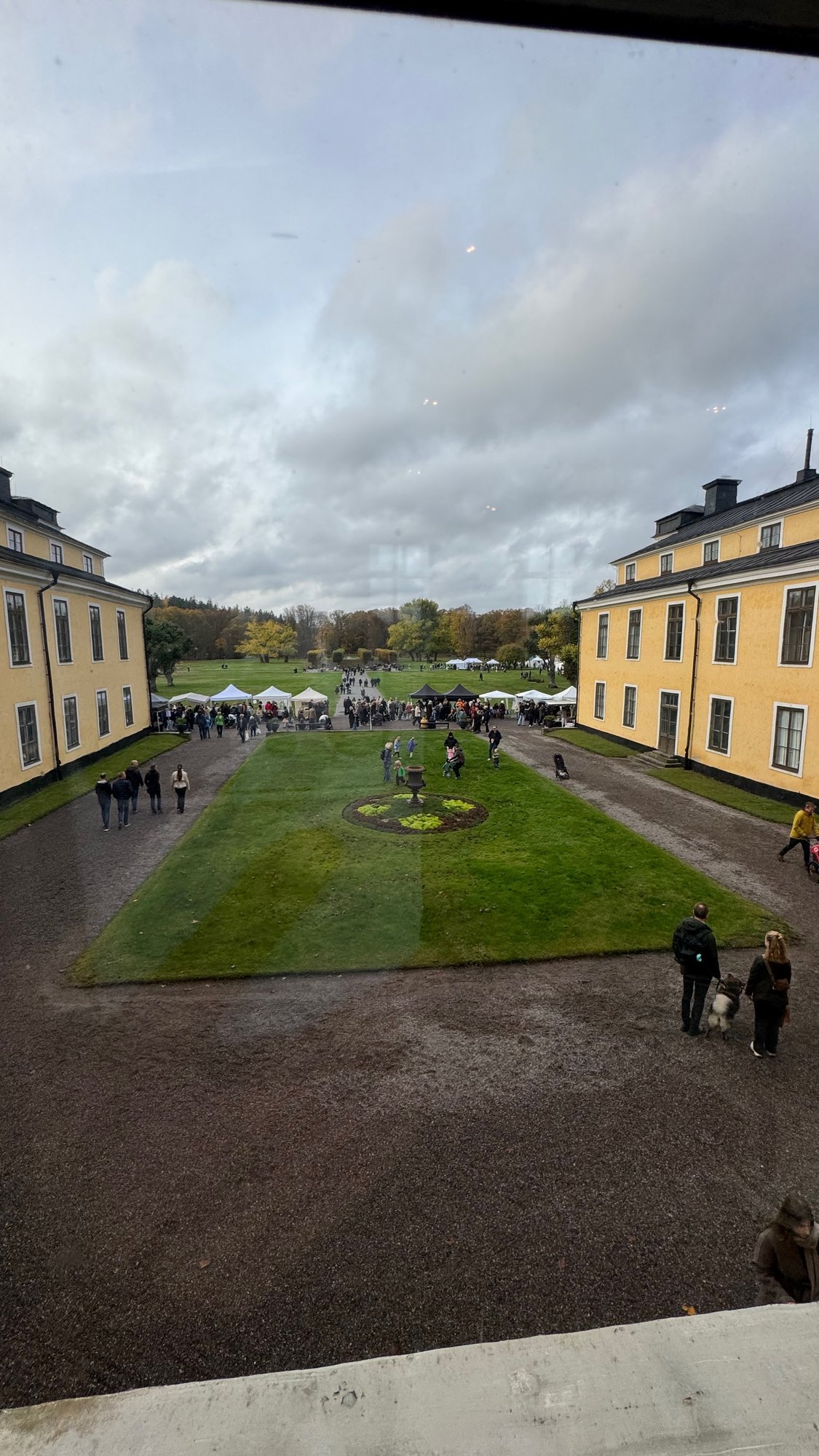
- Why visitRoyal rooms from four centuries, Queen Kristina’s coronation coach from 1650, and Carl Malmsten’s 1920s living room.
- Best forPeople who like history and design, and a day out in the Royal National City Park.
- AddressSlottsallén, Ulriksdal, Solna
- Opening hoursOpen in season only. In 2026, the last open days were 24 and 25 October, 11:00–15:00, during the autumn market. Check the dates for 2027 before you go.
- AdmissionAdults 140 SEK, students 120 SEK, children 7–17 years 70 SEK (2026).
- Guided toursAbout 45 minutes, for individual visitors. Groups must book in advance. A sign at the stable says you can see the coronation coach together with a pre-booked tour of the palace or the Orangery.
- Getting thereTake the metro to Bergshamra or the commuter train to Ulriksdal station, then the bus. From the bus, you walk 500–1,500 meters. By car, take the E4, exit 169 toward Norrtälje.
- ParkingPaid parking along Slottsallén, by card or app.
- AccessibilitySee the accessibility section below.
- Official websiteUlriksdal Palace on kungligaslotten.se
A palace by Edsviken
I live in Stockholm, and Ulriksdal is a short trip north of the city. I visited on 24 October 2026, on my own. It was one of the last two open days of the year.
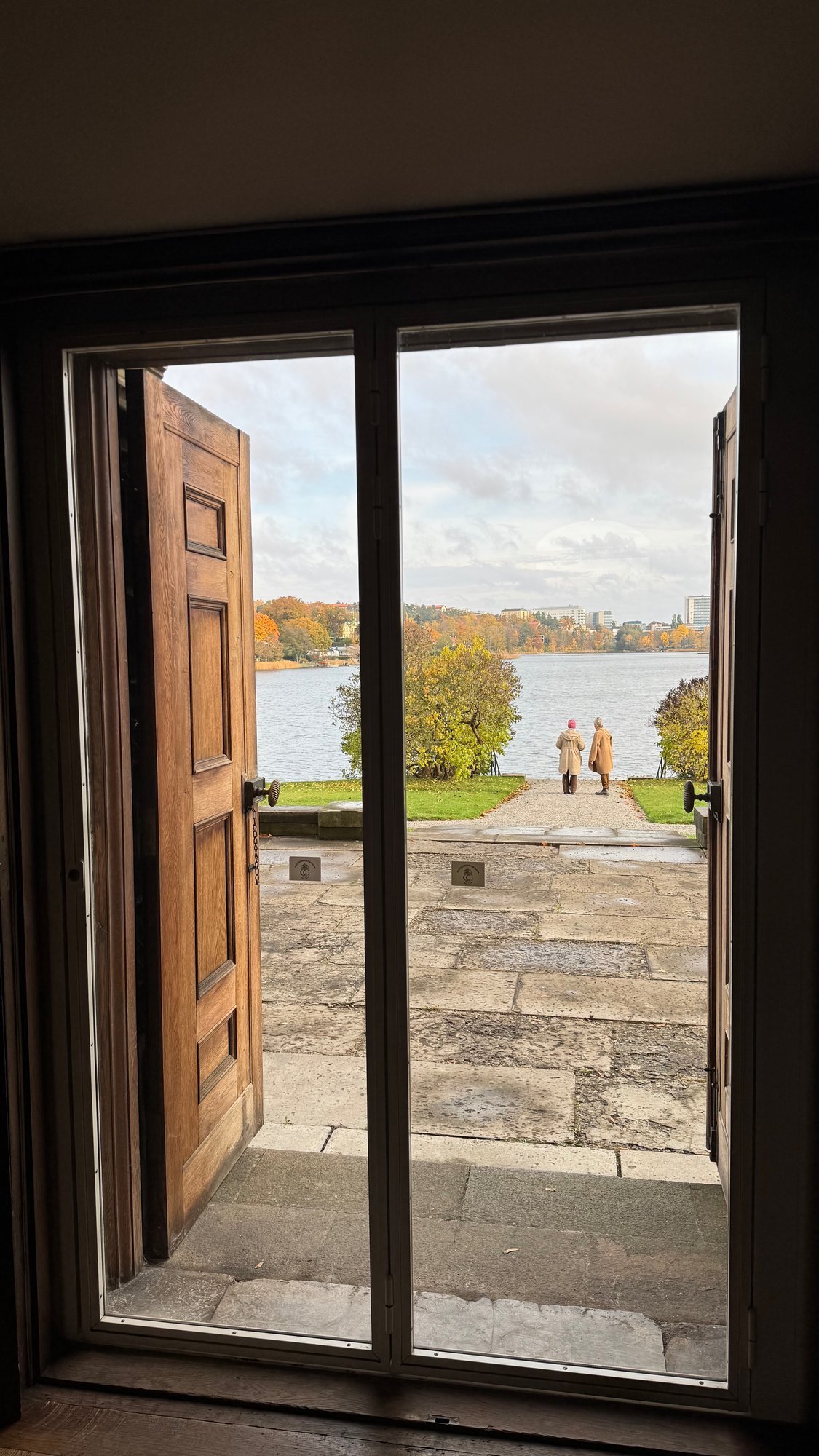
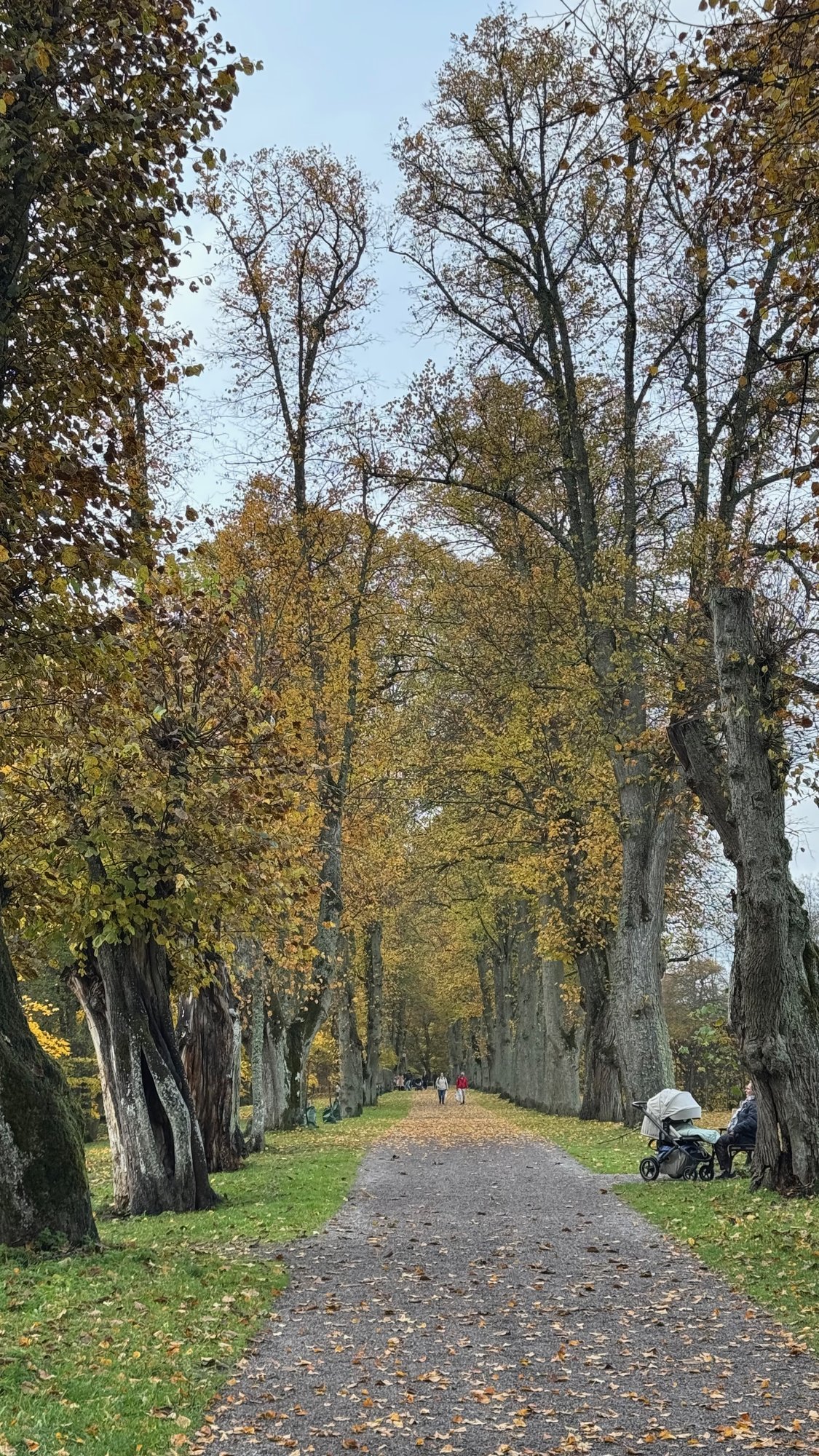
Ulriksdal Palace sits by the bay of Edsviken in Solna, inside the Royal National City Park. From the palace door, a path goes straight down to the water.
Count Jacob De la Gardie had the palace built in the 1640s. He named it Jacobsdal, after himself. A timeline in the palace says he built it together with his wife, Ebba Brahe. The signs do not agree on when it was finished. One says 1644. Two others say 1645.
In 1669, Dowager Queen Hedvig Eleonora bought the palace. In 1684, she gave it to her newborn grandson, Prince Ulrik, as a baptism gift. The palace got his name. The prince died the next year. The name stayed.
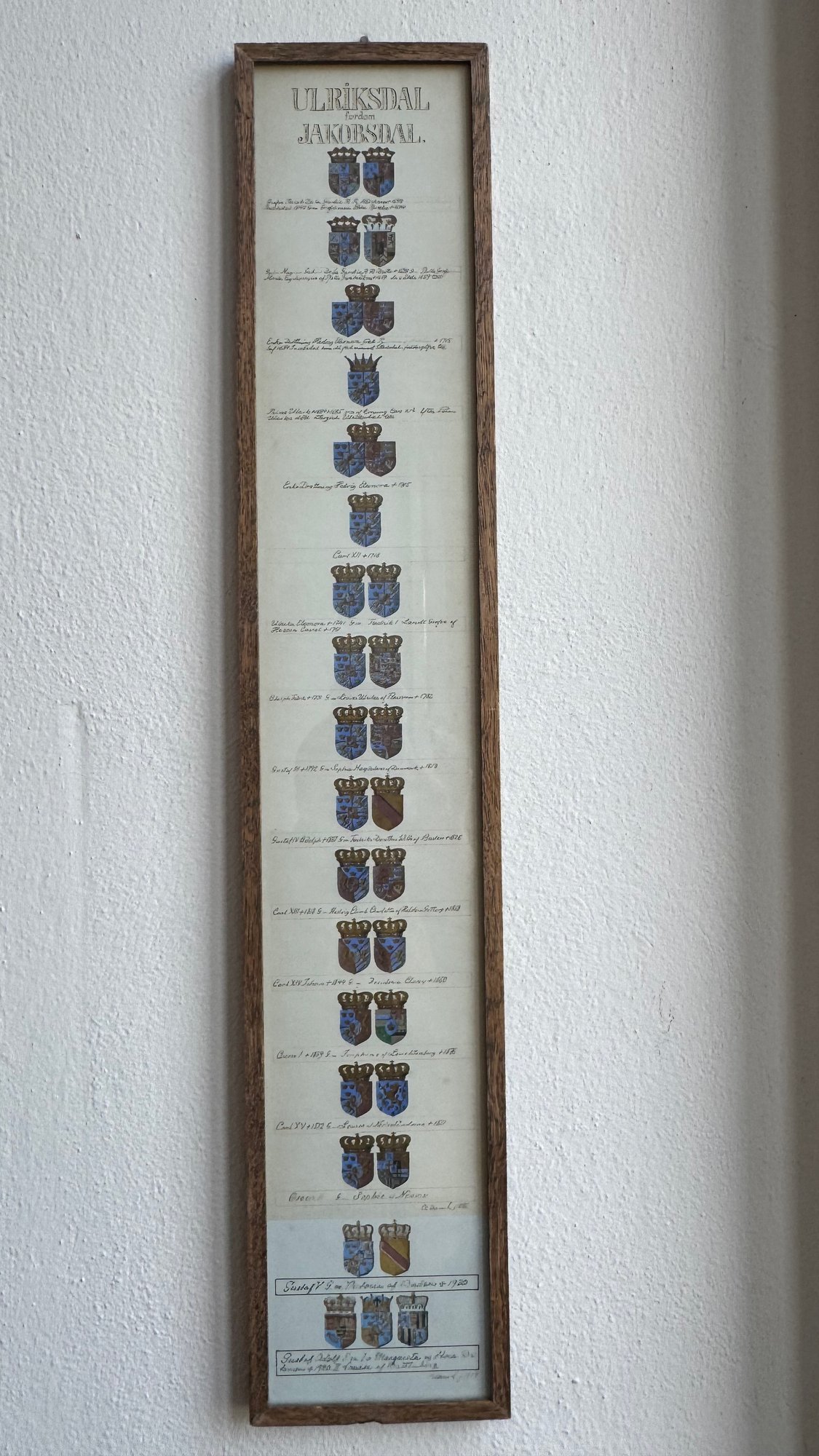
A tall framed board in the palace lists the royals who lived here, with their coats of arms. It starts with the De la Gardie family and ends with Gustaf VI Adolf. Almost every one of them changed something. In one afternoon, you walk through four centuries of royal taste. The south wing is not part of the walk. The WWF (World Wide Fund for Nature) has its offices there.
Karl XV’s rooms in historical styles
In 1856, Crown Prince Karl, later Karl XV, got the use of Ulriksdal. He collected old furniture and applied art. With the architect Fredrik Wilhelm Scholander, he decorated the rooms in different historical styles.
The style followed the use of the room. The printed room guide says Baroque was right for rooms used by men. Women should have rooms in the Rococo style. So even the walls had a gender.
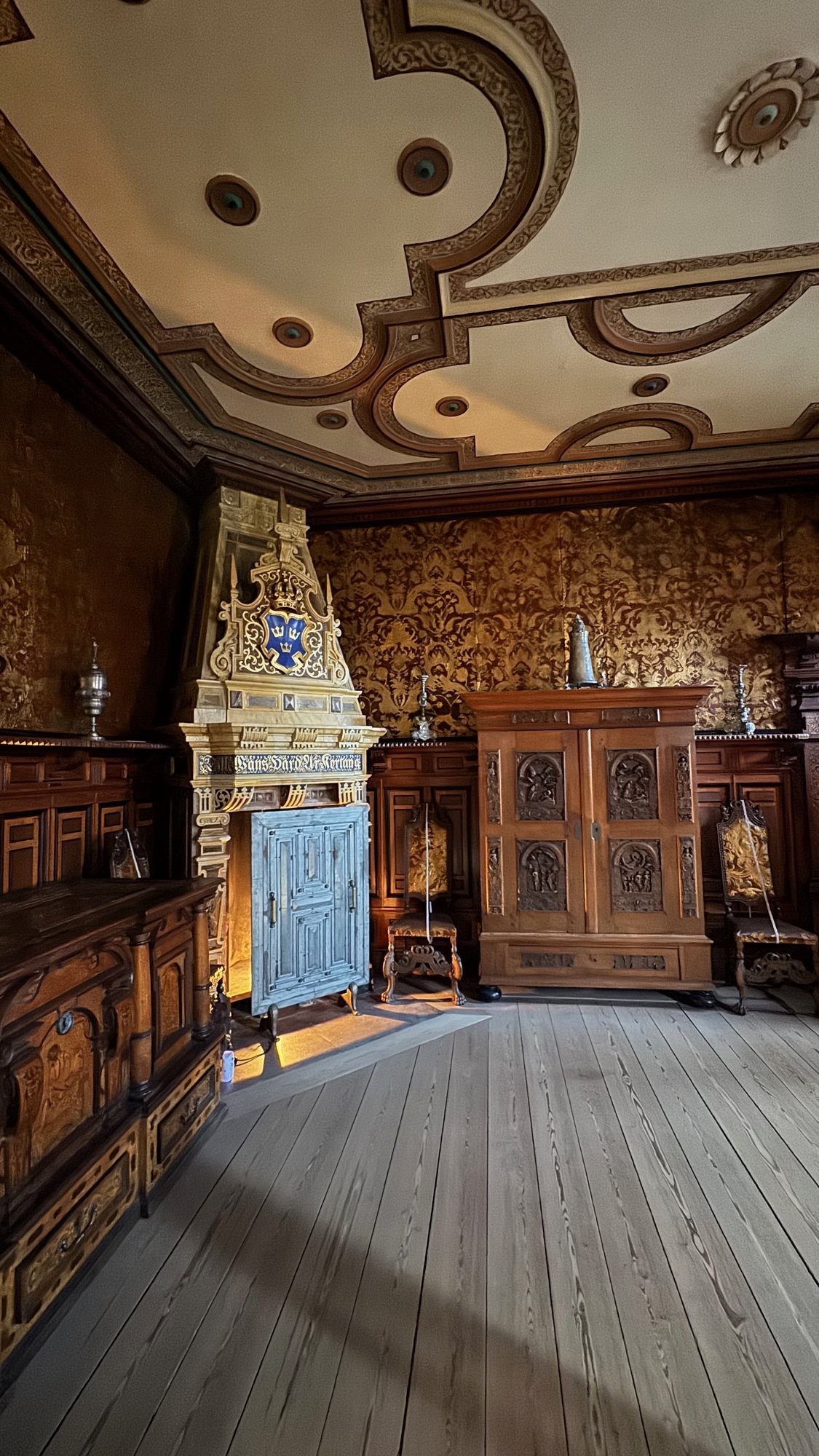
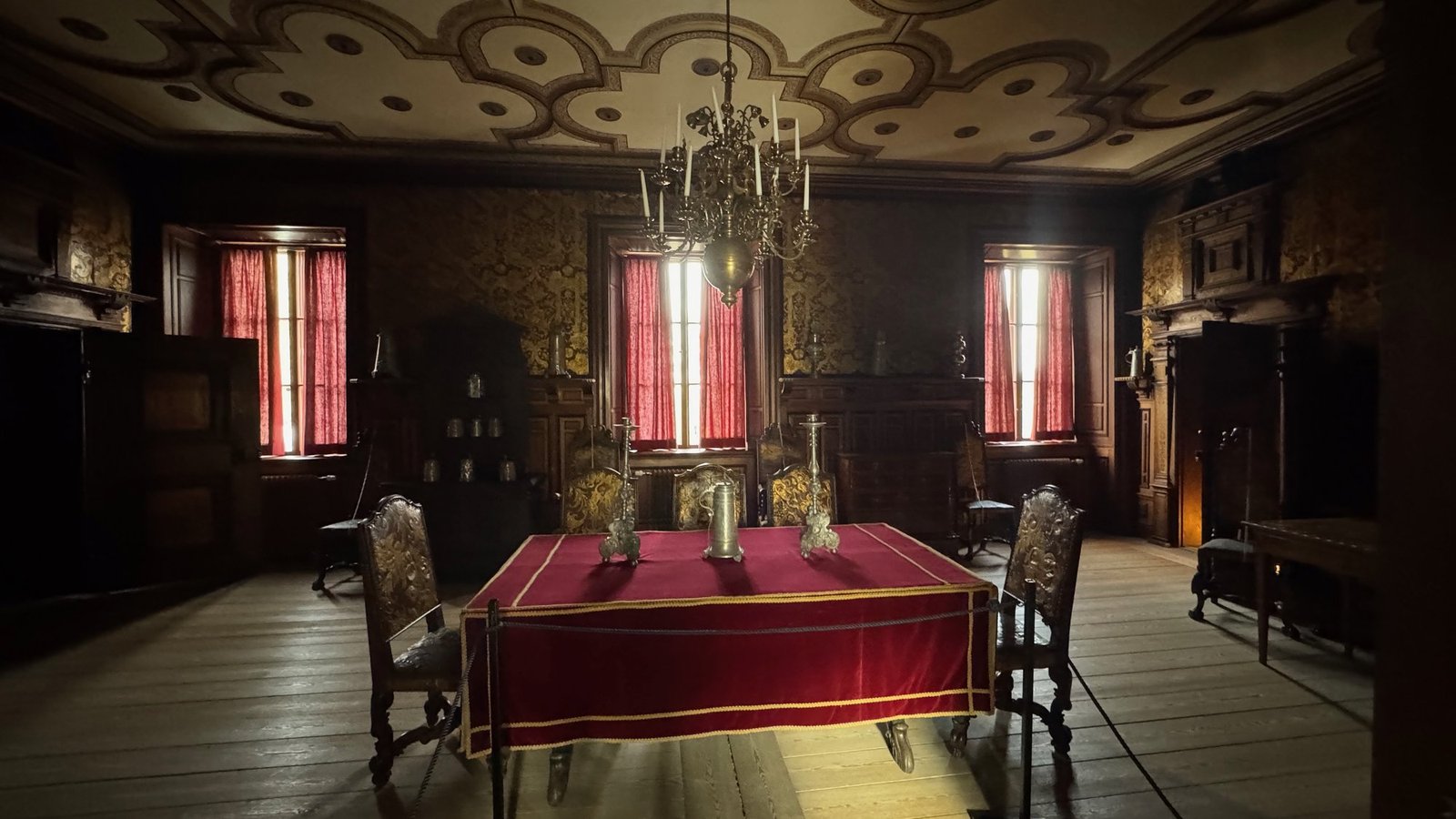
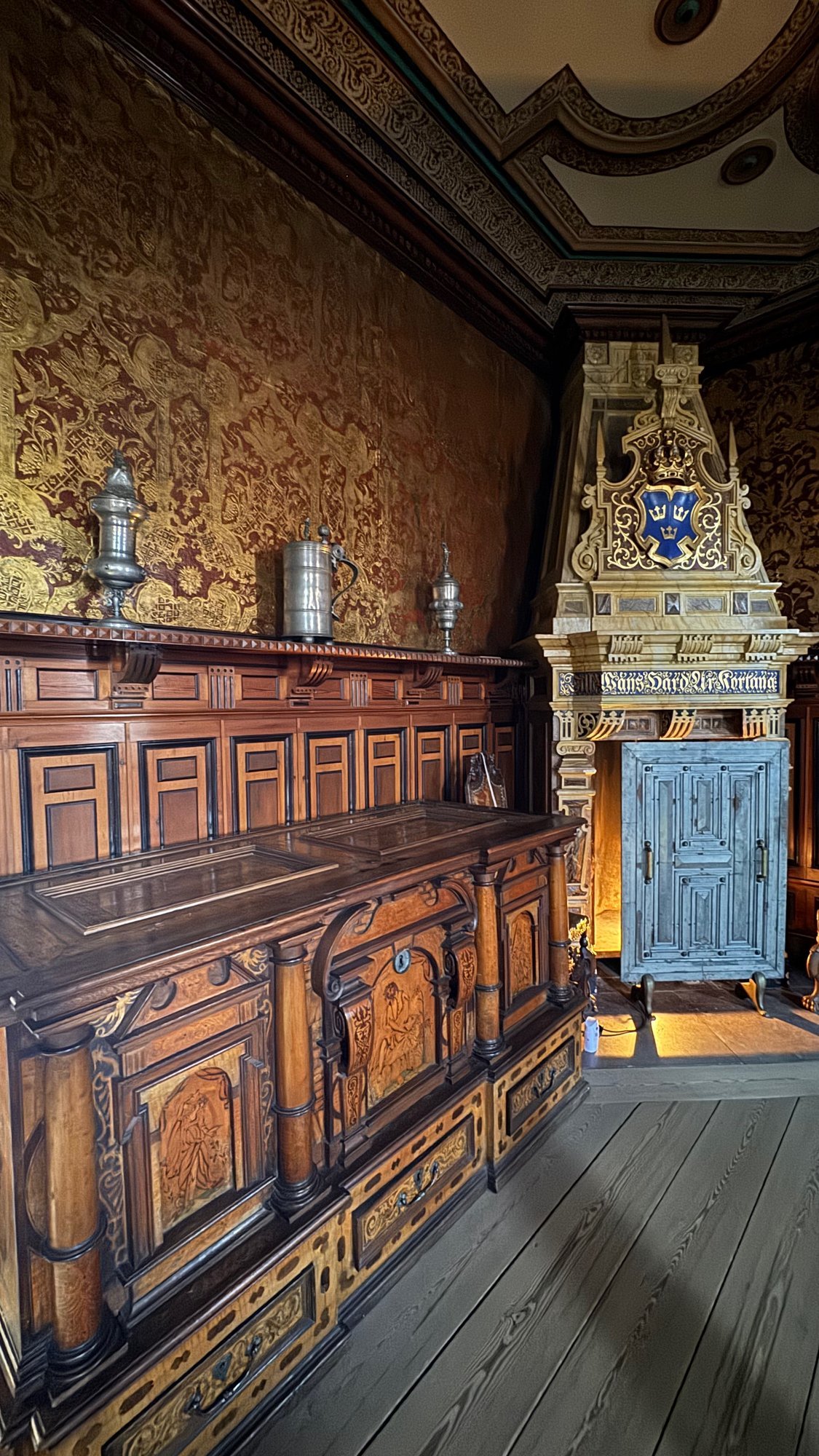
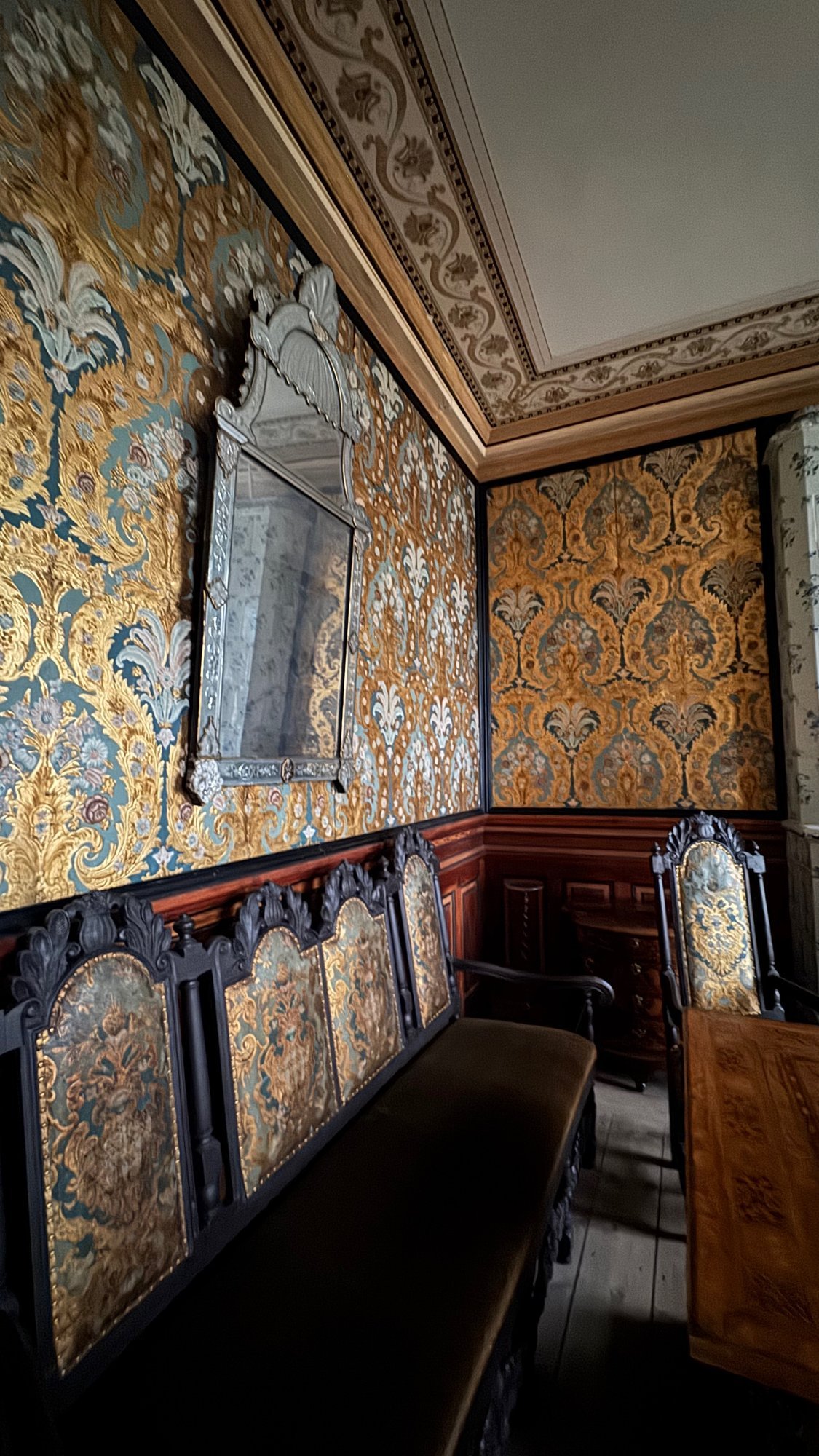
The Oxenstierna Hall was made to look like the late Renaissance. It is also called the Tidö Room, after its doors from the 1630s. They came from Tidö Castle, and Scholander used them as his starting point. Karl XV’s pewter from the 1600s and 1700s stands on the paneling, under walls of gilt leather. A leather hanging on the east wall shows the Disa legend, an old tale about the origin of Sweden.
In the Royal Palaces’ podcast Slott & Krona, the palace educators Caroline Edman and Jonas Rosin add a few details about this room. The two large fireplaces look like marble, but they are made of plaster. You could light a small fire in them, but never a big log fire.
Gilt leather is pressed and painted leather. It is often covered with silver or tin, not gold, and then varnished to a golden color. In a room lit only by candles, the gilt leather reflected the light and made the room brighter.
The beds in the two side rooms are “said to” have belonged to Axel Oxenstierna and Carl Gustaf Wrangel. The palace educators say plainly that this cannot be trusted. It was, however, convenient for Karl XV’s guests: after a long party, they only had a few steps to their beds.
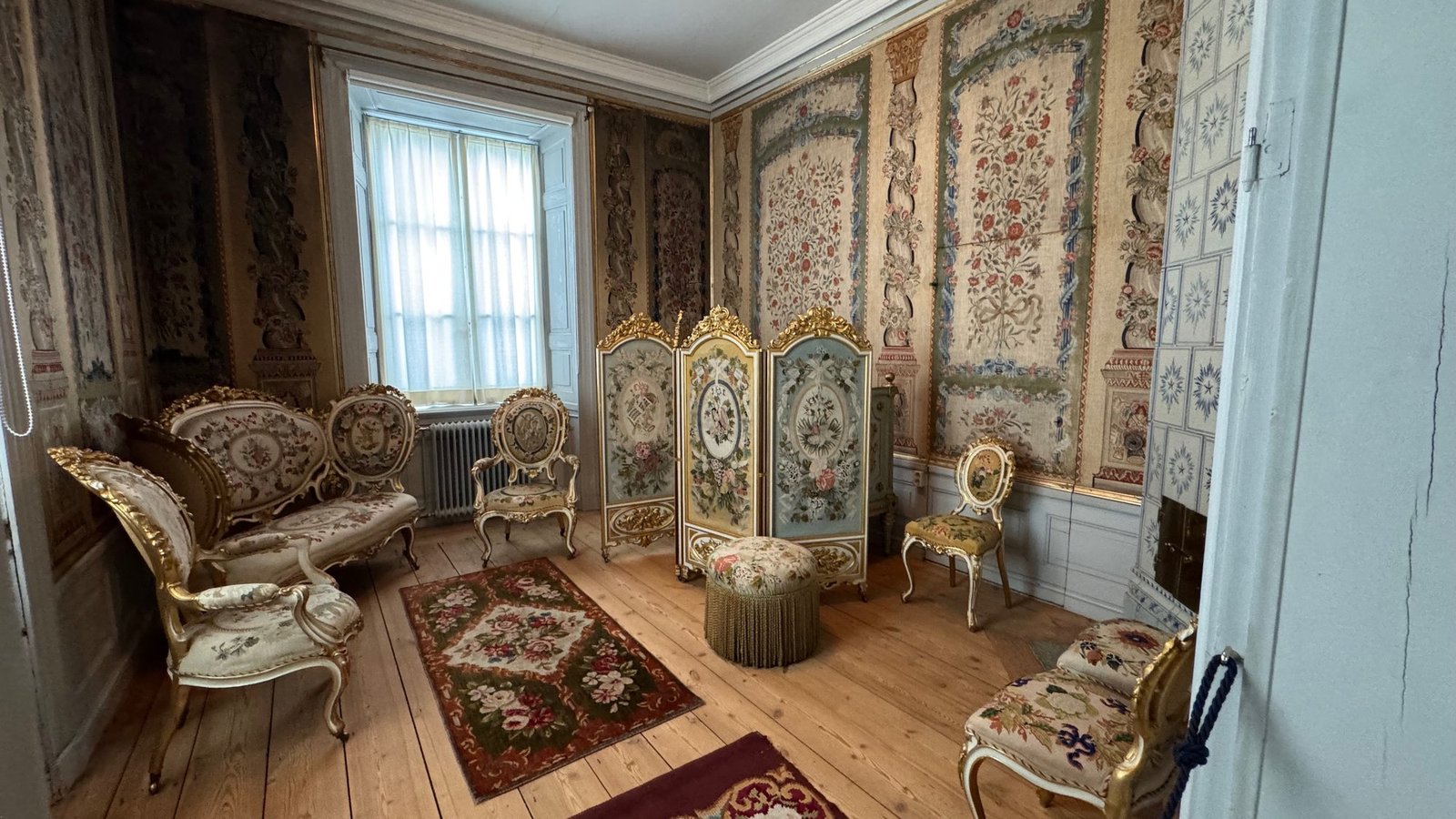
Next door, Princess Sofia Albertina’s rooms show the Rococo side. Gustav III’s sister Sofia Albertina and her ladies-in-waiting embroidered the silver wall panels. Karl XV moved them here.
Queen Lovisa liked a quiet life more than her husband’s parties, the palace educators say. Here she sat with her ladies-in-waiting. They did needlework, read aloud and, according to several diaries, liked to gossip. Her favorite cake was the Napoleon pastry. She also loved sleigh rides, and Stockholmers joked that in any weather you could see the queen’s sleigh on its way to Ulriksdal.
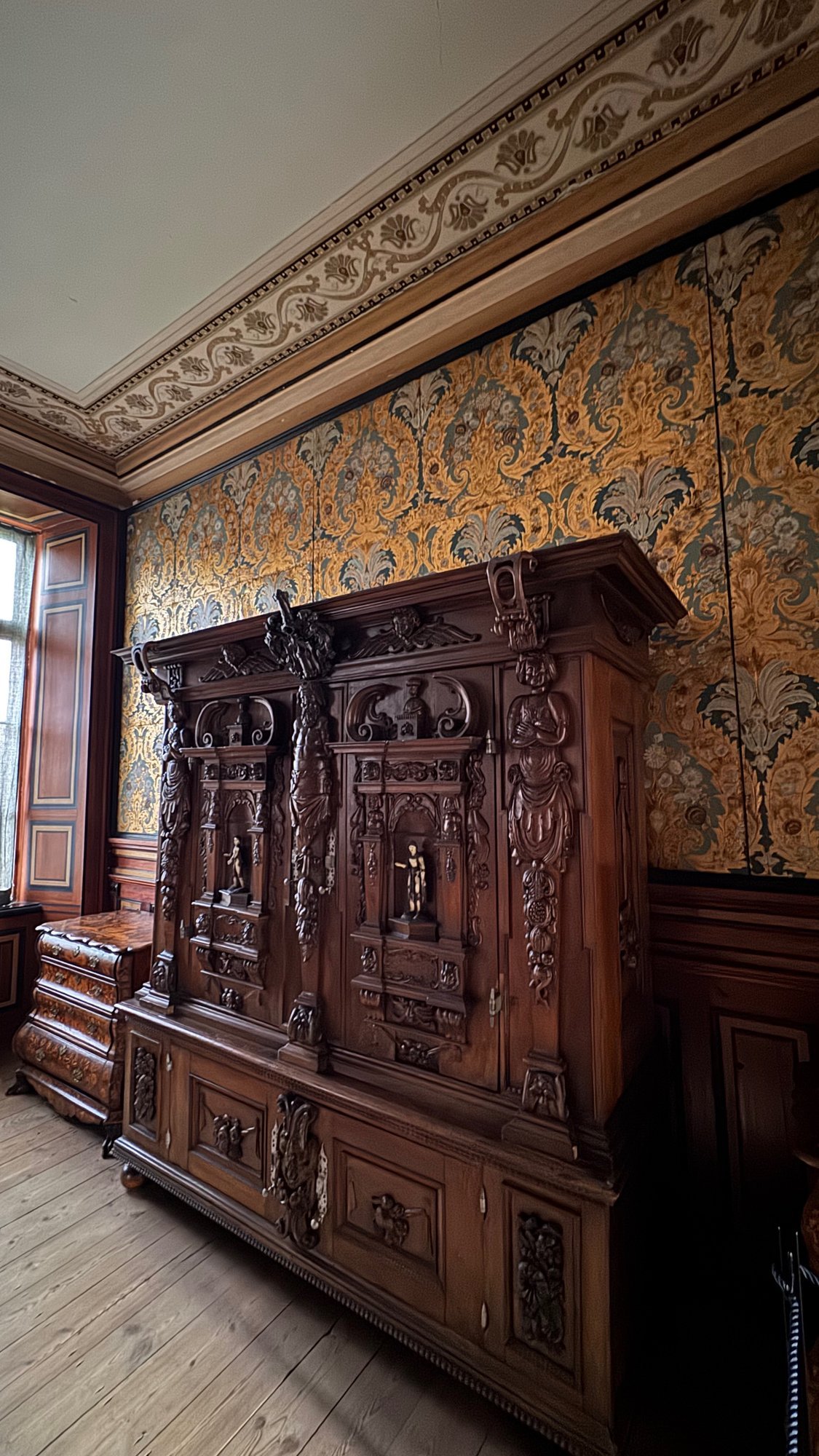
In Prince Oskar’s guest rooms, the gilt leather in the bedchamber is the oldest in the palace. Karl XV repainted parts of the gilt leather himself. A carved German cabinet from the 1600s stands against the wall. The Swedish sign says its doors carry small ivory figures of beggars. Maybe they reminded the owner of the misery of the world, the sign suggests. The English sign leaves the beggars out.
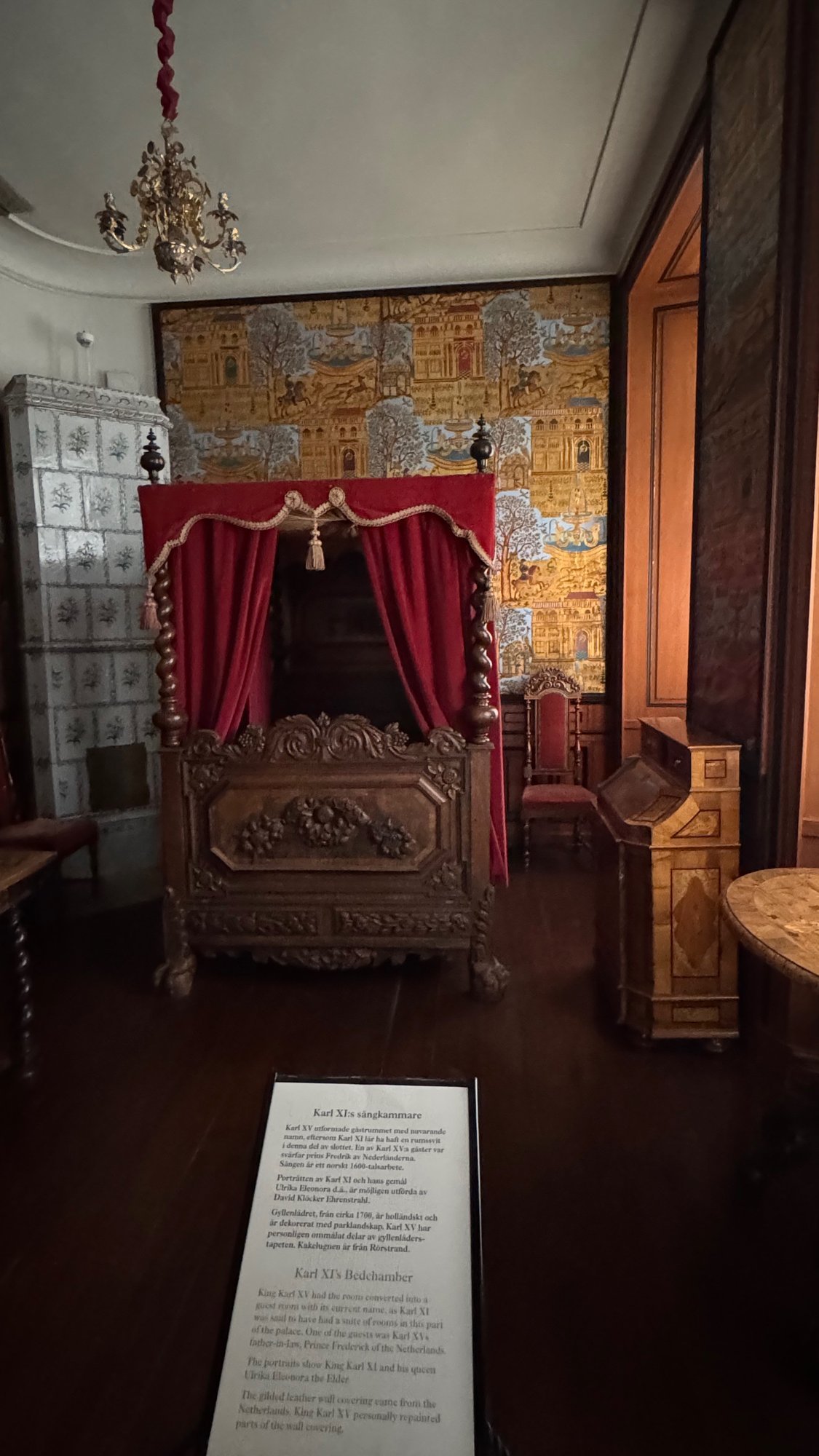
Karl XI’s Bedchamber was a guest room for Karl XV’s father-in-law, Prince Frederick of the Netherlands. Tradition says the bed was Karl XI’s. In fact, it is Norwegian work from the 1600s. The Dutch gilt leather from around 1700 shows park scenes. Karl XV repainted parts of this one, too.
Karl XV’s Bedchamber is a reconstruction of the room he had in the south wing. The printed room guide says the portrait of Karl XII hung where the king would see it first thing in the morning. The bed carries the arms of the Imhof family of Nuremberg. Gustav II Adolf did visit the family, but the palace educators say he probably did not sleep in this bed. Two putti and doves in the carving suggest it was made as a wedding bed. The washstand “of Karl XII” is from the right period, but there is no proof it was his.
Karl XV loved a good story about his objects. In the General’s Room stands an oak table with “Gustaff” carved into the top. In the 1800s, people said Gustav Vasa carved his name there in 1527, when he signed the papers that started the Reformation. The palace educators point out that the table is from the 1600s, so he is not likely to have sat at it. Nobody knows who carved the name.
Gustaf VI Adolf’s 1920s home
The last big change came around 1920. The palace became a summer home for Crown Prince Gustaf (VI) Adolf. From 1923 until his death in 1973, he and his family stayed here every spring and early summer.
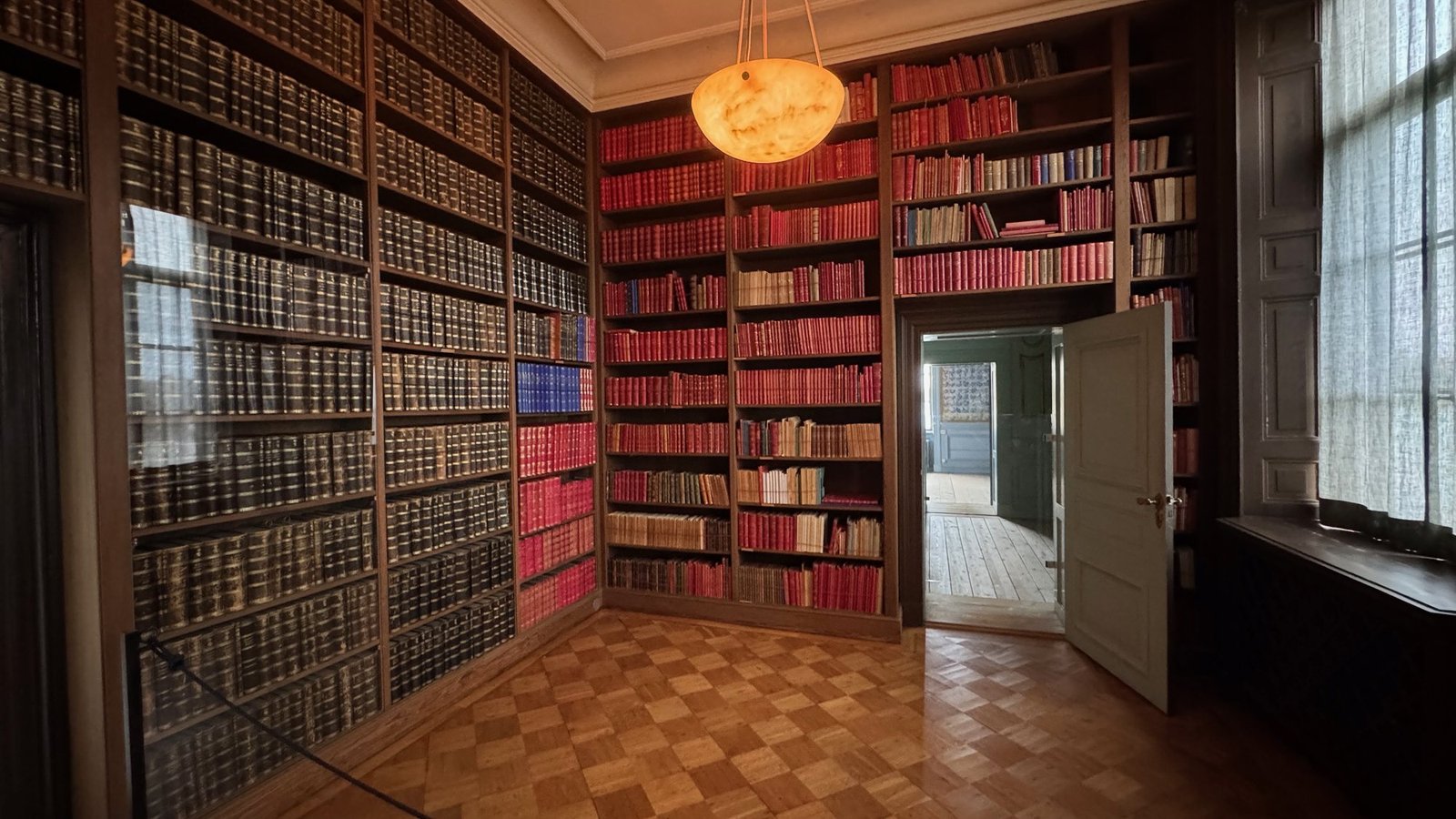
The architect Torben Grut furnished his library in 1925–1927. The books show 20th-century Swedish bookbinding. The king was an archaeologist, and scholars from all over the world sent him their papers. Gardening was another of his interests. The sign says his gardening books show traces of repeated reading.
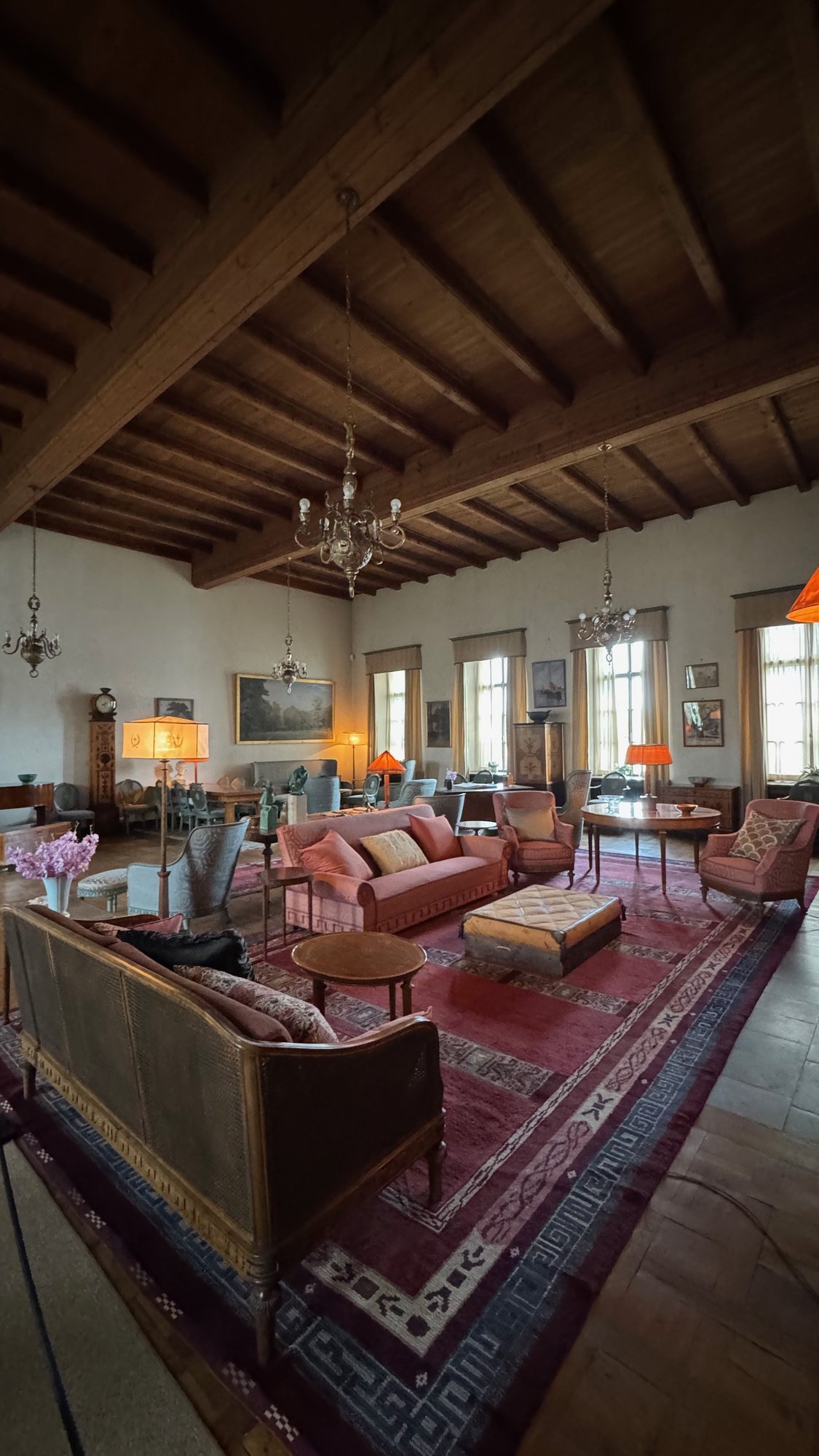
Karl XV’s Knights’ Hall became the Grand Living Room. In 1923, the people of Stockholm paid for its furniture as a wedding gift. It went to the crown prince and his second wife, Louise Mountbatten. The young architect Carl Malmsten designed the furniture, and the crown prince took an active part.
Malmsten put the furniture in groups for different moods. Blue was for water and day, with bare wood he saw as masculine. Red was for fire and night, with upholstered pieces he saw as feminine. Sixty years after Karl XV, the furniture still had a gender.
According to the palace educators, about 8,000 Stockholmers collected 50,000 kronor in 1923 for this wedding gift. Gustaf (VI) Adolf loved wicker furniture. On several of Carl Malmsten’s drawings, he wrote “rotting?” (“wicker?”) by hand, and the finished room has wicker chairs. Newspapers from 1973 still lie on the table. In summer, a bowl of polkagrisar, the King’s favorite candy, stands there too.
The room also holds work by Märta Måås-Fjätterström, Carl Milles and Prince Eugen. The bust of Crown Princess Louise is by Carl Eldh, from 1928. You can see more of his work at Carl Eldh’s studio museum. A few years before his death, Gustaf VI Adolf decided that the room must stay as it is.
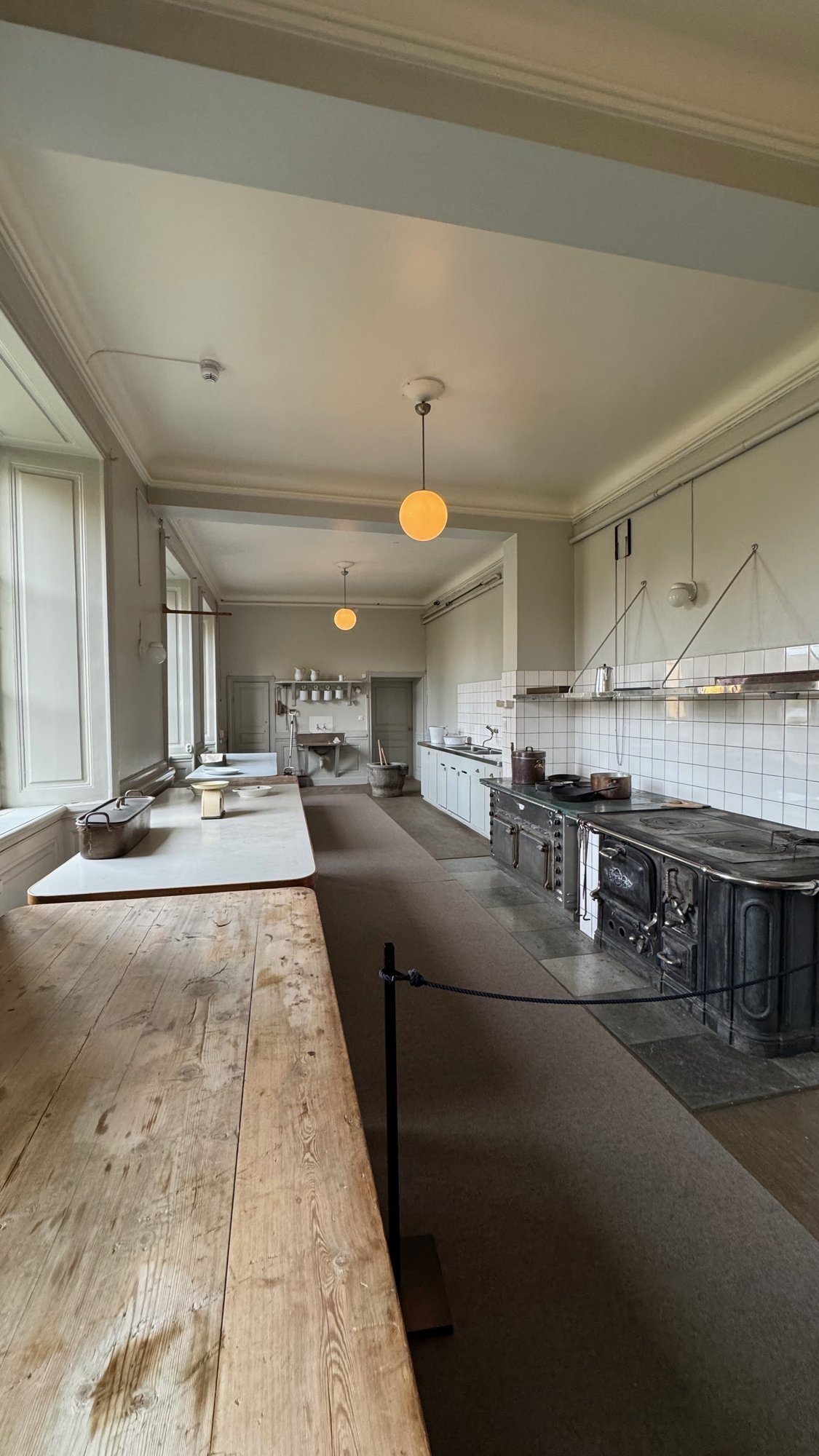
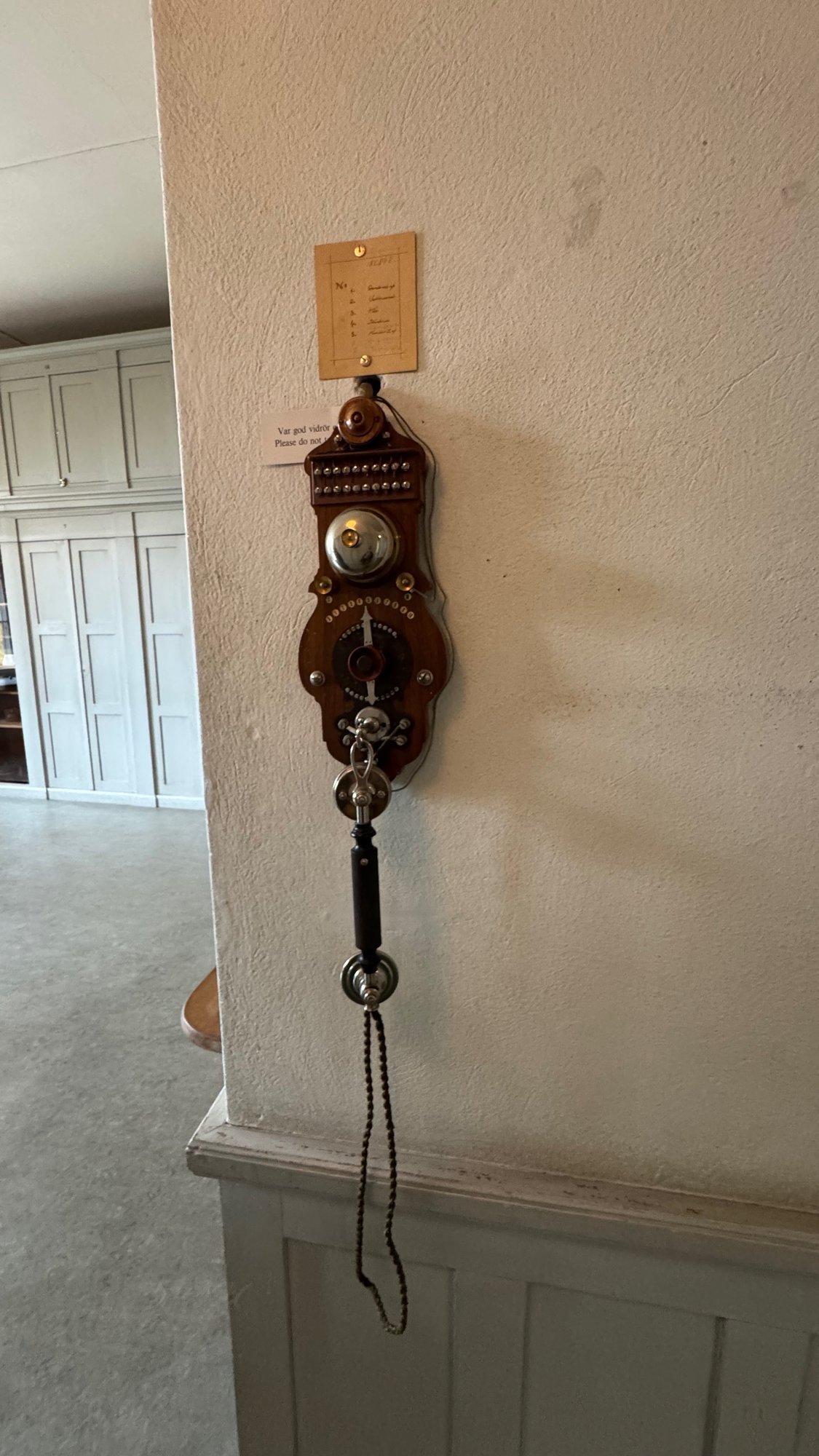
On the ground floor is the first kitchen inside the palace, from the 1920s. Before that, the kitchen was in a separate building because of the fire risk. The iron stoves were in use until after the Second World War. The palace educators say the kitchen had a dumbwaiter and an internal telephone. The kitchen staff could call the serving room upstairs when the food was ready, so it reached the table hot.
A head cook, the mamsell, was in charge of the kitchen and the menu. Two cooks, two “girls” who cleaned and cooked for the staff, a house hand and a kitchen hand helped her. Note the huge mortar, about half a meter tall. It was not for spices. The cooks used it to pound meat into mince.
Queen Kristina and the coronation coach
When Queen Kristina knew this palace, it was called Jacobsdal. Jacob De la Gardie, who built it, sat in the regency that ruled Sweden while Kristina was a child.
According to Slott & Krona, the regency wanted its members to build palaces in Stockholm. De la Gardie did build one in the city, Makalös. He did not want to live there, so he also built Jacobsdal for himself, on Edsviken bay.
Kristina was a frequent guest. At one masquerade here, she is said to have been a great success dressed as Diana, the goddess of hunting.
After Jacob De la Gardie died in 1652, the palace first became the widow’s home of his wife, Ebba Brahe. A few months later, she passed it to their eldest son, Magnus Gabriel De la Gardie. He sold it to Kristina. When she gave up the throne and left Sweden in 1654, the palace went back to him.
The procession that started here
On 17 October 1650, three days before her coronation, Kristina’s entry procession left Jacobsdal for the palace of Tre Kronor in Stockholm.
Until then, Swedish kings were usually crowned in Uppsala. They rode there on a white coronation horse and held the reins of the kingdom in their hands, as a symbol. Kristina rode in a coach instead, and she was crowned in Storkyrkan in Stockholm on 20 October 1650. The signs at the stable say she was the first Swedish ruler to ride in a coach to her coronation.
The procession was one of the grandest in Swedish history. About 700 people rode on horseback. The musicians wore blue with silver braid and played kettledrums and silver trumpets. The ladies-in-waiting rode in coaches, and mules and camels followed them.
People said the procession was so long that when the first riders reached Tre Kronor, the last ones had not yet left Ulriksdal. One sign in the stable names the starting point more exactly: the village of Överjärva, west of the palace. What is left of Tre Kronor is now Museum Tre Kronor.
The coach that survived
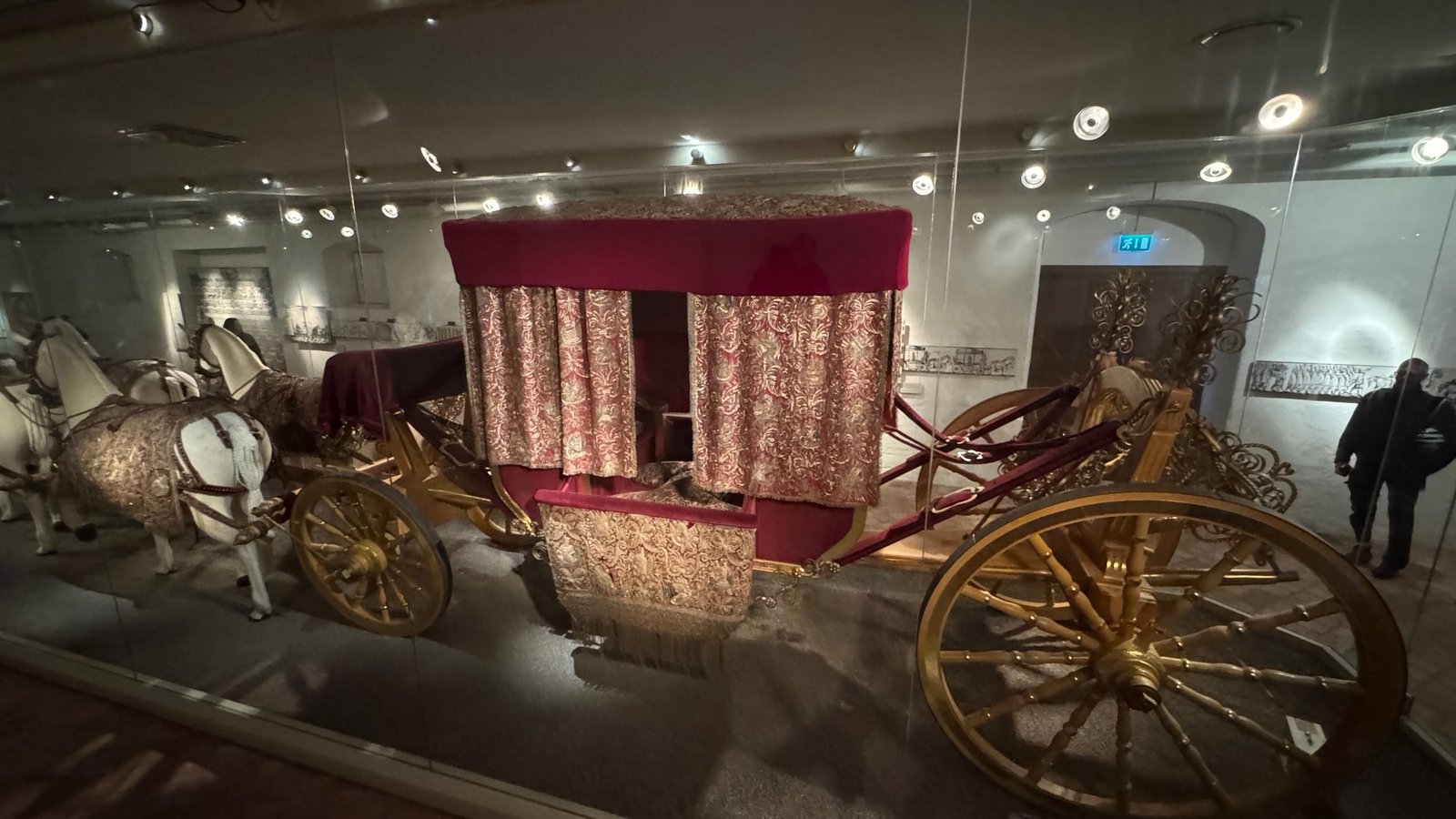
The coach was made in Paris. It was a gift to Kristina from Karl Gustav, the heir to the throne. It is called the “trophy coach” after the motifs in its embroidery, made in gold, silver and colored silk on crimson velvet and silk. It is an old, open type of coach, with curtains and a door made of cloth.
The body and the undercarriage of the coach were lost in the early 1700s. The original textiles are now mounted on a simplified reconstruction. The harness and the saddle cloths are also original, so the full coach and team can still be shown.
For more than 300 years, the textiles lay in storage at Livrustkammaren, the Royal Armoury. A reconstruction began in the 1980s. In 1989, the complete coach with six white horses was shown at the Royal Academy of Arts in London. It was the first time since the 1600s.
Since 1990, the coach has stood in the palace stable, which Carl Fredrik Adelcrantz designed in 1765. It still belongs to Livrustkammaren.
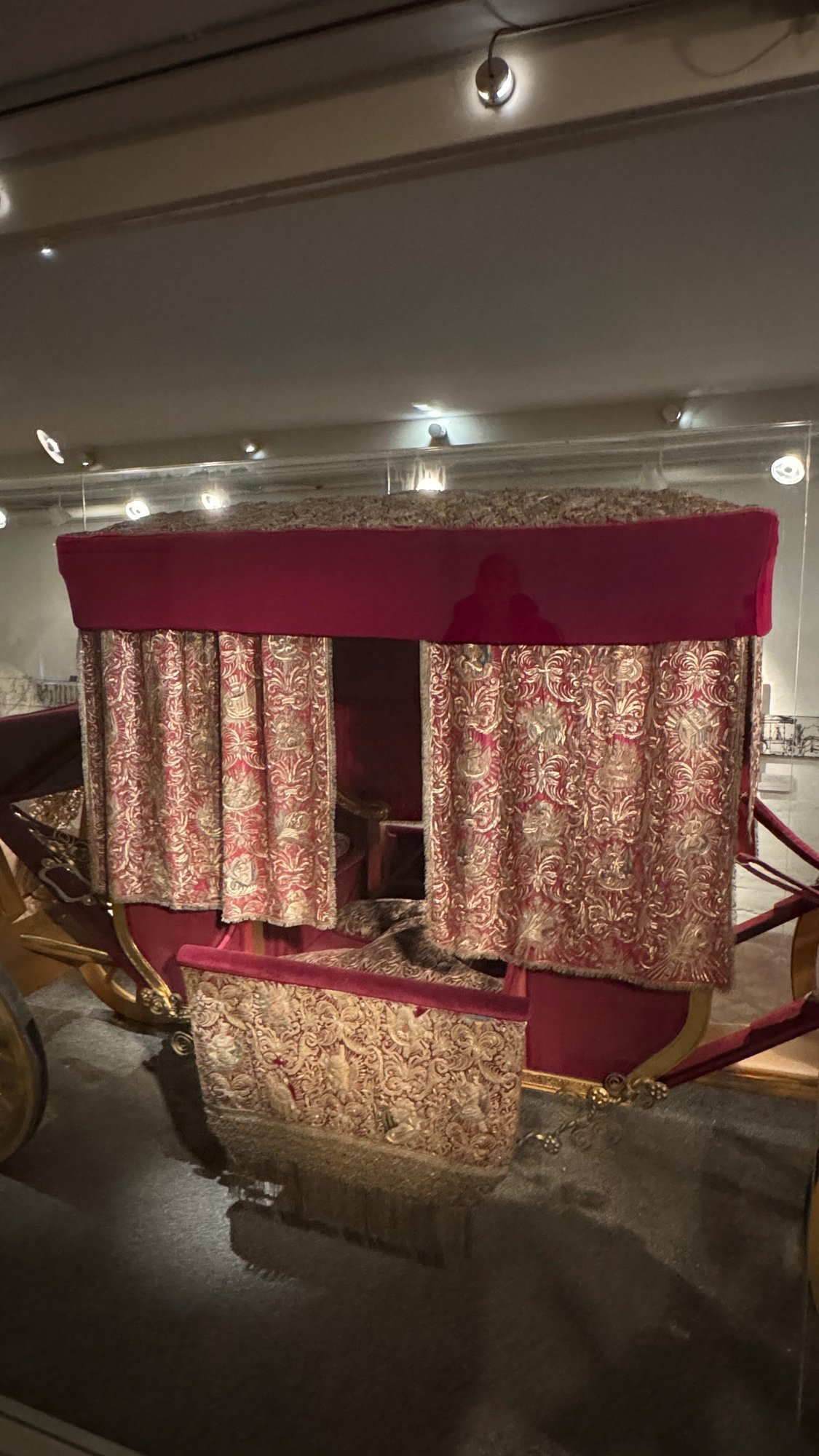
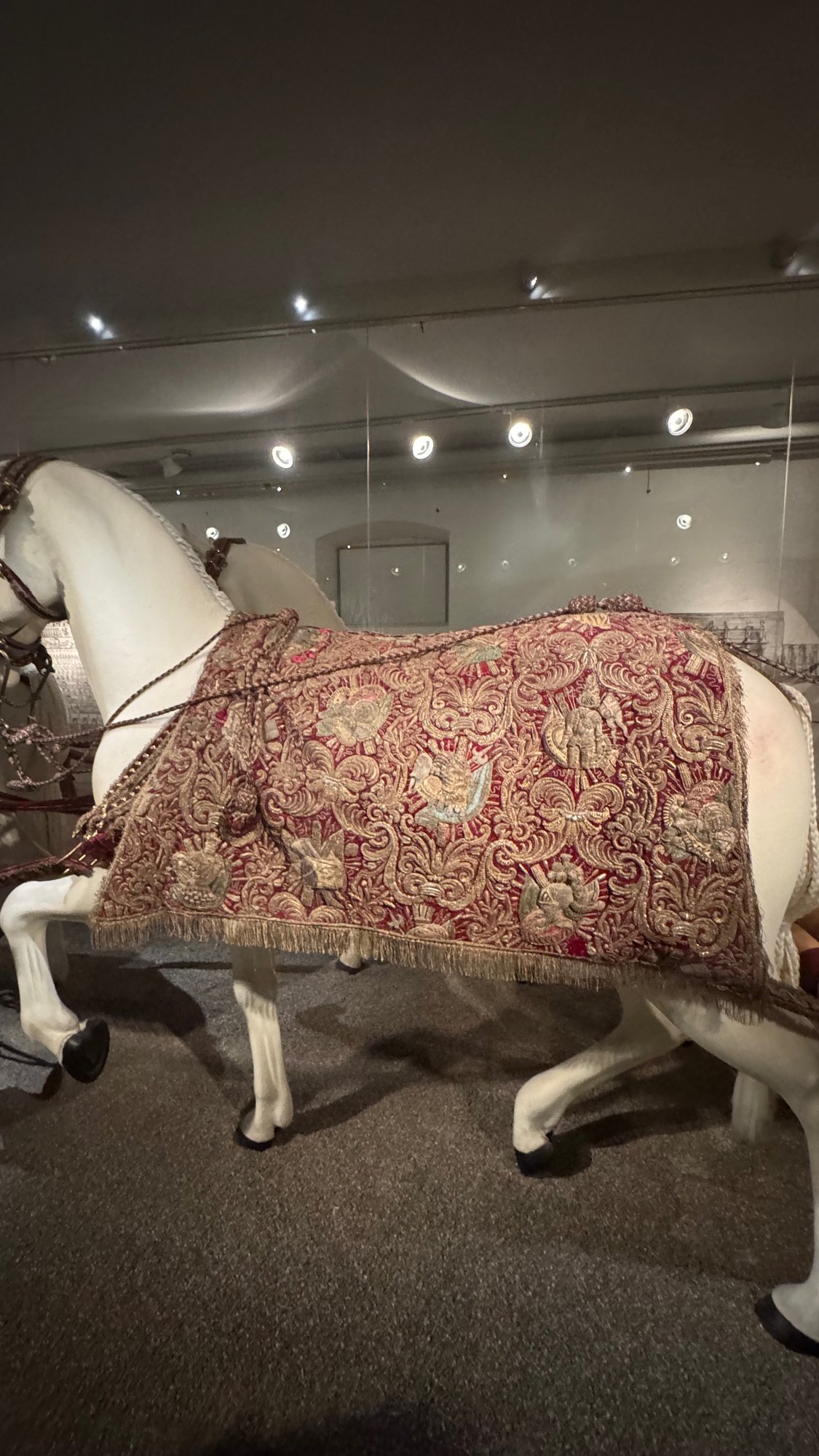
Kristina was a skilled rider. A sign in the stable says that even on a side-saddle, she handled her horse so well “that one could take her for a cavalier.” In 1648, Cardinal Mazarin gave her an Italian stallion “white as snow.” It was probably this horse that carried the coronation saddle in 1650.
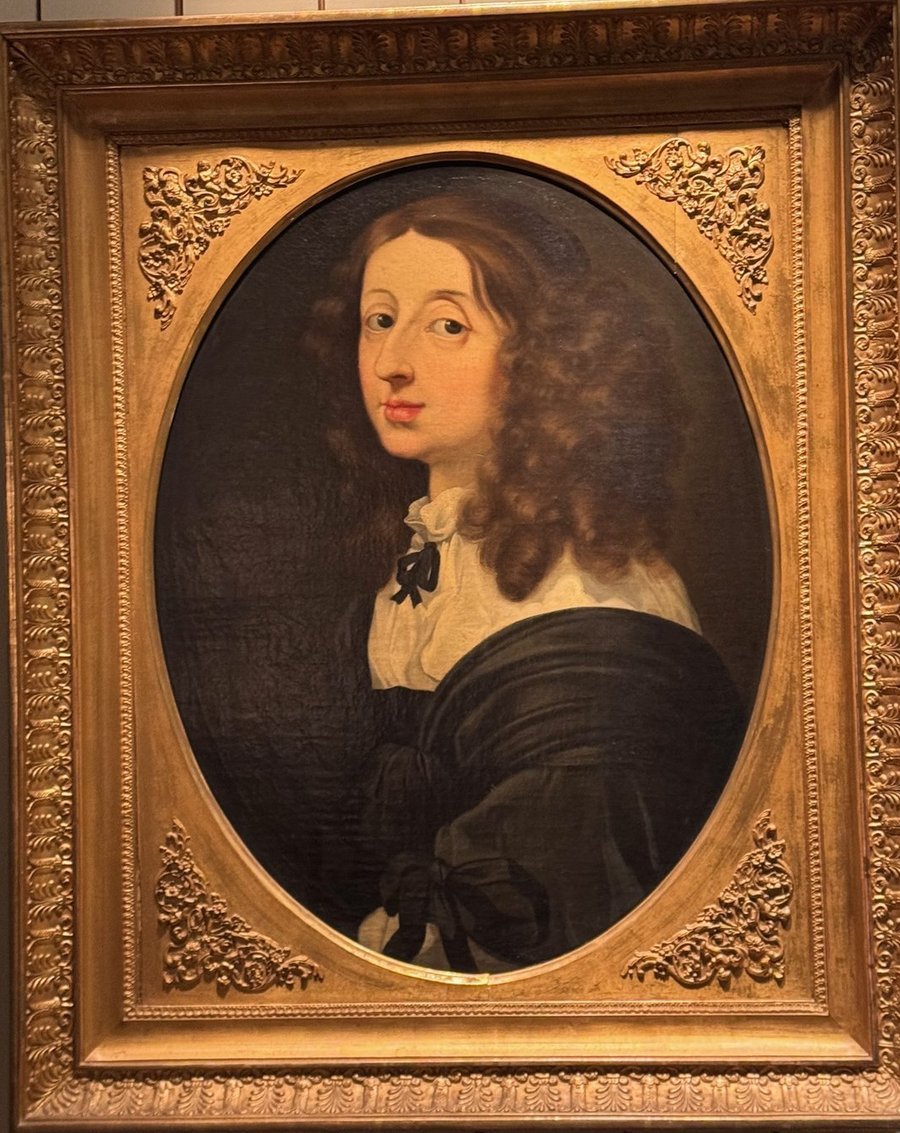
The label beside this portrait says the rumor of the learned queen spread around the world. People said that what the needle and the spindle were to other women, science was to her. Her motto is printed under it: “Wisdom is the pillar of the kingdom.” Kristina was born in December 1626, so this year marks 400 years since her birth. I am working on a separate article about her.
How to see the coach
The stable is not open on its own. Groups can see the coach as part of a pre-booked guided tour of the palace or the Orangery. An extra fee applies. Tours take up to 30 people and run in Swedish or English. You book through the Royal Palaces, phone 08-402 61 00, on weekdays from 9:00 to 12:00.
For Queen Kristina’s 400th anniversary, the stable opened to all visitors on 24–25 October 2026. I visited on 24 October and took the photos above.
The Royal Palaces’ accessibility page says nothing about the coach stable.
The women who shaped Ulriksdal
The board of residents puts the kings first. But women made many of the changes here.
Ebba Brahe built Jacobsdal with her husband, says the palace timeline. Hedvig Eleonora owned the palace for 46 years and added new wings. Under Lovisa Ulrika and Adolf Fredrik, the old riding house became a theater. Sofia Magdalena gave a party here for Gustav III in 1775. As a widow, she made Ulriksdal her main home for some years. Queen Lovisa took part in the design of the chapel, and it opened on her name day. And the Grand Living Room was a wedding gift to Louise and her husband.
Hedvig Eleonora did more than live here. In another episode of Slott & Krona, curator Alexander Holm explains that most of Kristina’s surviving art collection in Stockholm survived because Hedvig Eleonora had moved it to Ulriksdal. When Tre Kronor burned in 1697, those objects were safe.
I traced more of these links in my article on how Swedish royal houses are linked through women.
Next time someone tells you a palace belonged to a king, will you ask who changed the rooms?
The park, the chapel and Confidencen
In 1647, Jacob De la Gardie brought the gardener Hans Georg Kraus from Germany. Kraus was to bring at least 6,000 flowers. In the 1740s, the architect Carl Hårleman planted a wedge-shaped bosquet, about 250 meters long, to make the garden symmetrical. Most of it is still there. The garden got its present shape in the 1930s, and Crown Prince Gustaf (VI) Adolf took an active part. The Orangery now holds Nationalmuseum’s collection of Swedish sculpture. At the fountain stands Carl Milles’ Two Boars. The park sign asks you to take a closer look at the front legs.
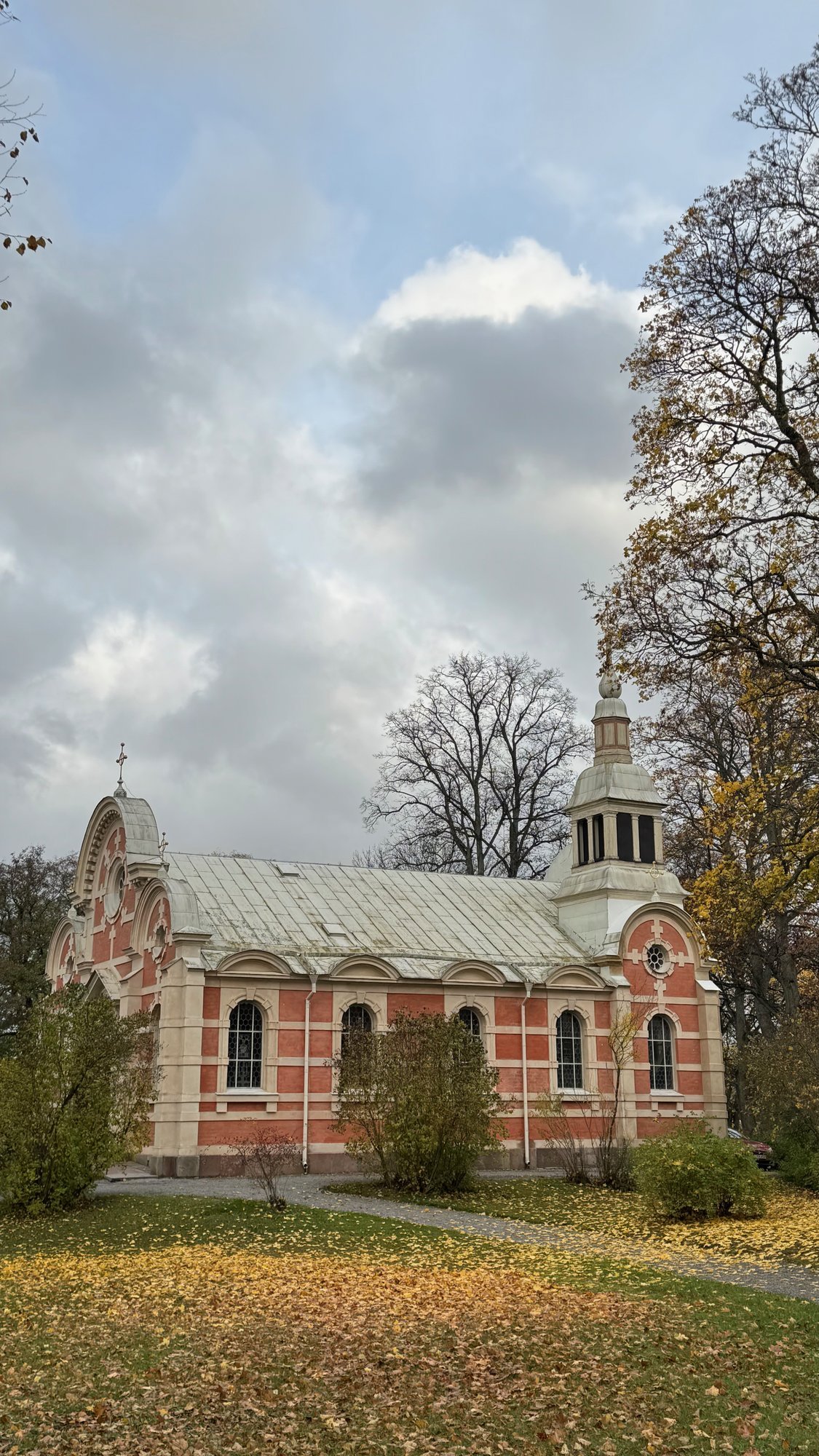
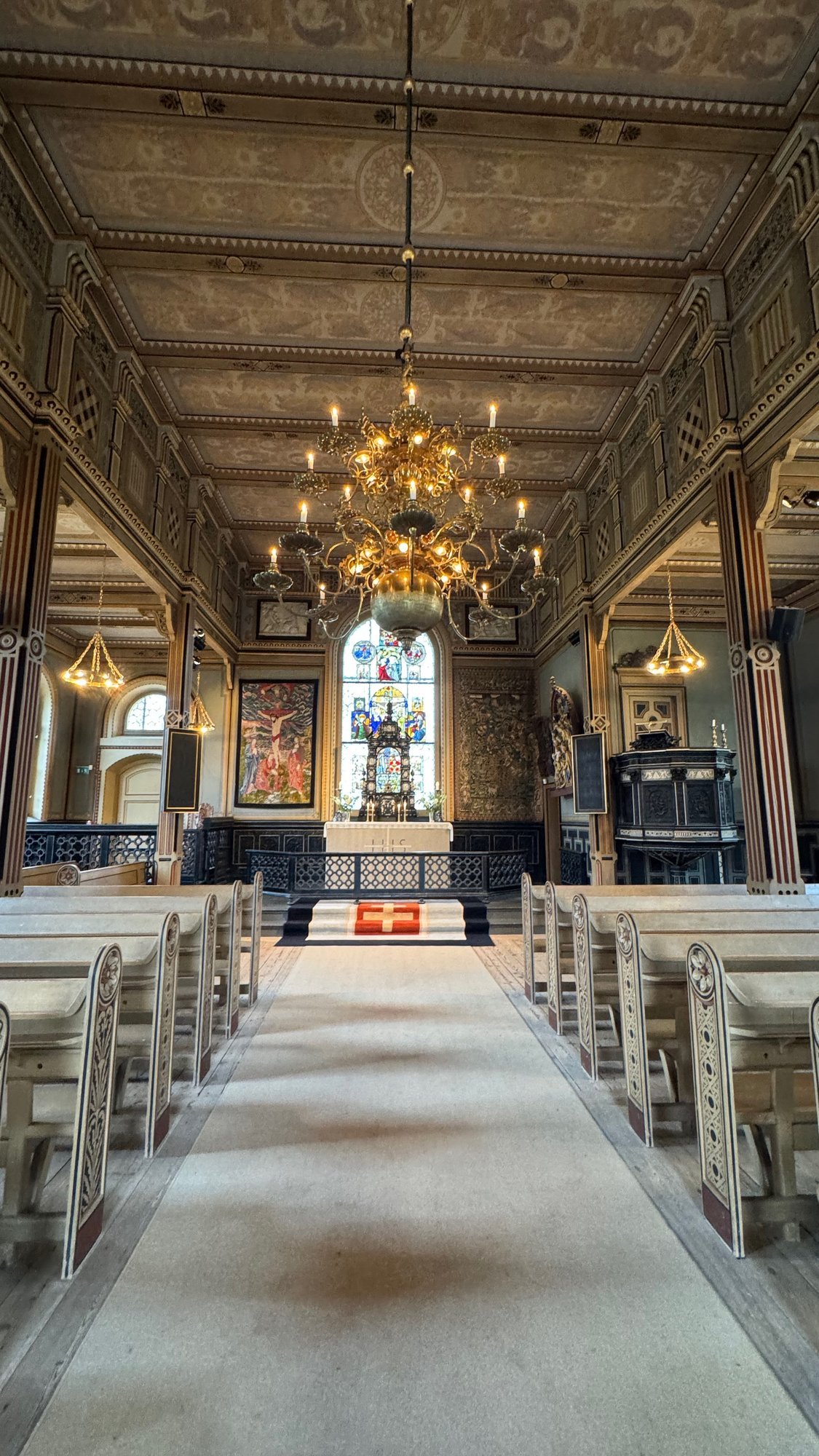
Scholander also designed the palace chapel. It opened on 25 August 1865, Queen Lovisa’s name day. The style is Dutch neo-Renaissance, with some inspiration from Venice. The stained-glass windows come from Karl XV’s collections, and the oldest are medieval. The two bells in the tower are from the 1660s. They carry the coats of arms of Magnus Gabriel De la Gardie and his wife, Maria Euphrosyne. After a large restoration, the chapel opened again on 8 April 2000. Today it is used mostly for weddings.
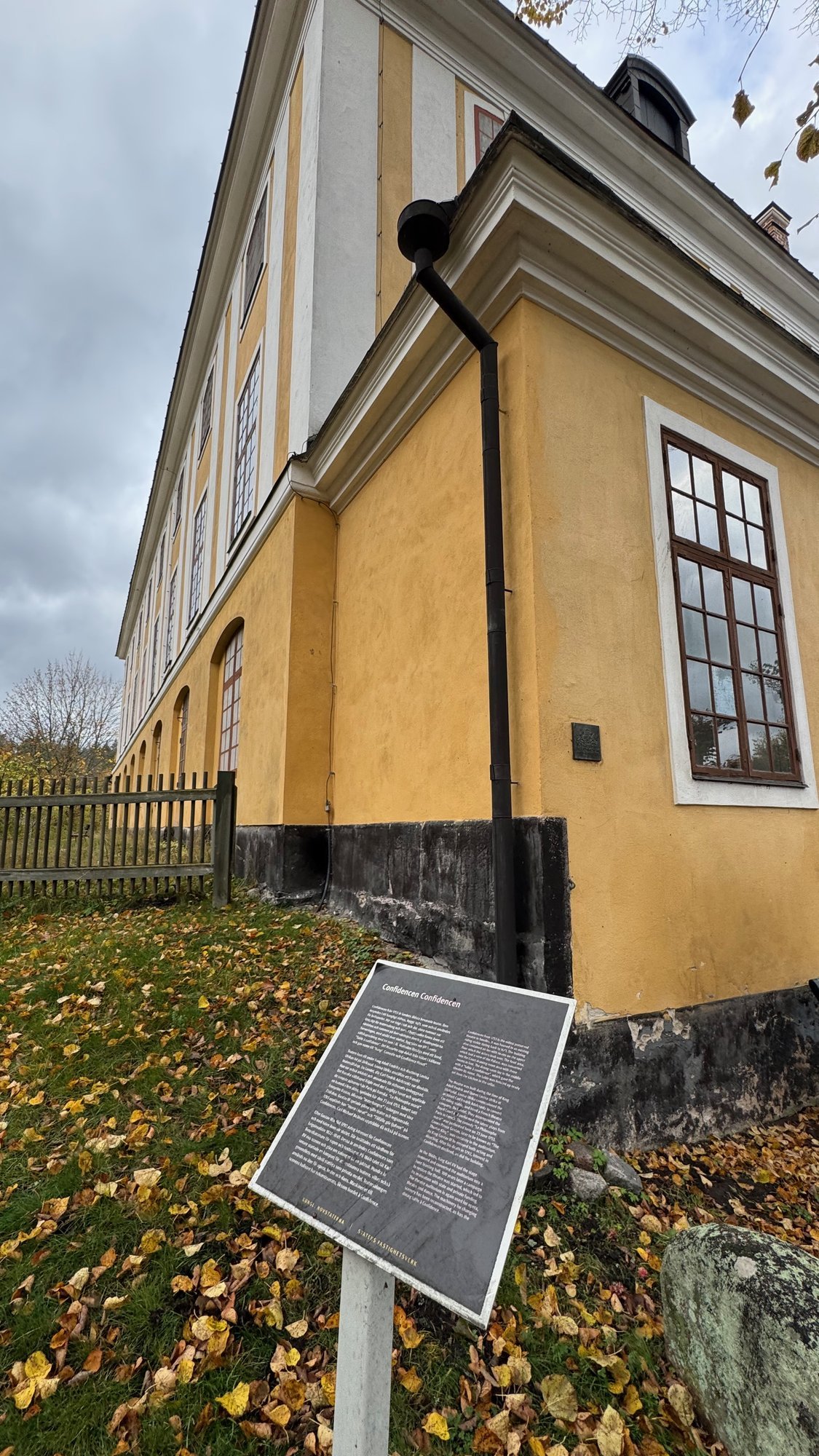
The Royal Palaces website calls Confidencen Sweden’s oldest rococo theater, from 1753. It was built into an older riding house. The name comes from a “table à confidence”, a dining table lifted up fully set from the kitchen below. In the 1860s, Karl XV removed the stage and made the room a hunting hall. About a hundred years later, a campaign started to restore it. Today it is used for opera, theater and dance again.
Accessibility
On my visit on 24 October 2026, the palace was full of people for Höstmarknad, the autumn market. In the crowd, I did not notice a lift or any accessibility signs. The toilets are in a separate building.
The Royal Palaces website gives more detail. It lists a lift for up to four people or 250 kg, with a door 81 cm wide. The entrance has two steps and a ramp. The upper floor is 27 steps up, with a handrail. Accessible toilets are at the stable outside the park gates, behind the Orangery, and behind the palace café. A companion of a visitor with a disability gets in free. In the Orangery, the smaller sculptures are about six steps up, with no ramp.
Most labels in the coach museum are in Swedish only.
I wrote more about this in my Medium story on why museums are inaccessible.
Photo gallery
All photographs on this page were taken by Zayera Khan during a visit to the museum, and are her own property. Please do not reuse them without permission.
Sources: Kungliga slotten – Ulriksdals slott; Kungliga slotten – Historik; Kungliga slotten – Praktisk information, tillgänglighet; Kungliga slotten – Hitta hit; Kungliga slotten – Öppettider; Kungliga slotten – Entréavgifter; Kungliga slotten – Guidade visningar; Kungliga slotten – Ur historien: Ulriksdals slott; Kungliga slotten – Historiens pampigaste kröningståg; Kungliga slotten – Grupper; Kungliga slotten – Höstmarknad på Ulriksdal; Slott & Krona, the Royal Palaces’ podcast: the episode on Ulriksdal, with palace educators Caroline Edman and Jonas Rosin, and the episode on Queen Kristina’s collections, with curator Alexander Holm; room signs, park signs and the printed room guide at Ulriksdal Palace, seen on 24 October 2026.