
Strindbergsmuseet in Stockholm: the Blue Tower where Strindberg died
His last home is a fourth-floor apartment on Drottninggatan, and his work still shapes Swedish culture
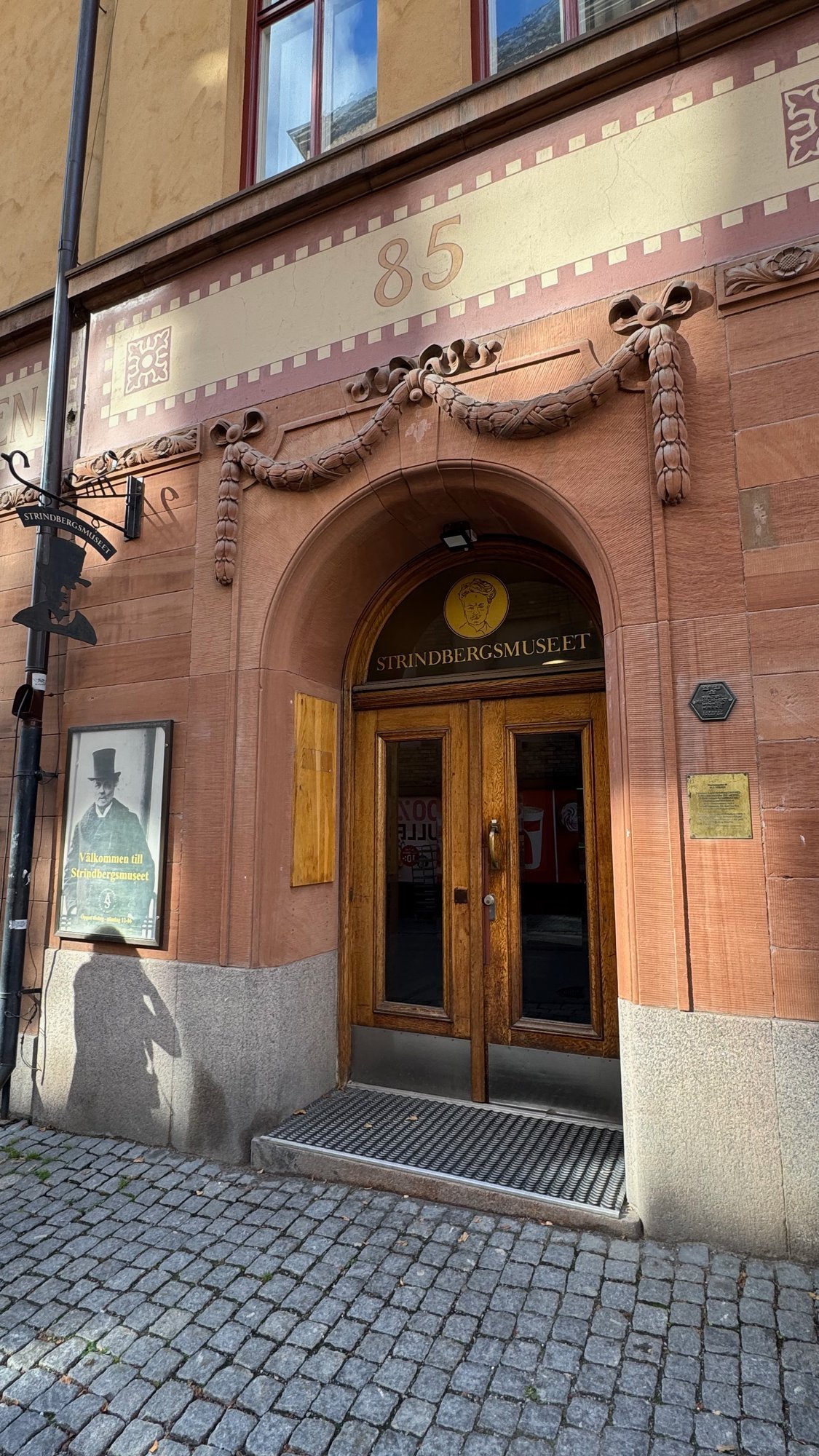
- Why visitThe only museum in Stockholm set in the last home of August Strindberg, with his study, bedroom and dining room, and an exhibition about his life and work.
- Best forReaders, theater lovers, and anyone who wants to see how a writer lived in Stockholm in 1912.
- AddressDrottninggatan 85, 111 60 Stockholm (fourth floor, in the building called Blå tornet, the Blue Tower).
- Getting thereMetro to Rådmansgatan, exit Sveavägen/Tegnérgatan. Then walk to Drottninggatan 85.
- Opening hoursTuesday to Sunday, 12:00 to 16:00. Closed on Monday. Closed on some public holidays, so check the museum website before you go.
- AdmissionAdults 120 SEK. Students, seniors and unemployed 80 SEK. Under 19 years free. Check the website for current prices.
- Guided toursYou can book a guided tour by phone: +46 (0)8 411 53 54.
- FacilitiesCloakroom and WC. The museum has a library with about 3,000 volumes on the sixth floor. No food or drink inside.
- AccessibilityThe building is a normal old apartment house and is not fully adapted. Read the accessibility section below before you go.
- Official websitestrindbergsmuseet.se
Strindberg lived at 24 addresses in Stockholm in 63 years. Only one of them is a museum.
I visited in September 2026. I rang no bell, I took the old lift, and I walked into three rooms where a famous writer spent the last four years of his life. The rooms are small. The wallpaper is bright. The study is behind glass.
This article has two parts. The first part is the visit. The second part is a longer text about Strindberg himself: why he matters for Swedish literature, drama, theater, film and art. If you only want practical facts, go straight to the visitor information at the end.
The Blue Tower on Drottninggatan
The house is called Blå tornet, the Blue Tower. It stands on a street corner and has a tower on the corner. The house was built in 1907 and designed by Hagström & Ekman. A brass plaque by the door says that Strindberg lived here between 1908 and 1912.
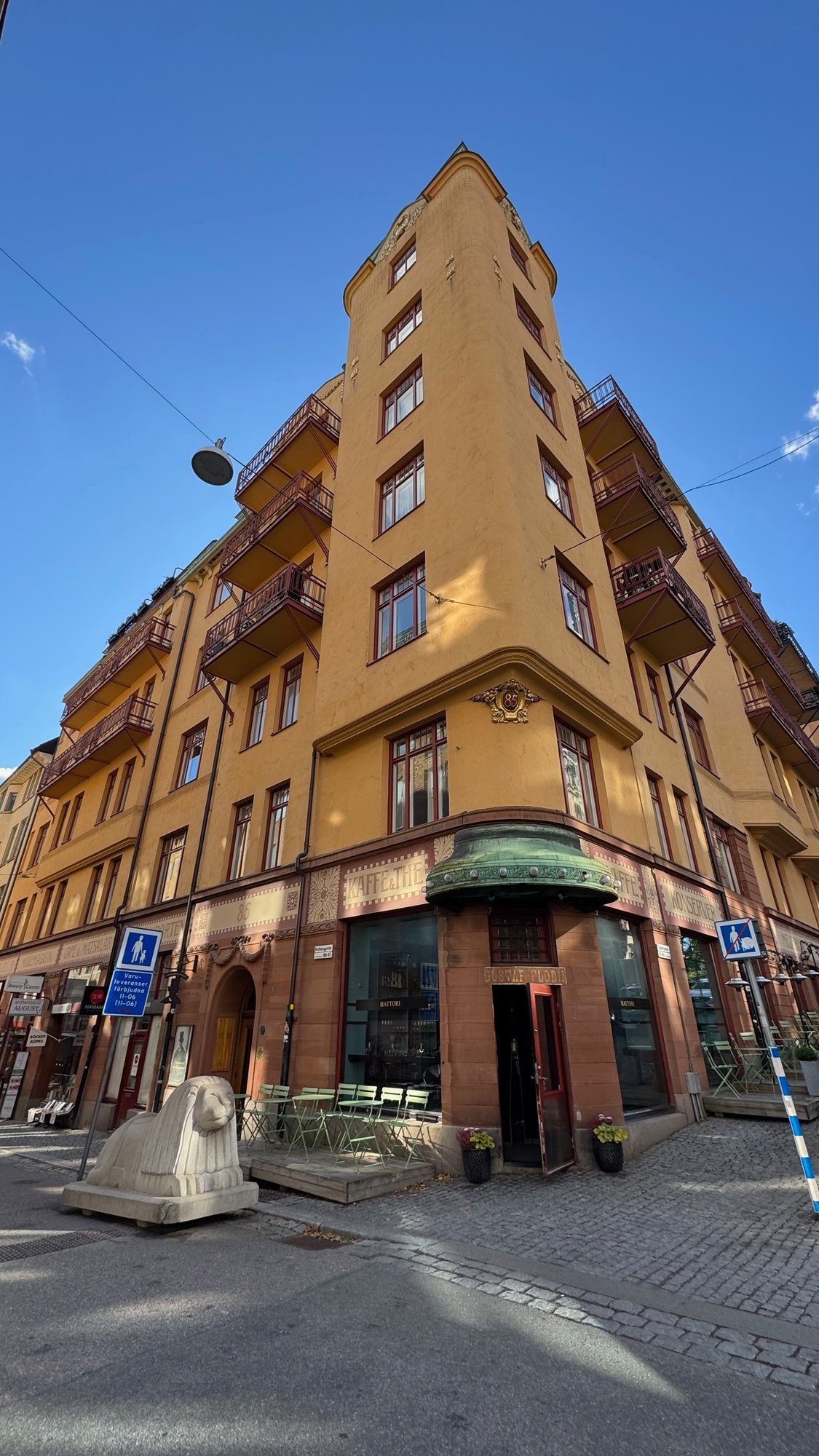
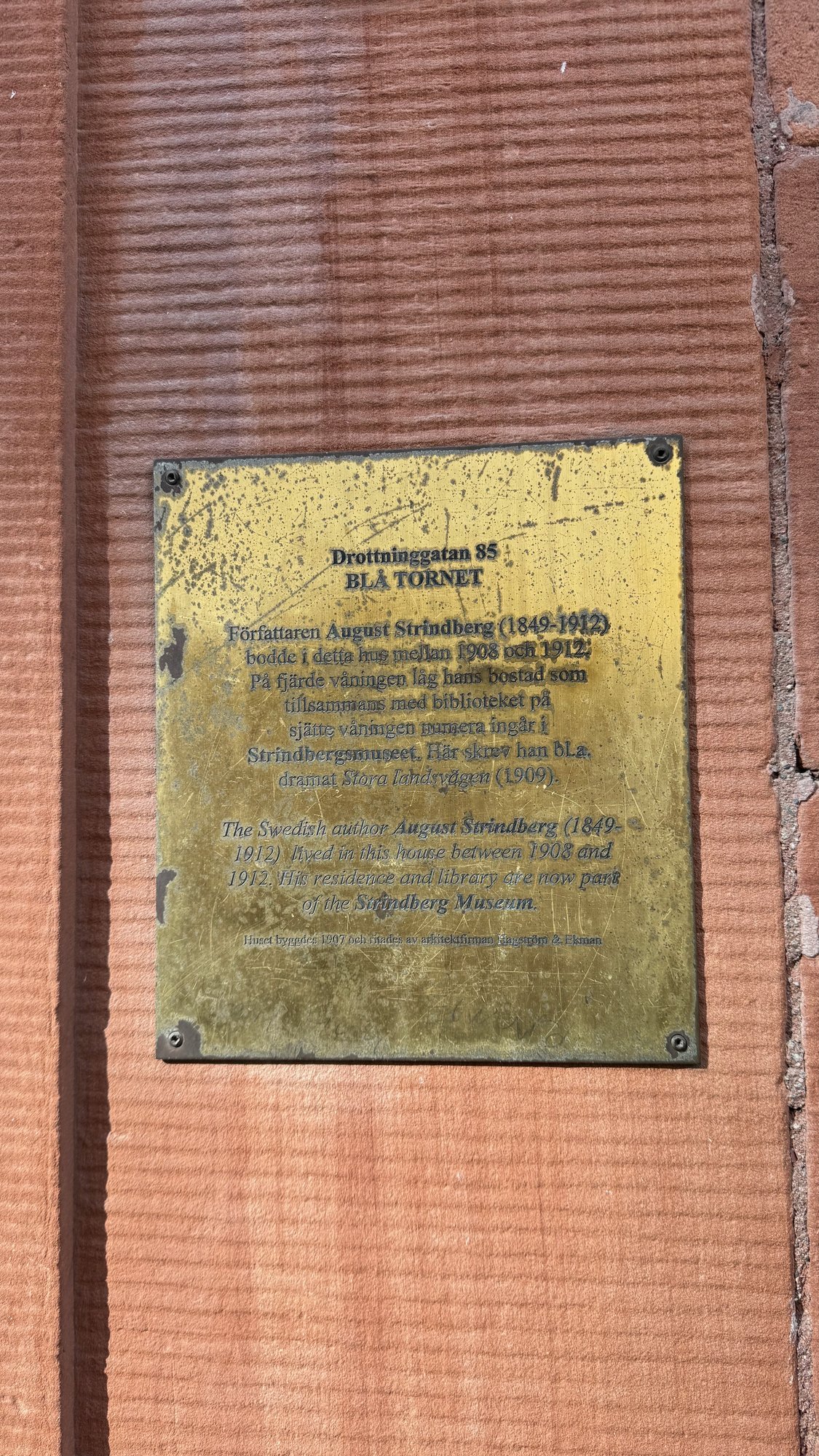
The plaque also says that he wrote the play Stora landsvägen (The Great Highway, 1909) in this house. His apartment on the fourth floor is now part of the museum. The library on the sixth floor belongs to the museum too.
The museum is not at street level. Look for the signs by the door. They show the opening hours in Swedish and English. If the outer door is locked during opening hours, press the gold button. A third sign shows a wheelchair symbol and tells you to ring the intercom.
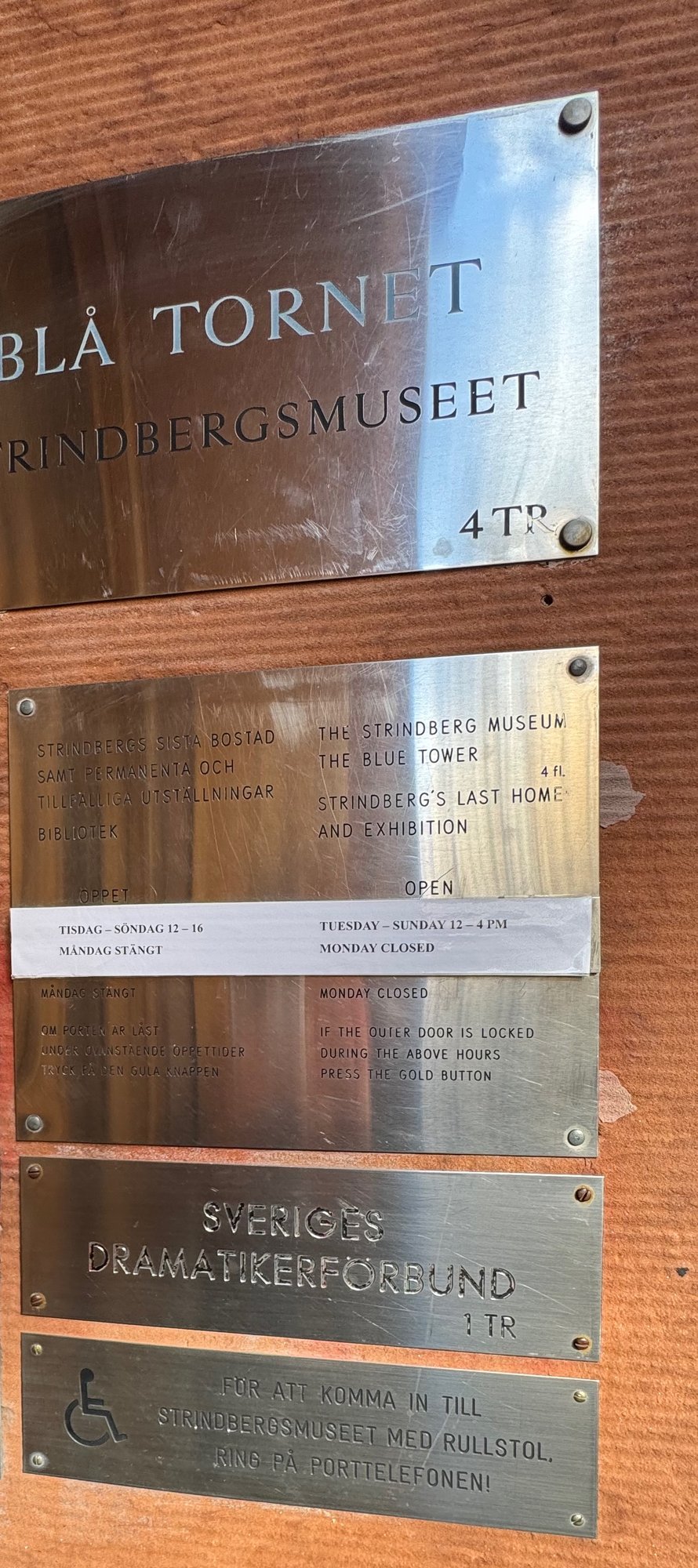
The signs also show Sveriges Dramatikerförbund, the Swedish playwrights’ association, on the first floor. A museum for a playwright and a playwrights’ office in the same house. I like that.
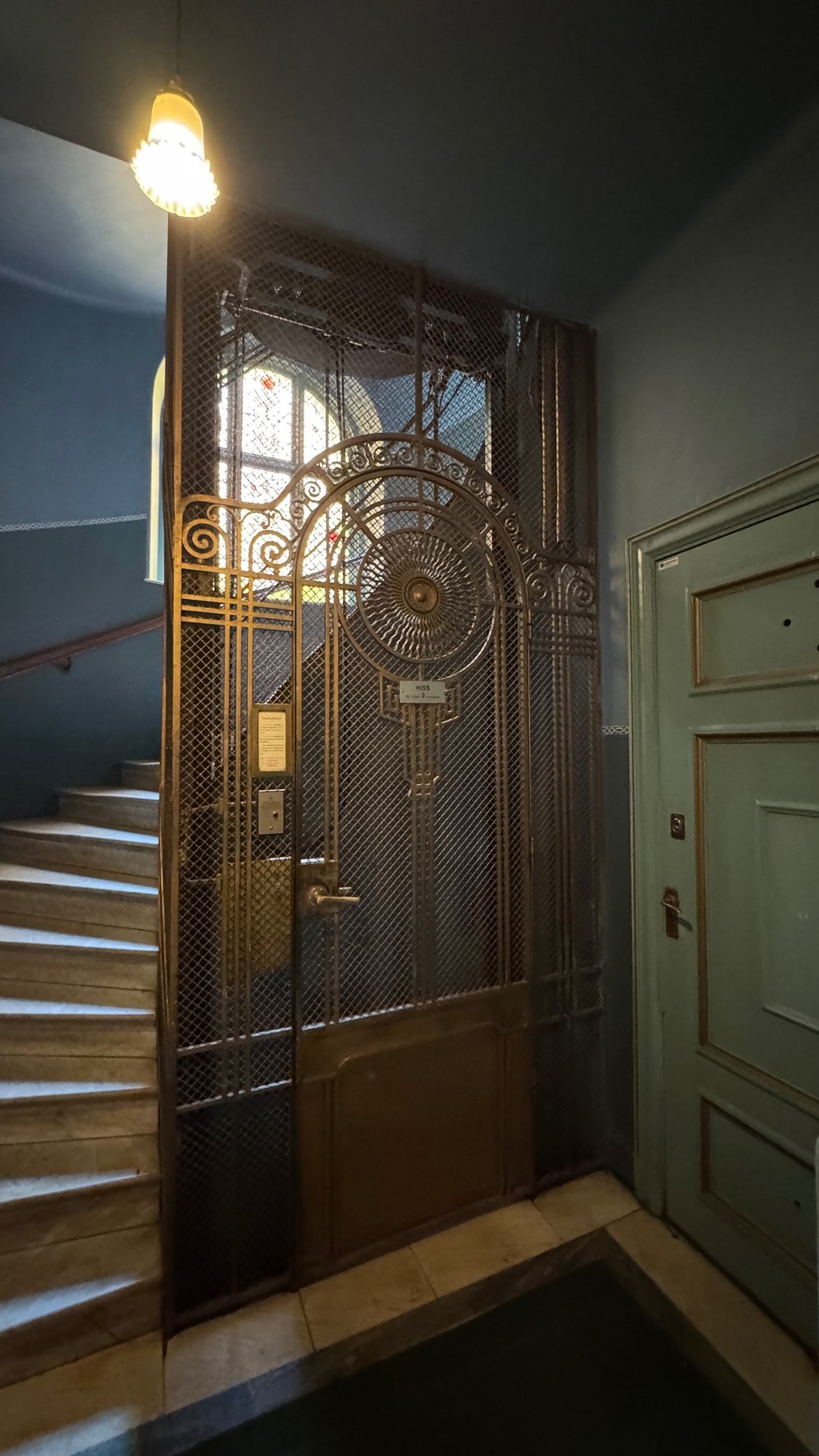
Inside, an old lift takes you up. It has an iron gate with a round sunburst pattern, next to a stone staircase in a blue stairwell.
Inside the apartment
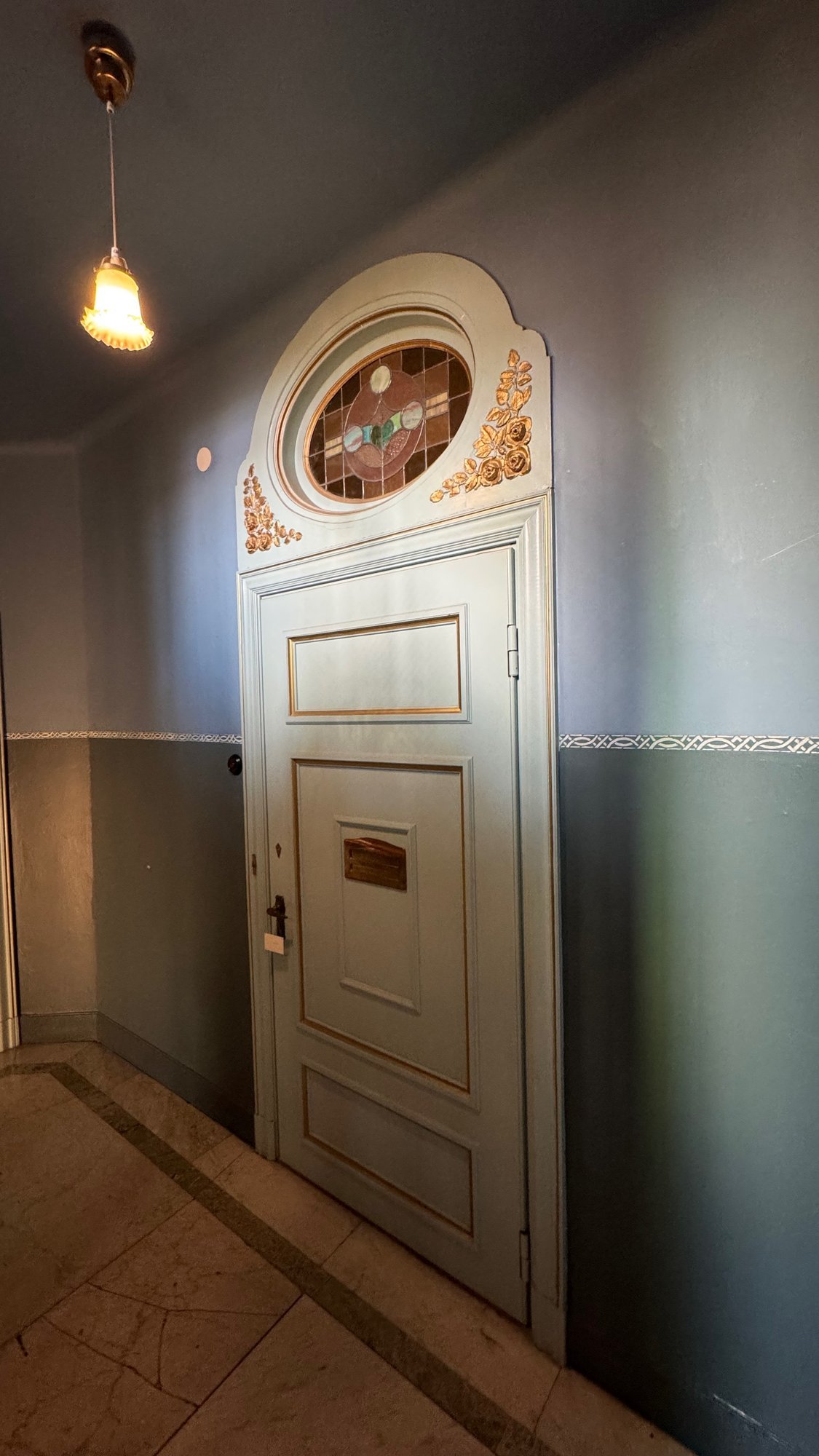
Strindberg moved in in 1908. He had just divorced the actress Harriet Bosse, and he left a larger apartment at Karlaplan. The actress Fanny Falkner, who worked at his theater, offered him this place near the theater. Her mother Meta rented out the three rooms with full board. The building was modern for its time. It had electricity, a WC, a telephone and central heating.
The home became a museum in 1973. Most of the furniture is original. The panels in the rooms say that the wallpapers and textiles are exact copies. That detail matters: when you stand in the room, the colors are bright, and they were bright in 1912 too.
The dining room and the drawing room
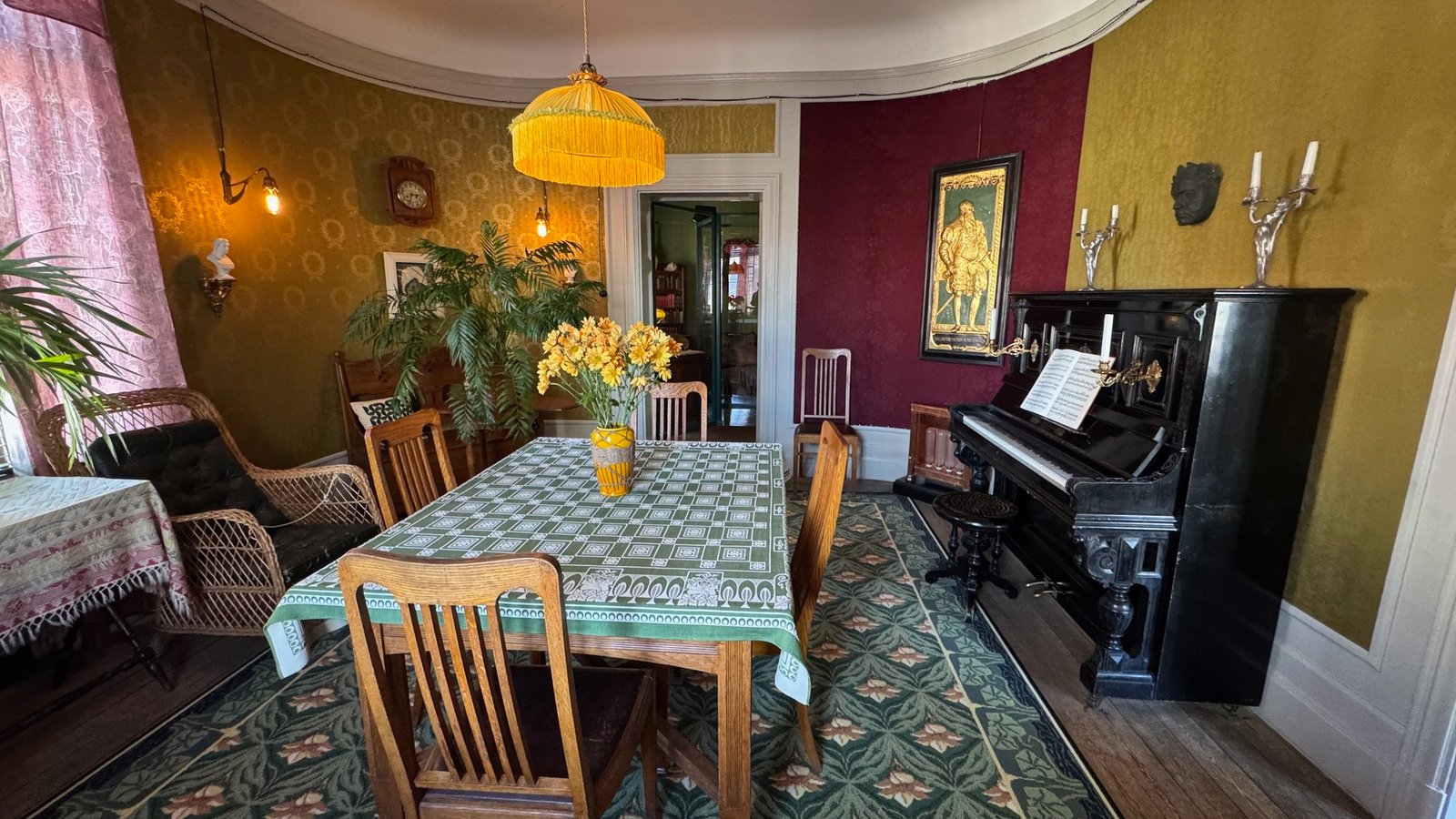
The panel in the drawing room says that Strindberg arranged the room around the people he admired: Gustav Vasa, Schiller, Goethe and Beethoven, and his daughter Anne-Marie. He made coffee at the window table. His meals came from the Falkner pension or from restaurants.
A group the panel calls the “Beethoven fraternity” met round the piano. It included his brother Axel, the composer Tor Aulin and the sculptor Carl Eldh. If you want to see Eldh’s own work, read my article on Carl Eldhs Ateljémuseum.
The study
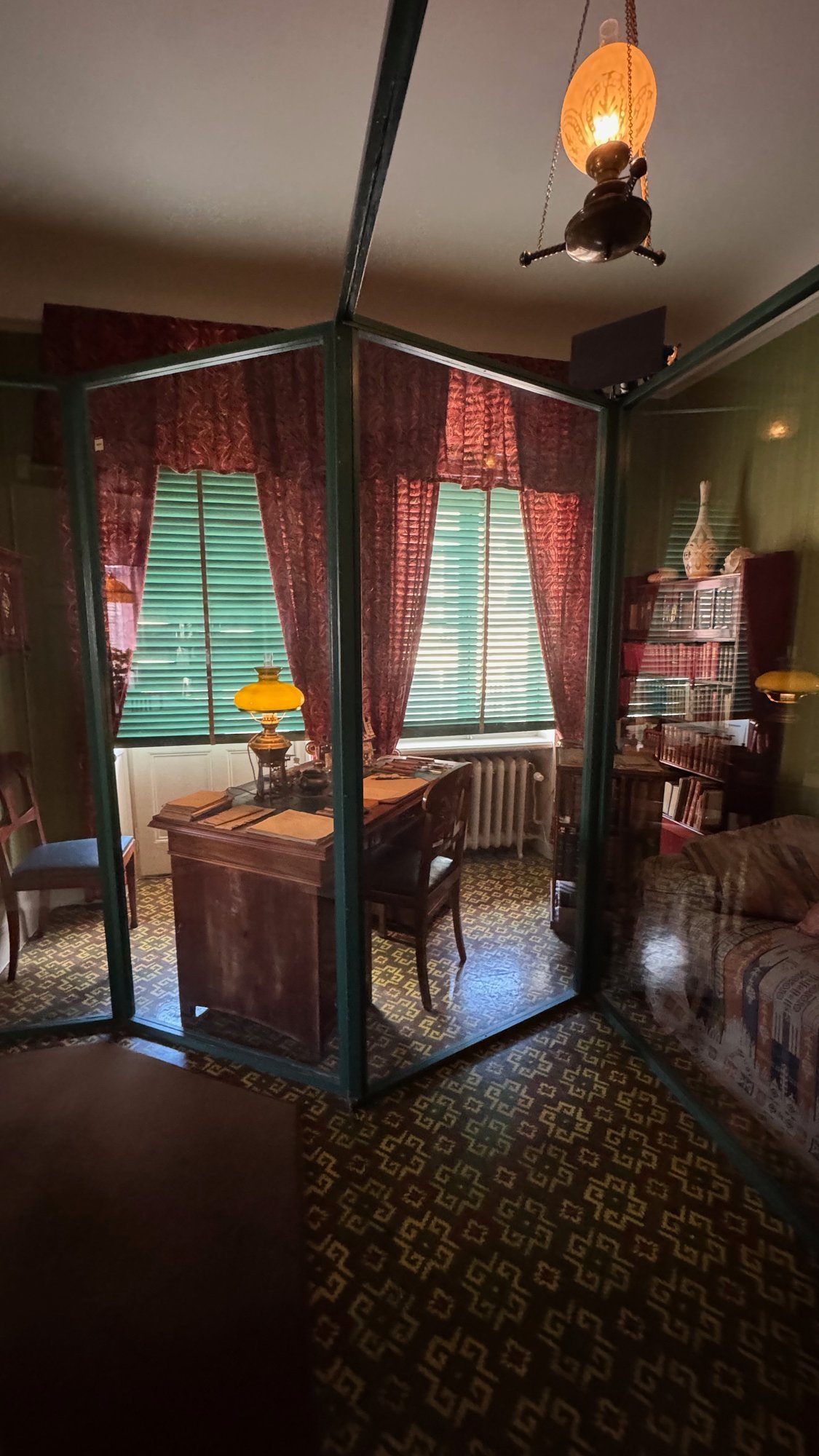
The study is behind glass walls. You cannot go in, but you can see the desk and the chair. The panel says that he wrote Riksföreståndaren (The Chancellor) and Stora landsvägen at this desk. He also wrote the newspaper articles that started the Strindberg feud here. I write more about the feud below.
Two wreaths hang in the room. The left wreath comes from the Social-Democratic workers’ commune of Stockholm, dated 1 May 1912. The right wreath comes from the Intima teatern, for the theater’s first anniversary in 1908. One room, two worlds: the workers and the stage.
The bedroom
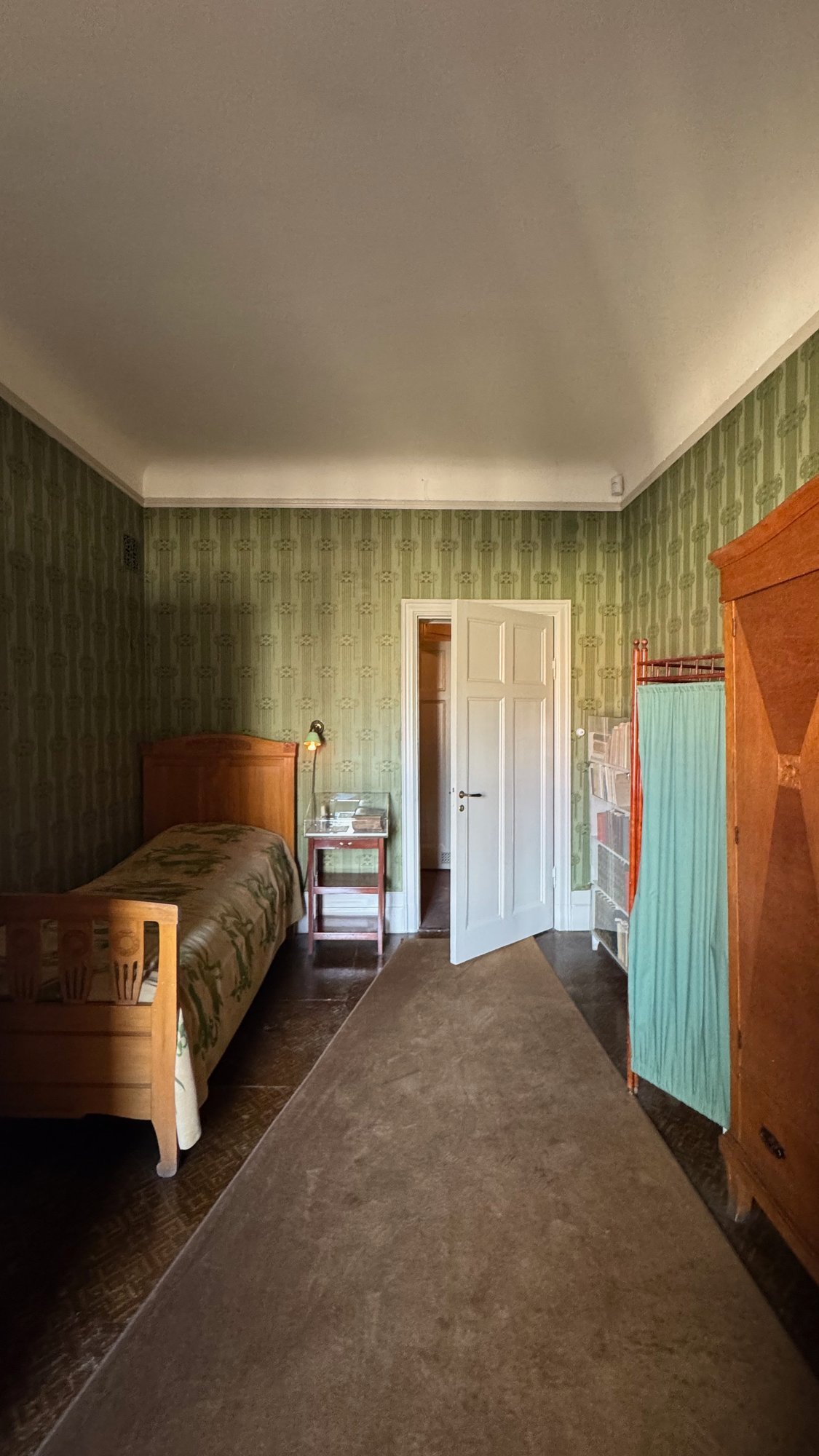
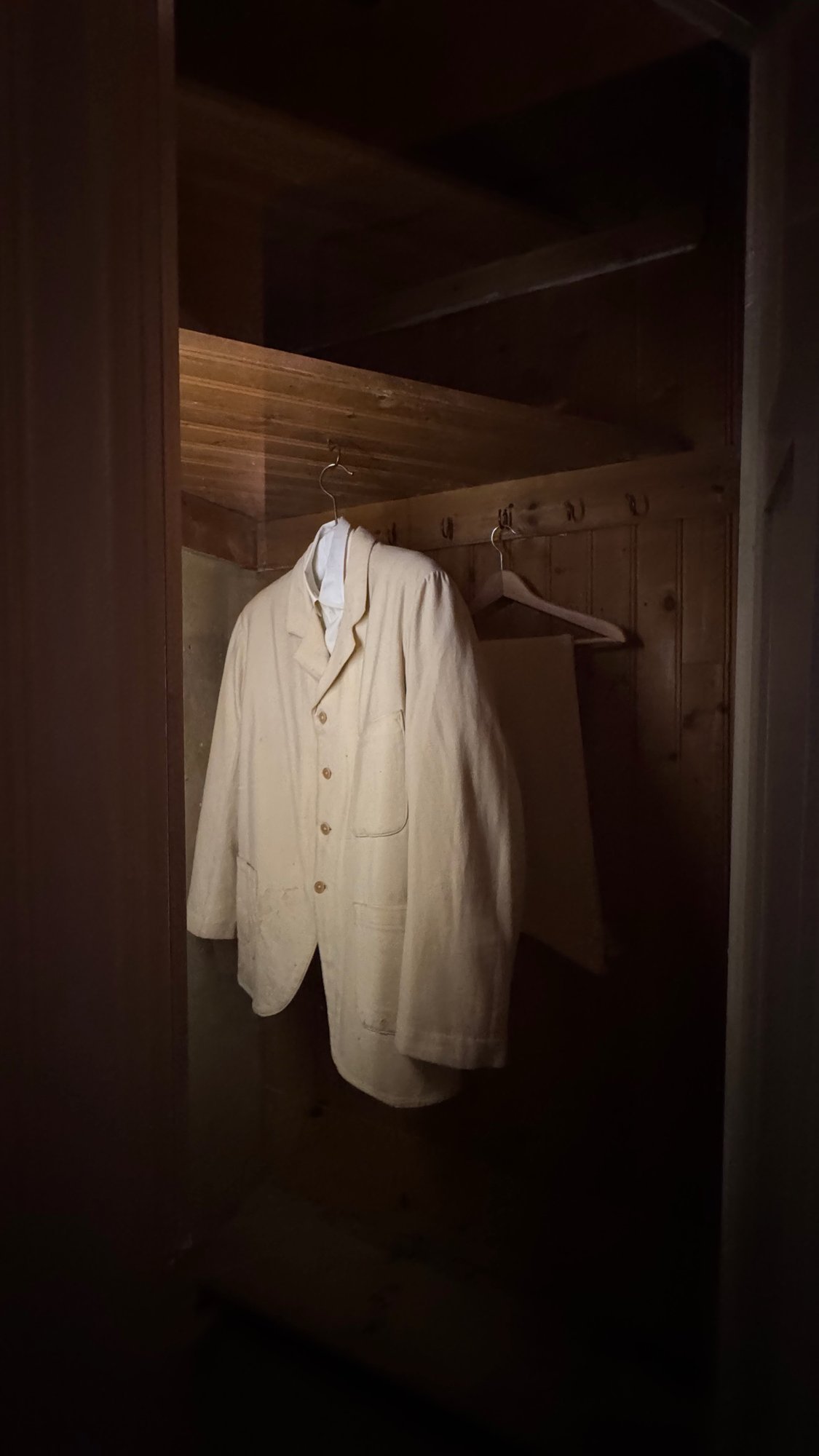
The bed is narrow. The wallpaper is green and has a pattern. Strindberg called the lamp in the cupboard “my loveliest electric lamp with the red eye”. On his 63rd birthday, 22 January 1912, he stood on the balcony. Torches lit the street. According to the panel, more than 10,000 people came to honor him, and most of them were workers. He died in this bed on 14 May 1912. The cause was stomach cancer.
The exhibition
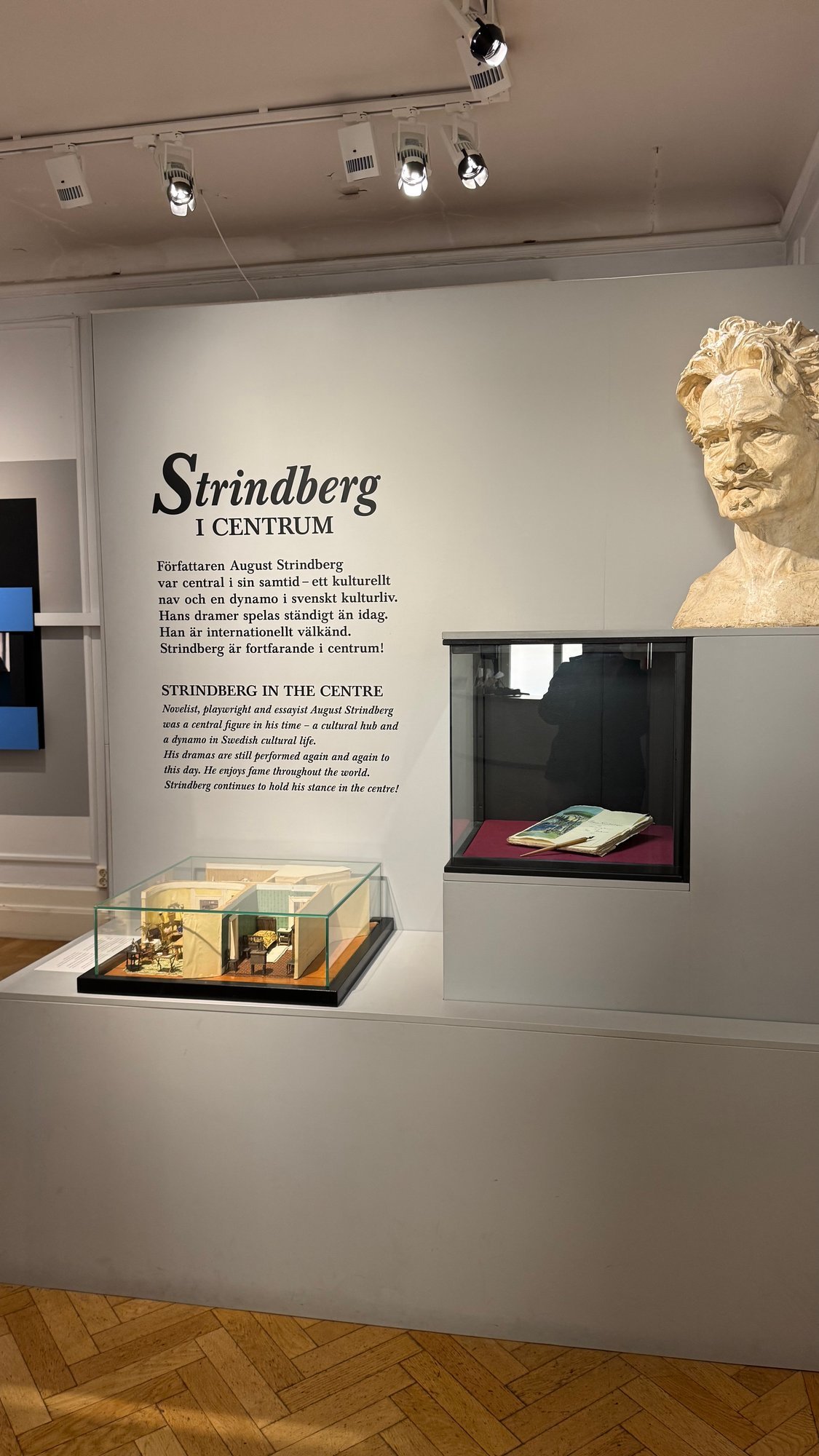
The museum also has exhibition rooms. The first wall I saw has the title Strindberg i centrum, “Strindberg in focus”. The text says that he was central in his own time, a cultural hub and a dynamo in Swedish cultural life. It says that his plays are performed again and again, and that he is famous around the world. A plaster bust and a model of the apartment stand under glass. An open manuscript lies next to a pen.
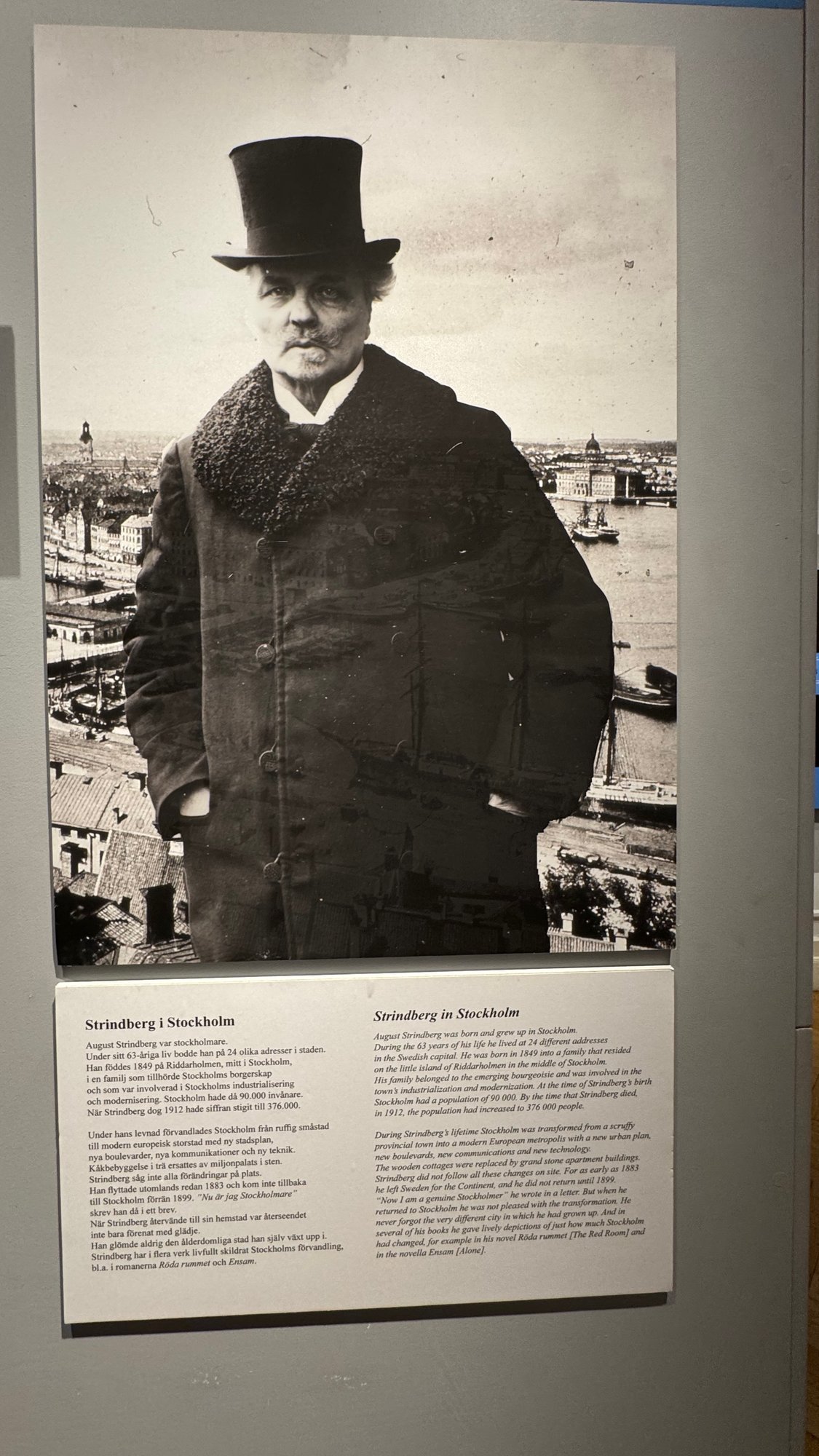
A big black and white photo shows him in a top hat and a long coat. The panel below it is called Strindberg i Stockholm. It gives three facts that I did not know. He was born in 1849 on Riddarholmen. He lived at 24 addresses in Stockholm. And the city grew from 90,000 people when he was born to 376,000 when he died in 1912. He left Sweden in 1883 and did not come back until 1899. In a letter he wrote, “Nu är jag Stockholmare” (“Now I am a Stockholmer”). The panel says that he described the change of the city in the novel Röda rummet and in the novella Ensam.
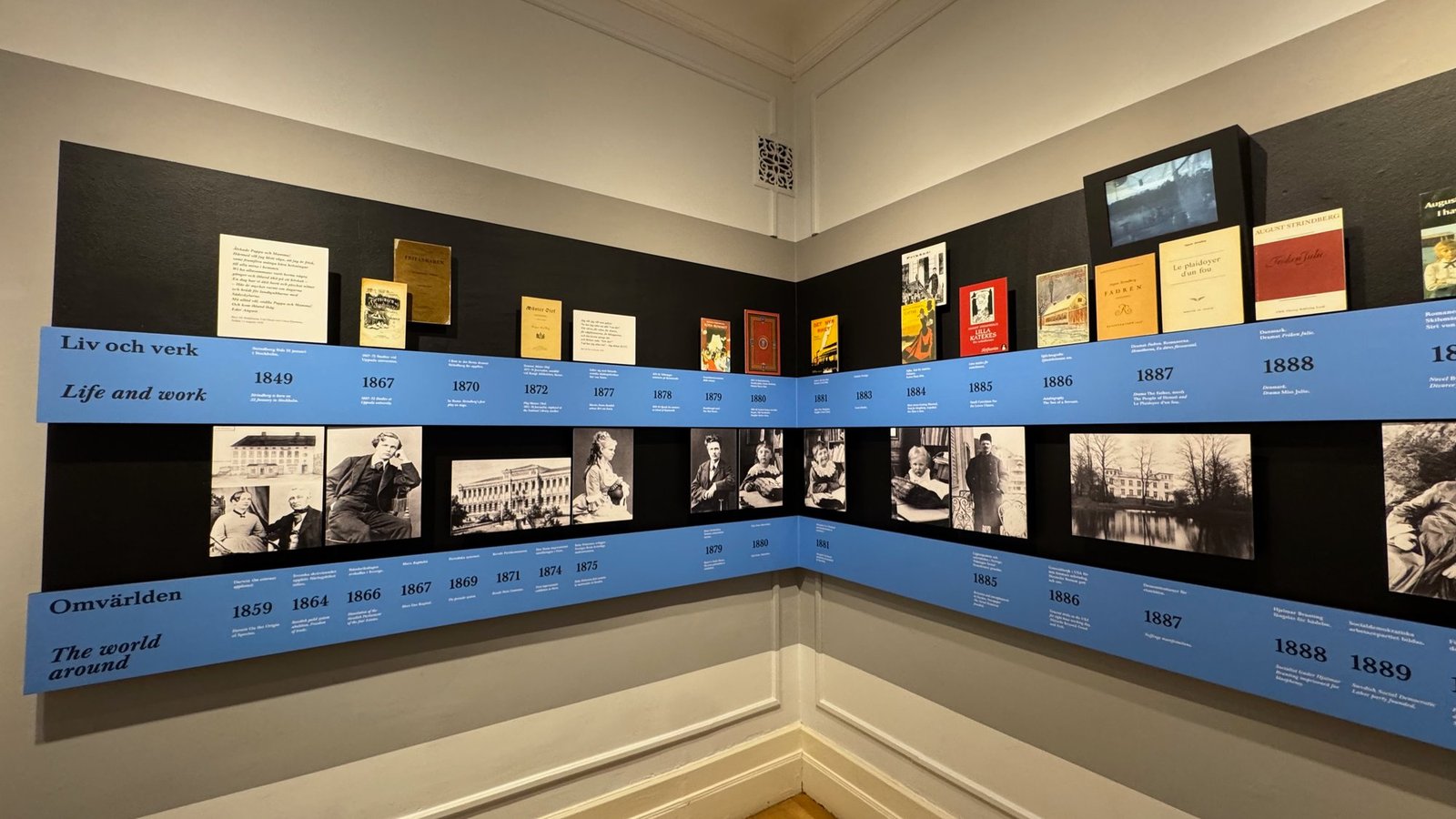
In the next room a blue timeline runs along black walls. It has two lines: Liv och verk (“Life and work”) and Omvärlden (“The world around”). Book covers and photos hang along the band.
My favorite wall is a simple one. It shows the outline of a man in a top hat. Colored cards hang on it, each with a Swedish word or word pair. Some cards say Kvinnohatare (woman hater), Socialist, Religiös (religious) and Ateist (atheist). Other cards show pairs that fight each other, such as Manlig – Queer (male – queer). The translations are mine. The wall does not tell you what to think. It shows that people have called him almost everything, and that many of the words cannot all be true.
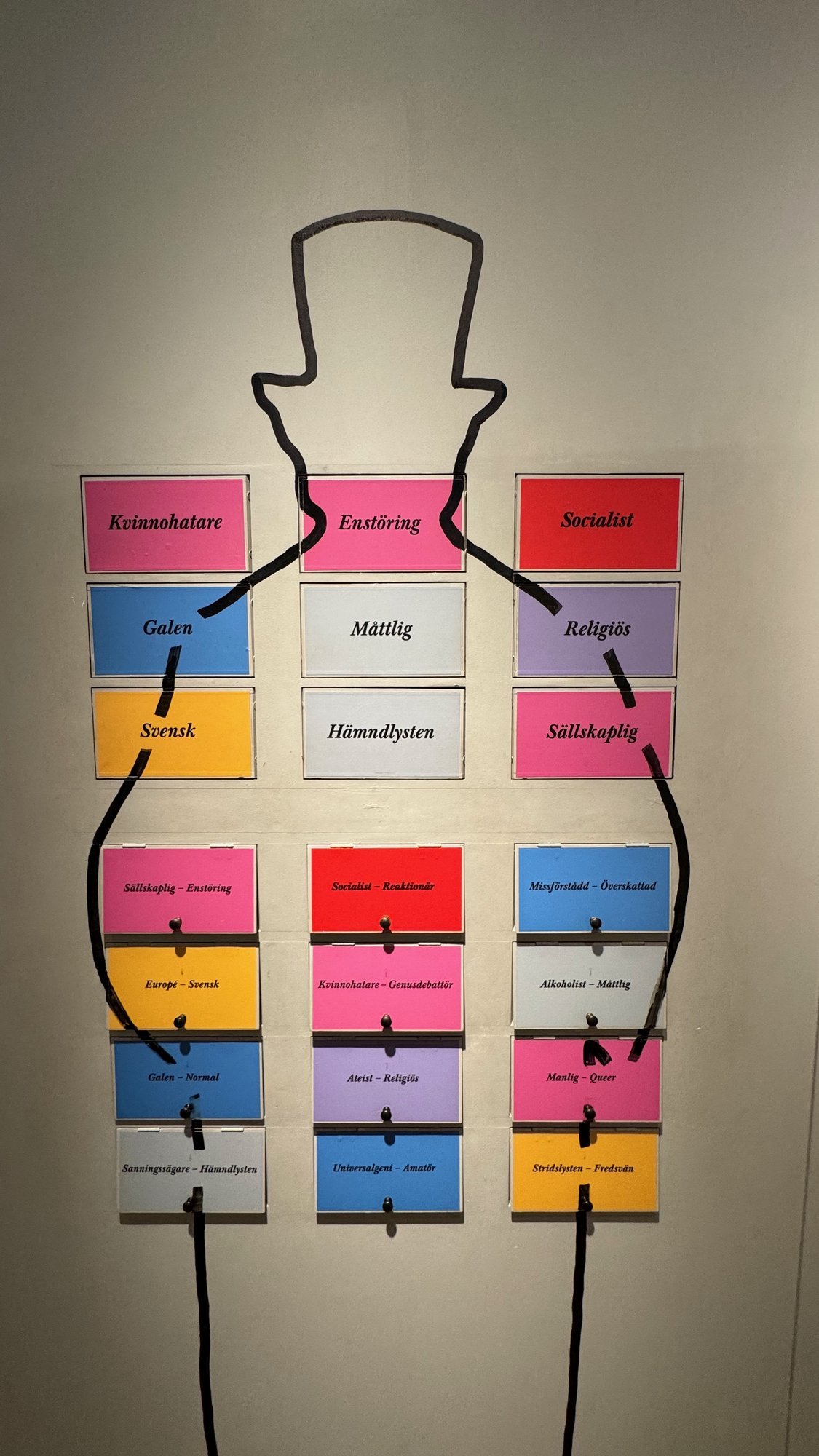
I want to stay with the word Kvinnohatare for a moment. Strindberg wrote about women with anger. He also depended on women: his wives, the actress Harriet Bosse, Fanny Falkner and her mother Meta, who rented him these rooms and fed him. The museum names them on its panels. I think that is the honest way to do it.
August Strindberg and Sweden
The next text is longer. I use the signs in the museum, the museum’s own website and a few other sources. I mark where a claim comes from one source only, mostly Wikipedia. Where I did not find a fact, I say so. That does not prove the fact is wrong.
His life in short
- 1849. Strindberg is born in Stockholm on 22 January (the museum says on Riddarholmen).
- 1879. Röda rummet (The Red Room) is published.
- 1881. Mäster Olof (Master Olof) has its premiere on 30 December. Wikipedia says that he finished the play in 1871.
- 1883 to 1899. He lives mostly abroad. See “Where he lived” below.
- 1887 to 1889. Fadren (The Father), Fröken Julie (Miss Julie) and Fordringsägare (Creditors). Wikipedia dates the premiere of The Father to 14 November 1887 and Miss Julie to 14 March 1889.
- 1894 to 1896. Wikipedia calls this period his “Inferno crisis”. He paints and experiments with photography at this time.
- 1898 to 1908. The dream plays: Till Damaskus (To Damascus), Dödsdansen (The Dance of Death), Ett drömspel (A Dream Play) and Spöksonaten (The Ghost Sonata).
- 1907 to 1910. He founds the Intima teatern. It goes bankrupt in 1910.
- 1908. He moves into the Blue Tower.
- 1910 to 1912. The Strindberg feud in the newspapers.
- 1912. He dies on 14 May.
Where he lived
Strindberg lived in four countries: Sweden, France, Switzerland and Germany. The sources I read give only some of the years.
- Stockholm. He is born on Riddarholmen in 1849. The museum says that he lived at 24 addresses in the city. One source says that after university he took an attic room on the edge of the city.
- Uppsala. He studies at the university. No year in my source.
- Kymmendö. An island in the Stockholm archipelago. One source says that he liked it better than any other place.
- France. He lives for a time in Paris, on the edge of the city, and in Grez-sur-Loing. The source gives no years.
- Switzerland. He stays there for periods. The source gives no years.
- Berlin, Germany. He arrives in the autumn of 1892 and stays four years. He meets the Austrian Frida Uhl there, and she becomes his second wife.
- Paris again. He moves back to Paris in the mid-1890s.
- Lund. One source says that he arrived in Lund on 29 September 1896 and left in June 1899. He wrote Inferno, Legender and parts of Till Damaskus in this period. He had also visited friends in Lund before, for example in October 1891 and October 1893.
- Stockholm again. He returns in 1899. From 1908 until his death in 1912 he lives in the Blue Tower.
Note that the sources disagree. The museum’s wall panel says that he left Sweden in 1883 and did not return until 1899. The Lund source says that he lived in Lund from 1896. I cannot tell from my sources why they differ. Frida Uhl was Austrian, but my sources do not say that he lived in Austria. The plays Fadren, Fröken Julie and Fordringsägare had their premieres in Copenhagen, but my sources do not say that he lived in Denmark.
Literature: a Stockholm novel
Röda rummet is a satire of Stockholm society in the 1870s. Wikipedia says that people often call it the first modern Swedish novel. I did not find a second source for the “first” claim, so I say it with care. The museum’s panel gives a clearer reason to read it: it shows how fast the city changed. Stockholm had 90,000 people in 1849 and 376,000 in 1912. Strindberg looked at this growth, at the clerks, the artists, the journalists and the officials, and he wrote it down with irony.
This is one of his big gifts to Swedish literature. He wrote about the city as it was, with its jobs, its rent and its quarrels. He did not write about an ideal Sweden. Later Swedish writers use the same city in the same way. I did not find a source in this research that lists the writers he influenced in Sweden, so I do not name any. If you know a good source, please send it to me.
Drama: from naturalism to the dream plays
His first big play, Mäster Olof, had its premiere on 30 December 1881, after many years of work. In the late 1880s he wrote Fadren, Fröken Julie and Fordringsägare. These plays are short, hard and about power between men and women, and between classes. Fröken Julie has a preface that people read as a manifesto of naturalism. In the play a noblewoman and a servant meet in a kitchen on one night.
After the crisis of the 1890s his writing changed. Wikipedia says that Till Damaskus (1898), Ett drömspel (1902) and Spöksonaten (1908) work like dreams: time and place shift, and one person can turn into another. Wikipedia names him a pioneer of expressionism and surrealism, and a precursor of the Theatre of the Absurd. The same source says that he influenced Eugene O’Neill, Tennessee Williams, Edward Albee and Ingmar Bergman. I use these names with the usual caution: it is one source.
Theater: the Intima teatern
In 1907 Strindberg opened the Intima teatern with the actor August Falck. Wikipedia says that the theater followed the model of the Kammerspielhaus of Max Reinhardt, a small house for plays that need a quiet room and a close audience. The theater lasted until 1910, when it went bankrupt. The wreath in the study, dated 1908, comes from this theater. It is one of the few objects that connects the study with the stage.
The theater also explains why Strindberg lives in this house. Fanny Falkner worked at the Intima teatern, and she offered him the rooms. In a way, the theater found him a home.
Directors in Sweden have returned to his plays for more than a century. The Ingmar Bergman Foundation writes that Bergman staged Spöksonaten for the first time in 1941 at the Medborgarhuset in Stockholm, a small theater with 99 seats. It was a success with the critics and a failure with the audience: according to the foundation, it ran for six of ten planned performances. Bergman staged the play again, for example in Malmö in 1954, and he returned to it later. I did not find a reliable number for all of Bergman’s Strindberg productions, so I give none.
Film: Fröken Julie on screen
The play with the most film versions in my sources is Fröken Julie. The Swedish director Alf Sjöberg made the best-known one in 1951, with Anita Björk and Ulf Palme. One source says that it shared the Grand Prix at the Cannes festival that year. Sjöberg opens the kitchen drama to the estate around it, so the viewer sees the world that traps the two people. Later versions came from Mike Figgis (1999) and Liv Ullmann (2014, with Jessica Chastain and Colin Farrell). At least four operas also exist, by Rorem (1965), Bibalo (1973), Alwyn (1977) and Boesmans (2005).
The museum keeps about 2,500 photographs. About 1,250 of them show theater productions of his plays around the world.
Art: Strindberg the painter
Many people do not know that Strindberg painted. Wikipedia counts 117 acknowledged paintings. He painted mostly in two periods: the early 1890s and the first five years of the 1900s, in years of crisis. Many show the sea and the Stockholm archipelago, with heavy waves, low skies and thick paint.
Wikipedia also mentions his photo experiments from 1894, which he called “celestographs”. Tate Modern showed his paintings and photographs in an exhibition in London in 2005. Its press release says that the show had more than 60 paintings and about 30 photographs. Tate compares his work to Turner and to expressionism. It says that in 1894 he came close to ideas that Dada and Surrealism used 20 years later. It also says that he was an early art critic who saw the value of Impressionism, and that Gauguin asked him for support for an exhibition.
I did not find a source for his influence on Swedish painters in this research, so I do not claim one.
His interests went further than art. Litteraturhistorien.se says that he learned Chinese and worked at the Royal Library.
The public figure: the feud and the People’s Prize
In April 1910 Strindberg started a fight in the newspapers. The museum calls it Strindbergsfejden, the Strindberg feud. The panel in the study says that he attacked the worship of the king, the military and authorities such as the writer Verner von Heidenstam and the explorer Sven Hedin. Wikipedia says that the feud ran for two years and filled about 1,000 articles in 80 newspapers. The panel says that it shook Swedish cultural life for several years.
In 1911 Swedes collected money for a People’s Prize for him. Wikipedia says that more than 20,000 donors gave about 45,000 kronor. He did not win the Nobel Prize. On his birthday in 1912, workers came to his street with torches. When he died in May, a workers’ commune sent a wreath. That wreath still hangs in his study. SO-rummet says that his funeral drew tens of thousands of people.
Strindberg on the street
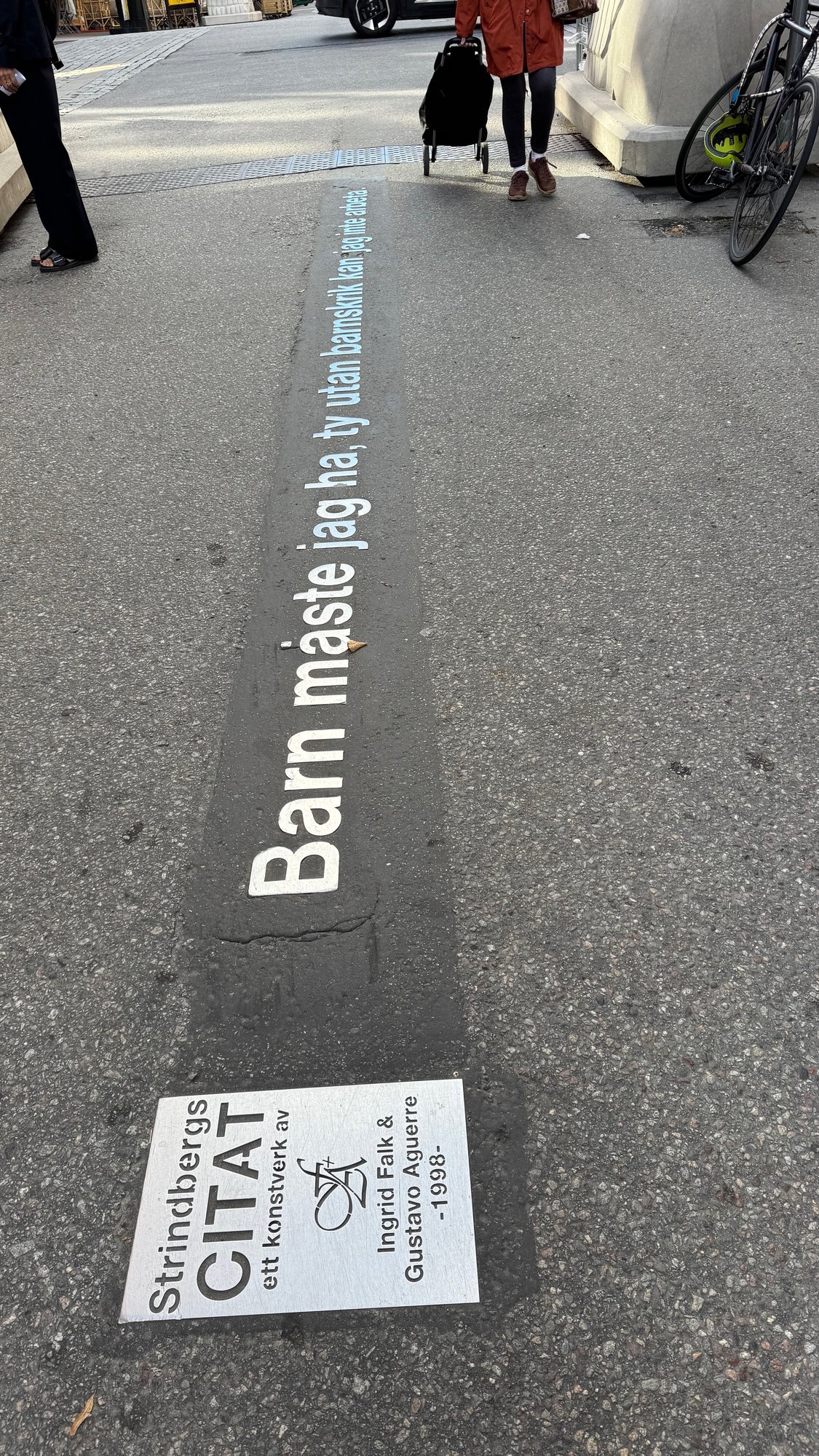
Outside the door, Strindberg is also in the street. A work of art called Strindbergs CITAT by Ingrid Falk and Gustavo Aguerre puts his words into Drottninggatan. It started in 1994 as 83 painted quotes during the first Strindberg Festival. The permanent version from 1998 uses stainless steel. The Stockholm Konst website says that the letters alternate between right and left, and that people stop to read or walk in a zigzag along the text with their heads turned.
One quote in my photo begins with the words I could read on the street: “Barn måste jag ha, ty utan barnskrik kan jag inte arbeta.” In English: “I must have children, for without the screams of children I cannot work.” The translation is mine. I did not find the work or the year that the quote comes from. Look down when you walk to the door.
Practical information and accessibility
The museum is open from Tuesday to Sunday, 12:00 to 16:00. Check the website for holiday closings, because they change each year. Adults pay 120 SEK. Students, seniors and unemployed people pay 80 SEK. Visitors under 19 years go in free. A guided tour needs a booking, by phone, +46 (0)8 411 53 54.
Rules in the rooms
The museum asks you not to bring a bag if you can avoid it. You cannot take outerwear, backpacks, umbrellas or large objects into the rooms. A cloakroom is available. Food and drink are not allowed.
Accessibility
The building is a normal old apartment house. The museum says that it is not fully adapted. There are four steps between the entrance and the lift. The museum can put out a wheelchair ramp if you ask. The lift door is 62 cm wide. The lift is 1 m wide and 91 cm deep. The museum door is 1 m wide and has a threshold. The doors inside the apartment are 60 to 80 cm wide, and most have thresholds. The doors to the exhibition are 90 cm wide.
If you use a wheelchair, ring the intercom at the door and call the museum before you go. The museum website has the full details.
The photos on this page were taken by Zayera Khan during a visit to the museum, and are her own property. Please do not reuse them without permission.
Which Strindberg did I meet in these three rooms? The wall with the colored cards does not say. Maybe that is the point.
Sources:
Strindbergsmuseet, official website;
Ingmar Bergman Foundation, ingmarbergman.se;
Stockholm Konst: Strindbergscitat;
SO-rummet: August Strindberg;
Litteraturhistorien.se: August Strindberg;
Kulturportal Lund: August Strindberg;
Tate Modern press release for the 2005 exhibition of his paintings and photographs;
Panels and signs at Strindbergsmuseet, read on my visit;
Wikipedia: August Strindberg;
Wikipedia: Strindberg Museum;
Wikipedia: Miss Julie.
If you have better facts and better sources, please send them to Zayera, the owner of this website.