Skansen in Stockholm: red houses, a wooden church and a snus and match museum
A hill of old Swedish buildings, with a small museum about snus and matches
- Why visitOld houses, farms, a town quarter, a church and a small museum about snus and matches, all on one hill on Djurgården. Skansen also has Nordic animals.
- Best forAnyone who wants to see how people lived in Sweden over several centuries. Good for families.
- AddressDjurgårdsslätten 49-51, 115 21 Stockholm.
- Getting thereTram 7 from T-Centralen. Bus 67 from Odenplan. Ferry line 82 stops 400 meters away.
- Opening hours28 September to 23 October 2026: weekdays 10:00 to 15:00, weekends 10:00 to 16:00. 24 October to 1 November: 10:00 to 16:00. Hours change by season. Check the website before you go.
- AdmissionDay ticket on 5 October 2026: adult 240 SEK, pensioner 200 SEK, student 200 SEK. Children 0 to 15 years are free. Annual pass: adult 445 SEK, student and pensioner 405 SEK. Prices change by season and day, and online is cheapest. The day ticket includes the Baltic Sea Science Center and Lill-Skansen. The aquarium costs extra. Buy at skansen.se/biljett.
- EventsSkansen 135 years on 11 October. Halloween on 24 October and 28 to 31 October, 15:00 to 19:00. Christmas market from 27 November to 20 December. New Year’s Eve on 31 December. Details below.
- FacilitiesRestaurant and stage at Solliden, storage lockers, accessible toilets, a rest room at the main entrance. Stroller rental at the main entrance costs 75 SEK.
- AccessibilitySkansen is on a hill with steep slopes and cobblestones. A platform lift serves the main entrance. Tram 7 and bus 67 stop at the main entrance, with space for wheelchairs. Details below.
- Snus and Match MuseumMuseum website. I did not find its opening hours or prices.
- Official websiteskansen.se
A sign at the entrance says it twice, in Swedish and in English: Skansen is the oldest open-air museum in the world.
I took these photos on 20 September 2026. They show the sign, the town quarter, the snus and match museum, the church and a few buildings on the hill.
Skansen is big. The museum says it has 190 buildings, from the early 14th century to the 1950s. I did not see all of them. This article covers what is in my photos, and the facts you need for a visit in autumn or winter.
The welcome sign
The sign is dark, with gold text: Välkommen till Skansen. It says Hazelius founded Skansen in 1891. It calls Skansen a place where you meet Swedish history, nature and animals. You can look at homes and farms from across the country, wild Nordic animals, and old gardens.
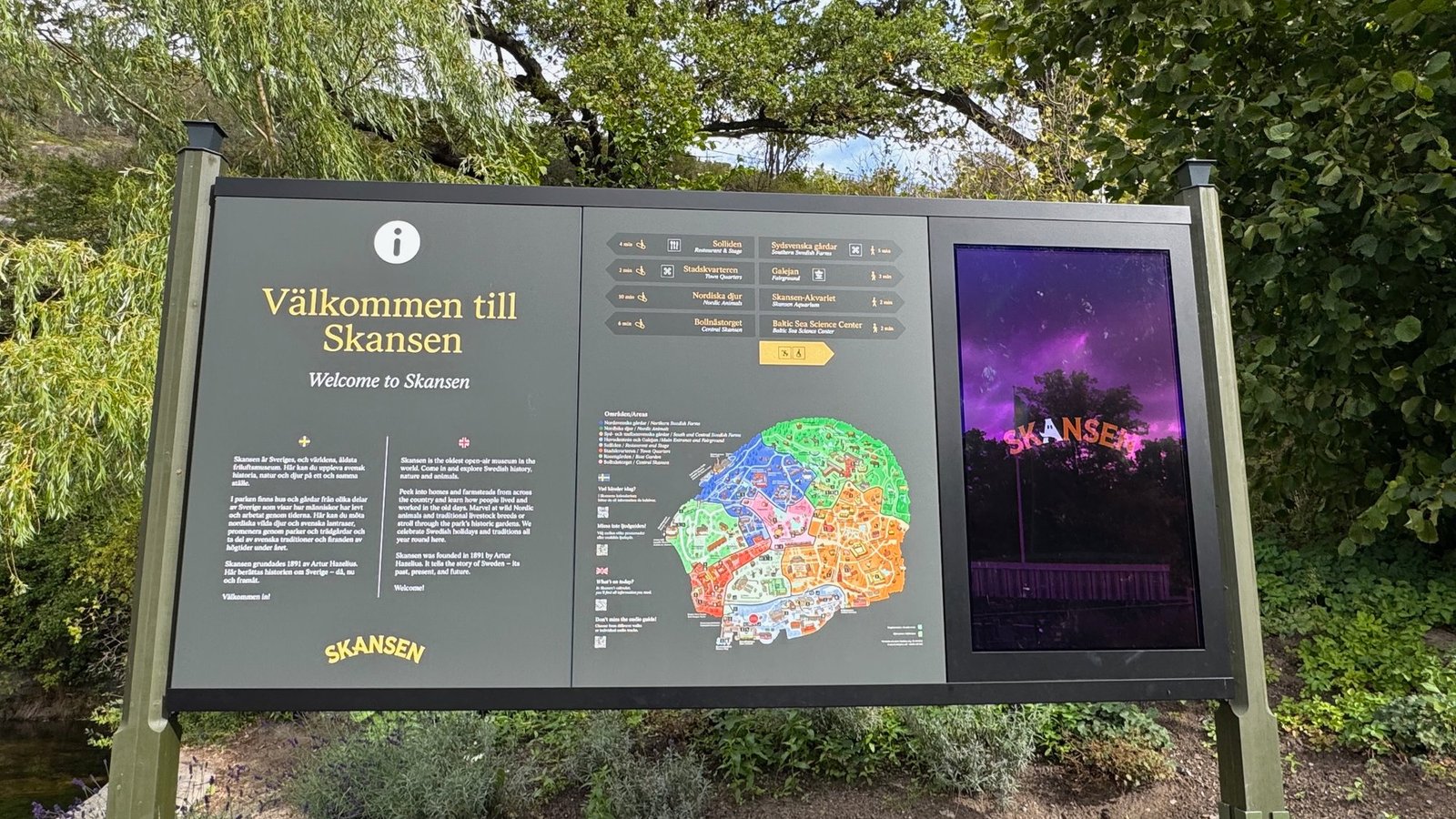
The map splits the hill into colored areas. The sign points to the Town Quarters, the Nordic animals, the aquarium, the Baltic Sea Science Center and the restaurant at Solliden. Take a picture of it. You will use it.
The town quarter
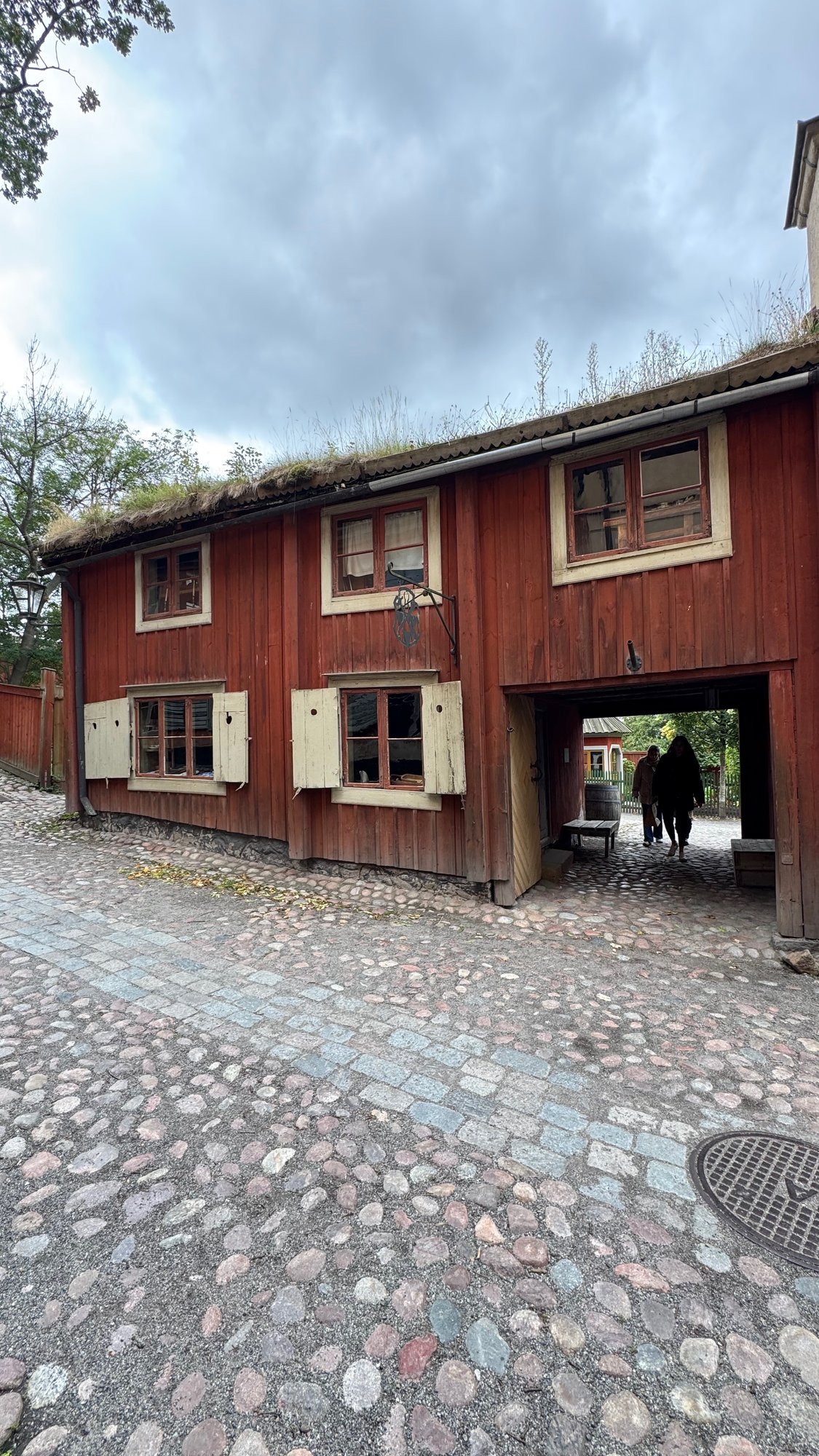
The Town Quarters are the part I liked to look at most. Red wooden houses stand along a cobbled lane. One house has grass on its roof. Cream shutters hang open on the windows, and a low gateway leads to a yard behind.
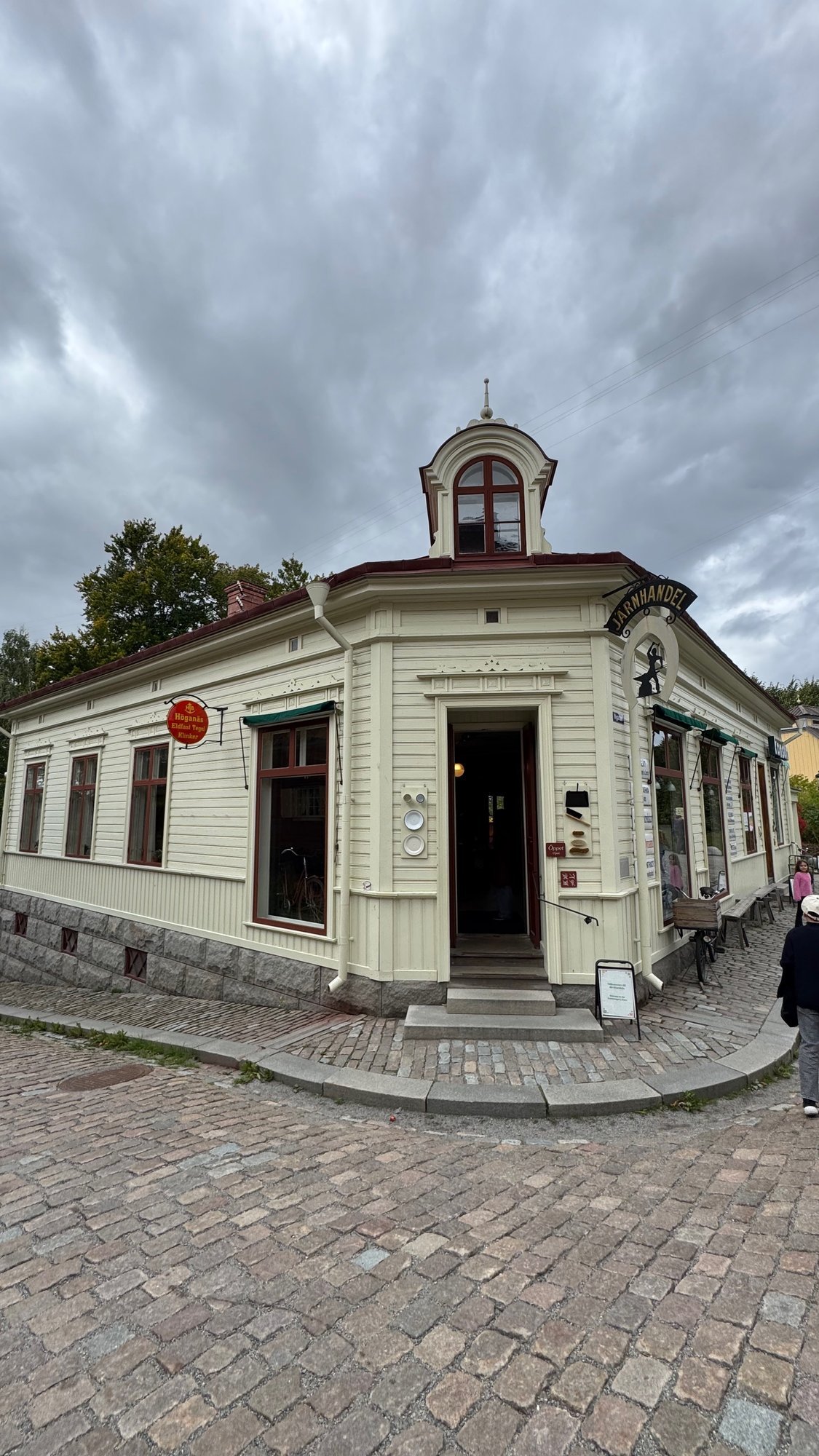
Around the corner stands a cream house with a small tower on the roof. A black iron sign reads Järnhandel, which means hardware store. A bicycle stands in one window. A small sign at the door says Öppet, open.
The Snus and Match Museum
Visit Stockholm places the Snus and Match Museum on the Skansen grounds. It says the museum follows snus and matches from the 17th century to today. It names rococo boxes, carved snus dogs and colorful match labels. The museum also has a creative workshop.
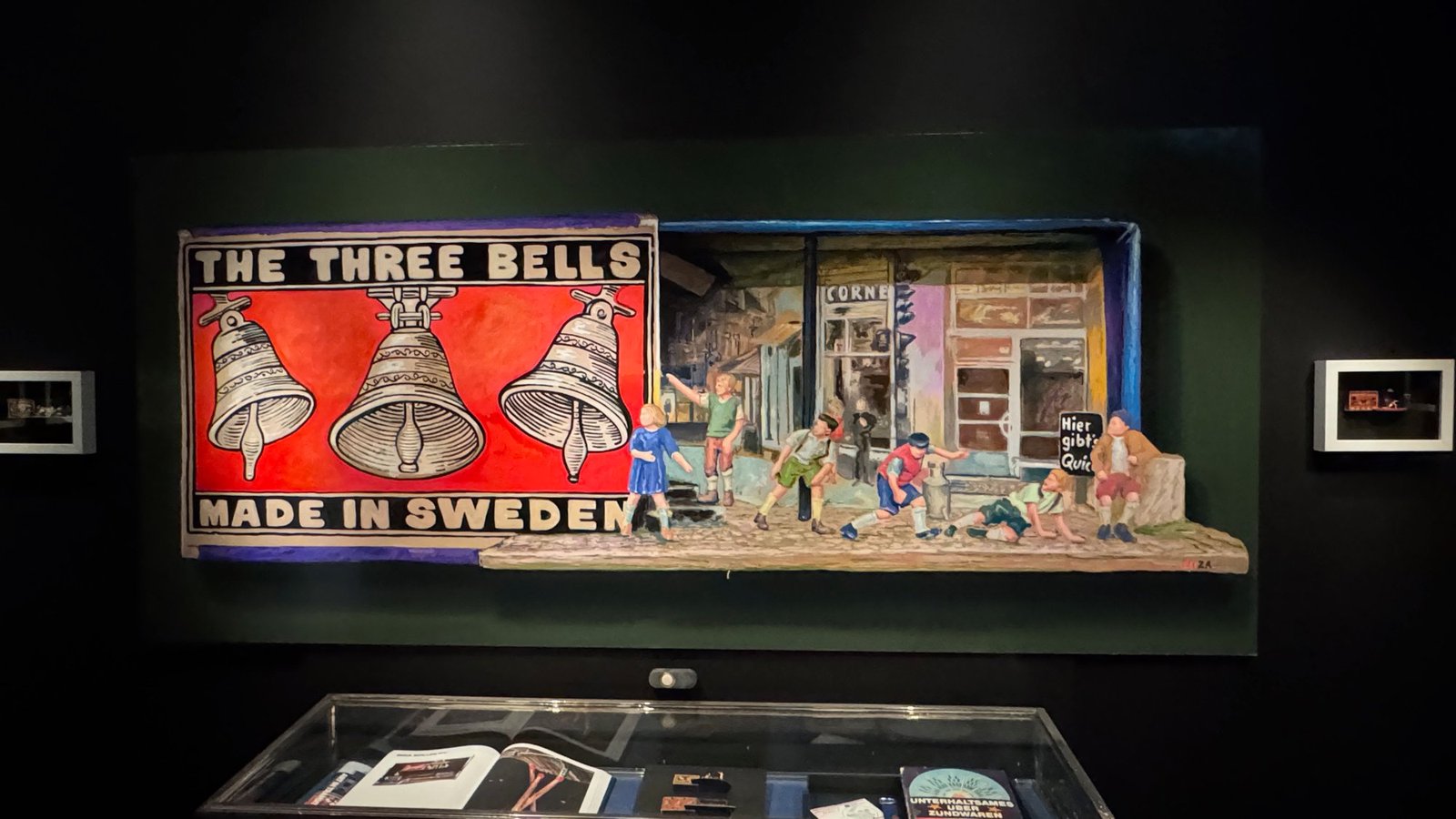
My photos from the museum show three things. First, a matchbox diorama. A red label with the words The Three Bells, Made in Sweden sits next to a street scene with small painted children.
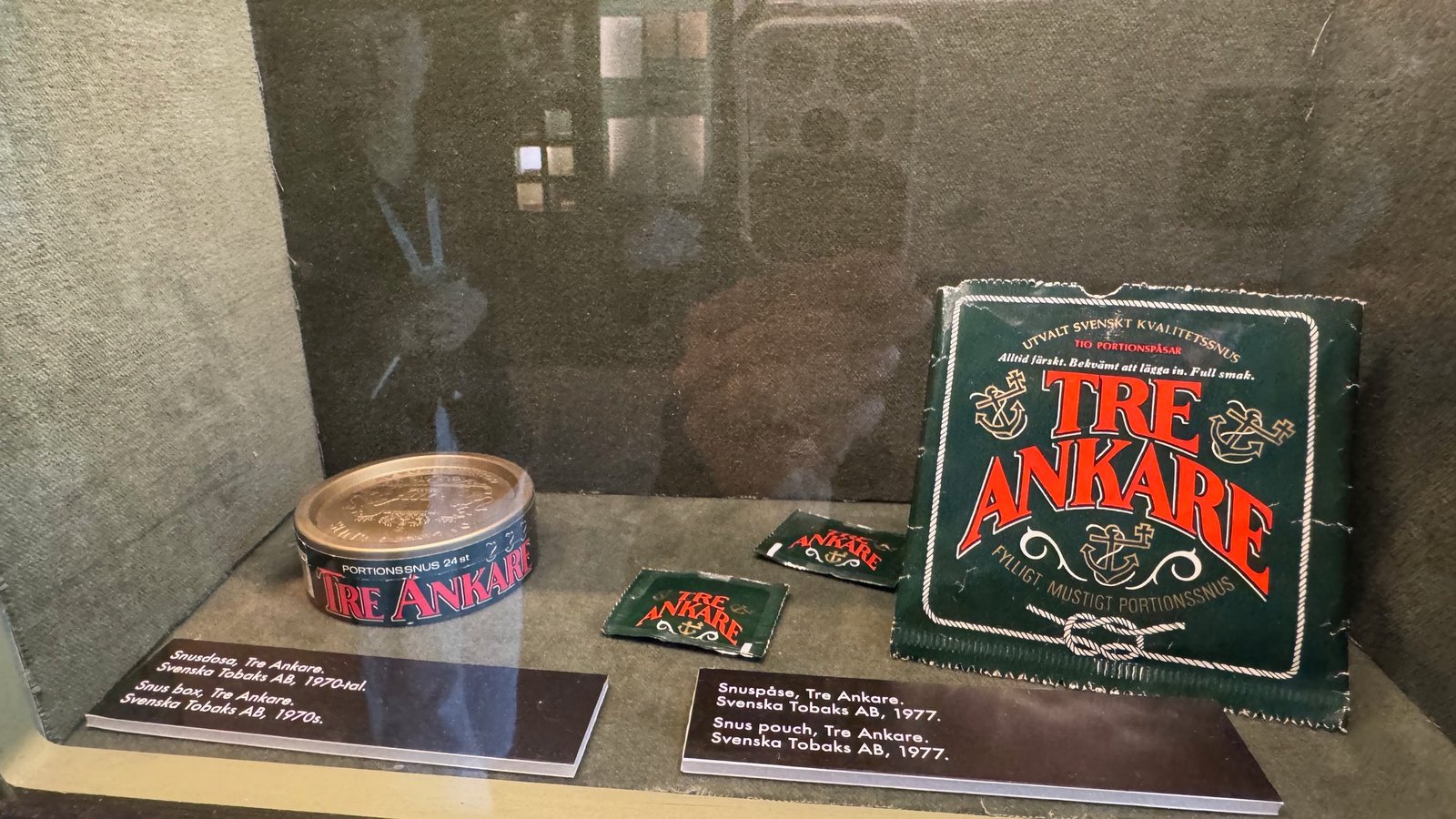
Second, a display case with a round snus tin and snus pouches called Tre Ankare. The labels name Svenska Tobaks AB. They date the tin to the 1970s and the pouch to 1977.
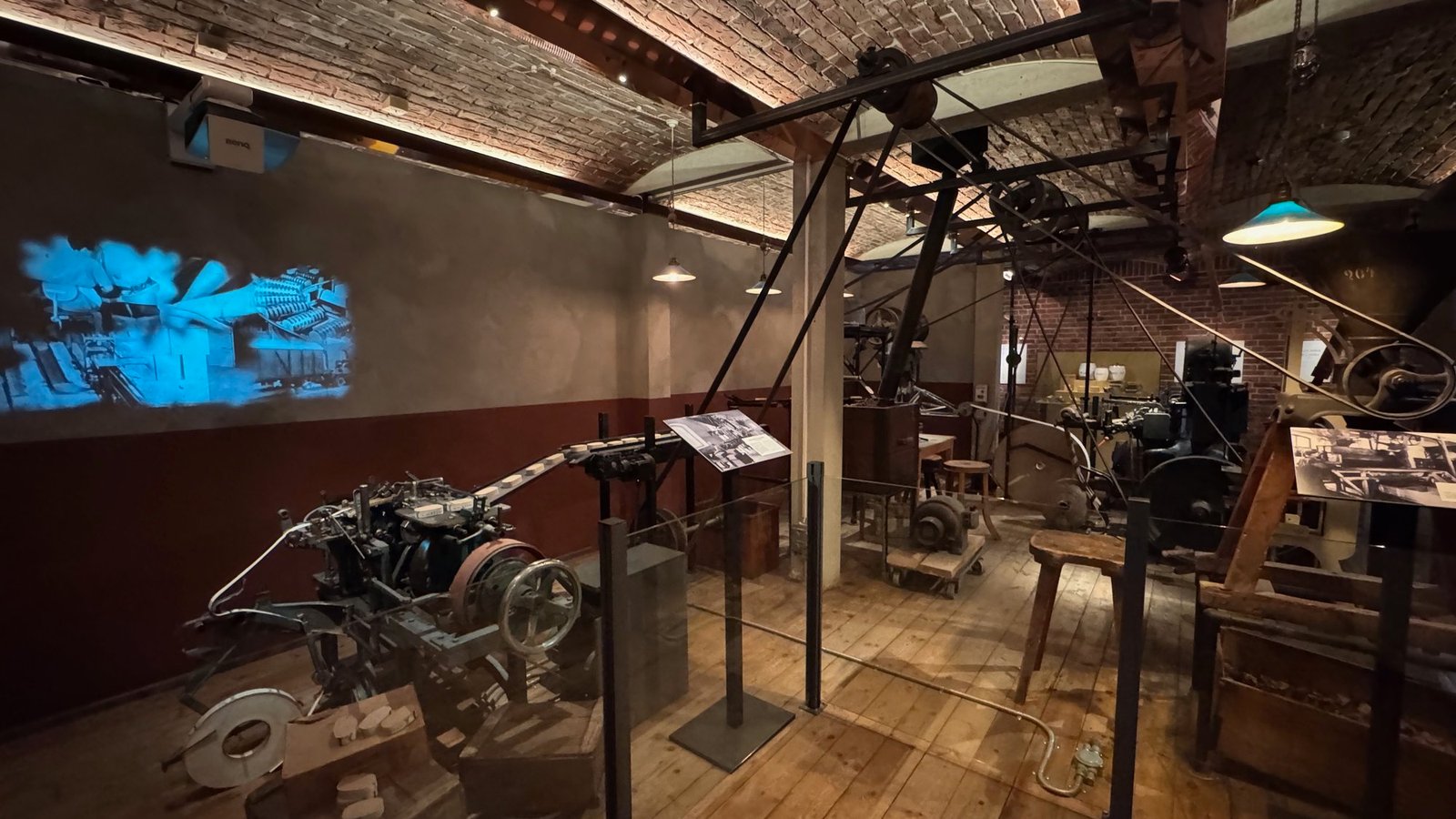
Third, a hall with old machines, belts and wheels under a brick vault. A film plays on the wall in blue light. I do not know what each machine did, and I did not find a source that says. Ask the staff.
Seglora church and the bell tower
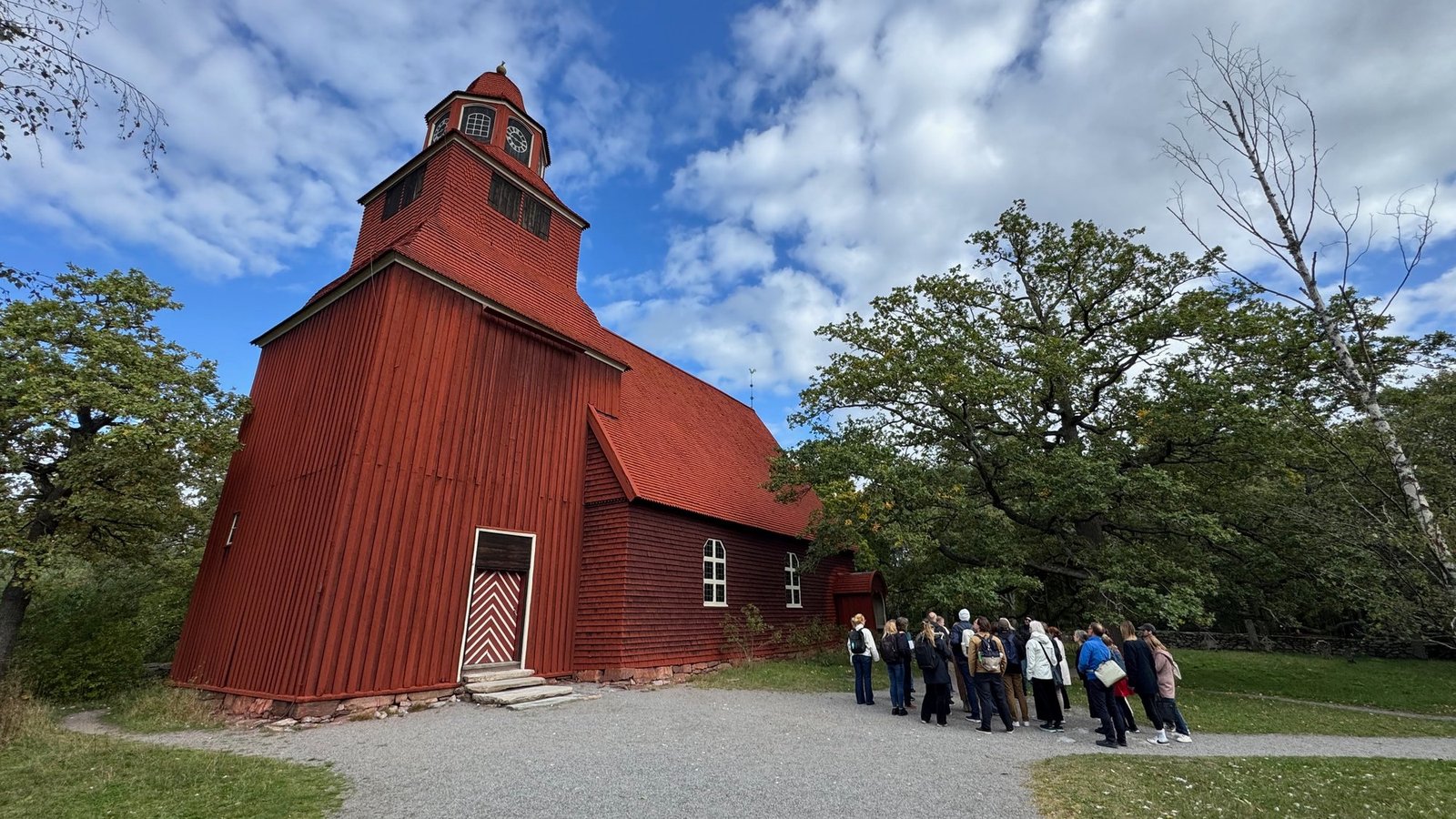
The red wooden church in the first photo is Seglora church. It has a tall tower with a clock and a small lantern on top. The door has a white zigzag pattern. A group of visitors stood by the wall when I took the photo.
Wikipedia says the church came from Seglora near Borås in western Sweden. It says Skansen bought the church in 1916 and opened it again in 1918. I found these dates only on Wikipedia, so treat them as one source.
Skansen says Seglora church has a fixed ramp and an induction loop. That helps visitors who use wheelchairs or hearing aids.
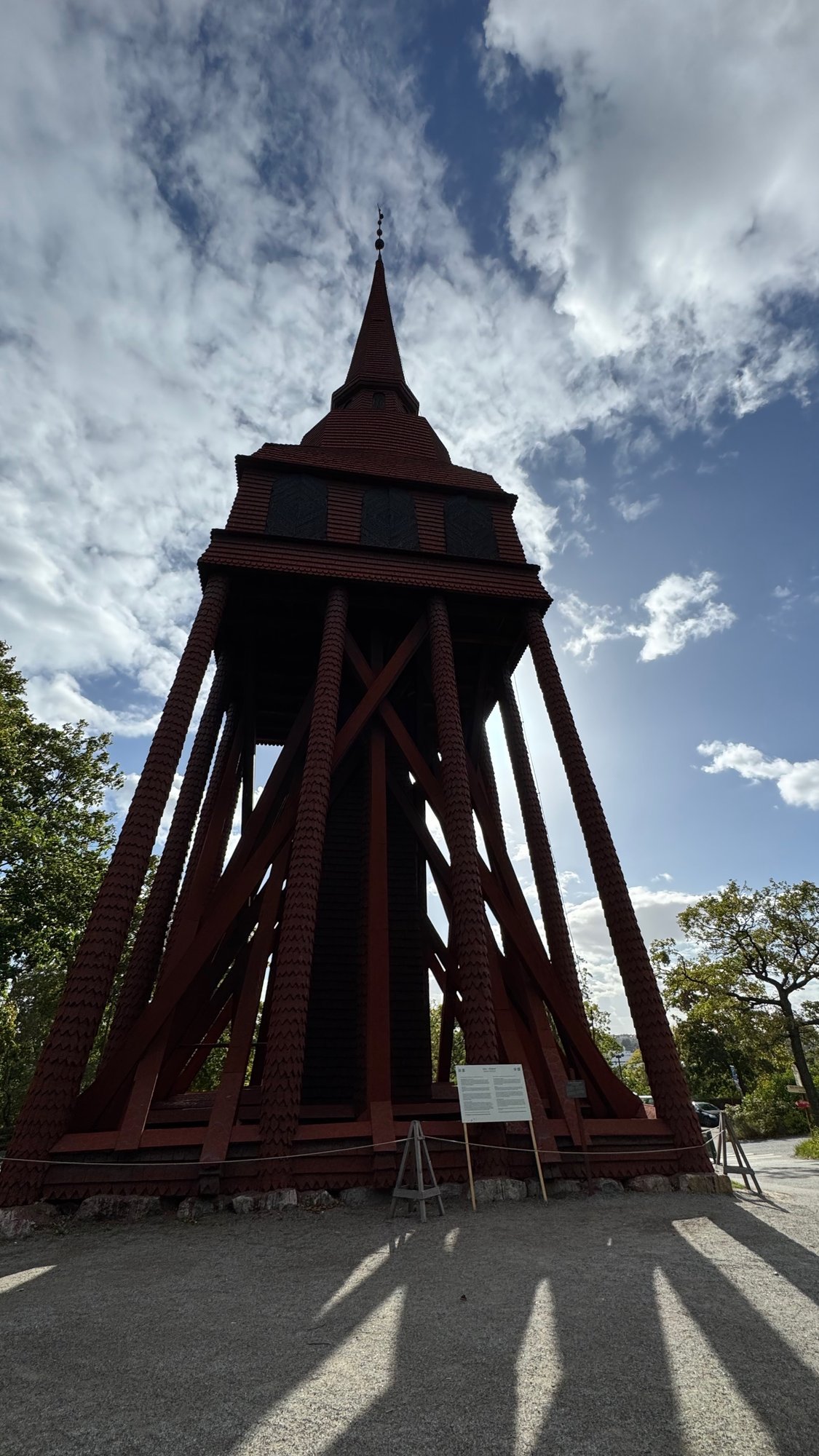
Not far away stands a red bell tower. Its legs lean inwards and are braced with crossed beams. A thin spire sits on top. An info sign stands at the foot, but I did not read it. So I do not state where the tower came from.
The windmill and the rune stone
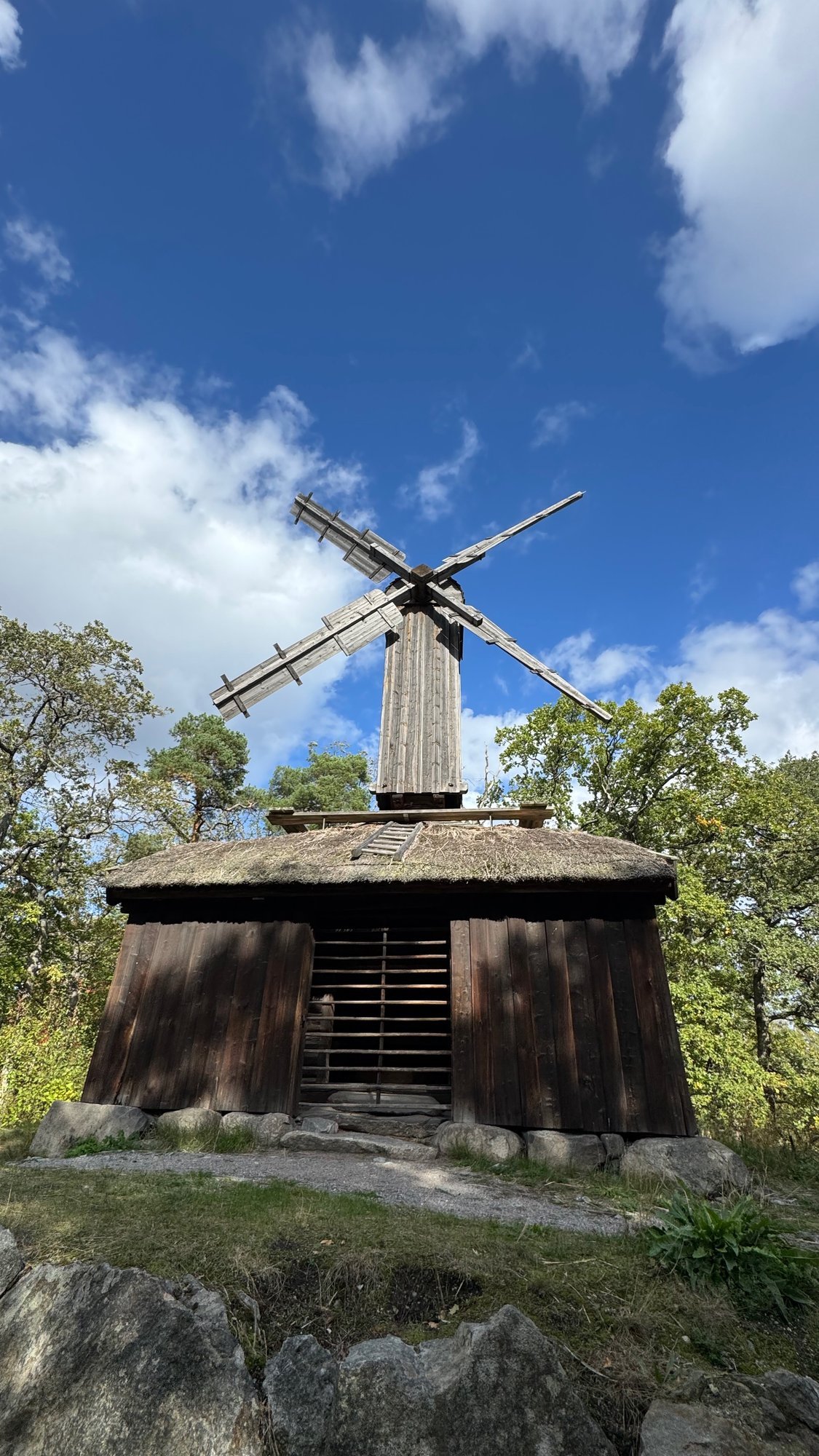
A dark wooden windmill with four wings stands among trees. It has a thatched roof and rests on large stones. A ladder leans on the roof.
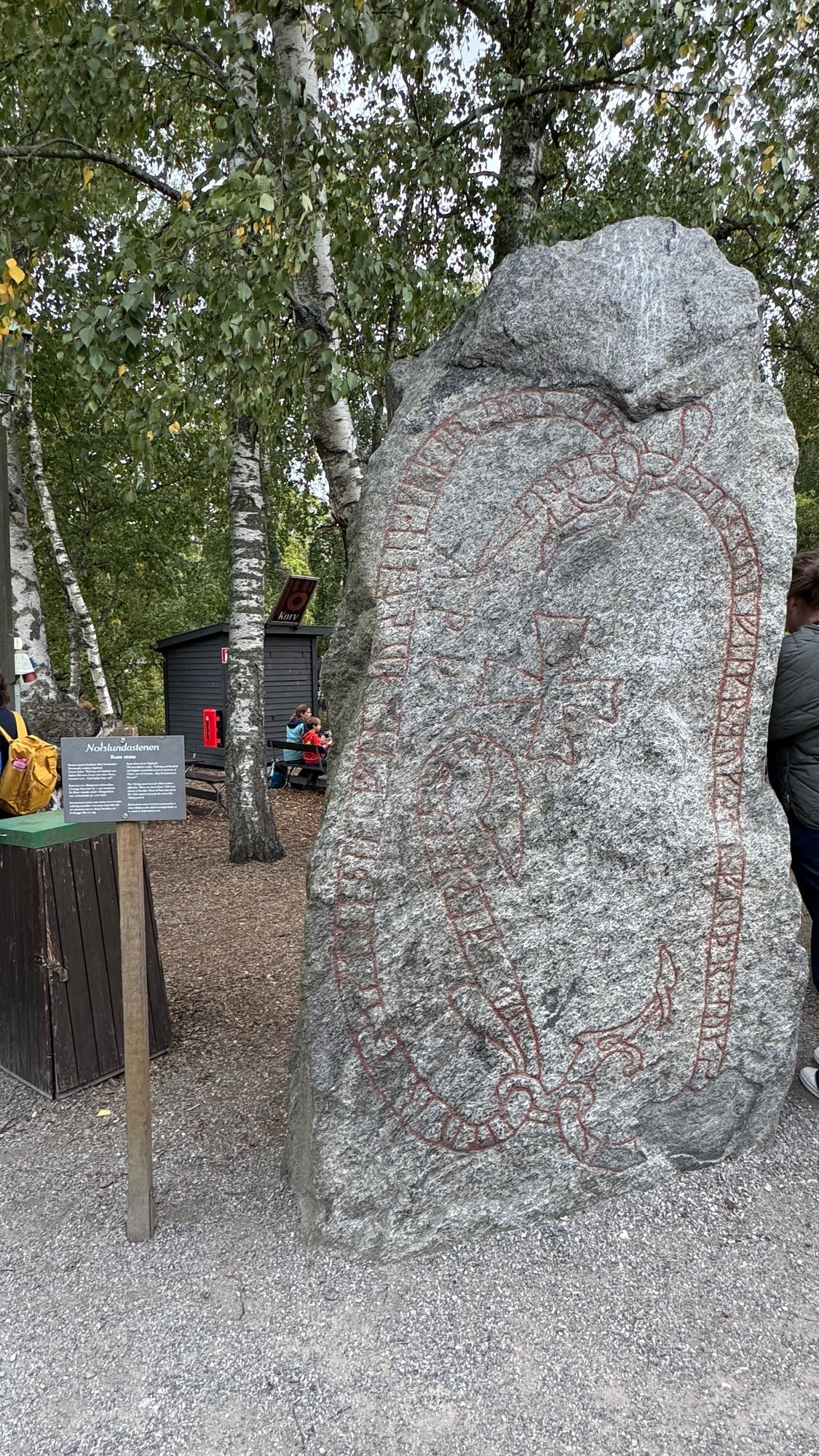
The rune stone is tall and gray. Its carved lines are painted red. A snake band with runes curves around a cross in the middle. The sign next to it says Norslundastenen, rune stone. I did not find facts on its age or origin in the sources I read, so I leave them out.
Behind the stone, a small kiosk sells korv, sausage. A thousand years of writing, and a hot dog stand in the same photo.
More buildings on the hill
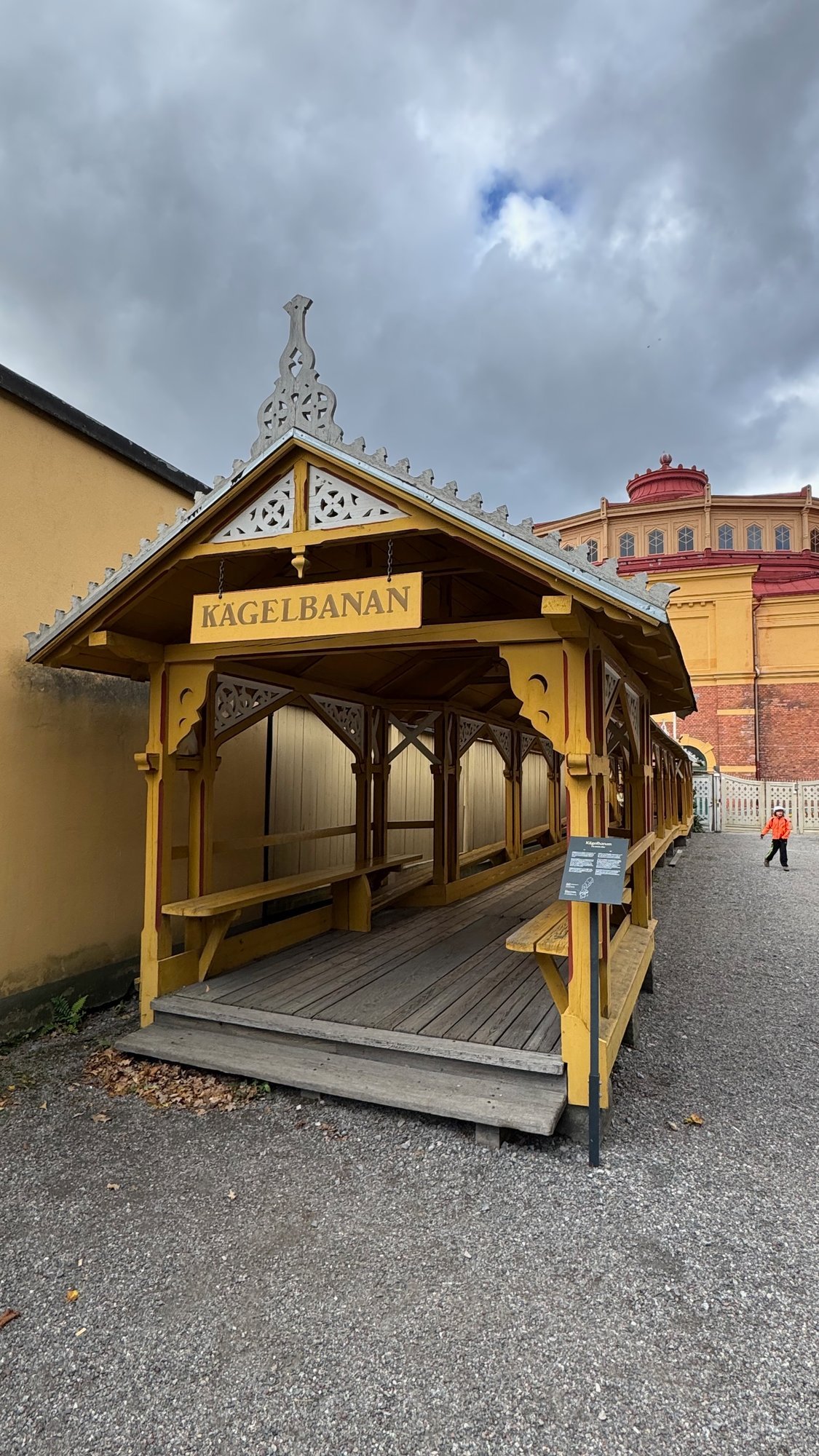
Kägelbanan is a yellow wooden pavilion with carved wood on the gable. Benches run along both sides. A bigger yellow building with a red roof stands behind it.
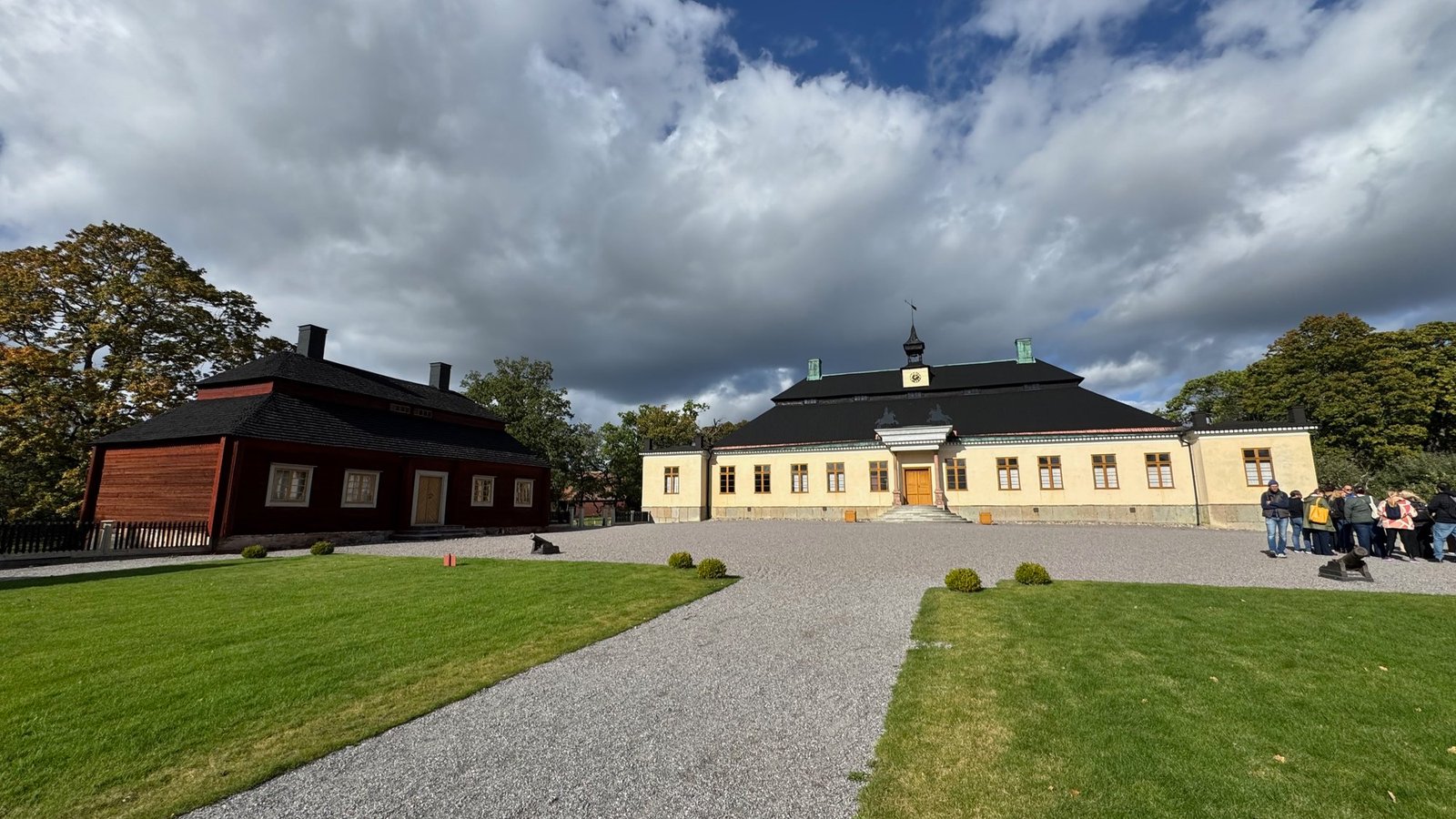
In another part of the park, a long cream building with a black roof and a small clock tower faces a gravel yard. A dark red wooden building stands to the left. Two small cannons stand on the gravel. I did not see a name sign, so I do not name the buildings.
Events and activities
Skansen keeps a calendar for the year. In autumn and winter, five dates stand out. All facts below come from skansen.se.
Skansen turns 135 on 11 October. The park opens from 10:00 to 16:00. Skansen promises 135 cakes, a historic fika, ice cream for all children and coffee for the adults.
Halloween. It runs on 24 October and 28 to 31 October, from 15:00 to 19:00. Skansen calls it “cozy and just enough spooky”. There is trick or treat at seven stops in the town quarter, a pumpkin disco on Bollnästorget, a parade from Solliden at 18:45, and a flashlight hunt for lost kittens. A maze and a witch’s broomstick course are also on the list. The graveyard at Seglora church opens at 17:00 and is for ages 12 and up. Halloween is part of the normal ticket. Trick or treat needs a booked time slot, for children and for adults.
Christmas market. It starts on 27 November. Skansen says the market has its origins in 1903. The stalls sell food for the Christmas table, marzipan, Christmas bread, and local crafts in textile, wood, ceramics and wool.
Christmas Eve and New Year’s Eve. Skansen opens on 24 December from 10:00 to 14:00. On 31 December, it opens in the evening from 20:00 for New Year’s Eve.
In summer, Skansen runs Allsång på Skansen on Tuesdays, dance evenings at Galejan, and Jazz på Skansen. Skansen says jazz has been part of summer there since the 1950s. I list these only so you know to come back. The page does not show 2027 dates yet.
The calendar also lists places where you can see old crafts. Examples are the bookbinder’s shop, the shoemaker’s workshop, the silver press and the iron shop from my photos. The glass works, Stockholms glasbruk, shows craftspeople at work, and it opens from 10:00 to 17:00. The calendar shows the other buildings open from 10:00 to 15:00. This is the weekday schedule, so check the day you plan to go.
Skansen also lists bookable events for weddings, christenings, company events and film shoots. You can marry in Seglora church. I did not find prices for these.
Animals and children
Skansen is also a zoo. It has Nordic wild animals and Swedish heritage breeds. The calendar names seals, Gotland horses and lapp owls. Staff give animal talks every day, called Djurprat. I did not find a feeding schedule, so ask at the entrance.
Lill-Skansen is the children’s part. It has rabbits, guinea pigs, snakes, birds, miniature pigs and more. There is a petting farm with sheep, indoor crawl tunnels, a snake slide and a pacifier ceremony with a diploma. Children 4 to 10 years can book a mini zookeeper experience. Lill-Skansen is part of the day ticket.
The park has playgrounds for different ages: Ekorrparken for climbing, Päronparken for quiet play, and the fairground Galejan in season. There is also Väla school, where children can compare school then and now. Children under 13 must have an adult with them. Children 13 to 15 may come alone, but Skansen recommends an adult.
The Skansen Aquarium is separate, and it costs extra. It has monkeys, fish, crocodiles, scorpions, parrots and frogs. It also breeds endangered small primates and lemurs. It opens at 10:00, and it closes between 16:00 and 18:00 depending on the season.
Tickets and annual pass
I looked at the ticket page on Monday 5 October 2026. A day ticket for an adult cost 240 SEK. Pensioners and students paid 200 SEK. Students show a valid ID. Children from 0 to 12 years cost 0 SEK, and so do children from 13 to 15 years. Add a free child ticket to an adult ticket when you book.
Skansen says the price changes by season and is lowest when you buy online. Check the price for the day you plan to go.
The day ticket includes the Baltic Sea Science Center and Lill-Skansen. The aquarium costs extra. The funicular costs 35 SEK.
The annual pass costs 445 SEK for an adult and 405 SEK for a student or a pensioner. Skansen says the pass pays for itself on the second visit. It is digital, and you use it on your phone. Skansen also sells gift vouchers for a day ticket or an annual pass.
Visit in autumn and winter
Skansen shortens its hours in autumn. From 28 September to 23 October 2026, it opens 10:00 to 15:00 on weekdays and 10:00 to 16:00 on weekends. From 24 October to 1 November, the school holiday, it opens 10:00 to 16:00.
Halloween has its own hours, from 15:00 to 19:00. The events section above has the details.
The Christmas market runs from 27 November to 20 December. Hours are 10:00 to 17:00 on Friday and Saturday, and 10:00 to 16:00 on Sunday. Skansen is open on 24 December from 10:00 to 14:00, and from 25 December to 10 January from 10:00 to 16:00. On 31 December it also opens from 20:00 to 24:00. Check the opening hours and prices page before you go, because the hours can change.
Getting there and access
Tram 7 runs from T-Centralen to Djurgården. Bus 67 runs direct from Odenplan to Skansen. Buses 69 and 76 stop at Djurgårdsbron, and from there it is a 950-meter walk. Ferry line 82 from Slussen stops at Allmänna Gränd, 400 meters from Skansen. Parking is limited.
The hill makes access hard in places. Skansen describes steep slopes, cobblestones and long distances between sights. A platform lift serves the main entrance. A funicular, Bergbanan, runs up the hill. It costs 35 SEK for a trip up or down from age 4, and it is free for a wheelchair user with a companion. Fixed ramps serve Seglora church and several other buildings. The park has accessible toilets, and a rest room at the main entrance. Only service dogs may enter, and not the aquarium or Lill-Skansen. Questions go to tillganglighet@skansen.se.
If you had one hour at Skansen, would you spend it outside on the hill, or inside with the matchboxes?
Photo gallery
All photographs on this page were taken by Zayera Khan during a visit to the museum, and are her own property. Please do not reuse them without permission.
Sources: Skansen, official website; Skansen, opening hours and prices; Skansen, getting here; Skansen, accessibility; Skansen, houses and farmsteads; Skansen, Halloween; Skansen, biljett; Skansen, högtider och traditioner; Skansen, marknader och temadagar; Skansen, evenemang och aktiviteter; Skansen, kalender; Skansen, för barn; Skansen, djuren; Skansen, Lill-Skansen; Skansen, Skansen-Akvariet; Visit Stockholm: Snus and Match Museum; Snus and Match Museum, website; Wikipedia: Seglora.