
Sigtuna: Sweden’s oldest town, built for kings and bishops
How a small town on Lake Mälaren shaped power and religion in Sweden
- Why visitThe oldest planned town in Sweden, with a pedestrian main street, church ruins, a brick church and a museum. You can walk all of it.
- Best forAnyone who wants to see where Swedish kings, coins and bishops began. A good half-day or full-day trip from Stockholm or Uppsala.
- WhereSigtuna, on Lake Mälaren, in Stockholm County.
- Getting thereFrom Stockholm: SL commuter train to Märsta, then bus 570 or 575 to Sigtuna. From Uppsala: train and bus, about 50 minutes in total. Details below.
- Tourist informationOpen daily 10:00 to 16:00 from 2 May to 30 September. I did not find the hours for October.
- Sigtuna MuseumOpen daily 12:00 to 16:00 in October. Hours change by month. Entry 60 SEK, free for everyone under 20, annual pass 100 SEK. Public holidays have different hours. Opening hours and prices.
- Town hallOpen daily 12:00 to 16:00 from 1 July to 18 August, and on special occasions. Free entry. You can book a guided visit. Information about the town hall.
- MariakyrkanOpen daily. Monday to Tuesday 8:00 to 17:00, Wednesday 8:00 to 18:30, Thursday to Sunday 8:00 to 17:00. Services every day. Details below.
- Guided toursThe tourist office lists guided tours of the town. The town hall takes bookings for guided visits. I did not find prices, languages or durations for the town tours. Details below.
- AccessibilityThe main street has cobblestones. I did not check step-free access in the churches or the museum.
- Official websitedestinationsigtuna.se (in Swedish)
I went to Sigtuna on 19 September 2026.
Sigtuna is small. It is also one of the places where Sweden began. The sources say kings had coins made here, and bishops had their seat here. Today it has a main street, red brick, gray ruins and a lot of green.
This article has three parts. First, the history, with the sources marked. Second, what I saw. Third, what you can do there now, and where to go from there.
A town built on a plan
Most old towns grew without a plan. Sigtuna did not. Ortshistoria says the town was founded in the 970s according to a fixed plan. Vikingaliv says Erik Segersäll founded it around 980. Destination Sigtuna says around 970, also by Erik Segersäll.
Vikingaliv says the town had a clear purpose: a Christian center of power on the shore of Lake Mälaren. Destination Sigtuna says about 1,000 people lived here around the year 1000. That was a lot for Sweden at that time.
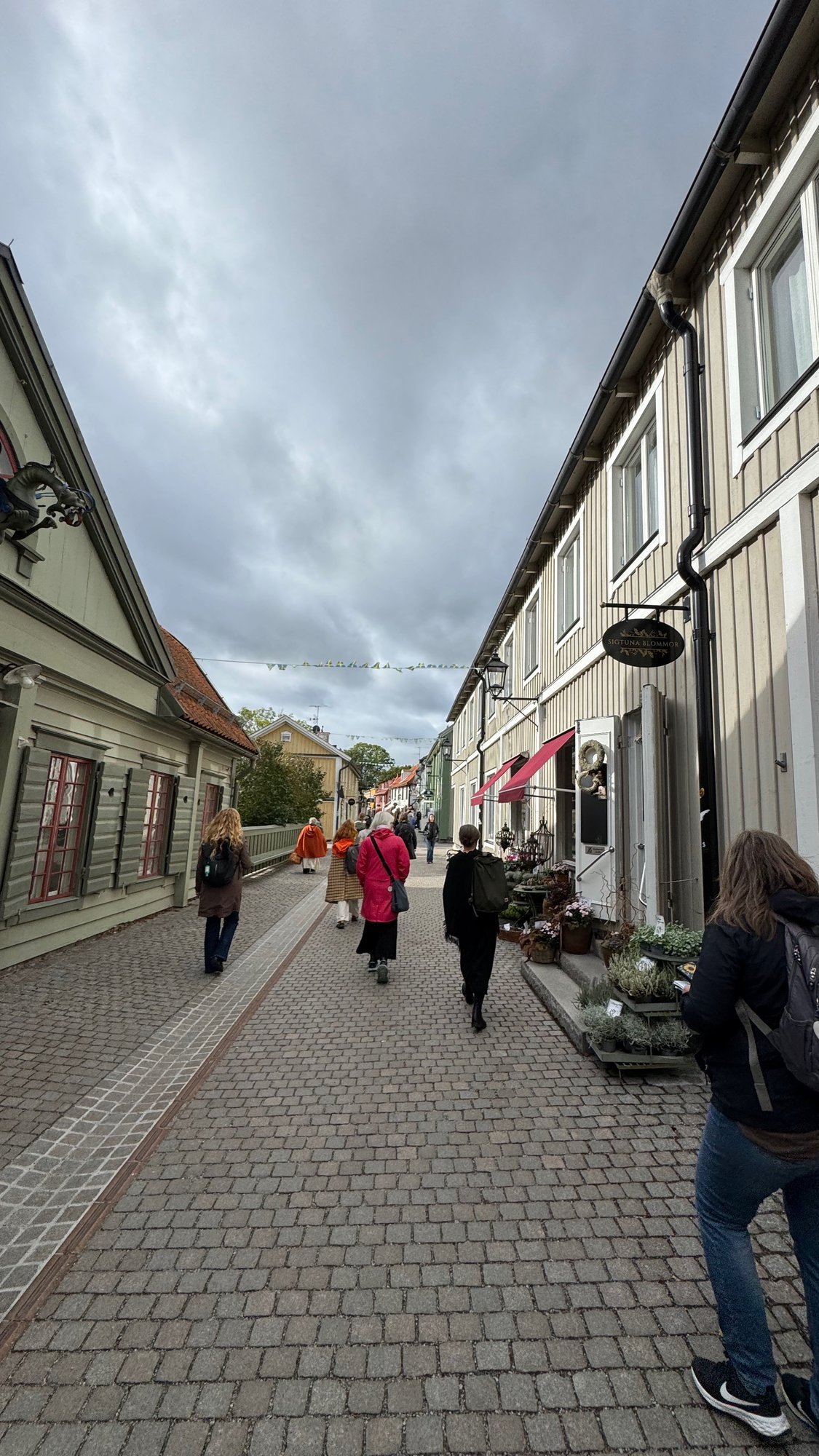
The street plan still exists. Stora gatan, the main street, runs through the town as it did then. Destination Sigtuna calls it Sweden’s first pedestrian street. I like that. A town that is a thousand years old, and cars still do not belong on its main street.
Kings, coins and plots
A king who builds a town needs people to live in it. Vikingaliv says the crown gave streets and plots to nobles. That is power in a simple form. If you get a plot, you owe the king. I read this as a way to tie the elite to the crown, but the source does not say it in those words.
The second tool was money. Vikingaliv says King Olof Skötkonung had the first Swedish coins made in Sigtuna around 995. Ortshistoria gives a wider range: minting took place here from the 990s to the 1030s. Destination Sigtuna says only that Sweden’s first coins were made here.
The sources disagree on who was king when the town began. They agree on Sigtuna as the first place with Swedish coins. A coin carries a name and a face. It says who rules. It also says that trade is under that ruler’s control.
One more name belongs here. Destination Sigtuna writes about Ingegerd Olofsdotter, the daughter of Olof Skötkonung. She married Prince Yaroslav, and the Orthodox tradition honors her as Saint Anna. I found this on one site only. It shows that a king’s daughter from this town became a power in another land.
Bishops, churches and friars
Power in the Middle Ages came as a pair: the crown and the church. Sigtuna had both.
Vikingaliv says Sigtuna became the first bishop’s seat in the country. Ortshistoria is more exact. It says Sigtuna was a bishop’s seat from the 1070s to the 1120s. In 1164 the episcopal seat moved to Gamla Uppsala.
The town had many churches. Ortshistoria says church remains date from the late 1000s. Several churches stand today as ruins. Destination Sigtuna names the ruin of St. Olof. I saw gray stone ruins with arches, and I did not note which ruin was which.
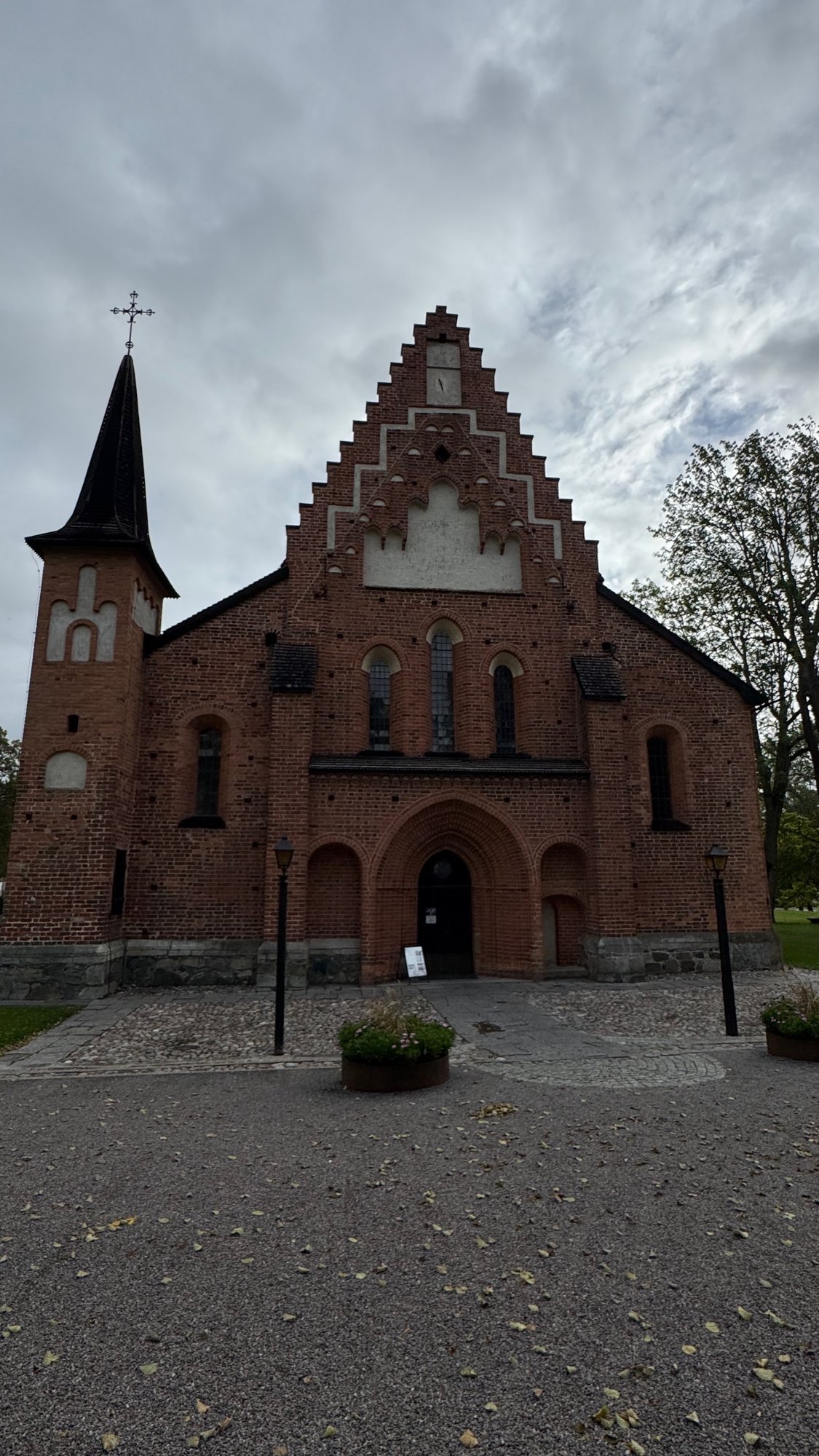
Mariakyrkan is different. It still stands, and it is built of red brick. Destination Sigtuna calls it the oldest brick church in Sweden. Wikipedia says the church dates from the 13th century and that Dominican friars used it. I found the Dominican link on Wikipedia only. Treat it as one source.
This is my reading, not a source. A king who has the church beside him is harder to challenge. A church beside the king is safer. Both sides gain from the pair.
Why the power moved away
Sigtuna did not stay at the top. Vikingaliv says Uppsala and Stockholm grew stronger in the 1200s. Fires and raids hurt the town. By the 1700s it was a small town with a local role.
Wikipedia dates one raid to 1187. Wikipedia has a page called “Pillage of Sigtuna”. I found the 1187 date there only. Wikipedia also says that excavations have not confirmed the traditions of a destroyed town. It names another reason for the decline: the land rose, and ships had a harder time reaching the town on Lake Mälaren. Other sources I read give no date for the raids.
The church tells the same story. The bishop left in 1164, and the archbishop’s seat in Uppsala took the role. The king and the church moved to places with more land and more people.
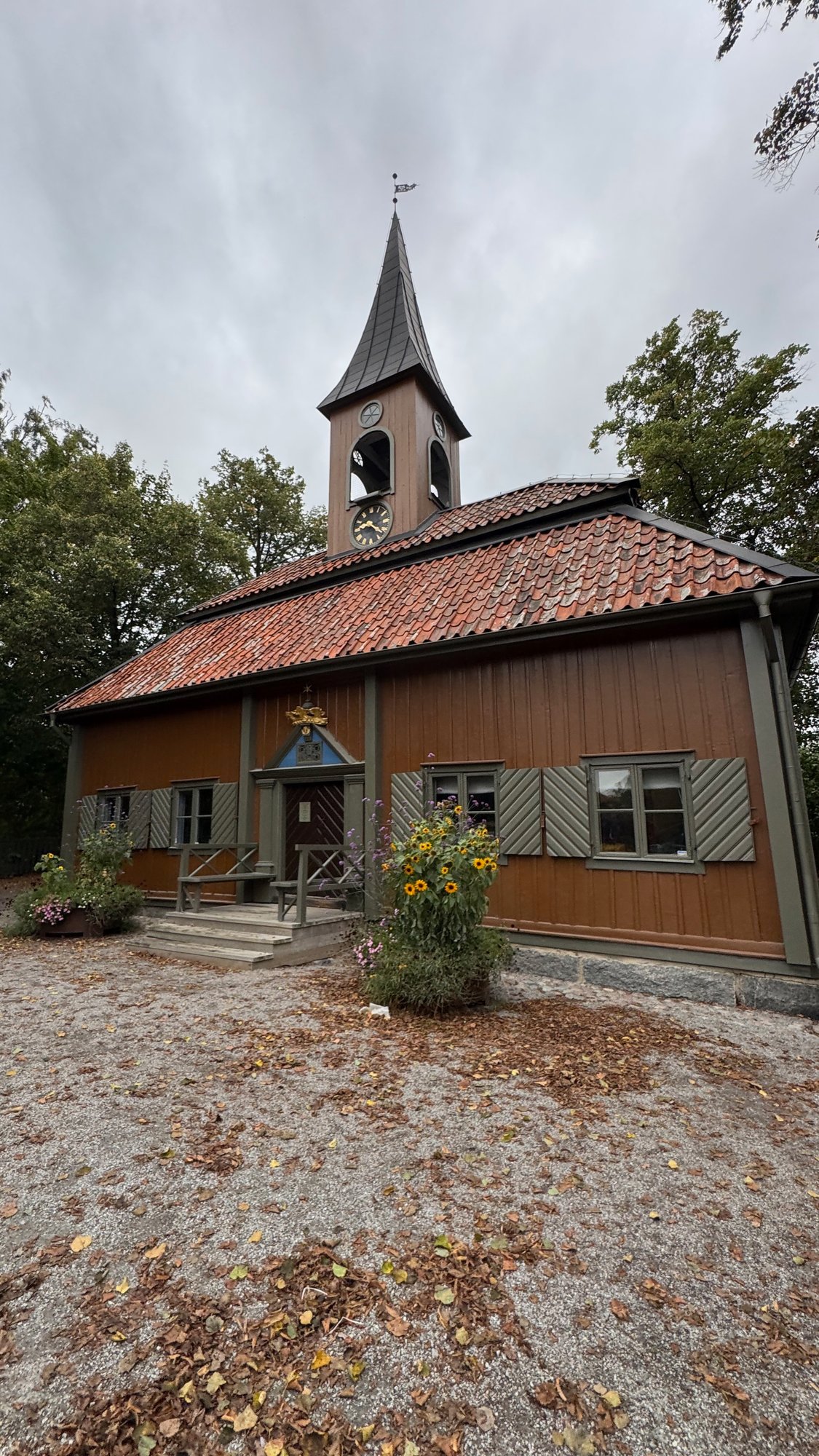
One date from the late period stays visible. The town hall on Stora torget was finished in 1744. The municipality says it is one of the smallest town halls in Sweden. It has a council room and a guard room. The guard room now holds an exhibition about the history of the house. The council room is kept as it was when the town court held its last meeting here in 1947. It is open daily 12:00 to 16:00 from 1 July to 18 August, and on special occasions. Entry is free. You can also book a guided visit.
More history: churches, friars and the crown
Svenska kyrkan says Sigtuna was Sweden’s first Christian town, from the late 900s. That is the end of the Viking Age. The first churches were built of stone between the late 1000s and the middle of the 1100s. The church says it found no sign of older wooden churches.
The town had eight churches in the end, with parish churches and private chapels. In the 1200s the town was sorted into three parishes. St. Per served the west. St. Lars was the town church. St. Olof served the area around Garnsviken. Wikipedia says St. Olof is among the oldest of the ruins, from the middle of the 1000s. I found that date on Wikipedia only.
The Dominicans came in the 1230s. They were friars, not monks. A monk lives in a closed house. A friar preaches and teaches among people. Svenska kyrkan says the church drew people from the whole area, for services and for teaching.
Their church is Mariakyrkan. Stockholms läns museum says work began in the 1230s. It says the church was probably consecrated in 1247 by Archbishop Jarler and finished around 1255. The museum calls it the oldest large brick building in Sweden. Destination Sigtuna says the friars made and fired their own tiles. Brick was new in the Mälaren valley then.
Wikipedia says the convent trained many church officials, among them several archbishops. It also says Archbishop Jarler was buried in the church in 1255. I found both claims on Wikipedia only.
See the pattern. The bishop left Sigtuna in 1164. The friars came about 70 years later. The church kept a strong place in the town, even after it lost the bishop’s seat.
Gustav Vasa and the end of the convent
Around 1530, the authorities ordered the three parish churches closed. The friars were expelled, and the convent buildings were torn down. Svenska kyrkan, Destination Sigtuna and Stockholms läns museum agree on this date. Mariakyrkan stayed and became the parish church for the whole town. Stockholms läns museum says it was the best fit for the new form of service. The bricks from the convent went to Venngarn and Svartsjö.
The year 1530 is the time of King Gustav Vasa. Wikipedia says the pope refused to accept the archbishops he proposed. In 1531 Gustav named Laurentius Petri archbishop himself, and the pope lost his hold on the Swedish church. Wikipedia also says Gustav moved power from local clergy to centrally named bishops, and that church property was later taken over by the state.
I did not find a source that says why Gustav Vasa acted against Sigtuna. The sources I read do not name him in connection with the town. The sources only name the Reformation and the date. This is my reading, not a source: a king who wanted control over the church had no use for a town where the church had so much weight.
Stora gatan and the old town
Stora gatan is the best start. Low wooden houses stand along the cobbles. Many are yellow or red. There are small shops, a flower shop with a sign over the door, and cafés.
It is easy to walk. The street is short, and you reach the square in a few minutes.
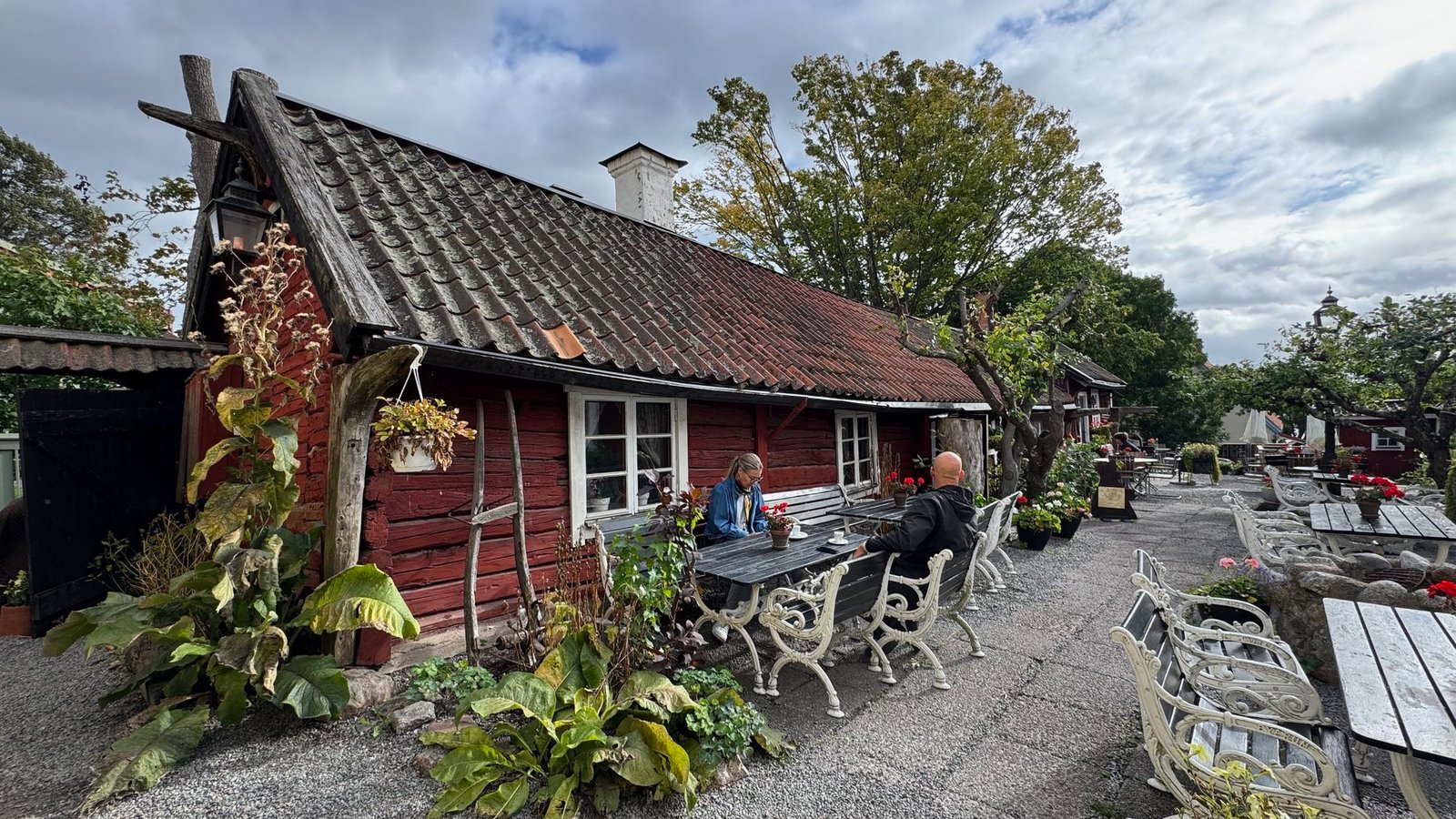
In a side garden I found a café in a red log cottage. Tables stood on the grass under trees. I did not note the name. I did not eat there, so I give no review.
The ruins and Mariakyrkan
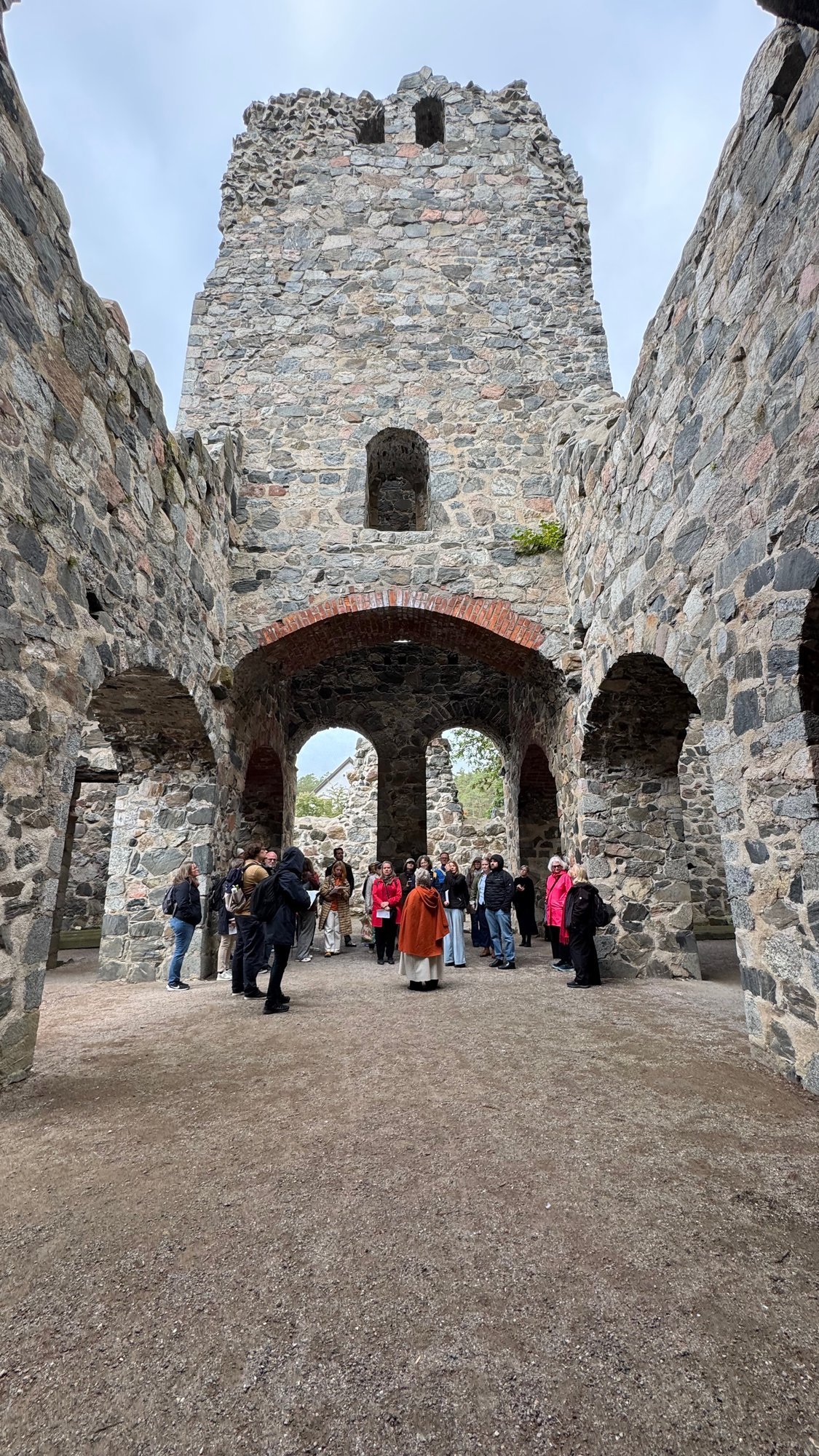
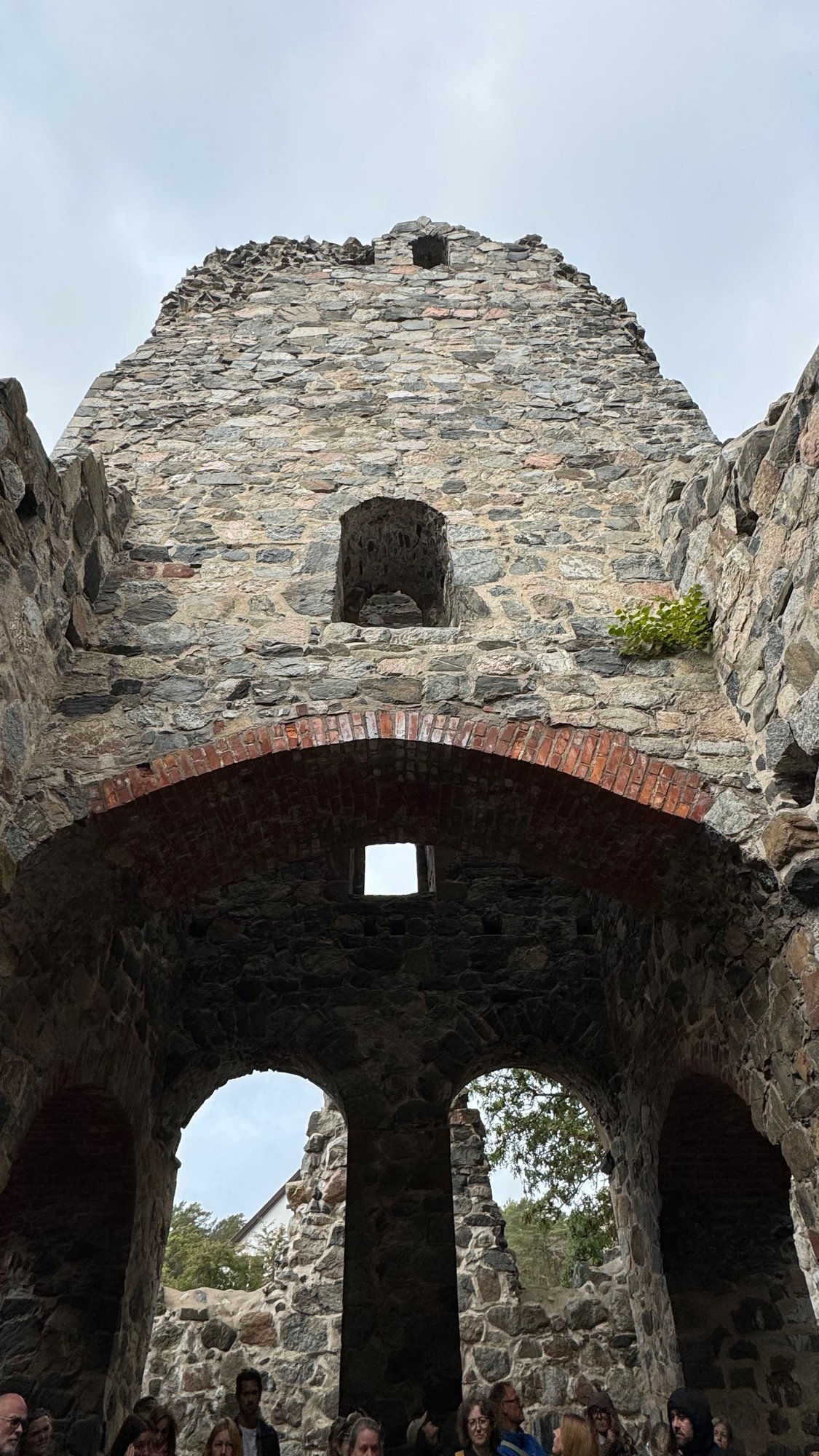
The ruins are the part that made me slow down. Gray stone walls stand open to the sky. A tower wall rises at one end, and arches stand along the sides. Inside one ruin I looked up at a brick arch. It is hard to picture a roof there.
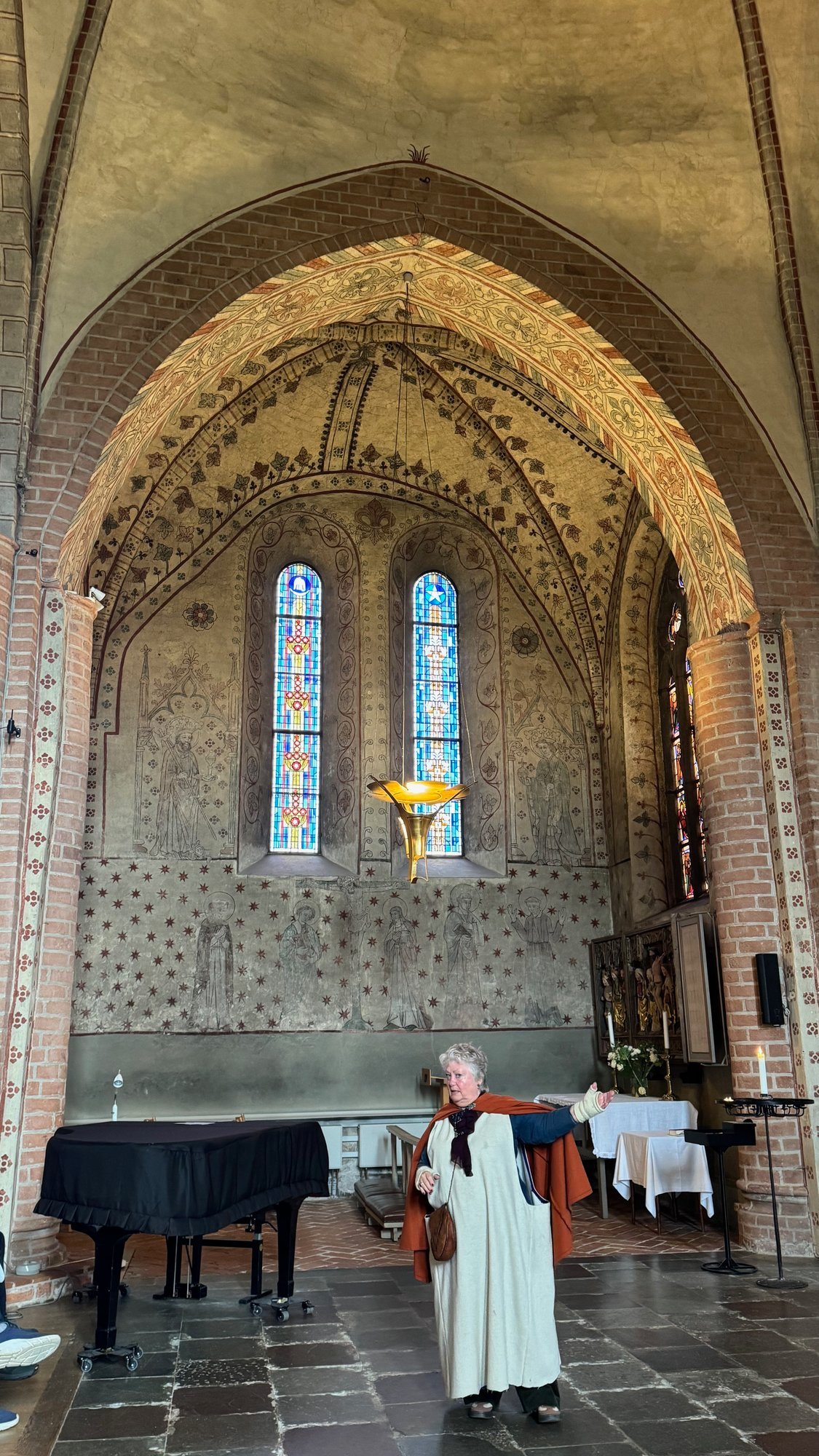
I did not note which ruin this was, so I do not name it. Guides in costume walk groups through here. One stood in the ruin when I took my photos, and another stood in the church.
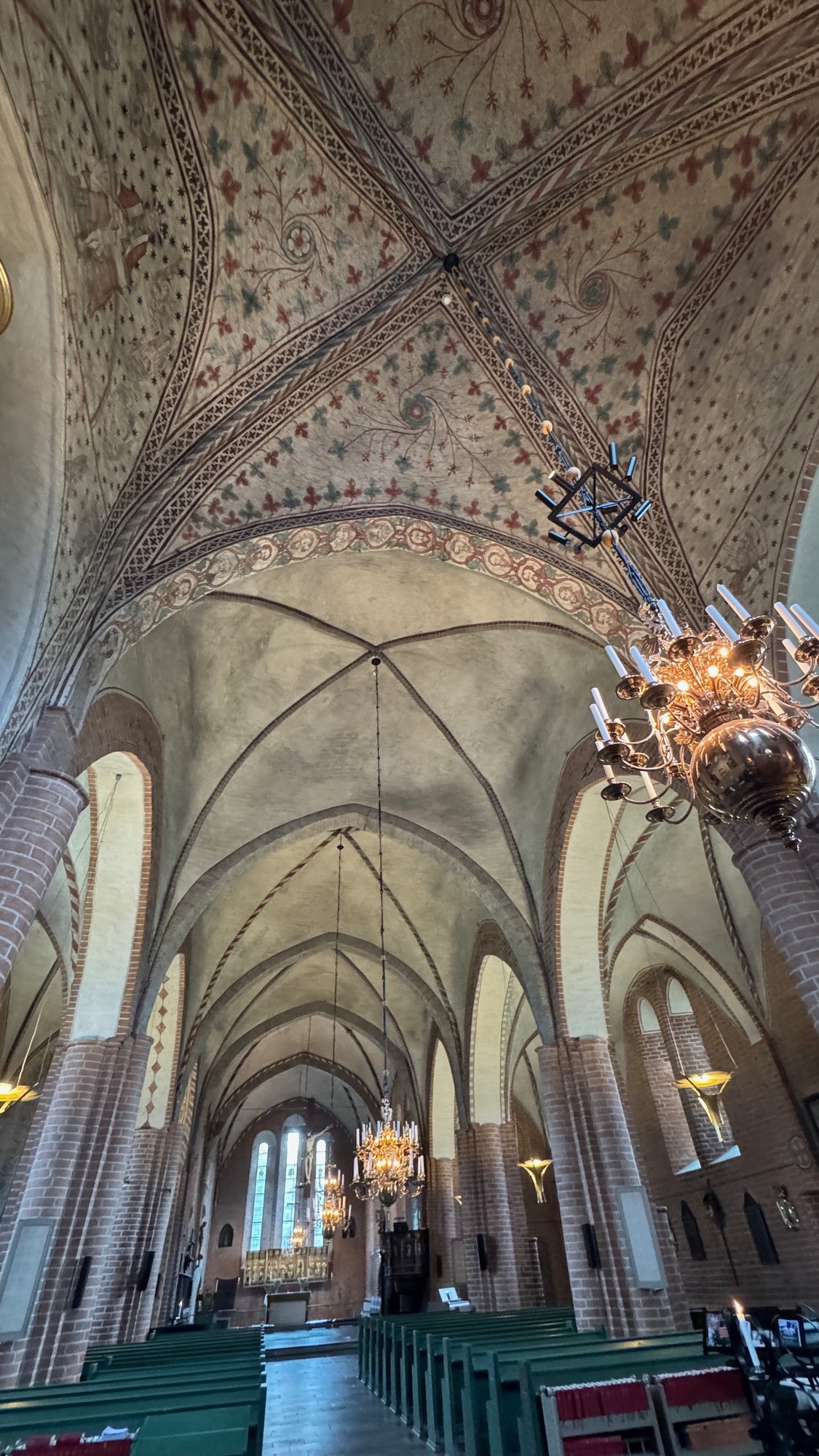
Mariakyrkan is the opposite. The ruins are open and cold. The church is closed and colored. Inside, the ceiling has painted vaults, and chandeliers hang low. The pews are green. At the choir, the walls have murals and the windows have colored glass. There is a piano near the front.
Mariakyrkan is open every day. Monday and Tuesday: 8:00 to 17:00. Wednesday: 8:00 to 18:30. Thursday to Sunday: 8:00 to 17:00. Services can change what you see inside, so check before you go. Svenska kyrkan lists these services: every day, morning prayer (laudes) at 8:15 and morning mass at 8:30. Wednesday, prayer at 13:00 and evening mass at 18:00. Sunday, high mass at 11:00. Once a month, the Sunday service is a family mass. The morning mass does not run on Good Friday, Holy Saturday and Ascension Day.
Sigtuna Museum and rune stones
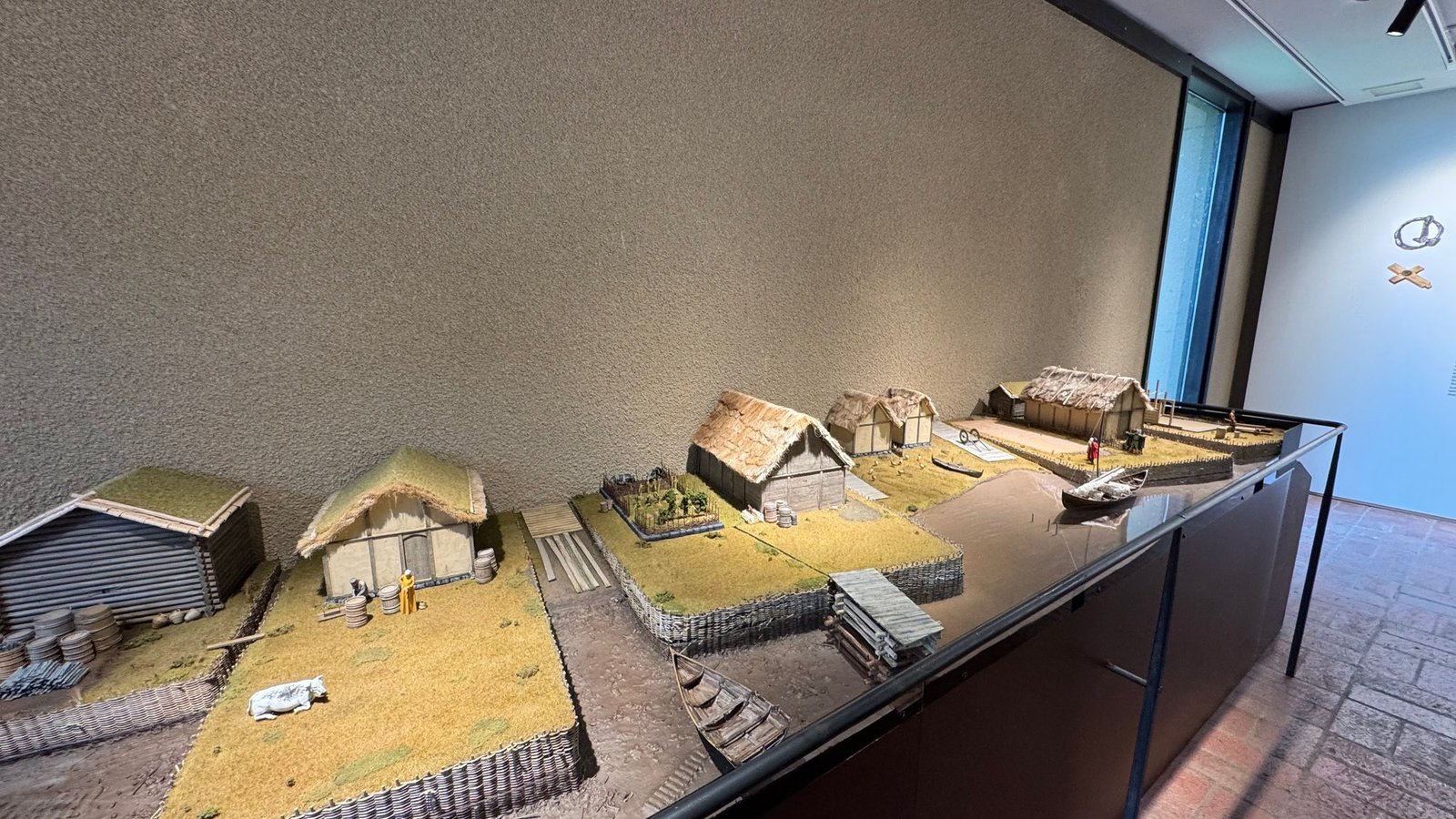
Sigtuna Museum is the town museum. My photos show two things from there.
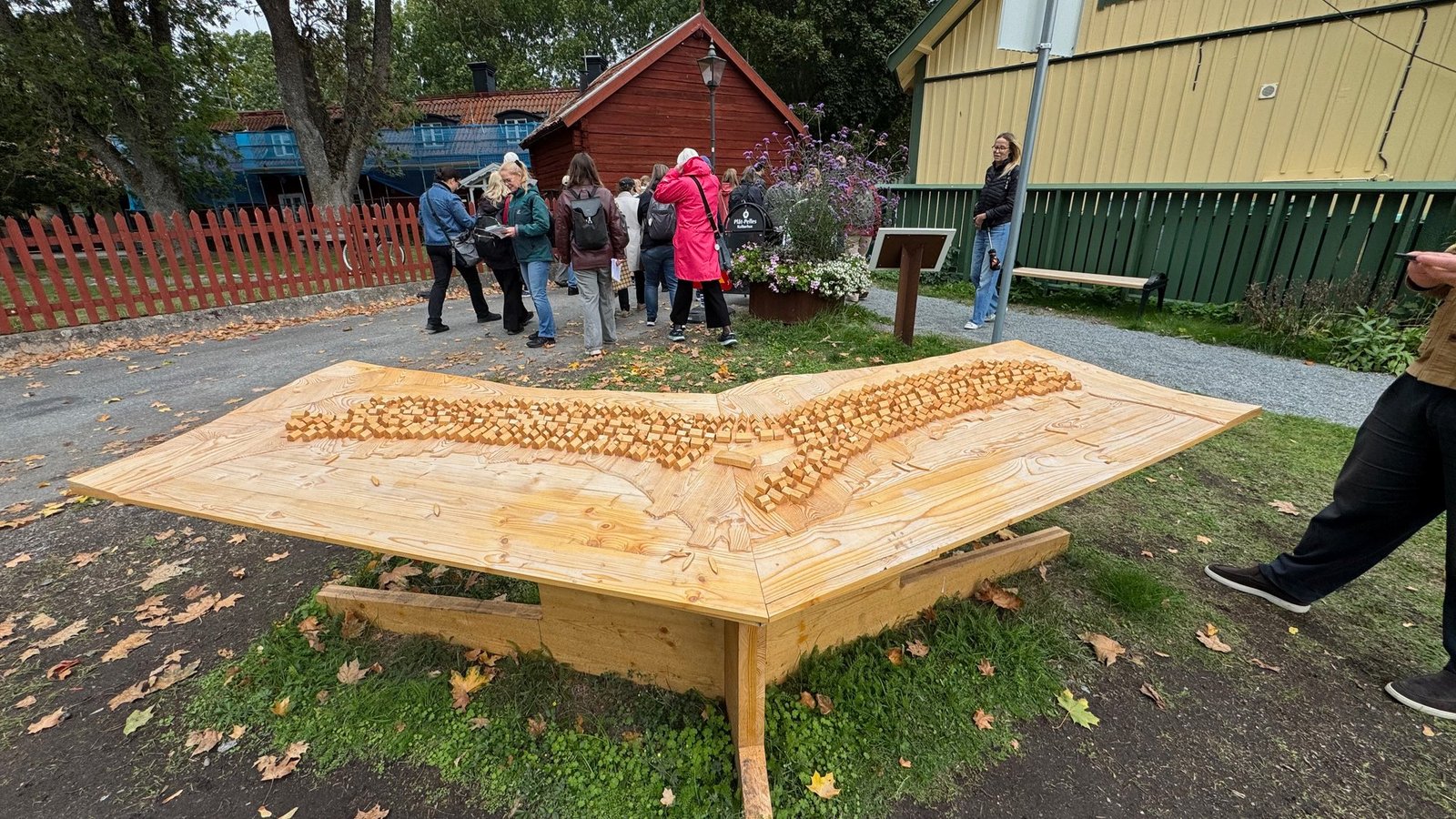
The first is a model of Viking Age buildings. Small wooden houses with steep roofs stand in rows. It helps to see how close the houses stood. A plot was not large.
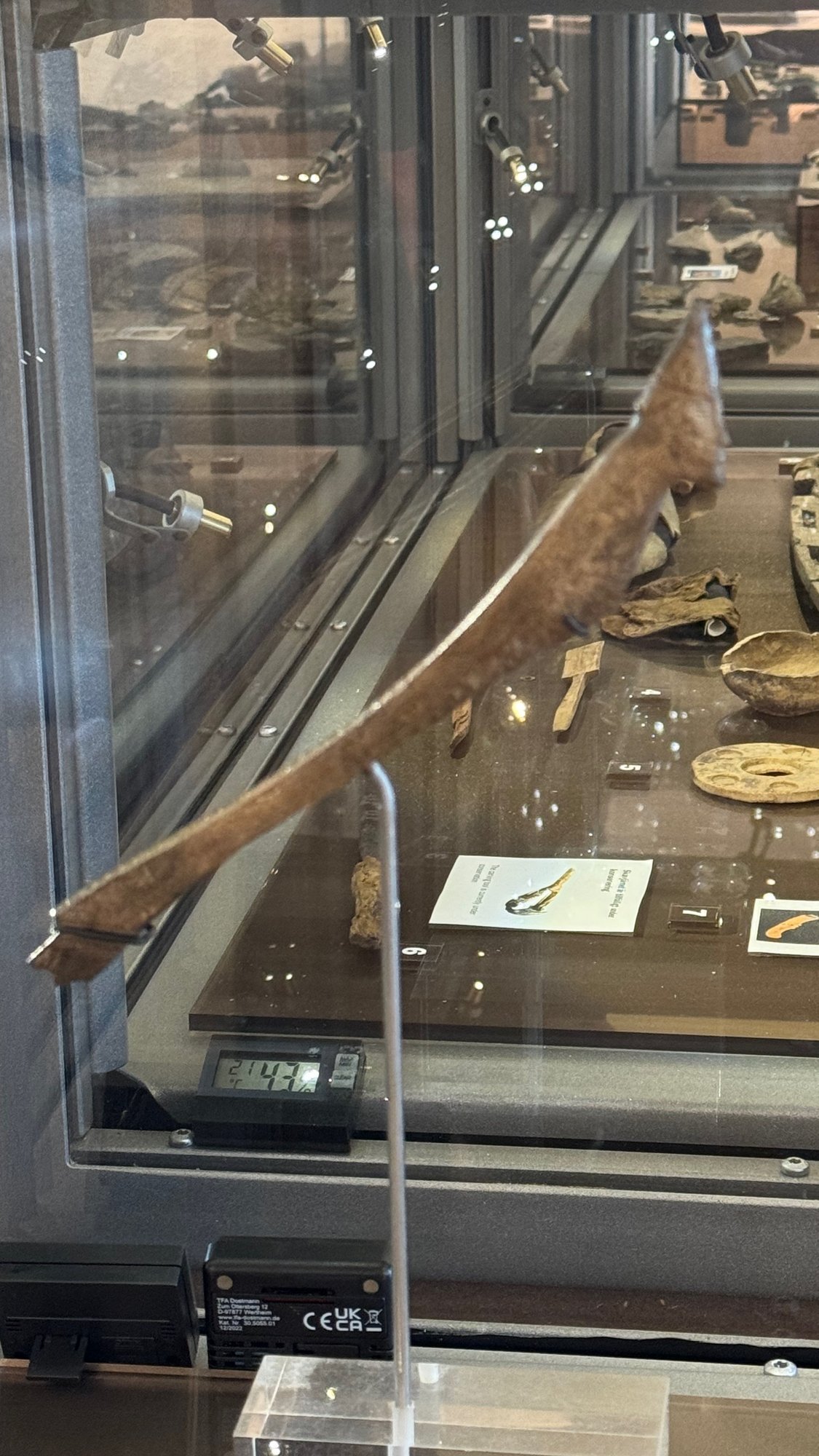
The second is the case with the “Sigtuna Viking”. It is a long, narrow mount of antler. At its pointed top sits a small carved head of a man in a pointed helmet.
The paper I read is by Uaininn O’Meadhra, in Situne Dei 2018, the yearbook of Sigtuna Museum. It says the mount is 22.5 cm long, and the head is 3 cm. The head has a helmet with a nose-guard, a braided moustache and hair combed into a roll. It was found in 1937 in a block called Trädgårdsmästaren 4, together with waste from antler work. The paper gives a wide date, the 11th or 12th century.
The author says the mount is unfinished and was never used. It broke at a thin, perforated peg, and the carver left it. If that is right, it was made in Sigtuna. It is one author’s reading, so treat it as one source.
The paper also lists other ideas. One writer has suggested that the head shows a Sigtuna king, Anund Jakob, who ruled in 1022 to 1050. O’Meadhra thinks it may be folk art by a master craftsman. The use of the mount is not clear. It may be the end of a chest.
I also photographed a rune stone. It is pink granite with red painted runes, a cross and a serpent. An info sign stands next to it. I did not read the sign, so I give no name or age.
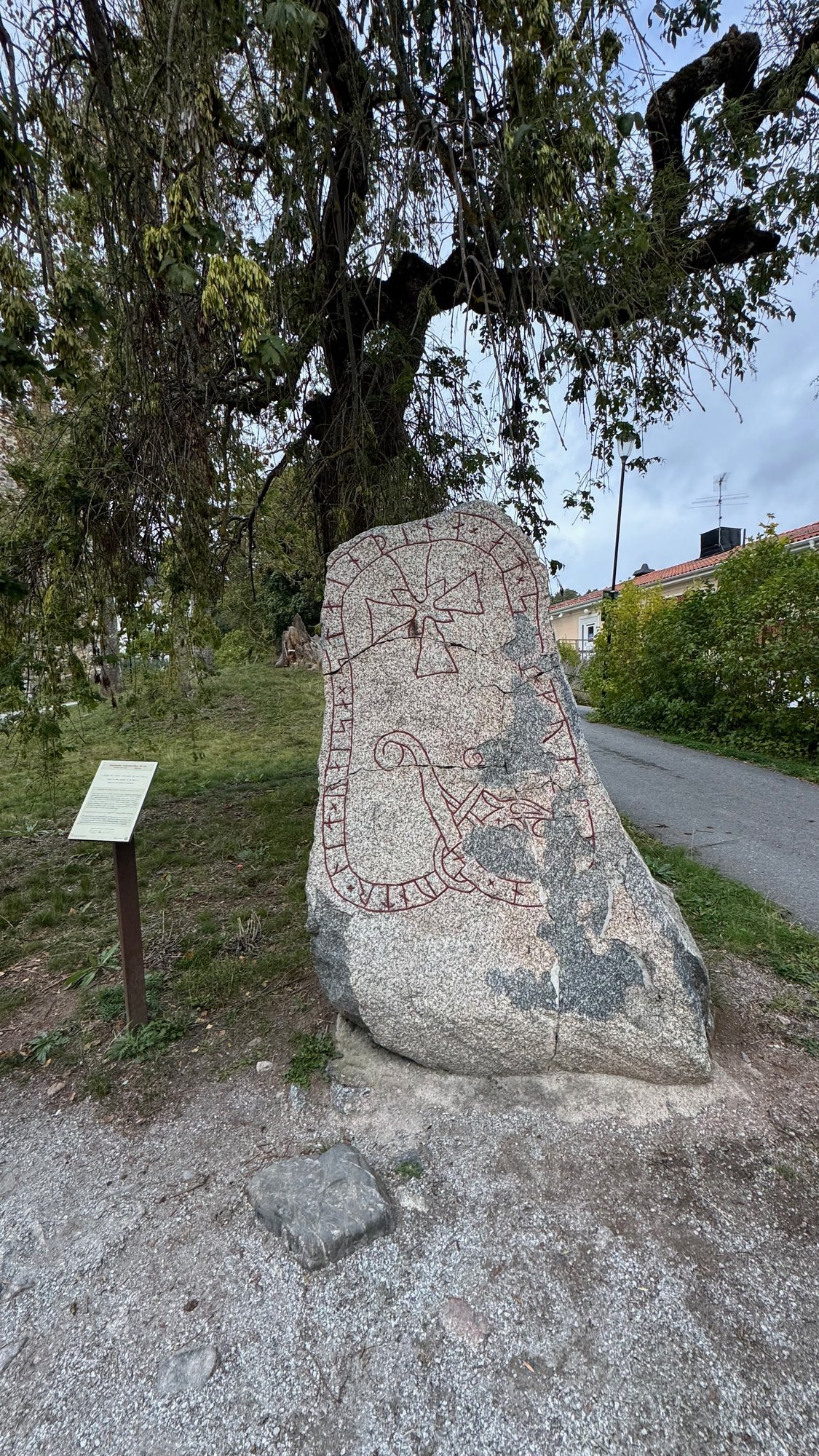
Rune stones are another way to read power and religion. This is my reading, not a source: a family paid for a stone, and the cross on it shows the faith they wanted to be seen with.
What you can do in Sigtuna now
Walk the town. Start at Stora gatan, then go to the square and the ruins. You need no ticket for the streets or the ruins that I saw. I did not check if a ruin has a fee or a closing time.
Visit Sigtuna Museum. It holds the finds. The hours change by month. January to March and November to December: 12:00 to 16:00, closed on Mondays. April and October: 12:00 to 16:00, open every day. May to September: 10:00 to 16:00, open every day. Public holidays have other hours. Entry is 60 SEK. Everyone under 20 enters free. An annual pass costs 100 SEK. One source says the museum is at Stora gatan 55, and another places it near Lilla Torget, so check the address on the museum website.
See the town hall. Look into the preserved council room, and see the exhibition about the house, the people who came here and the stories that took place here. It is open in summer only, from 1 July to 18 August, 12:00 to 16:00, and on special occasions. Entry is free. Guided visits need a booking. The council room is also a civil wedding venue. About 100 couples marry here each year. The fee is 1,537 SEK, and it includes a host who prepares the room and often can act as a witness.
Take a guided tour. Destination Sigtuna lists guided tours, and the museum has a booking page for tours. I did not find prices, languages or durations. Book ahead, and ask which language the guide uses.
Go inside Mariakyrkan. It is worth the stop for the vaults and the murals. It is open every day, from 8:00. Wednesday is the longest day, to 18:30.
Eat and drink. The town has cafés and a garden café in a red cottage. Sigtuna is small, so sit down for a coffee and look at the street.
Ask at tourist information. It is open every day from 10:00 to 16:00 from 2 May to 30 September. For October to April I found no hours. Call or write before you go in the cold season.
Day trips from Stockholm, Uppsala and nearby
From Stockholm. Take the SL commuter train to Märsta. From there, take bus 570 or 575 to Sigtuna. The local site Sigtuna Rännet gives this route. Check the journey planner at SL for today’s times.
From Uppsala. The same site says trains plus a bus, or a bus, take about 50 minutes. More details are on ul.se, the Uppsala regional transport site.
Make it a pair with Uppsala. This fits the story. Sigtuna lost its bishop to Gamla Uppsala in 1164. If you visit both in one trip, you see where the power went.
Nearby. Märsta is the transfer point. It is also near Arlanda airport. If you have a layover and some hours, Sigtuna is an easy way to see something real.
Sverigeinspiration says you can also reach Sigtuna by boat from Stockholm and Uppsala. I did not find a timetable, so I do not know if boats run in October.
I went to look at a town where kings once handed out plots and printed coins. What stayed with me was the church, with its painted ceiling, standing next to the ruins that lost their roofs.
Photo gallery
All photographs on this page were taken by Zayera Khan during a visit to Sigtuna, and are her own property. Please do not reuse them without permission.
Sources: Ortshistoria: Sigtuna historia; Vikingaliv: Sveriges äldsta stad; Destination Sigtuna: Historien om Sigtuna; Destination Sigtuna, official site; Sigtuna kommun: Turistinformation; Storstad: Sveriges äldsta stad; Sverigeinspiration: Sigtuna; Sigtuna Rännet: Transport; Sigtuna Museum; Sigtuna kommun: Sigtuna Museum, opening hours and entry; Sigtuna kommun: Rådhuset; Svenska kyrkan Sigtuna: Mariakyrkan; Uaininn O’Meadhra, “Unfinished and unused. A new look at two iconic antler finds from Sigtuna, the ‘Mammen’ sword-guard and the ‘Sigtuna Viking'”, Situne Dei 2018, Sigtuna Museum; Sigtuna Museum archive: articles; Sigtuna Museum archive: archaeological reports; Stockholms läns museum: Mariakyrkan; Destination Sigtuna: Mariakyrkan; Svenska kyrkan Sigtuna: Vår historia; Wikipedia: Gustav Vasa; Wikipedia: Sigtuna; Wikipedia: St. Mary’s Church, Sigtuna; Wikipedia: Pillage of Sigtuna.