Nationalmuseum in Stockholm: a steel arch, a glass courtyard and brick vaults
Sweden’s national art and design museum, seen from the street down to the cellar
- Why visitSweden’s main museum for art and design, in a 19th-century building with a glass-covered sculpture courtyard and old brick vaults in the cellar.
- Best forAnyone who wants a long look at European art and Swedish design. Also good for a free visit on the ground floor.
- AddressSödra Blasieholmshamnen 2, Stockholm.
- Getting thereKungsträdgården metro station (blue line) is the nearest station. Bus 65 stops nearby.
- Opening hoursTuesday, Wednesday and Friday to Sunday 11:00 to 17:00. Thursday 11:00 to 20:00. Closed on Monday.
- Admission160 SEK. In the last 60 minutes before closing the ticket costs 80 SEK. Under 20 years free. Free on Thursday from 17:00 to 20:00. The ground floor is free. Check the website for current prices.
- Guided toursTours of 20 and 60 minutes, exhibition tours, thematic tours and pop-up visits, in Swedish and English. Book on the museum website or call +46 (0)8 519 543 00. Private tours cover themes such as female artists and design history.
- EventsFree entry every Thursday from 17:00 to 20:00 until 17 December 2026, with music, drinks and workshops. Studio workshops for adults and families, and short viewings in English.
- FacilitiesRestaurant, shop, cloakroom and lockers, WC.
- AccessibilityA sign in the entrance hall points to a lift, the cloakroom and WC. The museum has a page about accessibility on its website. Check it before you go.
- OnlineSearch the collection online (in Swedish) and a media portal with images.
- Official websitenationalmuseum.se
I saw the arch before I saw the door.
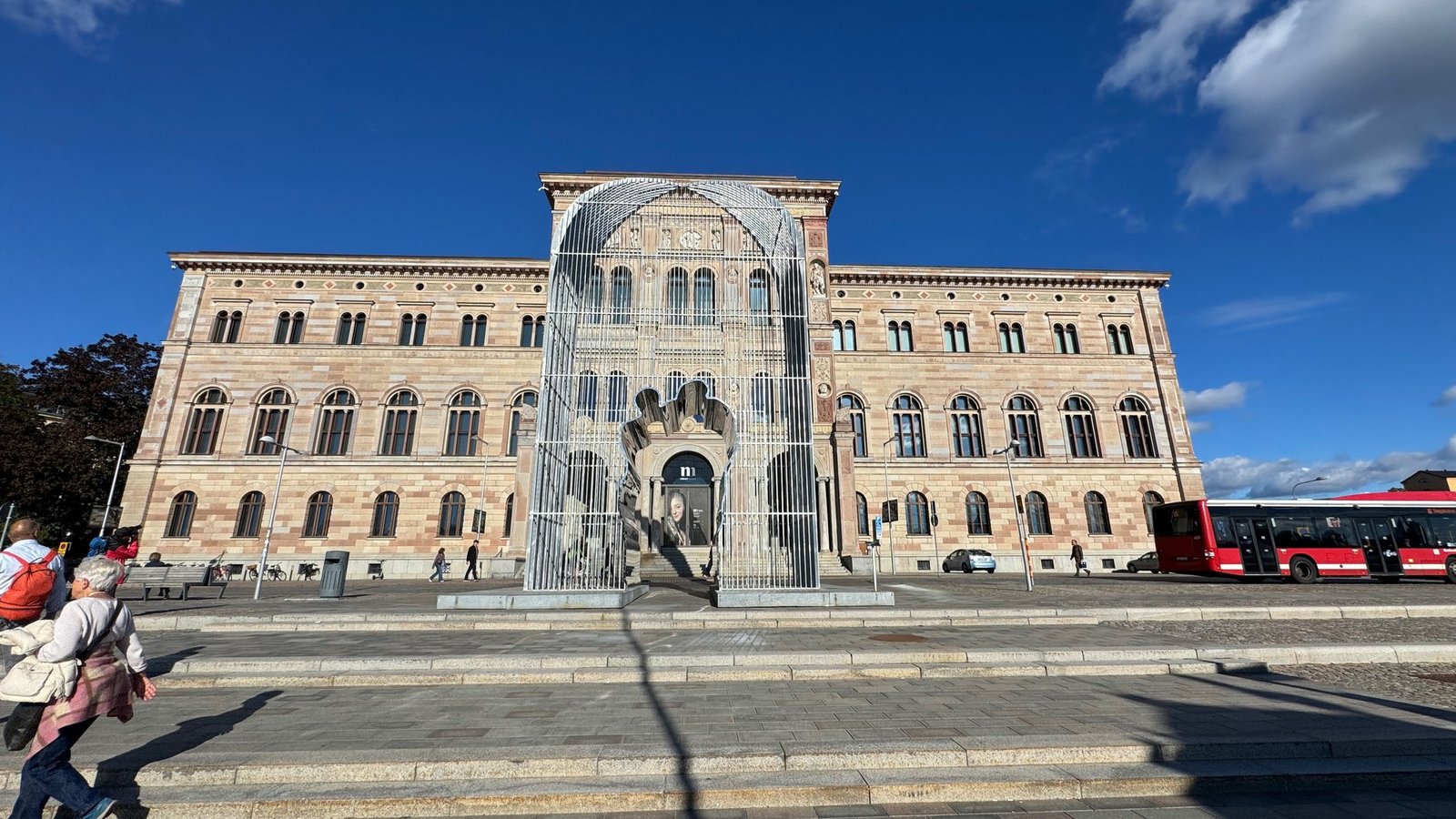
A tall cage of steel bars stands in front of Sweden’s national art museum. I visit Nationalmuseum often. I took these photos on 24 September 2026: the front, the hall, the courtyard and the cellar.
This article also tells you what I come back for: the workshops, the free Thursday evenings and the other events.
A steel arch in front of the museum
The arch looks like Arch by Ai Weiwei. Dezeen and Arquitectura Viva both describe a work that is 12 meters tall and made of polished steel. Inside the bars, a mirrored silhouette of two people holding each other seems to break through. Arquitectura Viva says the work stands for the idea of a world without borders. The foundation Brilliant Minds commissioned it. The same work was shown in New York in 2017, as part of Good Fences Make Good Neighbors.
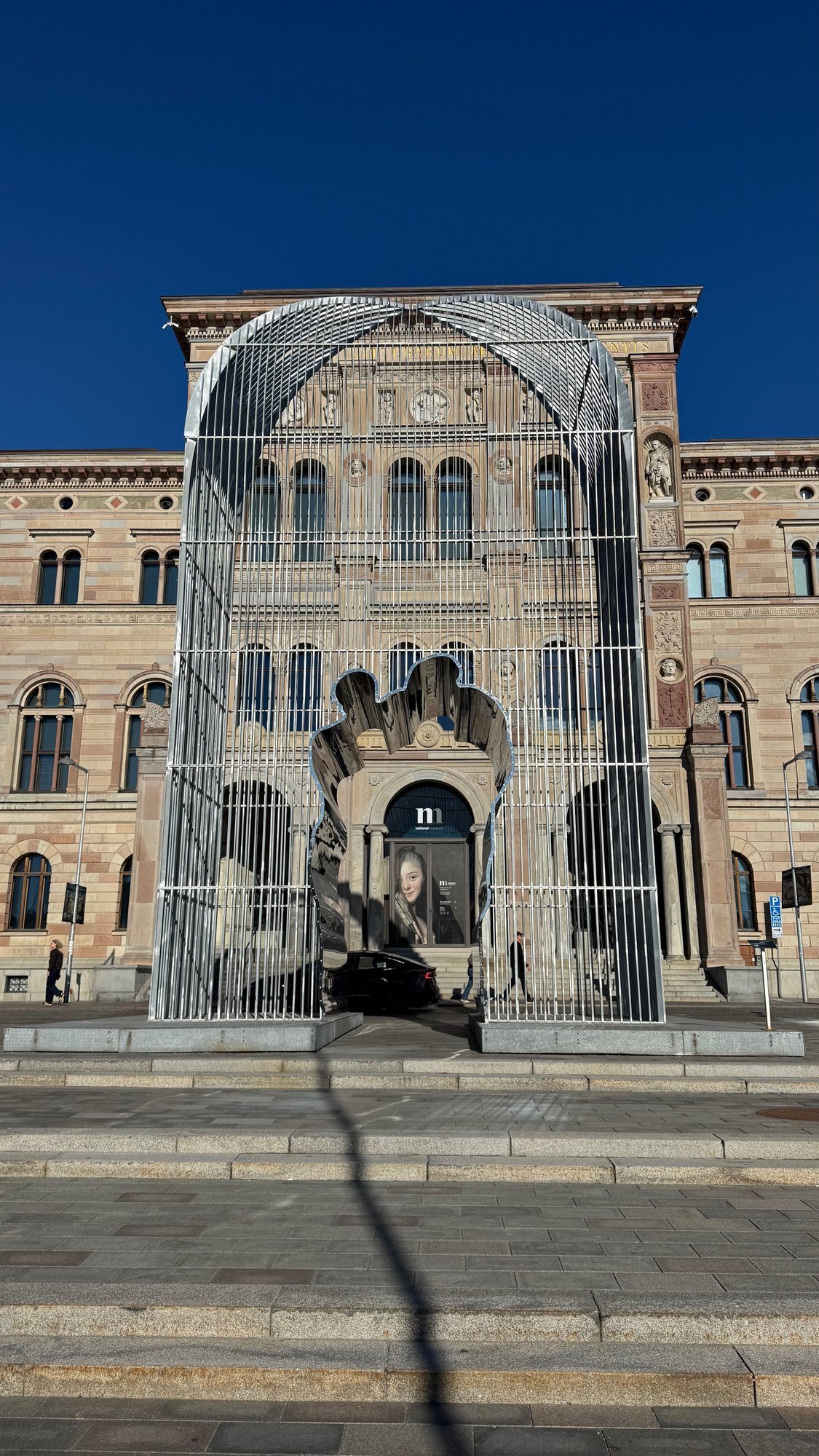
In 2022, both sources said the arch would stand outside Nationalmuseum for one year and then move to a permanent site in Stockholm. That plan changed. The arch is now a permanent installation in front of the museum, and it was there when I took my photos in September 2026. I did not find this change in the written sources I read, so check it with the museum.
The building on Blasieholmen
The facade is pale stone in cream and pink bands, with rows of arched windows. Wikipedia says the German architect Friedrich August Stüler drew the building, and that it opened in 1866. The same source says the museum started in 1792 as the Royal Museum, and that it closed in 2013 for a large renovation and reopened on 13 October 2018. I found these dates only on Wikipedia, so treat them as one source.
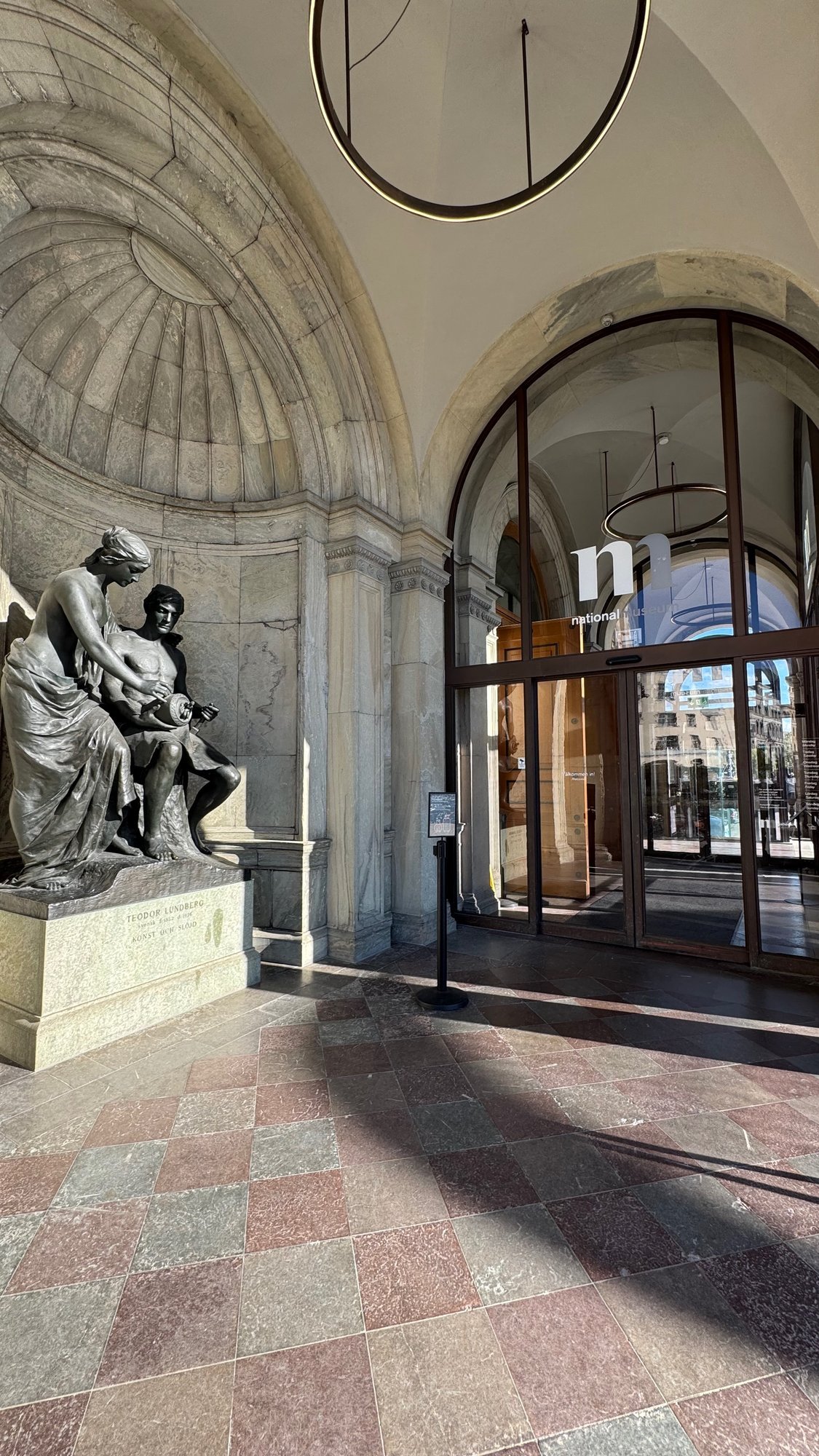
At the door, a bronze group stands in a stone niche. A woman helps a seated man who holds a round object. The base names Teodor Lundberg and the title Konst och slöjd (Art and craft). Behind it, the glass doors carry the museum’s lowercase m logo.
The entrance hall
The hall is high and made of marble. Pink and gray stone covers the lower walls. Four black columns carry a balcony. The ceiling has gold and cream decoration. Two thin ring lights hang in the middle of the room.
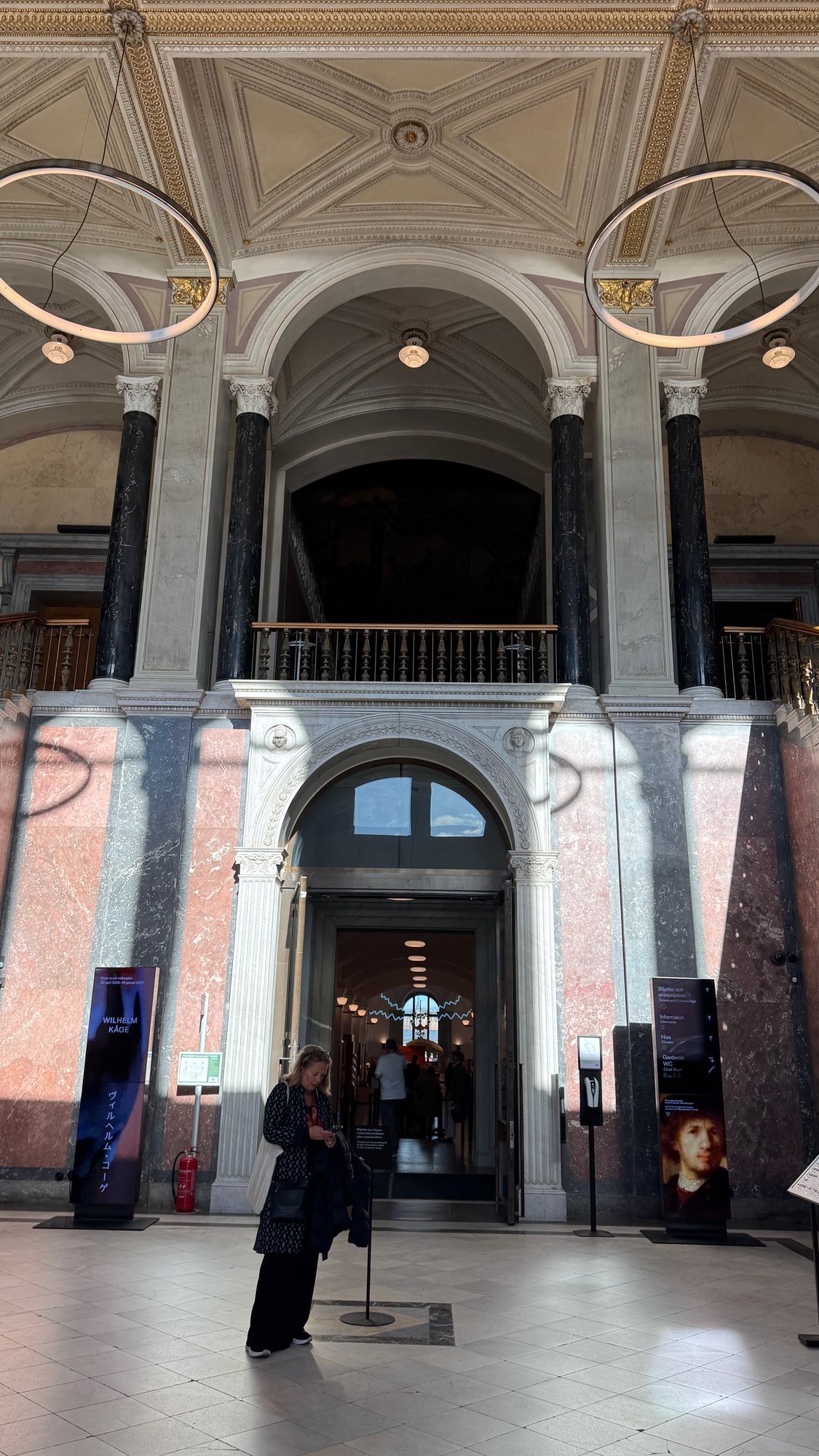
Two tall banners stand by the inner door. One shows the exhibition about Wilhelm Kåge, with Japanese text. The other shows a portrait. A sign next to the door lists tickets, information, lift, cloakroom and WC.
The sculpture courtyard
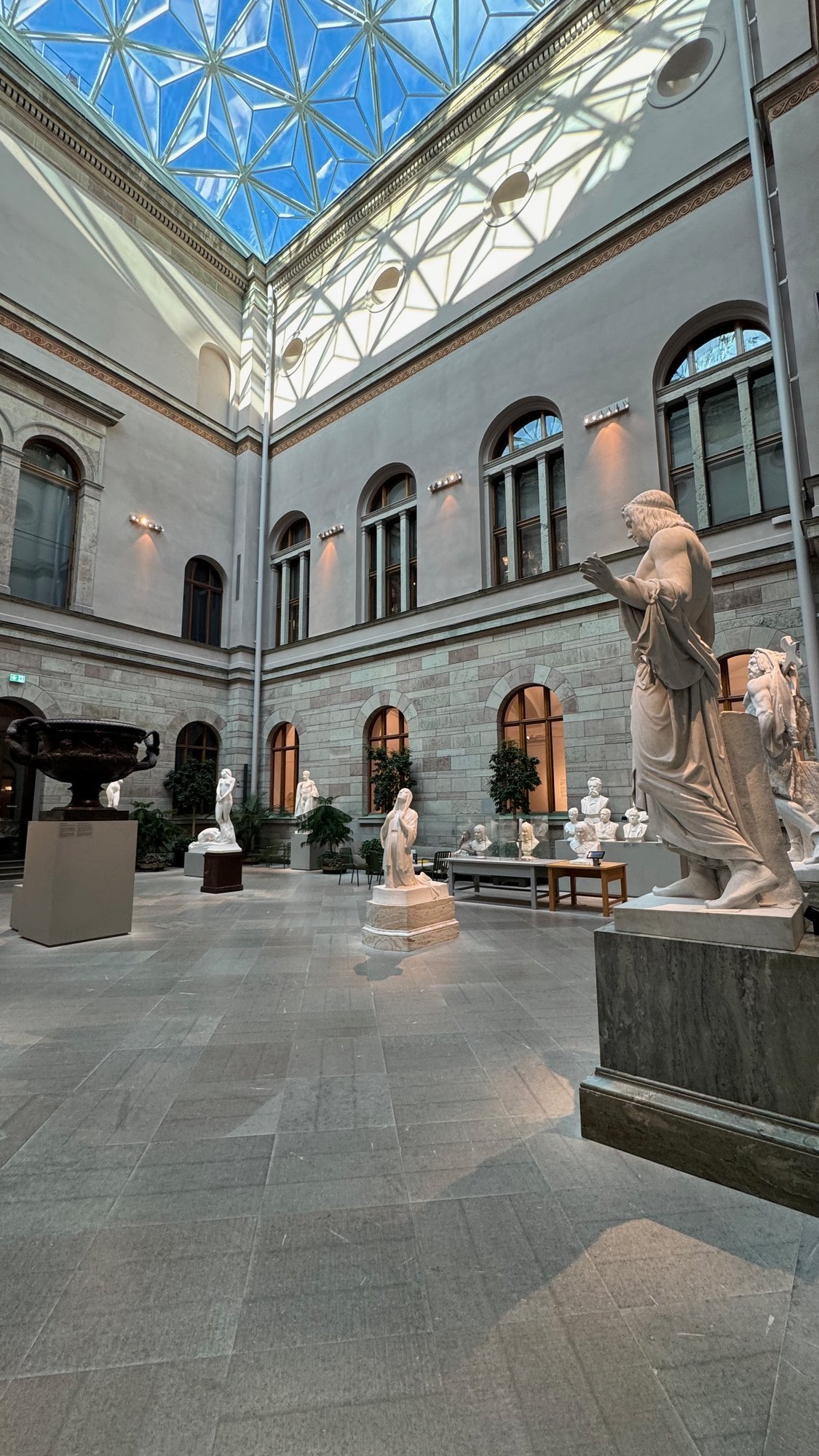
A glass roof with a star pattern covers the courtyard. Wikipedia says it was added in the renovation. White marble statues stand on gray bases across a stone floor. On the left, a large dark bronze vase stands on a high plinth. Arched windows look onto the court from the stone walls.
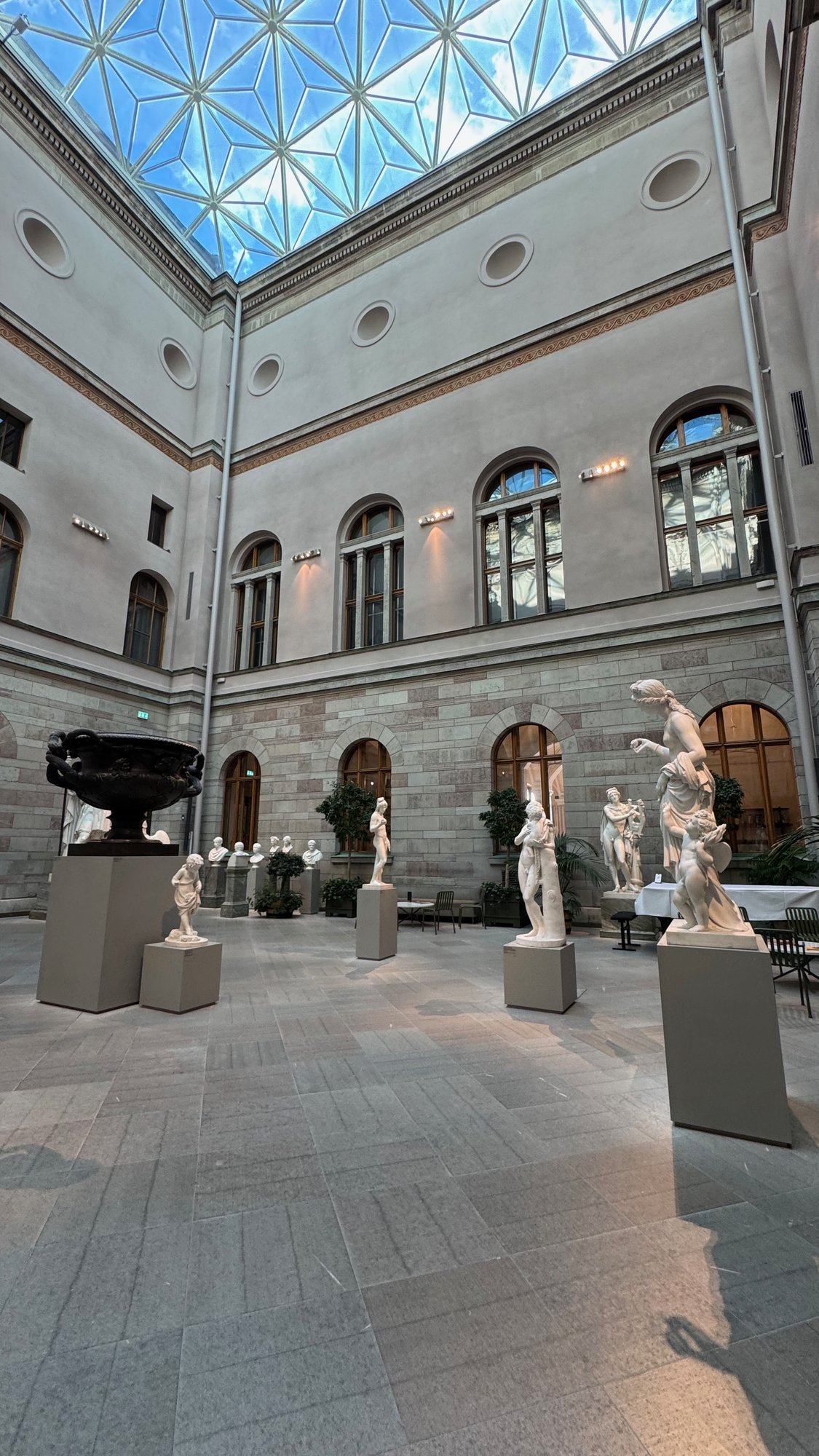
The museum says the ground floor is free. That includes the restaurant, the sculpture garden, the studio, the children’s exhibition and the shop. You can walk in here without a ticket.
The brick vaults
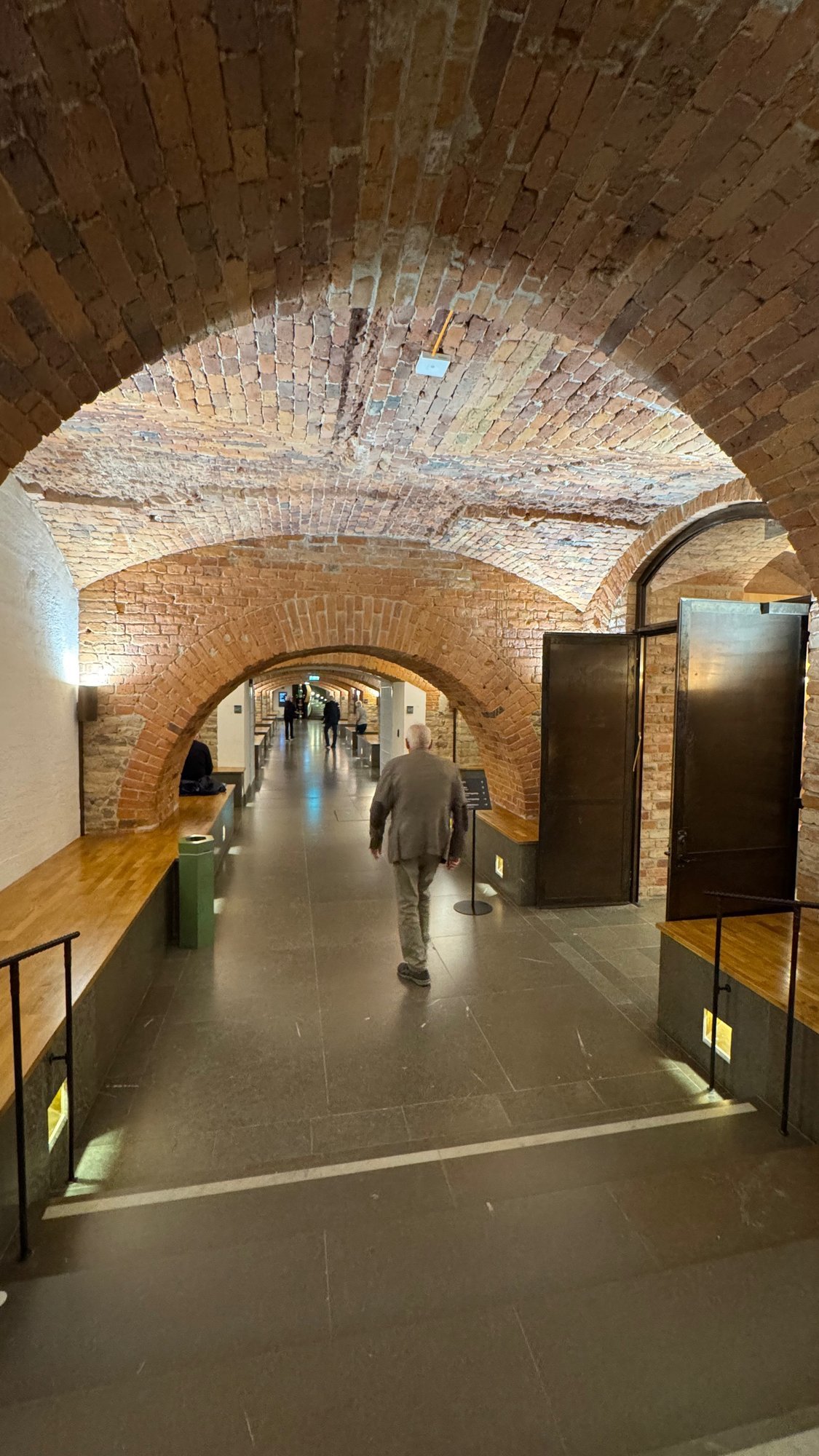
Downstairs, the building changes. The ceilings are old brick vaults, and the walls are bare brick. Warm light runs along wooden lockers with pink labels. A dark metal door stands open at the entrance to the passage.
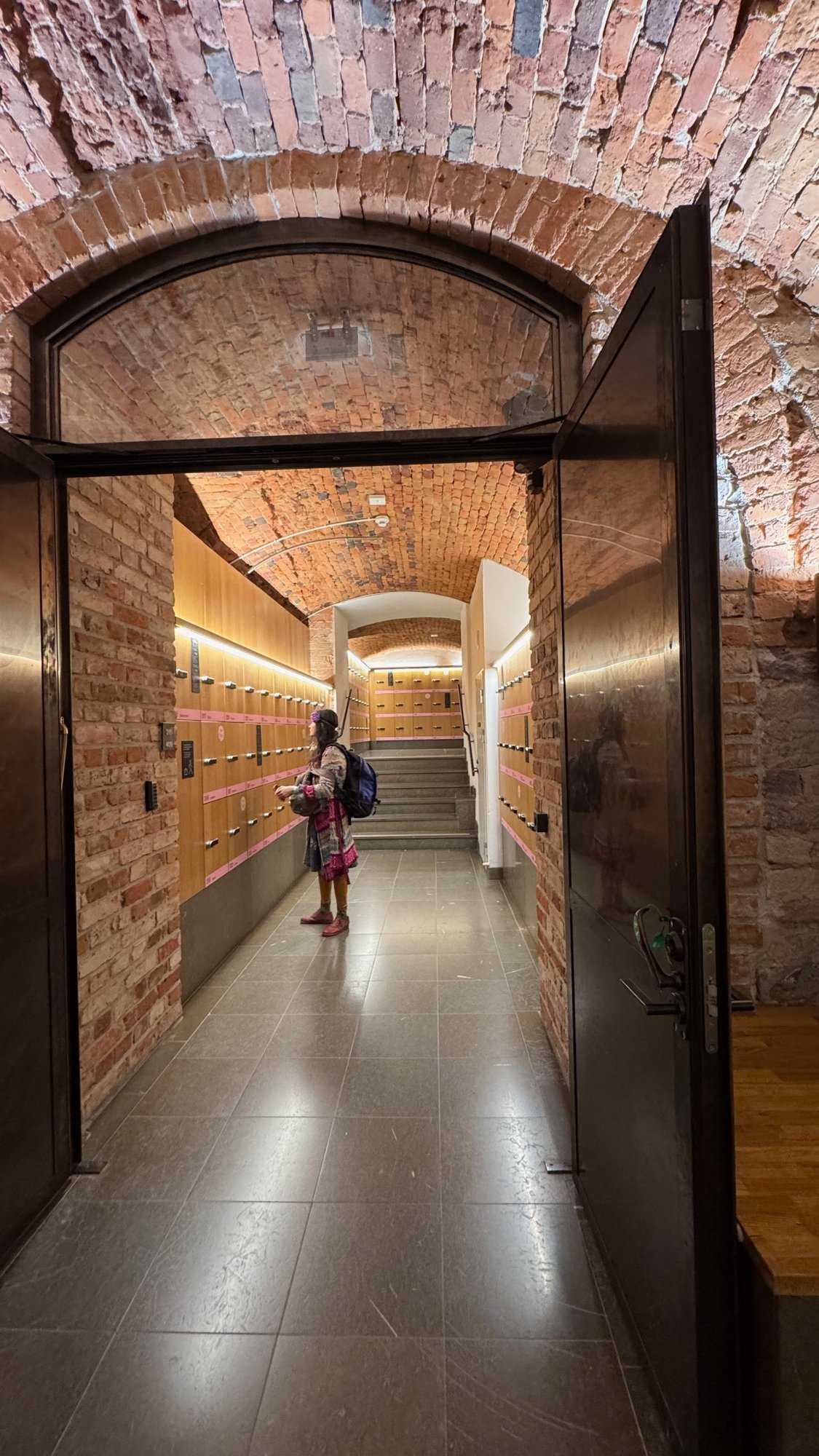
Further on, the passage has arches, a stone floor and wooden benches along the walls. I do not know if these lockers are the main cloakroom. The sign in the hall points to a cloakroom, so ask at the desk.
What the museum shows now
My photos from 24 September show the building, not the exhibitions. The museum lists three temporary ones. To the Sea! (Till havet!) runs from 24 September 2026 to 7 February 2027. Wilhelm Kåge & Shōji Hamada runs from 23 April 2026 to 10 January 2027. A third show of Kåge’s sketches and drawings from the museum’s archive runs from 2 June 2026 to 14 February 2027.
Some displays stay. Tidslinjen shows art and design in time order. Designmagasinet shows how ceramics changed over the centuries. Skattkammaren is the treasury, and Skulpturgården is the sculpture courtyard. Färg! (Colour!), for children and curious adults, runs until 12 August 2029.
Next year, Women as Technology opens on 18 February 2027, and Akseli Gallen-Kallela opens on 18 March 2027. Check the museum website for the latest dates.
The museum’s online collection says it holds over 700,000 objects. Wikipedia names a large 17th-century group of Rembrandt and other Dutch painters, and more than 5,200 portrait miniatures. I have not checked those two numbers with the museum.
Workshops, Thursday evenings and other happenings
I visit Nationalmuseum often, and not only for the paintings. I recommend the workshops, the free Thursday evenings and the other events.
Free Thursday evenings. Every Thursday from 3 September to 17 December 2026, entry is free for everyone from 17:00 to 20:00. The museum plans drinks, music, workshops and other activities. A pop-up bar with a playlist opens in the sculpture courtyard, the room in my photos. Some activities may need a separate ticket. The program changes, so read the page Thursday evenings at Nationalmuseum before you go.
Workshops. The studio runs drawing and watercolor sessions. There are also sketching sessions with the sculptures. Families can join workshops and color tours, and some are drop-in without booking. For adults, the museum lists dance workshops with salsa.
Other happenings. The museum offers short pop-up viewings of 15 minutes in English. It also runs slow-looking sessions, lectures by art historians, philosophy discussions and design talks. It lists jazz on the grand staircase. You can also book a private guided tour. The Nationalmuseum activities page shows what is on.
If you want the exhibitions without paying, come after 17:00 on a Thursday. You have three hours.
Guided tours
The museum lists several guided tours. The short ones are an introduction of 20 minutes and Nationalmuseum in 60 minutes. There are also tours of the exhibitions To the Sea! and Wilhelm Kåge & Shōji Hamada, thematic tours such as Wilhelm Kåge – Beauty for All, and pop-up visits.
The museum names tours in Swedish and in English. Groups can arrange a tour. To book, use the museum website or call +46 (0)8 519 543 00. I did not find prices or group sizes in the pages I read, so ask the museum.
The collection online and the media portal
You can also look at the art from home. The Nationalmuseum online collection lets you search objects, artists and makers. Here you find several hundred thousand of the museum’s more than 700,000 objects, and many have images. It covers paintings from the Middle Ages to the 1800s, miniatures, sculpture from the Renaissance onward, and design from 1900 to today. The page is in Swedish.
The museum’s website also points to the Nationalmuseum media portal, which holds 123,619 images. The museum describes them as free high-resolution images. I could not open the portal’s pages to read the terms. Before you reuse an image, read the museum’s rules for it.
Which room would you start with: in the museum, or on your screen?
Photo gallery
All photographs on this page were taken by Zayera Khan during a visit to the museum, and are her own property. Please do not reuse them without permission.
Sources: Nationalmuseum, official website; Nationalmuseum, visitor information; Nationalmuseum, exhibitions; Nationalmuseum, online collection; Nationalmuseum, Thursday evenings; Nationalmuseum, activities; Dezeen: Ai Weiwei unveils cage-like Arch installation in Stockholm; Arquitectura Viva: Arch, art installation in Stockholm; Wikipedia: Nationalmuseum.