Spritmuseum in Stockholm: from Viking mead to Absolut Vodka and Systembolaget
A museum about the long, bittersweet relationship between Sweden and alcohol, in two red naval sheds on Djurgården.
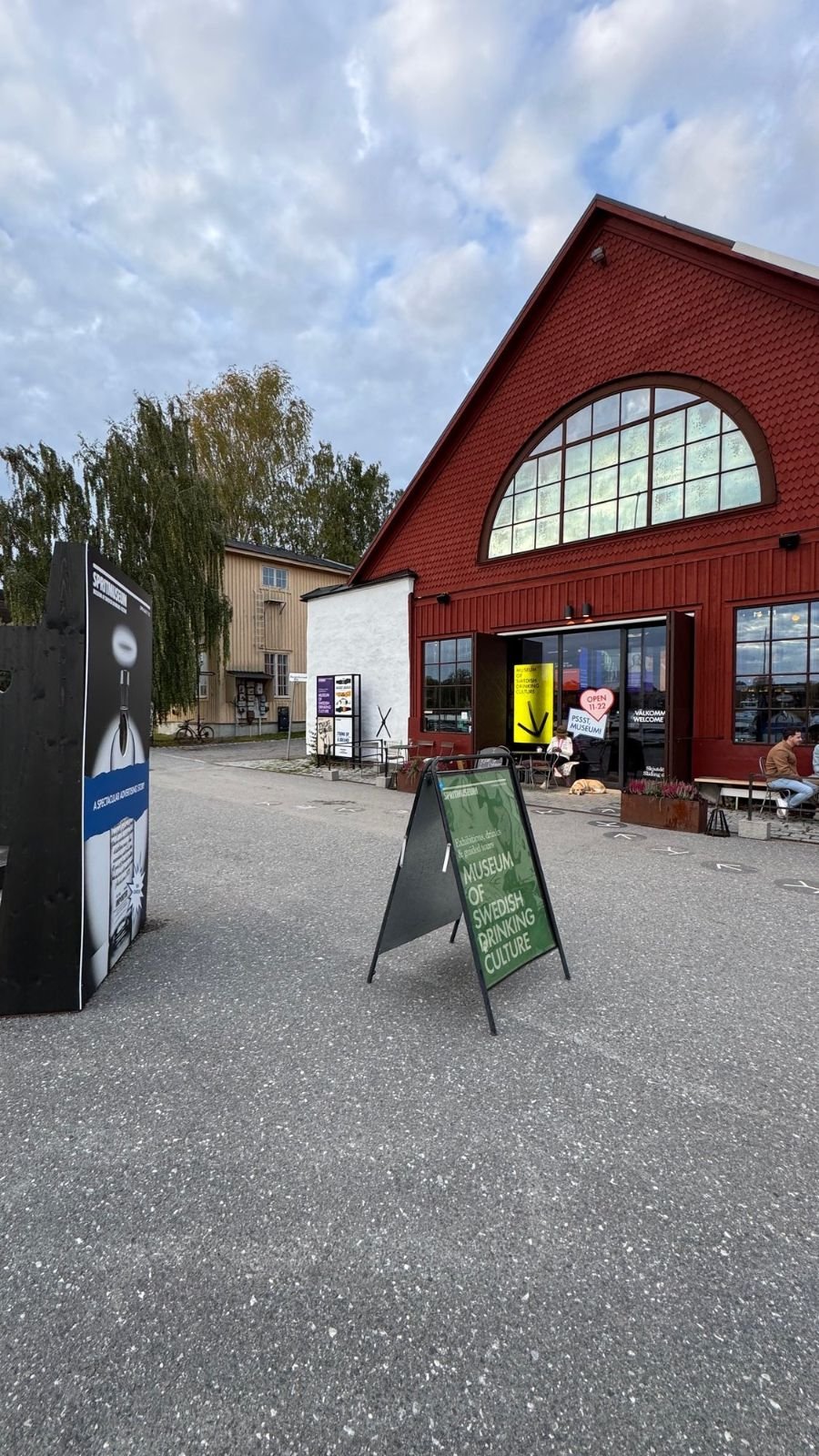
- Why visitThe museum of Swedish drinking culture. It tells the story of alcohol in Sweden from the 1400s until today, with scenes, films, scents, music and tastings. It is also home to the Absolut Art Collection.
- Best forAnyone curious about Swedish history, food and drink, advertising and art. Visitors who want a museum that stays open in the evening.
- AddressDjurgårdsstrand 9, 115 21 Stockholm, on Djurgården, between the Vasa Museum and The Viking Museum.
- Getting thereTram 7 or bus 67 to Liljevalchs/Gröna Lund, then walk about 500 meters. Bus 69 and 76 to Djurgårdsbron. The Djurgården ferry from Slussen to Allmänna Gränd.
- Opening hoursMuseum, restaurant and bar: every day 11:00–22:00. On 24 October 2026, the museum is open 11:00–15:00. Check the website for other changes.
- AdmissionAdults 190 SEK. Seniors and students 140 SEK. Youth 15 to 18 years 95 SEK. Children 0 to 14 years free. Annual card 365 SEK.
- Guided toursShort introductory tours every hour, 11:30–19:30, included in the ticket. English on request. Private tours of about 30 minutes can be booked.
- Tastings and dinnersTasting trays from 180 SEK, without museum admission. Expert-led tastings, a snaps workshop and two dinner experiences for groups. Details below.
- AccessibilityRamps and a lift between the floors. Parking for disabled visitors outside the entrance. Assistants enter free. Some rooms are dark and use scents. Details below.
- Official websitespritmuseum.se
I visited Spritmuseum on Djurgården on 16 October 2026. I joined a guided tour and walked around the exhibitions on my own. I took the photos on this page that day.
How did a country of mead drinkers become a country where a state company sells the wine, beer and spirits you take home? Spritmuseum tries to answer that question. In English, it calls itself the Museum of Swedish Drinking Culture. The museum says it explores how alcohol has shaped Swedish traditions, identity, politics and everyday life.
This article follows the same road: from mead and monasteries, through brännvin and home stills, to Absolut Vodka, the temperance movement and Systembolaget. After that come the exhibitions, the tastings and the practical facts.
From a company museum to the galley sheds
Spritmuseum opened in 1967 as Vin & Sprithistoriska Museet, the museum of wine and spirits history. Wikipedia says it started in the Grönstedtska palace at Dalagatan 100 in Vasastaden, as a company museum for the 50th anniversary of the state company AB Vin- & Spritcentralen. Since 1992, a foundation owns and runs the museum. The Swedish government selects its board.
In May 2012, the museum moved to Djurgården. The museum says that in the middle of the 1700s, the south shore of Djurgården had a row of long galley sheds, where the navy kept its ships. Only two of them are left, numbers 16 and 17. They are two of only three such naval buildings left in Sweden. Today they are red again, as they were at the start.
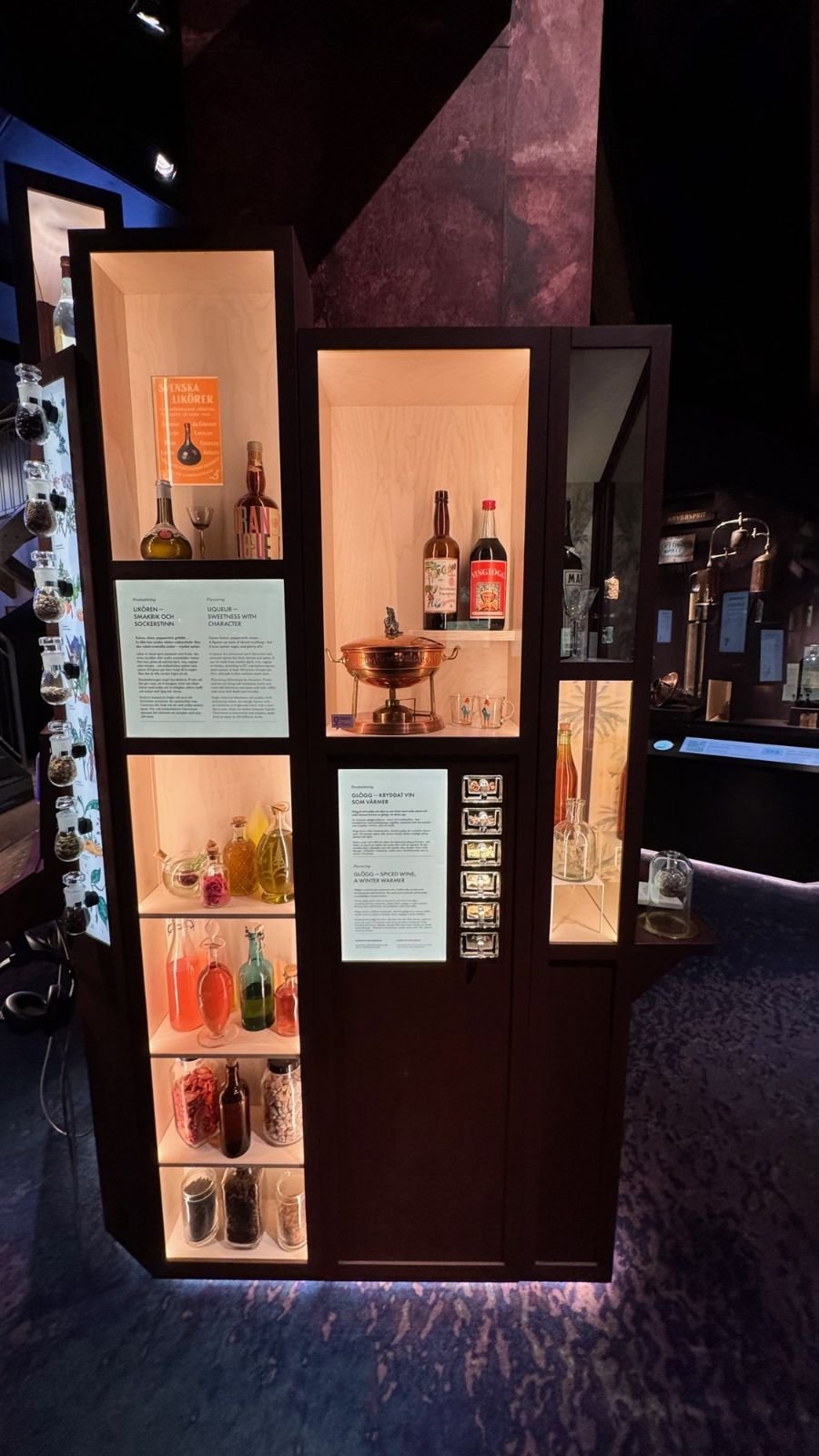
The collections hold about 13,000 objects. About half are bottles. The largest object is Stora Stycket, an oak barrel for 23,500 liters that once stood under the Royal Palace in Stockholm.
Mead, ale and drinking horns in the Viking Age
Historiska museet says ale and mead were the most common drinks in the Viking Age, because they were simple to brew. Wine was probably rare, because it had to be imported. The museum also says that women seem to have done the brewing. At Birka, archaeologists found large amounts of hops.
Drinking was more than thirst. Historiska museet says ritual drinking linked people with the gods and with their dead ancestors. The lady of the house offered each guest a cup, in order of rank. In the sagas written down by Snorri Sturluson, people drank ale and mead from cups and drinking horns at the winter feast of jól, to honor the gods. Wikipedia says the first toasts went to Odin, and then to Njord and Freyr, “for a good year and peace”.
Mead also has its own myth. In Norse myth, two dwarfs killed the wise Kvasir and mixed his blood with honey. The drink became the mead of poetry. In Valhalla, the goat Heiðrún gives mead that never runs out. Odin himself drinks only wine.
What was in the mead? Sources name different herbs. Sveriges Bryggerier names honey, angelica and bog myrtle. Kulturen in Lund names yarrow, pine and honey. Spritmuseum says the Vikings brought wine home from long journeys, but it stayed rare and expensive for a long time.
You can see a painted Viking ship and a Viking village scene at The Viking Museum, a few minutes’ walk along the same shore.
Monasteries, hops and wine in the Middle Ages
The first monasteries in Sweden, Alvastra and Nydala, were founded in 1143 by Cistercian monks from Clairvaux in France. Sveriges Bryggerier says hopped beer may have come to Sweden with these monks. The source says “possibly”.
Hops became part of the law. The provincial laws of the 1300s and 1400s mention hop gardens. One source says hop growing was made compulsory in 1442, with at least 40 hop poles for each farmer. In 1483 the number rose to 200 poles. The rule stayed until 1860.
The largest brewing business in medieval Sweden was a monastery. Matkult says Vadstena Abbey had at least two breweries and a malthouse. At feasts in Stockholm’s town hall, each guest drank about 10 liters of beer, and in some years more than 14 liters.
Wine came with the church. Spritmuseum says wine was imported for Communion from the 1100s. Stockholm controlled the wine trade from the late 1200s. Most wine was Rhenish wine from Germany, bought through the Hanseatic towns. People also drank spiced wine, called hypocras and klaret. From the 1500s, German beer was popular, and Sweden imported a lot of it.
From medicine to brännvin
The word brännvin means “burnt wine”, wine that is distilled. Spritmuseum says German merchants brought brännvin to Sweden in the 1400s. The first written trace is in Stockholm’s accounts, where a man called Berend, who made gunpowder, paid for brännvin. Spritmuseum gives the years 1467–70. A research article in the journal RIG gives 1469–70. Systembolaget gives 1467. So brännvin was used for gunpowder before people drank it.
Next, brännvin became medicine. In 1522, Peder Månsson published the oldest printed Swedish recipes for spiced brännvin, in his book of medicine. Spritmuseum calls him the Bishop of Västerås. The RIG article calls him a monk from Vadstena.
In the 1600s, brännvin reached ordinary people. Spritmuseum says this happened when grain took the place of wine as the raw material. A tax on production came in 1638.
Home distilling and the crown distilleries
For about 200 years, the state could not decide. Should people be allowed to distill brännvin at home or not? Home distilling for your own use was called husbehovsbränning. The rules changed again and again:
- 1718: home distilling was banned. In 1731 it was allowed again, for a fee.
- 1756: a new ban. Spritmuseum says about 180,000 home stills were taken away. The ban ended in 1760.
- 1772: all distilling was banned from 1 September, after a bad harvest in 1771.
- 1775: King Gustav III started crown distilleries (kronobrännerier) and banned home distilling. Sources give different numbers: about 60 distilleries, or 42 in 1776 and later 61.
- 1786–87: the Riksdag ended the crown monopoly, and home distilling came back. The last crown distillery closed in 1824.
- 1809–1810: home distilling was made easier, and in 1810 distilling became free.
The result was a country full of stills. Spritmuseum says about 175,000 small stills were in use around 1830. In the 1830s, steam distilleries in Skåne made more than 100 million liters a year, for a country of about 3 million people.
Then came the great change. The Riksdag decided to stop home distilling in 1854, and the new law came in 1855. Spritmuseum says the number of legal stills fell from about 43,000 to 591 by 1861. One Wikipedia article says home distilling was formally banned in 1860.
Today, home-distilled spirits, hembränt, are illegal in Sweden. Under the Alcohol Act, illegal distilling can give a fine or up to two years in prison.
Eva De la Gardie and brännvin from potatoes
For a long time, brännvin was made from grain. Grain was also bread. In years with bad harvests, that was a problem. A woman helped to change the raw material.
The potato came to Europe from South America in the 1500s and reached Sweden in the 1600s. Spritmuseum says one of the first to grow potatoes here was the scientist Olof Rudbeck, in his botanical garden in Uppsala. Wikipedia says this was in 1658. A common story says that Jonas Alströmer brought the potato to Sweden. Wikipedia calls that a myth. Alströmer did start to grow potatoes for food at Alingsås in 1724.
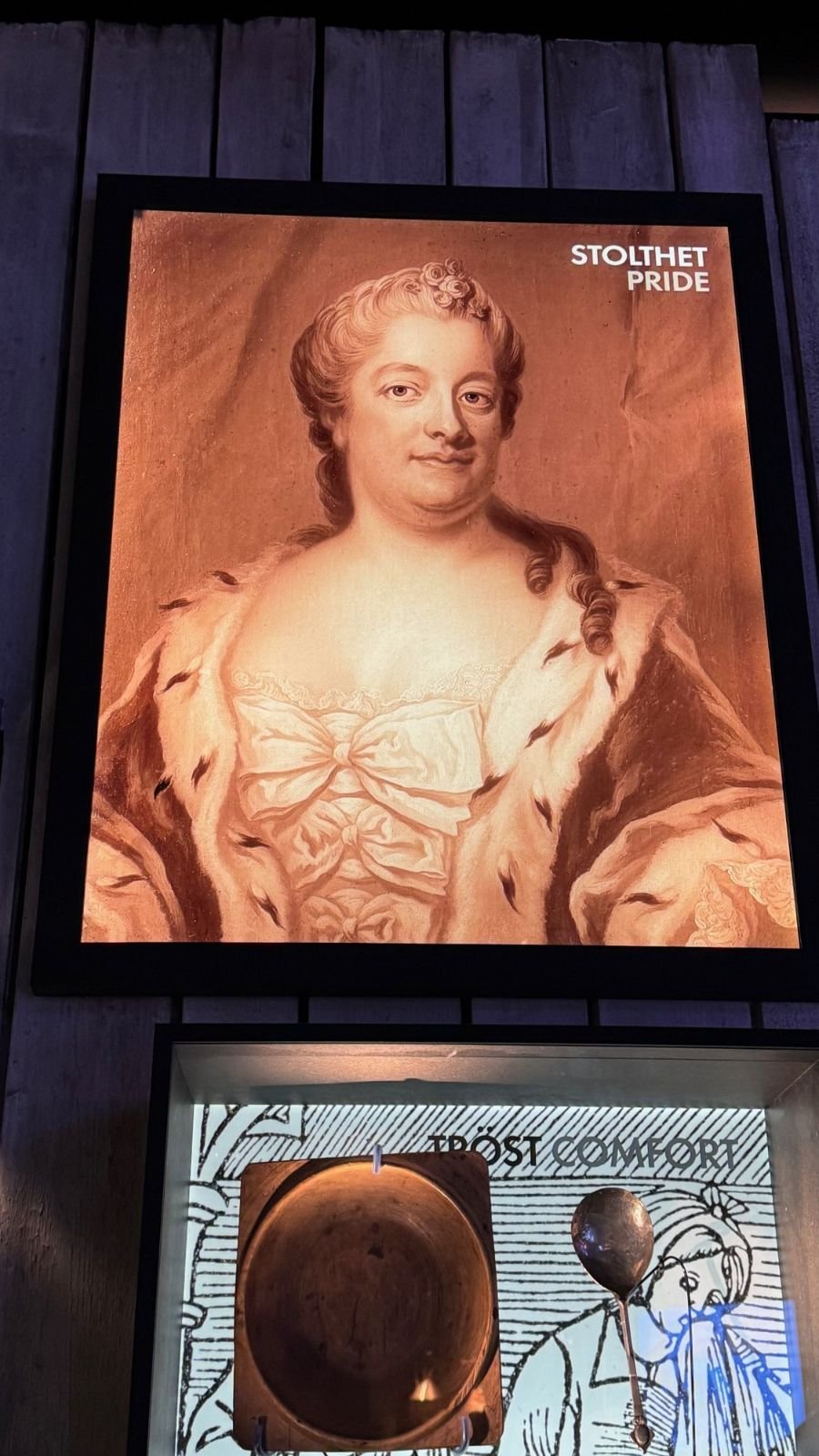
Eva De la Gardie was born in Stockholm on 10 July 1724. In 1740 she married Count Claes Ekeblad, so she is also known as Eva Ekeblad. Spritmuseum says she showed how potatoes could be used to make starch, bread and brännvin. Sources give two years for her work: Wikipedia says she presented flour and alcohol from potatoes in 1746, and the KTH library says she described them in 1748.
In 1748 she became the first woman elected to the Royal Swedish Academy of Sciences. Wikipedia says the Academy made her an honorary member in 1751, and that there are no records that she attended its meetings. Wikipedia also says her work helped to reduce famine, but it gives no numbers. She also suggested potato flour in cosmetics, in place of arsenic. She died on 15 May 1786.
In the 1800s, the potato became the main raw material for Swedish brännvin. In the exhibition, Eva De la Gardie’s portrait hangs large, under the word Pride.
On 26 October, Spritmuseum marks Potato Day (Potatisens dag). On that day, the restaurant serves kroppkakor, a classic Swedish potato dumpling.
Innovation: from pot stills to Absolut Vodka
Cleaner spirits
Old brännvin was often harsh. It contained fusel oils, which give a bad taste. New stills changed that. The RIG article says Isidor Henius used column distillation in Aalborg in Denmark in 1846, the first in the Nordic countries. In 1866, Hellerström in Karlshamn brought in a modern way to purify spirits in a column.
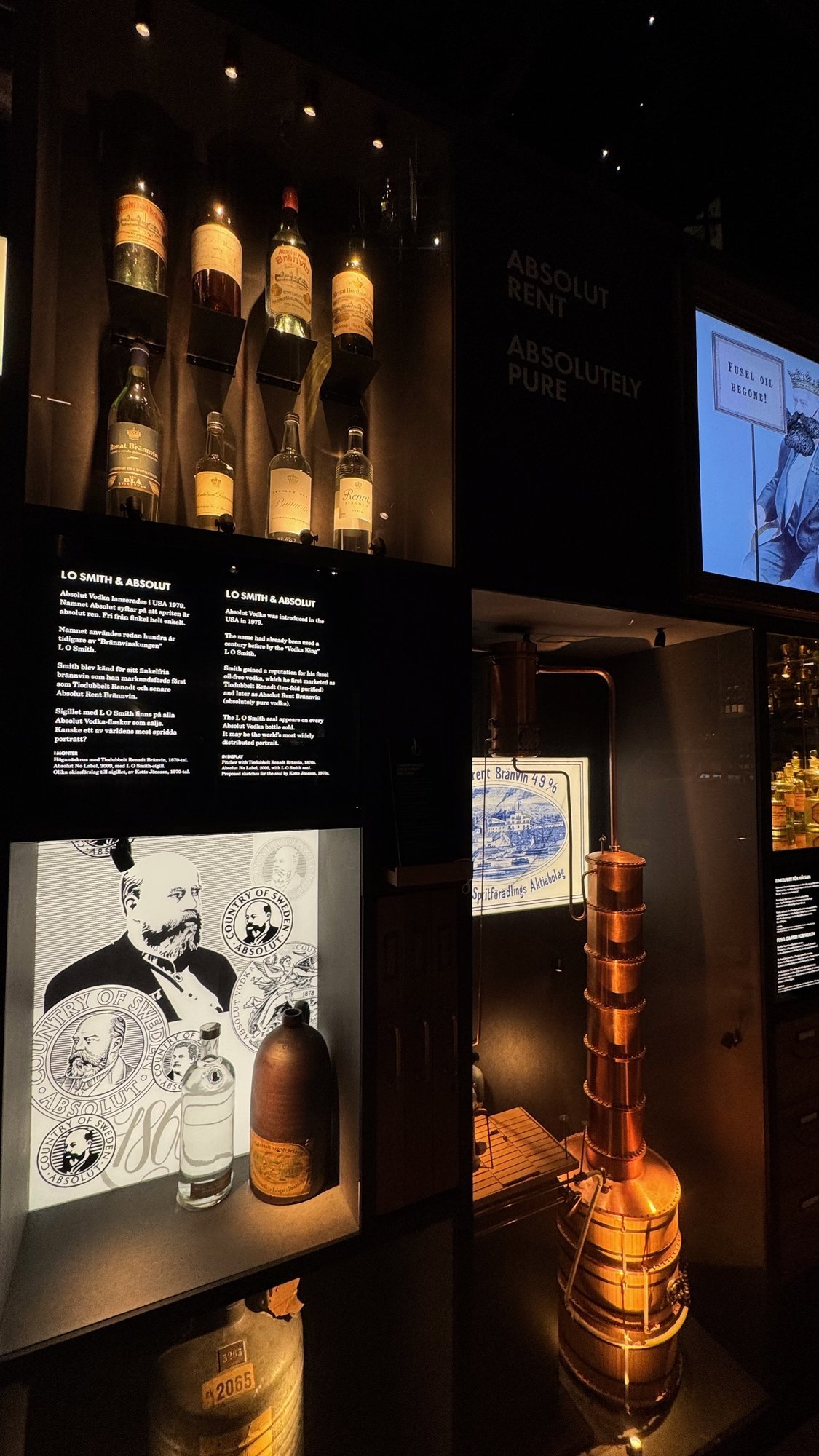
The best-known name is Lars Olsson Smith, “L.O. Smith”, born on 12 October 1836 in Kiaby in Skåne. People called him Brännvinskungen, the King of Brännvin. The panel at the museum says he became known for brännvin without fusel oil. He sold it first as Tiodubbelt renadt, ten-fold purified, and later as Absolut rent brännvin, absolutely pure brännvin. The Absolut company dates this to 1879.
Smith was also a fighter. The Absolut company tells the story like this: in 1876, one company got the sole right to sell brännvin in Stockholm, and Smith was left out. On 12 September 1877 he opened a shop on Reimersholme, which was then outside the city. He sent boats from the city every 20 minutes, and he claimed 25,000 visitors a day. He died on 9 December 1913.
In 1917, the state took over. Spritmuseum says the state company AB Vin- & Spritcentralen was founded that year, when the state monopoly began. Smith’s old company on Reimersholme became part of it.
Aquavit, snaps songs, punsch and glögg
Swedish brännvin is often flavored with herbs. Aquavit (akvavit) is a name protected by the EU. Systembolaget says it must taste mainly of caraway or dill, or both, and contain at least 37.5% alcohol.
A snaps often comes with a song. Spritmuseum says the tradition of snaps songs grew in the late 1800s. Helan går is about 150 years old. At the ice hockey World Championship in 1957, the Swedish team sang Helan går in place of the national anthem. The museum has collected snaps songs since 1992 and has more than 12,000. Wikipedia says the museum has run the Swedish championship in newly written snaps songs since 1995.
Punsch came with the East India trade. Spritmuseum says arrack, a strong spirit from Asia, came to Gothenburg in 1733 on the first ship of the Swedish East India Company. The first bottled punsch was sold in 1845. Today it lives on with pea soup on Thursdays. Glögg, the hot spiced wine of Christmas, comes from the word glödga, to heat. Spritmuseum says it became a Christmas custom in the 1890s.
Absolut Vodka
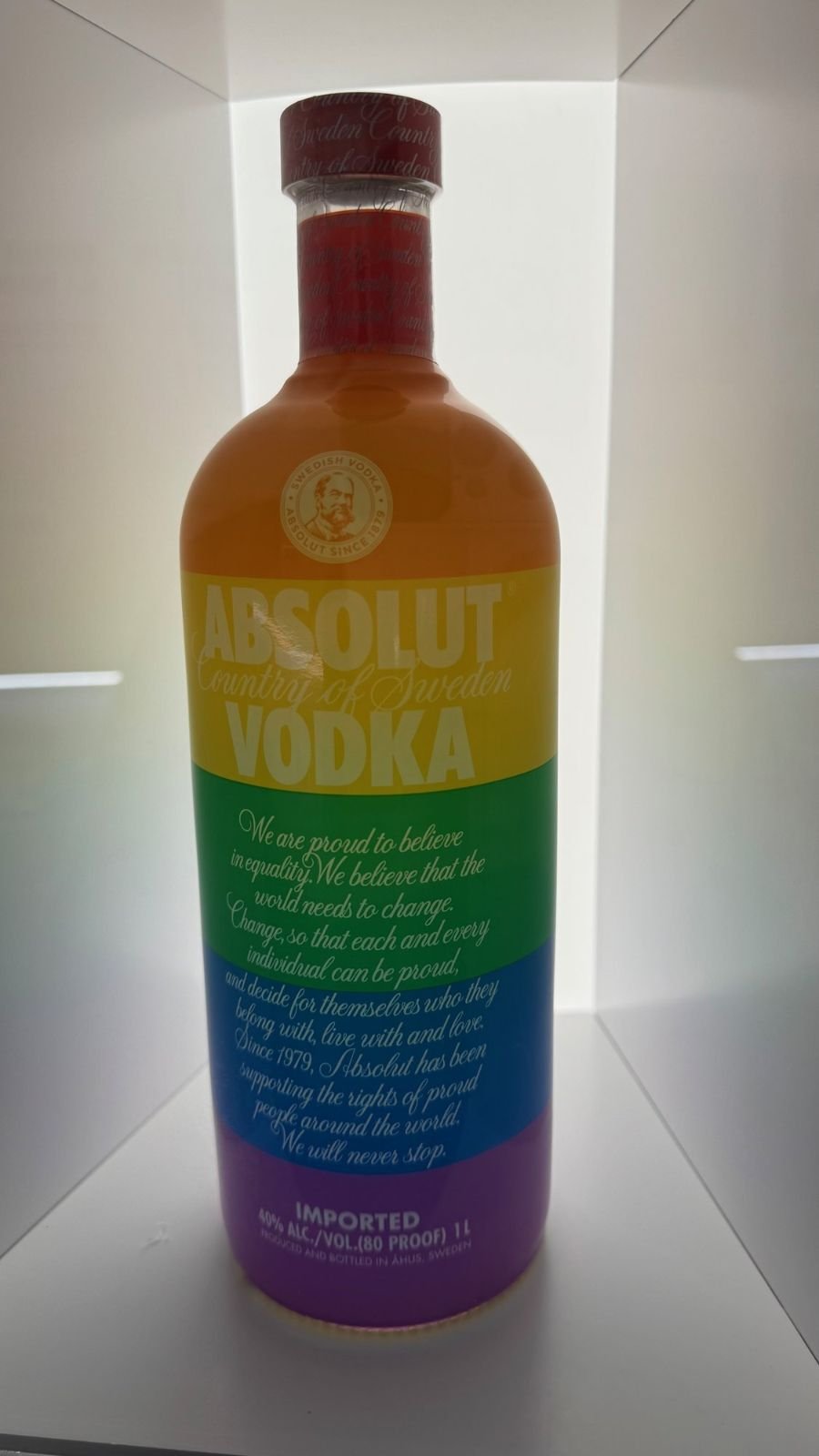
The museum panel says Absolut Vodka was launched in the USA in 1979. The name Absolut had already been used 100 years earlier by L.O. Smith. His portrait seal is on every Absolut bottle. The panel says it may be the most widely spread portrait in the world.
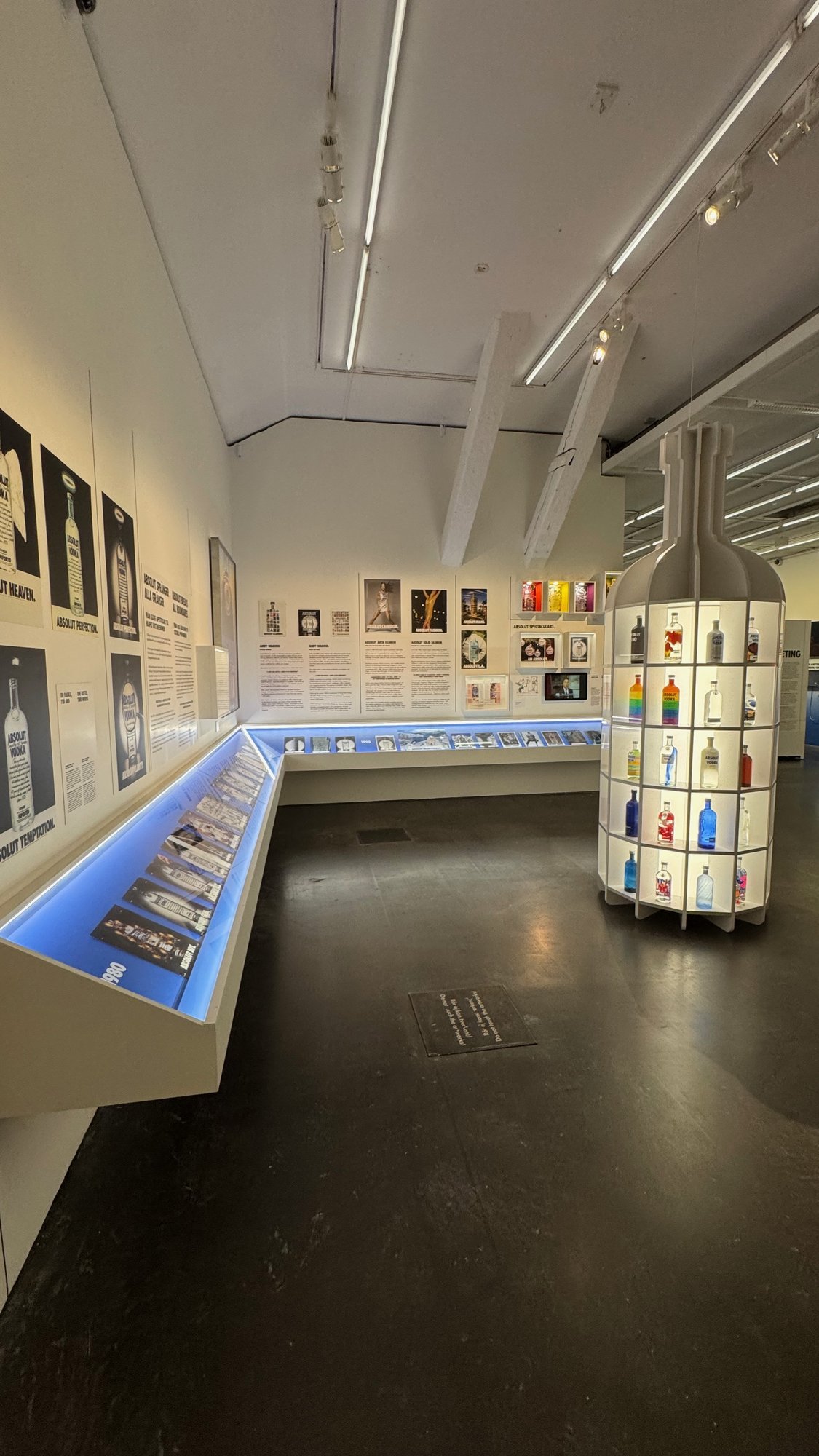
The Absolut company says the first batch was bottled at Åhus in Skåne on 17 April 1979. It also says the bottle shape came from an old medicine bottle found in a Stockholm antique shop. The advertising became famous: the museum says more than 1,500 ads were made, with one idea, one bottle and two words. In Sweden, the ads were almost invisible, because new rules limited alcohol advertising.
Artists joined in. Spritmuseum says Andy Warhol made the first artwork for Absolut in 1986. Wikipedia gives 1985. Keith Haring, Kenny Scharf, Damien Hirst, Louise Bourgeois and many others followed. When the Swedish state sold Absolut to Pernod Ricard in 2008, the art stayed with the state. The Absolut Art Collection has about 850 works by about 550 artists, made from 1985 to 2004. It is kept at Spritmuseum.
The exhibition Absolut Absolut. A Spectacular Advertising Story runs from 20 May 2026 to 26 March 2028. The museum says it shows about 90 bottles and 130 ads, with works by artists and creators such as Andy Warhol, Chris Ofili, Tom Ford, Vivienne Westwood, Swedish House Mafia and Annie Leibovitz. It also has a bar where a robot mixes cocktails.
The temperance movement: why it came about
In the early 1800s, Sweden drank a lot. How much is hard to say. Wikipedia says consumption peaked in 1829 at 46 liters of brännvin per person a year. Riksarkivet says nearly 50 liters. But Wikipedia also warns that the high figure comes from the temperance society itself and is not very reliable. The historian Per Frånberg estimates about 20 liters of pure alcohol per person a year. Even that was a danger to public health.
The harm was real. Grain and potatoes went into brännvin in place of food. Some workers got part of their wages in brännvin. And the state needed the money: in 1870, brännvin gave about 20% of the state’s tax income.
The Swedish Society for Temperance and Public Education (Svenska Sällskapet för Nykterhet och Folkbildning) points to who paid the price. Men did most of the drinking. But women and children carried most of the social burden: violence, abuse, and a family budget drained by alcohol. The society says the temperance movement was to a large part built by women.
The movement grew step by step:
- 1819: the schoolboy Peter Wieselgren started what was probably the first temperance society in Sweden. He later became a central figure in the Swedish Temperance Society.
- 1837: the Swedish Temperance Society (Svenska Nykterhetssällskapet) was founded. In 1846 it had more than 95,000 members.
- 1879: on 5 November, the first Swedish lodge of the IOGT opened in Gothenburg. One Wikipedia article says the IOGT came to Sweden in the 1860s, but the article about the IOGT gives 1879. In 1910 the IOGT had 160,000 members.
- 1883: the start of Blå Bandet, the Blue Ribbon. In 1900 came Vita bandet, the White Ribbon, a women’s organization.
- 1902: the IOGT started the first study circle in Sweden, led by Oscar Olsson.
The temperance movement was one of the great popular movements (folkrörelser) of Sweden, together with the free churches and the labor movement. UR describes these movements as working for women’s right to vote, for better working conditions and against alcohol abuse. Wikipedia says about 6% of the population were members of temperance organizations in 1910.
The big test came in 1922. On 27 August, Sweden voted on a total ban on alcohol. The result was very close: 50.8% voted against a ban and 48.8% voted for it. Men and women voted on different ballots. Among men, 59% voted no. Among women, only 41% voted no.
The movement still exists. In 2025, IOGT-NTO, UNF and Junis joined, and the new organization took the name Movendi Sverige. It works with alcohol policy, social work, support for parents and international work, and it has about 400 alcohol-free meeting places.
From the motbok to Systembolaget
Systembolaget did not start in Stockholm. Its history site says the first step came in Falun in 1850, when mine owners started a company to sell alcohol. The profits went to the miners’ welfare, not to the owners.
In 1865 came the Gothenburg system (Göteborgssystemet). The city took over the pubs, and a company with no private profit sold brännvin. The rules included an age limit of 18 and a demand to serve hot food and coffee. From 1870, the profits went to the public. The model spread to Finland, Norway and Britain.
Then came Ivan Bratt, a doctor and liberal politician. He started the Stockholm system in 1913, and the motbok came to Stockholm in 1914. The motbok was a ration book. With it, you could buy only a set amount of spirits each month. Sources give different years for when it covered all of Sweden: 1917 (Systembolaget’s own site) or 1919 (its history site). Critics in the 1930s called the system unequal and degrading.
The exhibition True Crime shows the dark side of these years. The museum says that in 1920s Stockholm, thousands of liters of 96% export spirits were smuggled in from the Baltic every night, and home stills worked at full capacity. The exhibition runs until 31 March 2027.
The motbok ended in the autumn of 1955. On 1 October 1955, 41 local companies with 247 stores in 147 towns became one national company: Systembolaget. Strong beer came onto the shelves. The age limit was 21. In 1969 it became 20, as it is today. In bars and restaurants, the limit is 18. Systembolaget says this is because staff in a restaurant can see if a guest is drunk, and a lower limit in the shops would make it easier for minors to get alcohol.
Some later dates: all shops were closed on Saturdays from 1982. Since 1 July 2001, all shops open on Saturdays again.
Why Systembolaget exists
Systembolaget says the reason is public health. Alcohol is “not an ordinary product”. The company sells without trying to make the most profit, and its staff never encourage customers to buy more than they planned. In February 2026, a government inquiry found that the monopoly and the alcohol tax reduce consumption and the costs to society.
When Sweden joined the EU in 1995, the state lost its monopolies on import, export, production and wholesale. The shop monopoly stayed. In 1997, the grocer Harry Franzén from Röstånga tested it: he sold wine in his shop. On 23 October 1997, the EU Court ruled that the monopoly was allowed.
In 2025, Systembolaget had 452 stores. The full story is on Systembolaget’s history site, made by the Centre for Business History (Centrum för Näringslivshistoria).
Alcohol in Sweden today
Swedes drink less than before. CAN, the Swedish Council for Information on Alcohol and Other Drugs, says that in 2025, people aged 15 and over drank about 8.2 liters of pure alcohol per person. That is 2.6% less than in 2024 and 8.9% less than in 2019. Consumption peaked in 2004.
Where does the alcohol come from? CAN’s figures for 2025:
- Systembolaget: 72%
- Restaurants and bars: 12%
- Brought home from travel: 7%
- Folköl, light beer from grocery stores: 4%
- Home production: 2%
- Bought on the internet: 2%
- Smuggled: 1%
Since 1 June 2025, farm sales (gårdsförsäljning) of alcohol are allowed. CAN has no figures for them yet.
For comparison, the WHO says adults in its European Region, 53 countries, drank an average of 9.2 liters of pure alcohol in 2019. That region is not the same as the EU, and the WHO counts in a different way from CAN.
What you see at Spritmuseum
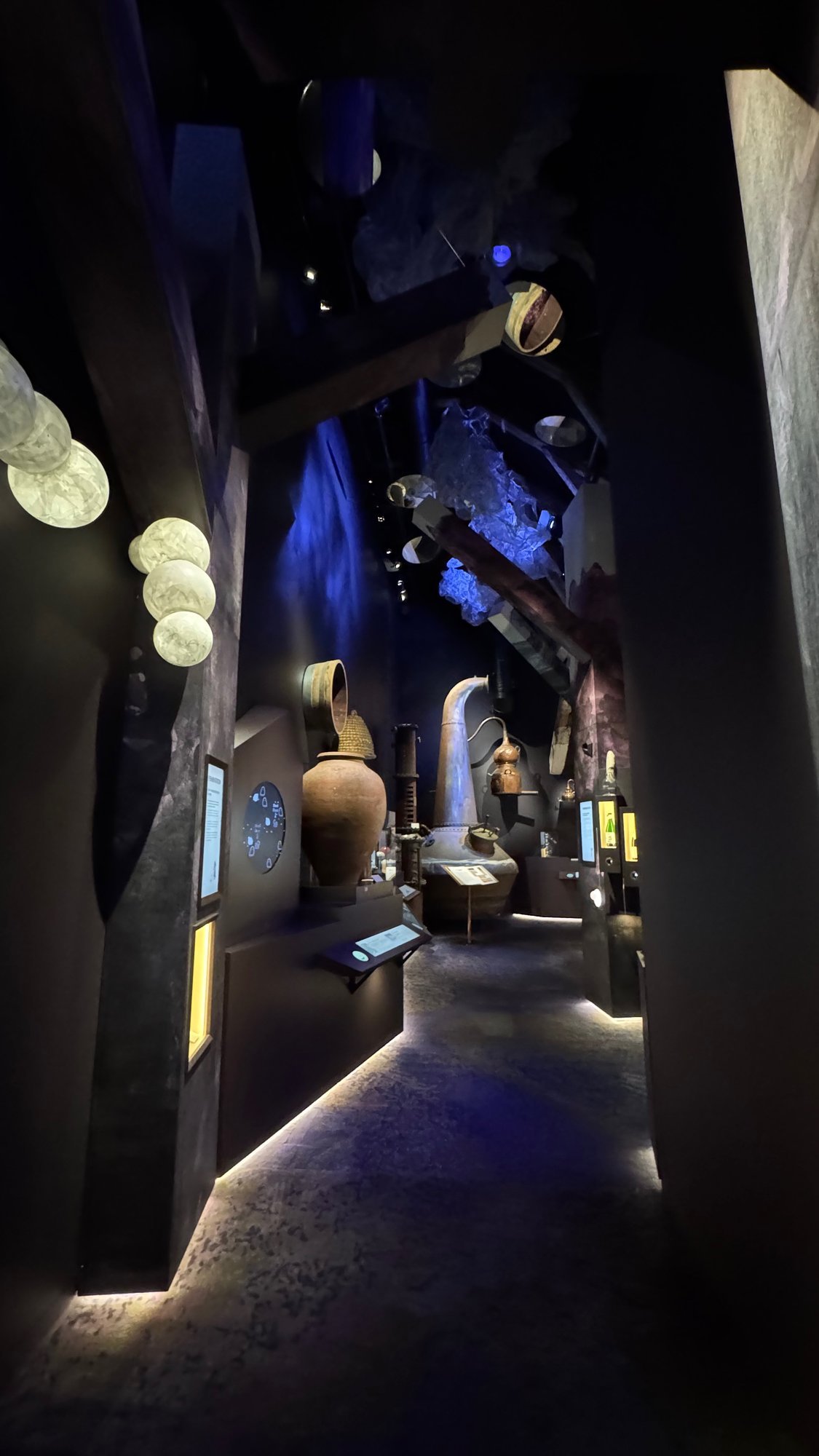
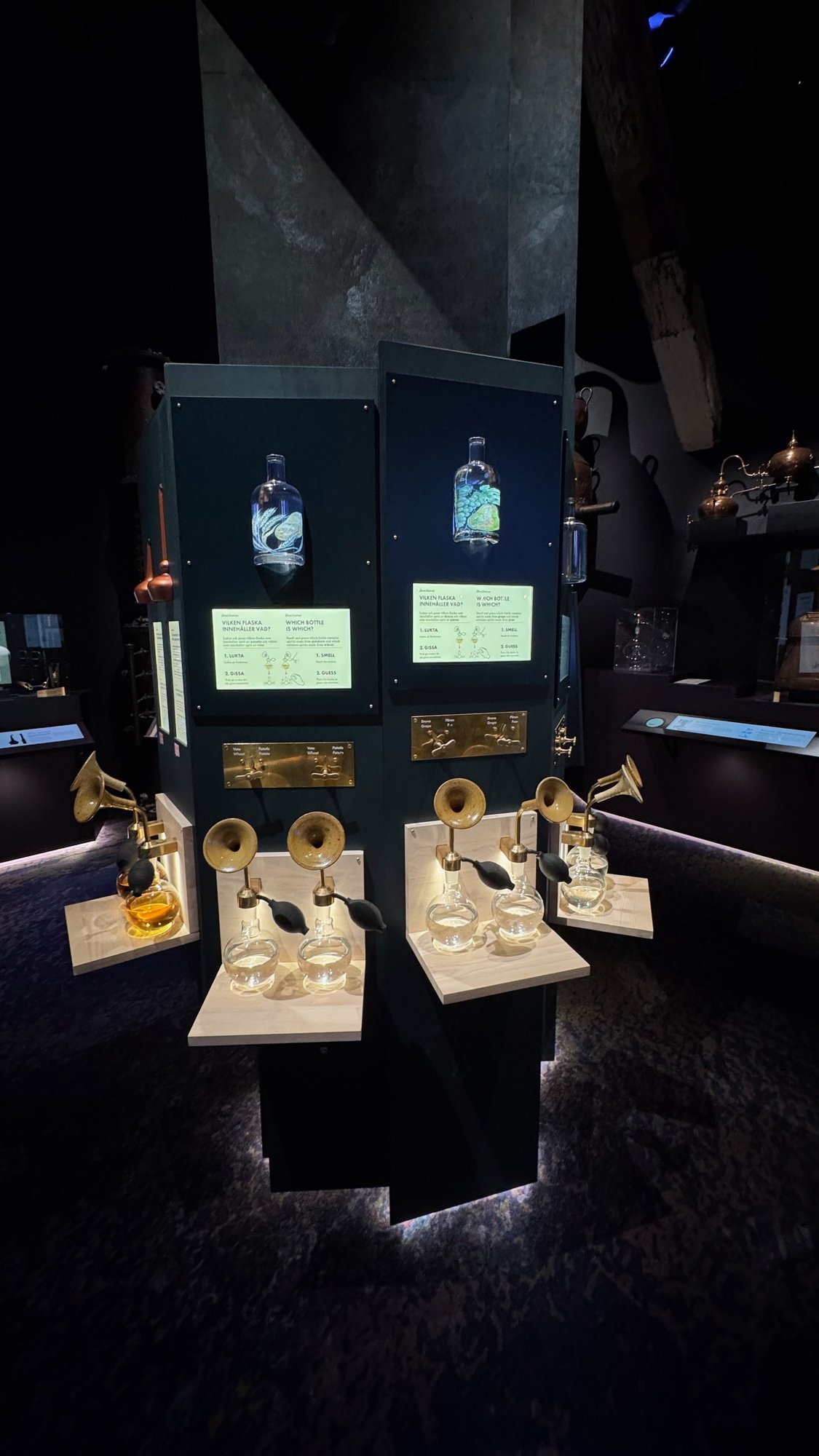
The permanent exhibition is Sweden: Spirits of a Nation (Dryckeslandet Sverige). The museum says it covers Swedish drinking culture from the 1400s until today, with scenes, films, scents and music. You can test if you can tell whisky from rum, learn the rules for Swedish alcohol production and take a quiz.
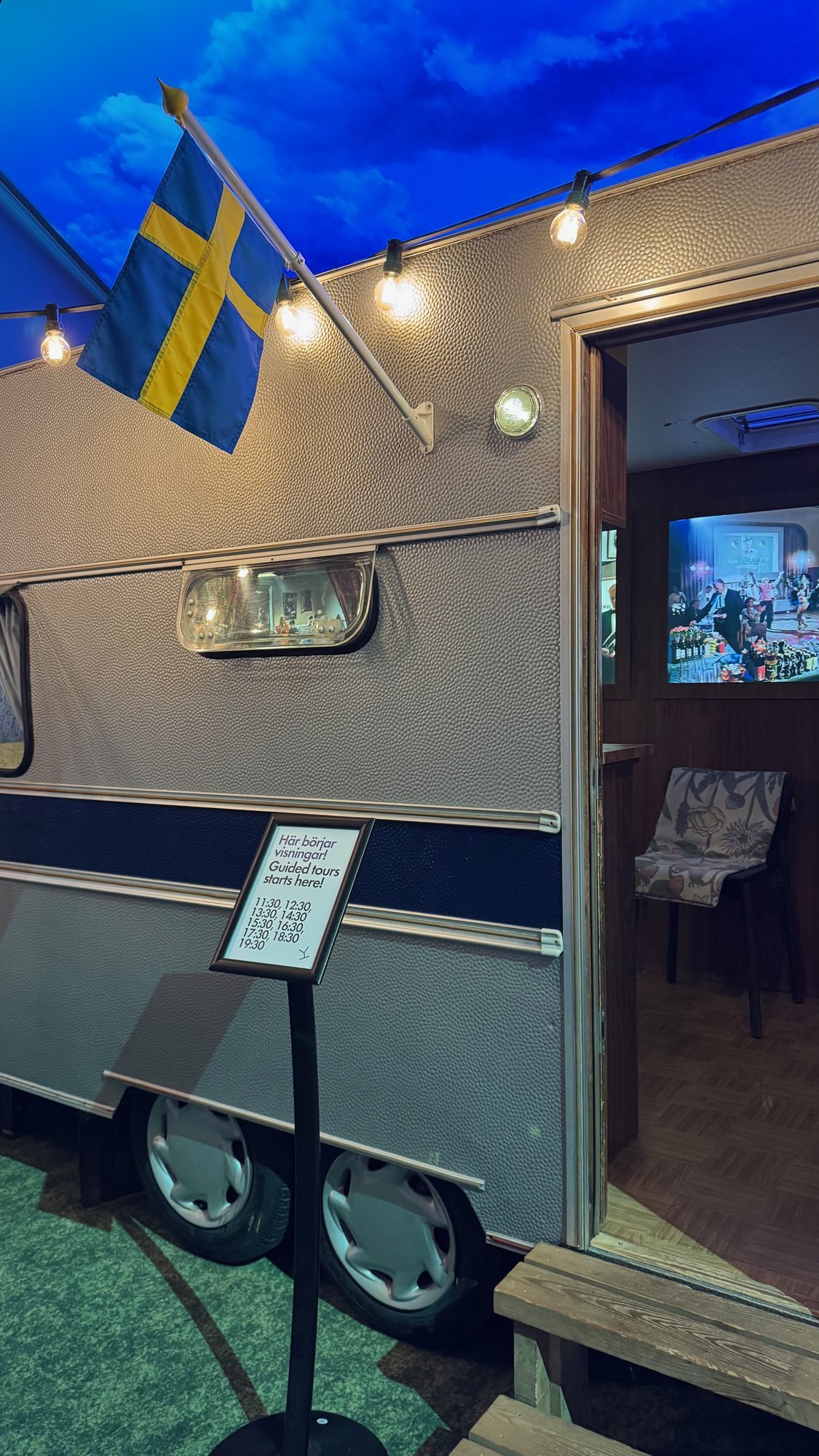
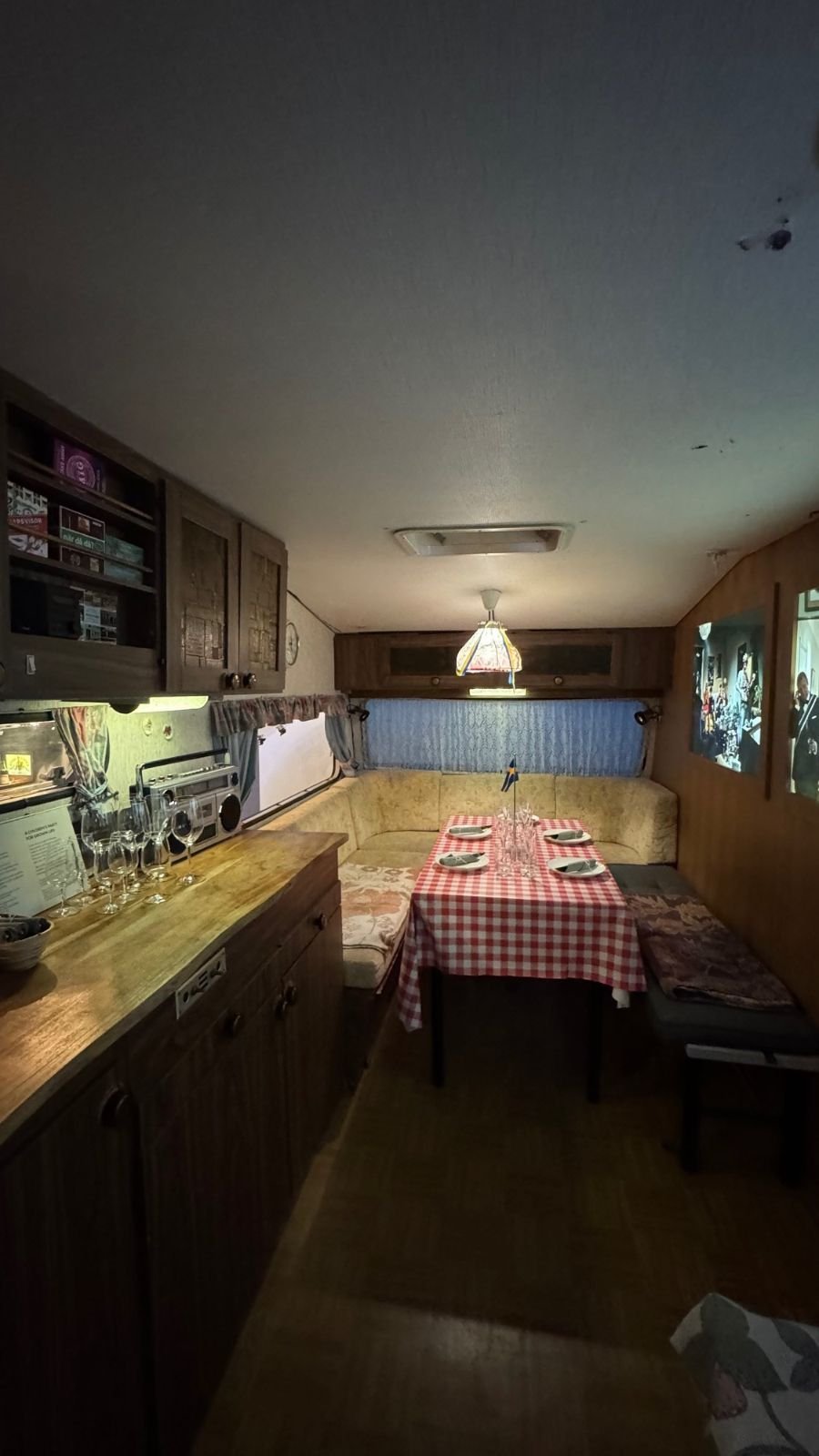
In my photos, the rooms are dark, with blue light, old copper stills and lit glass cases under the old wooden roof beams. Brass horns hang over glasses on white tables. One scene is an old caravan with a Swedish flag and string lights. Inside it, a table has a red checkered tablecloth.
The exhibition True Crime takes you to the smugglers and bootleggers of the 1920s. You can buy a puzzle game, The Dry Run, at the entrance. The museum says it takes about 45 to 60 minutes. Absolut Absolut is the bright room with the ads and the bottles, as in my photos above.
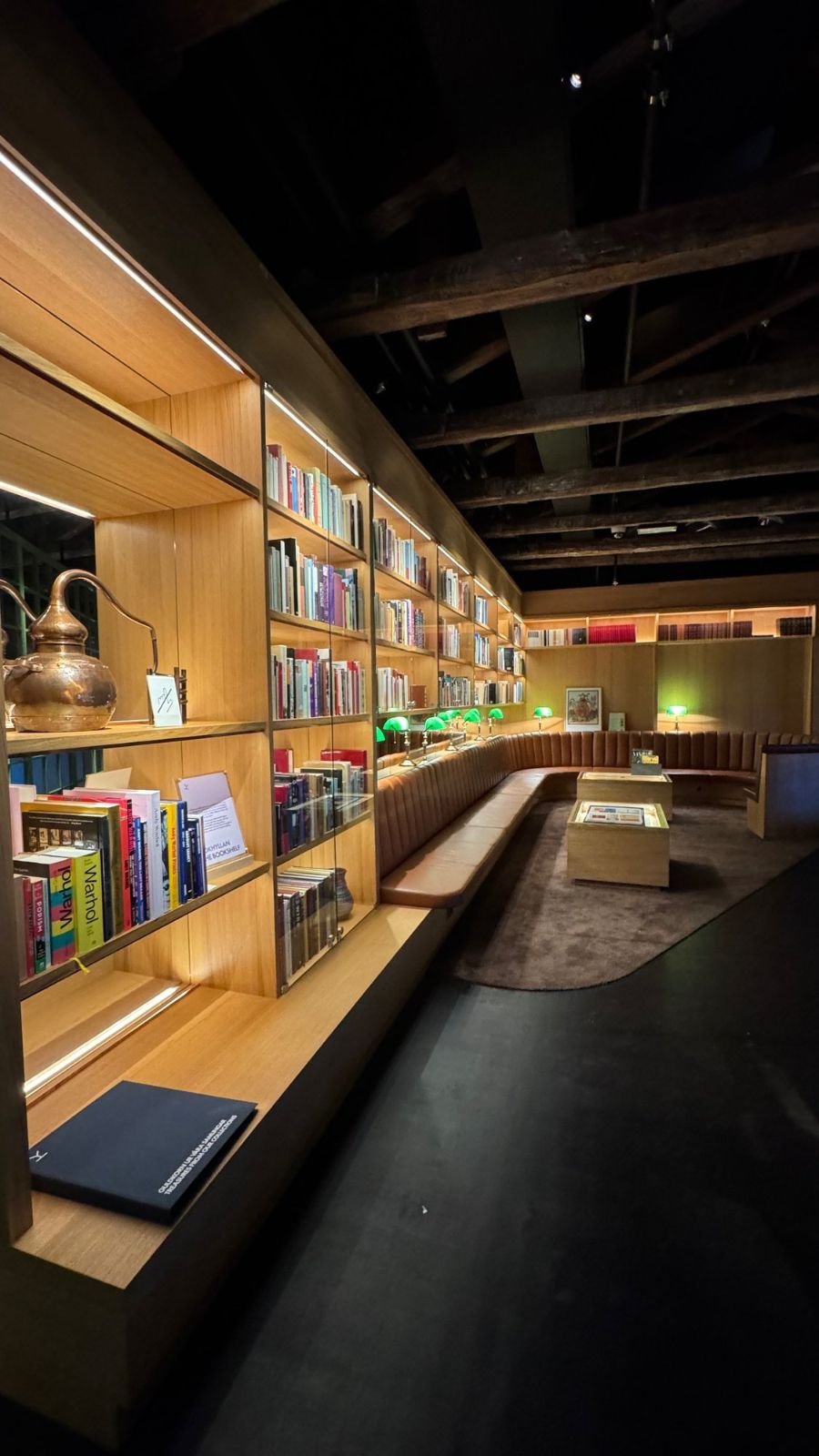
There is also a library lounge, with wooden bookshelves, a long sofa, green lamps and a copper pot.
The guided tour
I joined a guided tour. The museum offers short introductory tours every hour, from 11:30 to 19:30, every day. They are included in the ticket, if there is space, and you do not need to book. The museum says they last about 10 to 15 minutes, and English is available on request. In my photo, the sign by the caravan says: Guided tours starts here!
For a group, you can book a private tour of about 30 minutes. It costs 345 SEK per person, or 295 SEK for students and seniors. The price includes museum admission and a drink, with or without alcohol. Book by email at info@spritmuseum.se.
Tastings, dinners and a snaps workshop
Spritmuseum is a museum where you can taste the history. In Sweden, bars and restaurants serve alcohol only to guests aged 18 and over.
Tasting trays
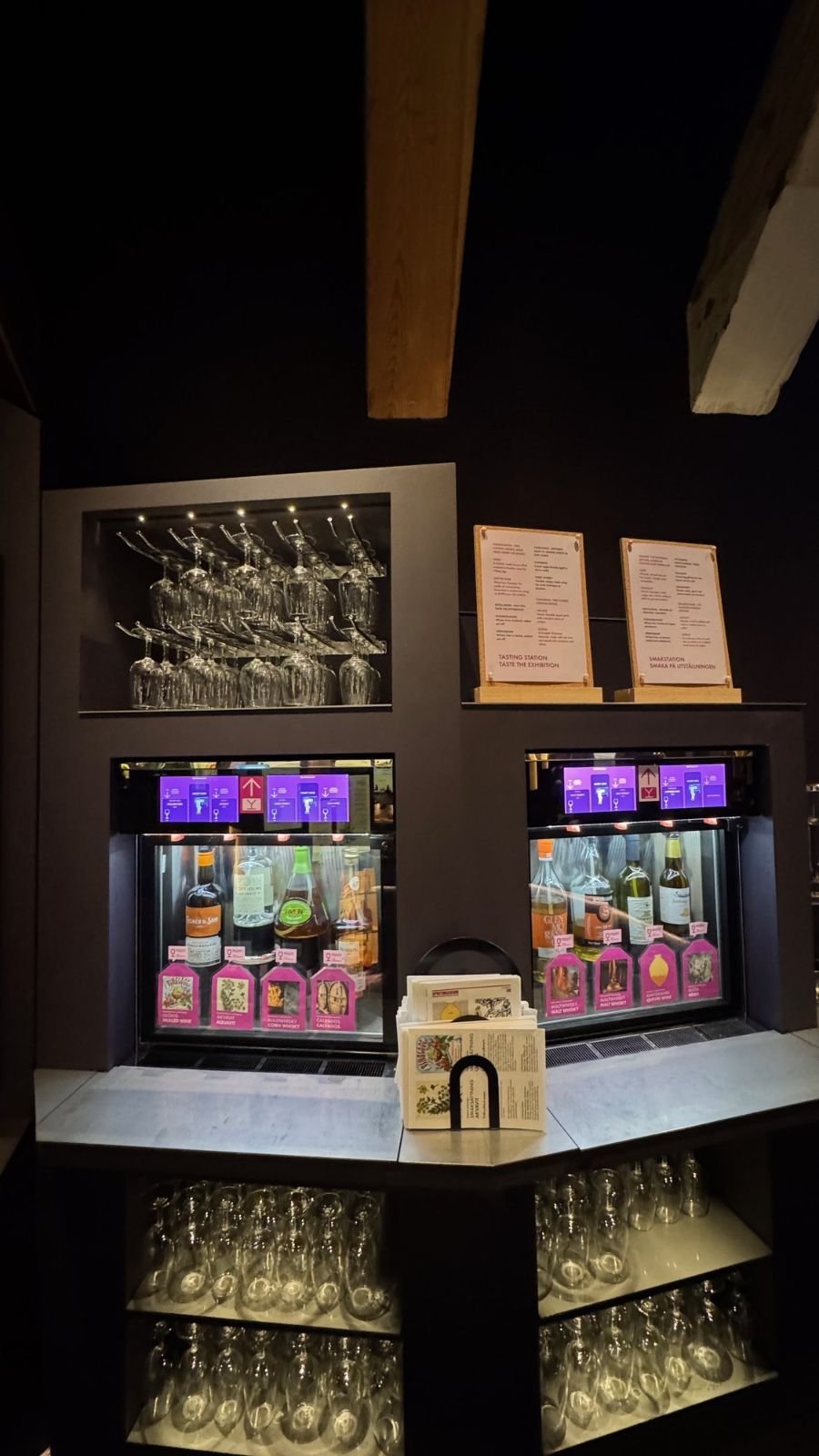
The tasting trays are drop-in. You do not need a museum ticket. The museum lists four trays:
- Traditional tray, 180 SEK: aquavit, spiced brännvin, bäsk (wormwood snaps) and Swedish punsch. With virtual reality, 290 SEK.
- Absolut Vodka tray, 180 SEK: Absolut Vodka, Vanilia, Citron and Passionfruit.
- Beer tray, 180 SEK: pale lager, wheat beer, West Coast IPA and nitro stout.
- Swedish wine tray, 245 SEK: Swedish sparkling, white, orange and red wine.
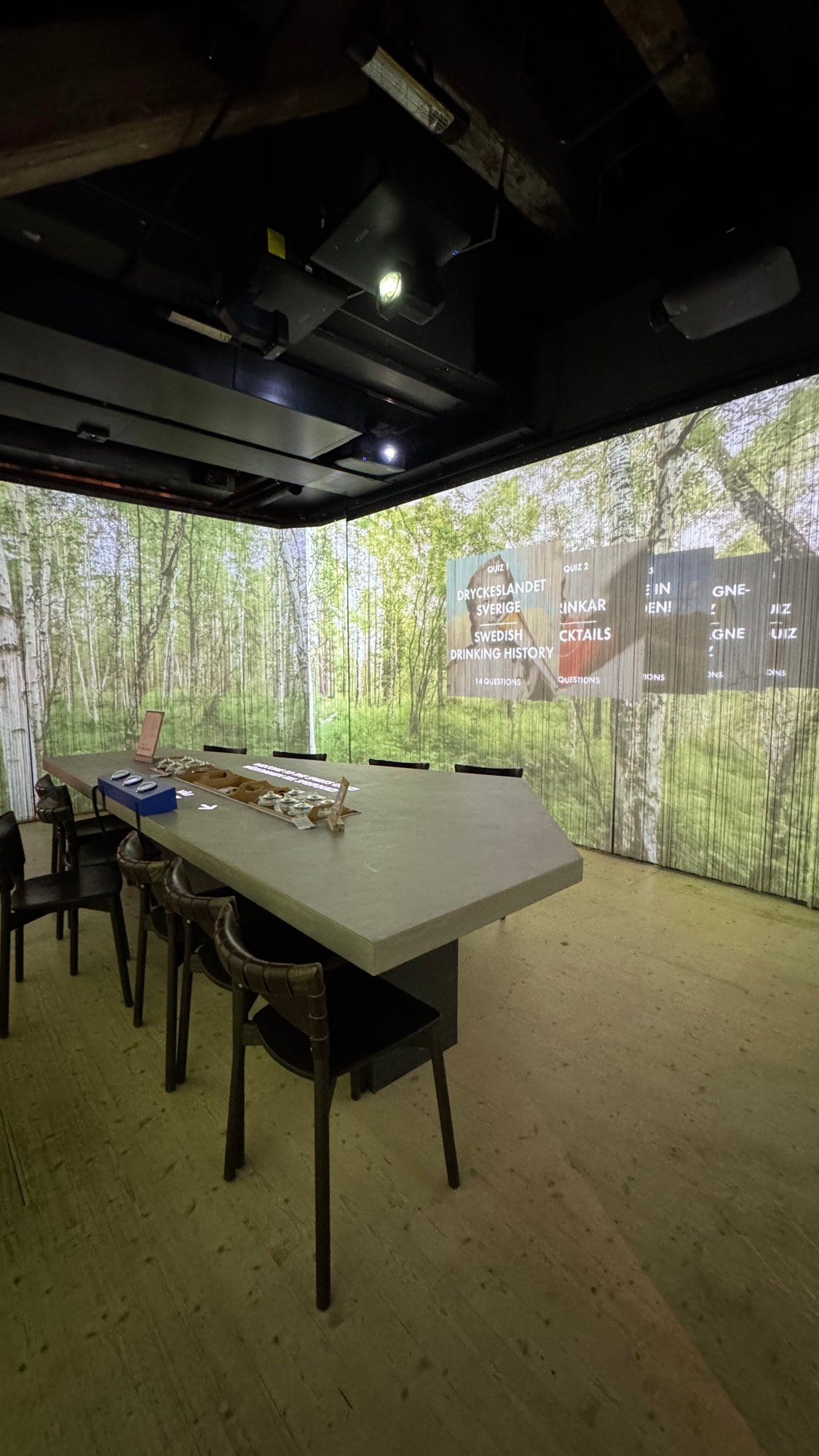
In my photos, two self-service machines hold bottles behind glass, with rows of glasses below. The tasting room has a long table and a birch forest on the walls. On the screen, a quiz on Swedish drinking history waits, with 14 questions.
Tastings with a drinks expert
The museum also runs tastings led by its drinks experts, on set dates. Museum admission is included. This autumn the list includes champagne with sausage, Captain Haddock’s favorite drinks, smoky whisky, cognac, wines from Spain and Italy, and wines made by women. Most cost 595 or 695 SEK. The tasting pages are in Swedish.
There is also a 30-minute tour in Swedish, Dryckeshistoria & snaps, for 345 SEK including admission. With a snaps or an alcohol-free drink in your hand, you walk from the 1500s, when spirits were medicine, through the motbok years to the start of Systembolaget. The museum asks: who was Eva De la Gardie?
The Time Travel Dinner
The Time Travel Dinner (Tidsresan) is a private dinner for groups of 8 to 12 guests. It travels through 300 years of Swedish food and drink, with projections, sound and scent. The museum says it goes from the crofter’s beer and crispbread and the manor’s snaps table to the wines of the welfare state and the bubbles of the nightclub era. It has four courses with paired drinks. It costs 1,995 SEK per person, including drinks, and lasts about 2.5 hours. It is held in Swedish or English.
Happy Camper
Happy Camper is a private dinner inside the real caravan in the exhibition, the one in my photos. It is for groups of 5 to 10 guests. The museum says it is a three-course dinner inspired by camping trips, folk parks and midsummer, from herring and snaps to pork shoulder and strawberry cake. It costs 1,295 SEK per person, including food and drinks, and lasts about 3 hours. It is available in English.
Master Blending: make your own snaps
In the Master Blending workshop, you make your own aquavit with herbs, spices, plants and berries. You design your own label and take the bottle home. It is for private groups of 8 to 16 people and lasts about one hour. It costs 800 SEK per group plus 290 SEK per person.
The restaurant
The restaurant is open every day from 11:00 to 22:00. It serves Scandinavian, seasonal food for lunch, brunch and dinner, with a view over the water. The museum says the menu goes well with Swedish wine, beer and aquavit. Royal Djurgården says the museum also brews its own beer.
If you want to taste Stockholm with a local guide, my Culinary & Cultural Tour of Stockholm’s food traditions is a taste-led walk that ends with fika.
Tickets and prices
Adults 190 SEK. Seniors and students 140 SEK. Youth 15 to 18 years 95 SEK. Children 0 to 14 years free. The ticket includes all exhibitions and the short introductory tour.
The annual card costs 365 SEK. It gives free entry for a year, including the Spritmuseum Talks, half price for a friend, and 10% off in the shop and on food and alcohol-free drinks in the restaurant. The museum takes American Express, Swish, UnionPay, cash and the Go City Stockholm Pass, among others.
Getting there and access
Take tram 7 from Sergels torg toward Waldemarsudde, or bus 67, and get off at Liljevalchs/Gröna Lund. Walk past Liljevalchs down to the water, and turn right toward the Vasa Museum, about 500 meters. Bus 69 and 76 stop at Djurgårdsbron. From the Karlaplan metro station, it is a 10 to 15 minute walk. The Djurgården ferry from Slussen stops at Allmänna Gränd, and so does the boat M/S Emelie.
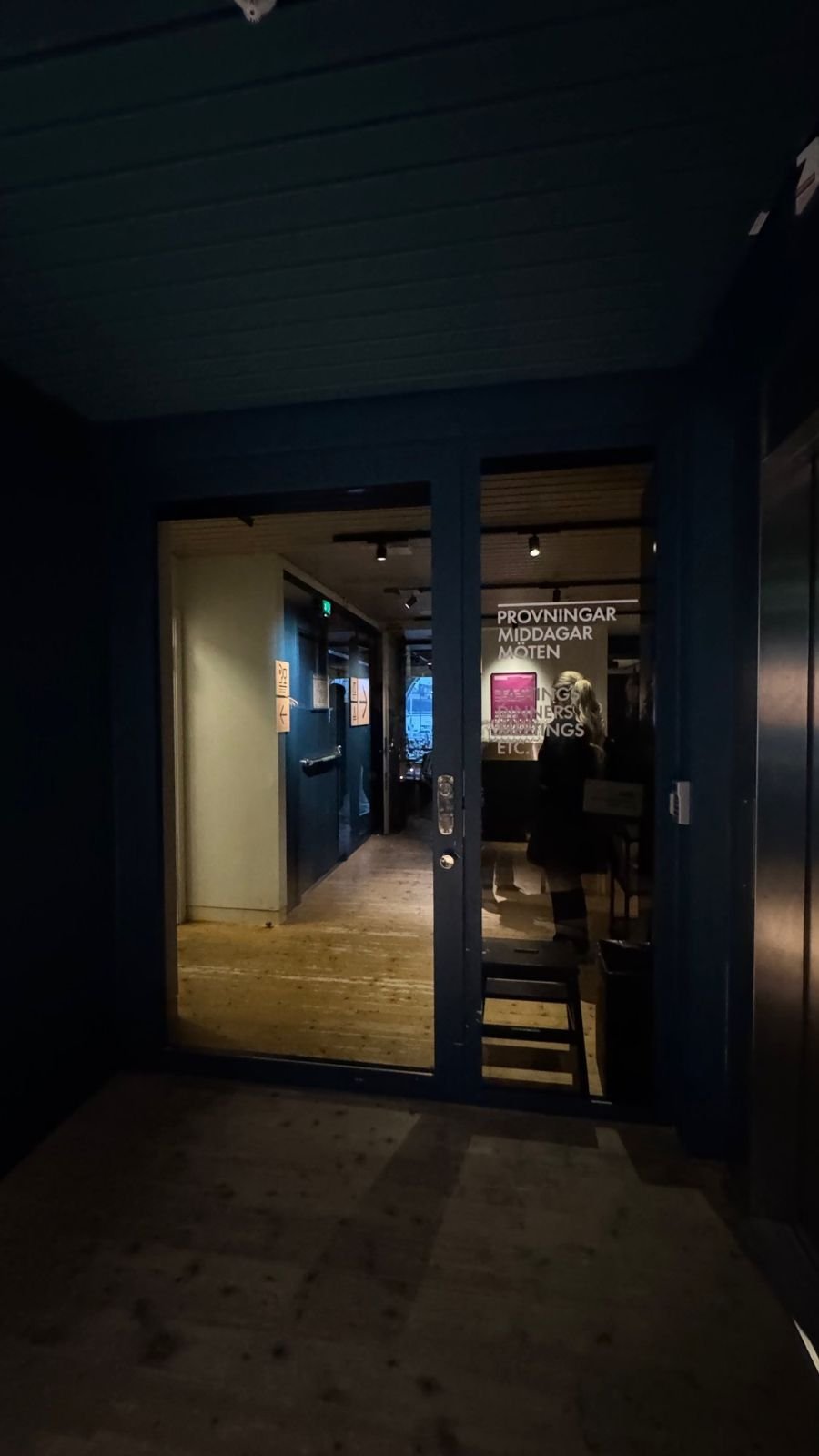
Entrance and lift. Parking for disabled visitors is outside the entrance. The museum says it is accessible by wheelchair, with ramps and a lift between the floors. The glass doors to the entrance hall have a low threshold. A lift door, coat racks and lockers stand by the stairs.
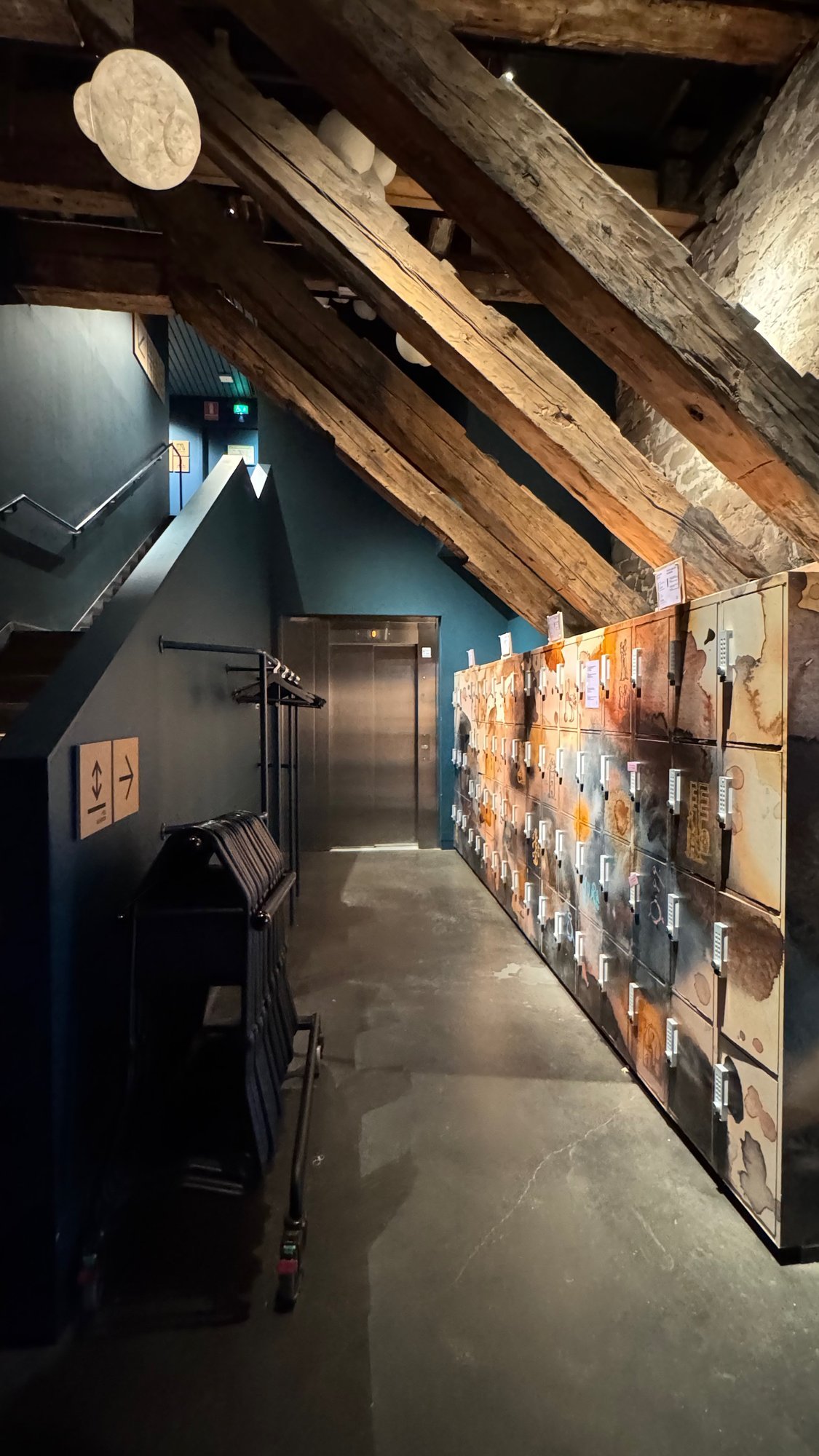
Toilets and stairs. A toilet door with a sign is next to the lift. Short stairs have a handrail.
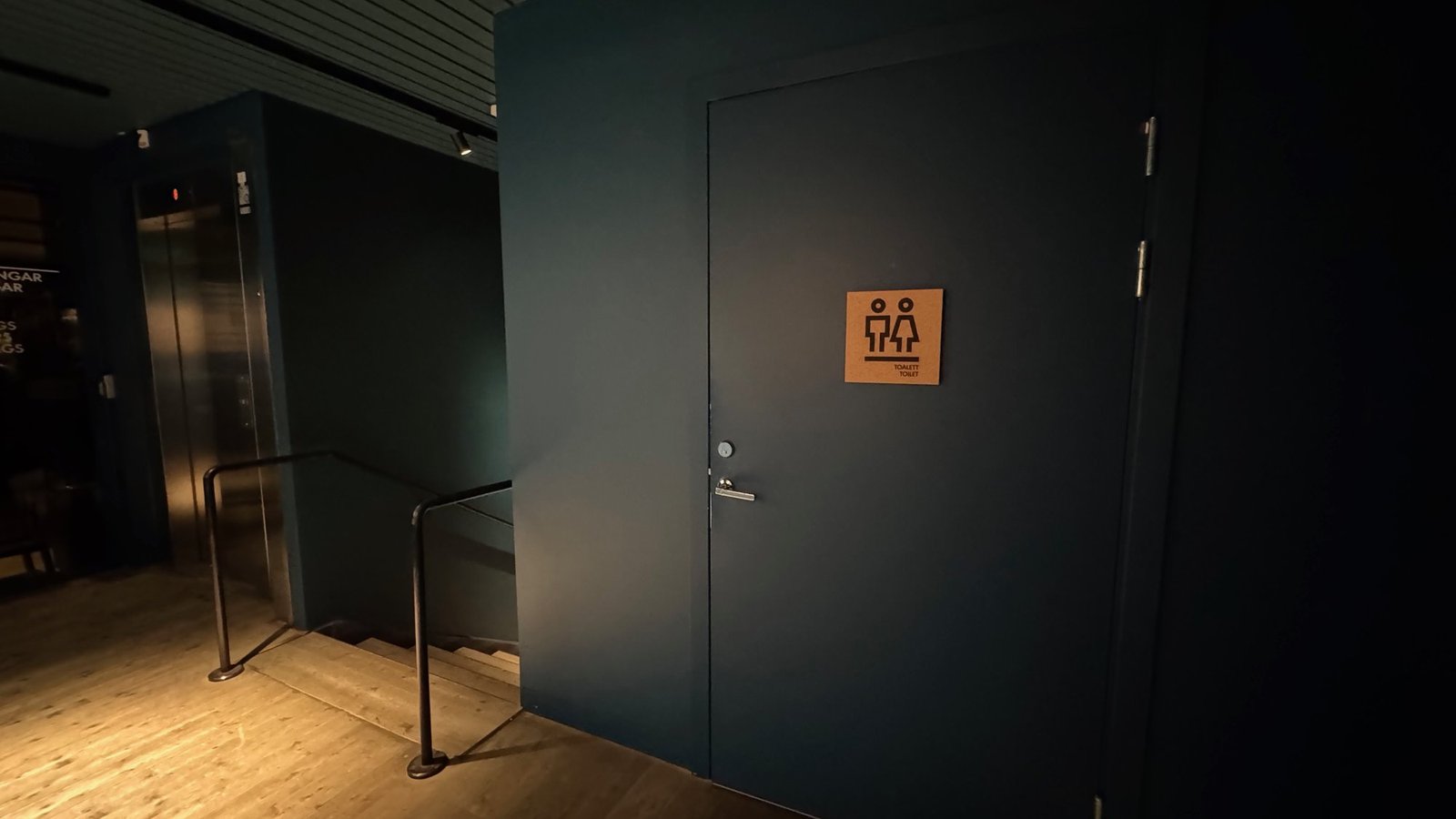
Bags and strollers. Strollers are not allowed in the exhibitions, but you can borrow a baby carrier. The lockers measure 51 × 30 × 55 cm. The museum cannot store large luggage.
Hearing. There is a hearing loop in the tasting and conference room. On guided tours, you can borrow a neck loop.
Senses. Sweden: Spirits of a Nation uses scents, and some parts are dark. Plan for this if you are sensitive to smells or low light.
Other facts. Assistants enter free. The museum has a defibrillator and free Wi-Fi. For help to plan your visit, email info@spritmuseum.se.
I have written about why many museums are still hard to visit in my Medium story Why Are Museums Inaccessible?
What is my verdict?
Spritmuseum tells a story that many visitors know only in parts. Mead and drinking horns. Monks and hops. Home stills in every village. A countess and her potatoes. A brännvin king with his own boats. Women who carried the cost of men’s drinking and built a movement against it. A ration book, a referendum where the ban lost by two percentage points, and a state shop that still sells most of the alcohol in Sweden.
You can see all of it without drinking anything. Or you can taste some of it on a tray.
Next time you stand in line at Systembolaget, will you think of Eva De la Gardie, of L.O. Smith, or of the women who voted for a ban in 1922?
Photo gallery
All photographs on this page were taken by Zayera Khan during a visit to the museum, and are her own property. Please do not reuse them without permission. The portrait of Eva De la Gardie in the exhibition is a copy by Jacob Björck after Gustaf Lundberg (Svenska Porträttarkivet, Nationalmuseum).
Spritmuseum: Spritmuseum, Visit us; Spritmuseum, Opening hours; Spritmuseum, About us; Spritmuseum, Collections; Spritmuseum, Absolut Art Collection; Spritmuseum, Exhibitions; Spritmuseum, Sweden: Spirits of a Nation; Spritmuseum, True Crime; Spritmuseum, Absolut Absolut; Spritmuseum, Guided tours; Spritmuseum, Tasting trays; Spritmuseum, Dryckesprovningar; Spritmuseum, Dryckeshistoria & snaps; Spritmuseum, The Time Travel Dinner; Spritmuseum, Happy Camper; Spritmuseum, Master Blending; Spritmuseum, Restaurant; Spritmuseum, Besök Spritmuseum; Spritmuseum, Potatisens dag; Spritmuseum, Svenskt brännvin; Spritmuseum, Vinet i Sverige; Spritmuseum, Punsch; Spritmuseum, Glögg; Spritmuseum, The history of the snaps song; Royal Djurgården, Spritmuseum.
Early history: Historiska museet, Vikingarnas dryck; Historiska museet, Jul på vikingatiden och medeltiden; Sveriges Bryggerier, Öl; Kulturen, Historik om öl (PDF); lex.dk, Alvastra Kloster; Nydala klosterträdgård, Medeltida trädgårdar (PDF); Agro Biodiver, humleodling; Matkult, Bryggerinäringen; Persson, Akvavitens historia i Norden, RIG 1995 (PDF); Systembolaget, Brännvin; Hallands släktforskare, Brännvinslagstiftning; Riksarkivet, Den som dricker tänker inte; Library of Congress, Proclamation of 1809; KTH Library, Eva Ekeblad; Västsverige, Potatisens historia.
L.O. Smith and Absolut: The Absolut Company, The first vodka war; Absolut Ad, History.
Temperance movement: Svenska Sällskapet för Nykterhet och Folkbildning, Den manliga arenan; UR Play, Folkrörelserna; Movendi Sverige (iogt.se); Movendi Sverige, press room; Länsstyrelsen Skåne, Nykterhetsrörelsen. Further reading: SO-rummet, Folkrörelser.
Systembolaget and alcohol today: Systembolagets historia, Från bergsman till Bratt; Systembolagets historia, 1955; Systembolagets historia, Tidslinje; Systembolagets historia, Viktiga vändpunkter; Centrum för Näringslivshistoria, Ny historiesajt; Om Systembolaget, Monopol; Systembolaget, Responsibility report 2025 (PDF); Systembolaget, Why 18 in bars and 20 in the shops; CAN, Alkoholkonsumtionen 2025 (PDF); CAN, Hur mycket dricker svensken (PDF); WHO Europe, 9.2 liters per year.
Wikipedia: Wikipedia: Spritmuseum; Wikipedia: Til árs ok friðar; Wikipedia: Kvasir; Wikipedia: Valhalla; Wikipedia: Sveriges alkoholpolitik; Wikipedia: Kronobränneri; Wikipedia: Crown distillery; Wikipedia: Eva Ekeblad; Wikipedia: Jonas Alströmer; Wikipedia: Lars Olsson Smith; Wikipedia: Absolut Vodka; Wikipedia: Nykterhetsrörelse; Wikipedia: Nykterhetsrörelsen i Sverige; Wikipedia: Peter Wieselgren; Wikipedia: IOGT; Wikipedia: Blå Bandet; Wikipedia: Nykterhetsrörelsens bildningsverksamhet; Wikipedia: Folkomröstningen 1922; Wikipedia: Göteborgssystemet; Wikipedia: Ivan Bratt; Wikipedia: Movendi Sverige.