The Viking Museum in Stockholm: a ride, a ship and a wall of souvenir Vikings
Walk up the stairs and back in time to the Viking Age, on Djurgården
- Why visitA museum about the Viking Age. It has a ride, a Viking ship, built scenes and guides in Viking-age clothes.
- Best forFamilies, first-time visitors to Stockholm, and anyone who wants history told as a story.
- AddressDjurgårdsstrand 15, 115 21 Stockholm, by Wasahamnen on Djurgården.
- Getting thereTram 7 from T-Centralen or bus 67 from Odenplan to Liljevalchs/Gröna Lund. Then walk down toward Wasahamnen. The Djurgården ferry from Slussen stops at Allmänna Gränd.
- Opening hoursMonday to Friday 11:00–17:00. Saturday and Sunday 10:00–17:00. Autumn break, 26 October to 1 November 2026: every day 10:00–17:00. Christmas break: every day 10:00–17:00, closed 23 and 24 December. Check the website before you go.
- AdmissionAdults 239 SEK. Students and seniors 189 SEK. Youth 15 to 18 years 189 SEK. Children 0 to 14 years free with a paying adult. The ticket includes the ride and the guided tours. The museum is cash-free. Buy tickets at the entrance or on the official website.
- Guided toursEvery day, in English and Swedish. Included in the ticket. No booking needed.
- FacilitiesRestaurant Eld, a museum shop, lockers, a cloakroom and a free audio guide on your own phone.
- AccessibilityA lift serves all floors. Wheelchair users can move through the exhibition, the shop and the restaurant. The ride has two carriages for wheelchair users. There is a hearing loop at the entrance. Details below.
- Official websitethevikingmuseum.com
I visited The Viking Museum on Djurgården on 15 October 2026. I joined a guided tour, rode Ragnfrid’s Saga and visited the shop. I took the photos on this page that day.
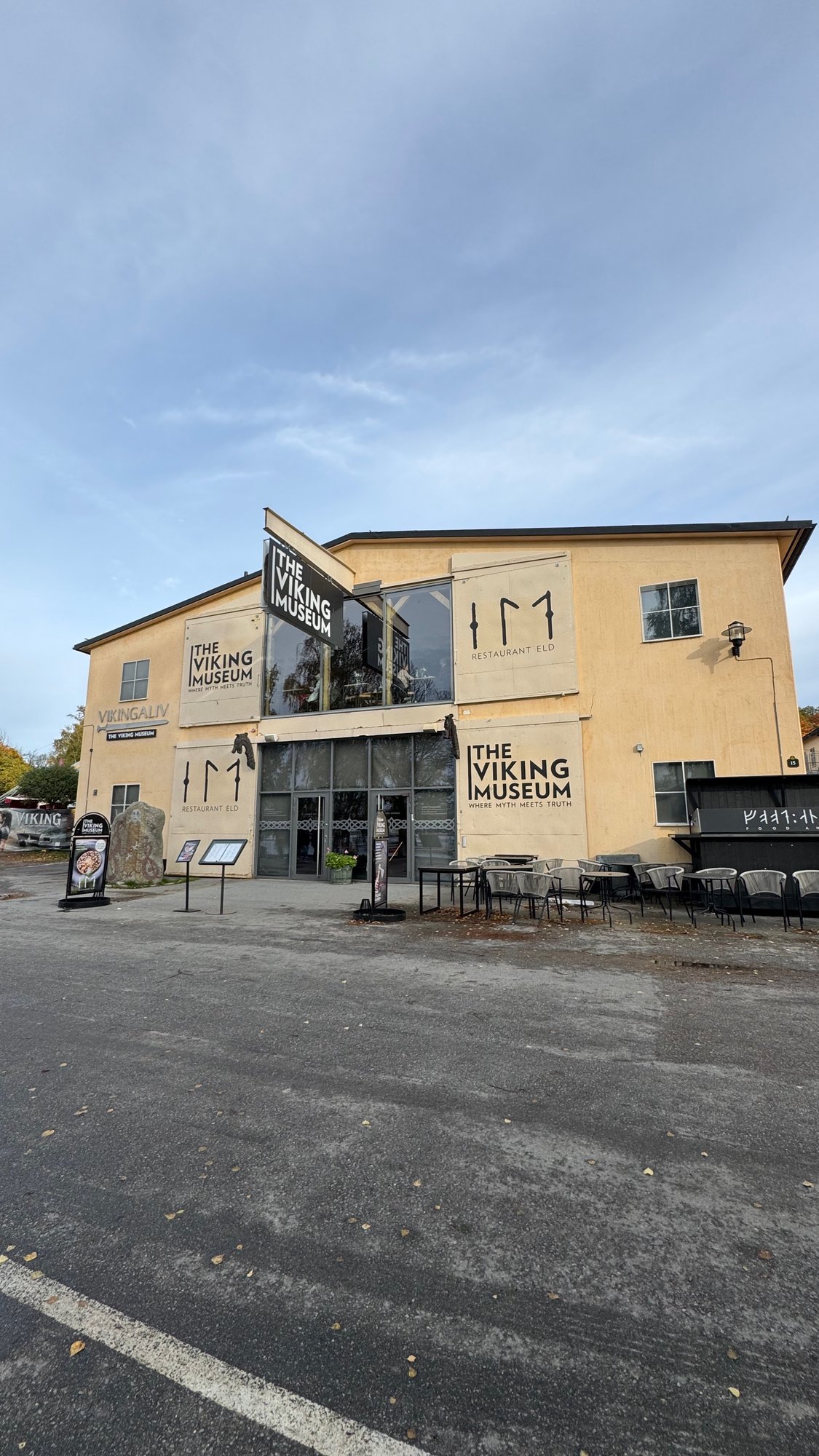
The museum is in a yellow building near Wasahamnen. Black signs on the front say The Viking Museum, Where myth meets truth. Another sign says Restaurant Eld. On the left, a smaller sign still says Vikingaliv. Visit Stockholm still lists the museum under that name. Both names are the same place.
Where myth meets truth. Keep that line in mind. This museum plays with both.
Up the stairs, back in time
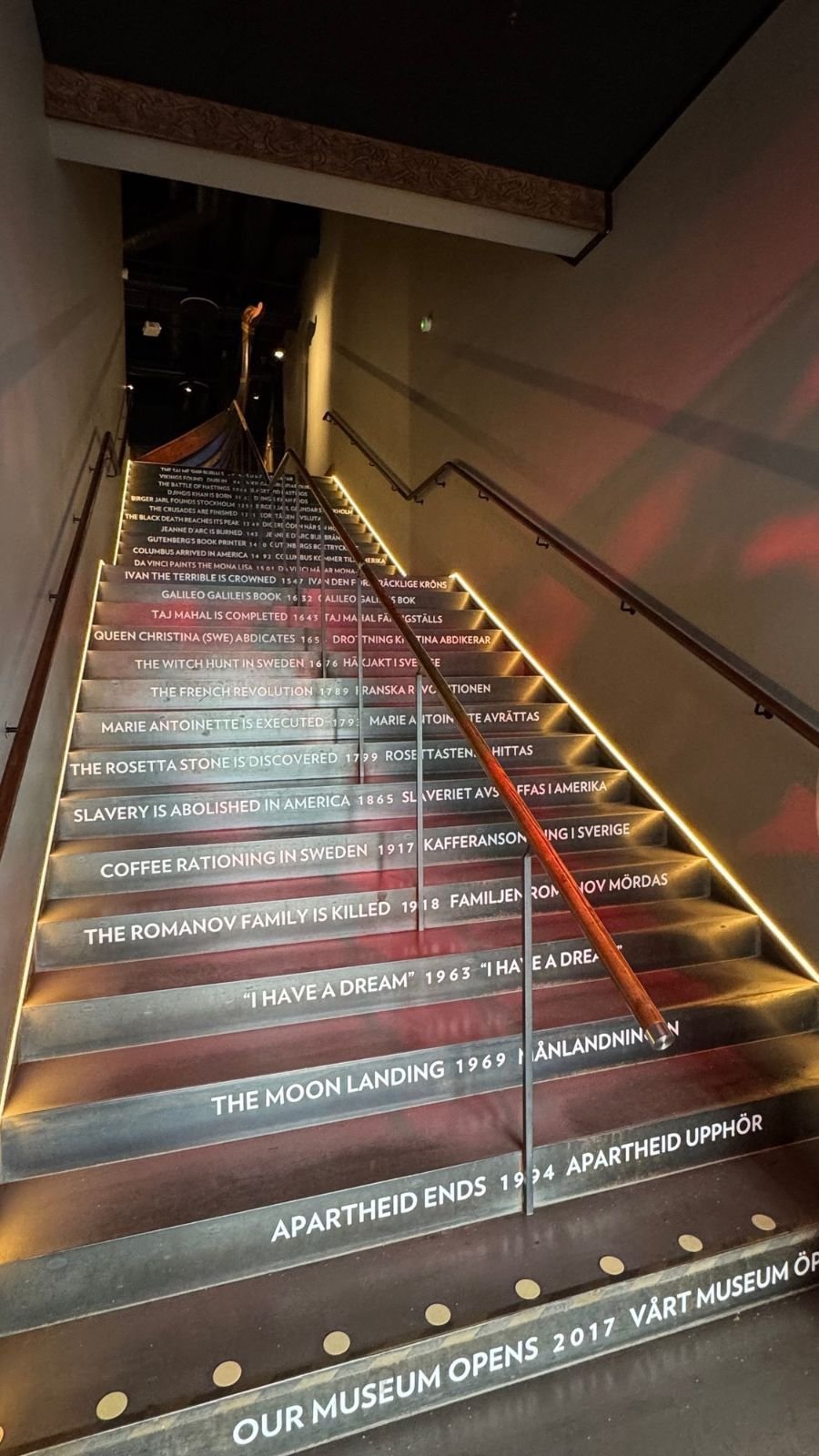
The visit starts with a staircase. Each step shows one date from world history, in English and in Swedish. The bottom step says: Our museum opens 2017.
Then you climb back in time. Apartheid ends, 1994. The moon landing, 1969. Coffee rationing in Sweden, 1917. The witch hunt in Sweden, 1676. Queen Christina abdicates, 1654. Birger Jarl founds Stockholm, 1252. The Battle of Hastings, 1066. Near the top: the Salme ship burials.
At the top, the prow of a ship waits in the dark. By then, you have climbed more than a thousand years.
The guided tour
I joined one of the daily guided tours. The tours are included in the ticket, and you do not need to book. On weekdays, tours in English start at 11:30, 12:30, 13:30 and 15:30. The tour in Swedish starts at 14:30. On weekends, there is also a family tour in Swedish at 11:30 and a themed tour in the early afternoon.
The museum says its guides wear Viking-age clothes and tell personal stories. The weekend themes change from week to week. One weekend is about mythology, gods and legends. The next is about Viking warfare and weapons. On some weekends, staff show old crafts, such as how to make a chainmail shirt. The themed tours stop during school holidays.
If you like your own pace, there is a free audio guide. You use your own phone.
A ship and a village
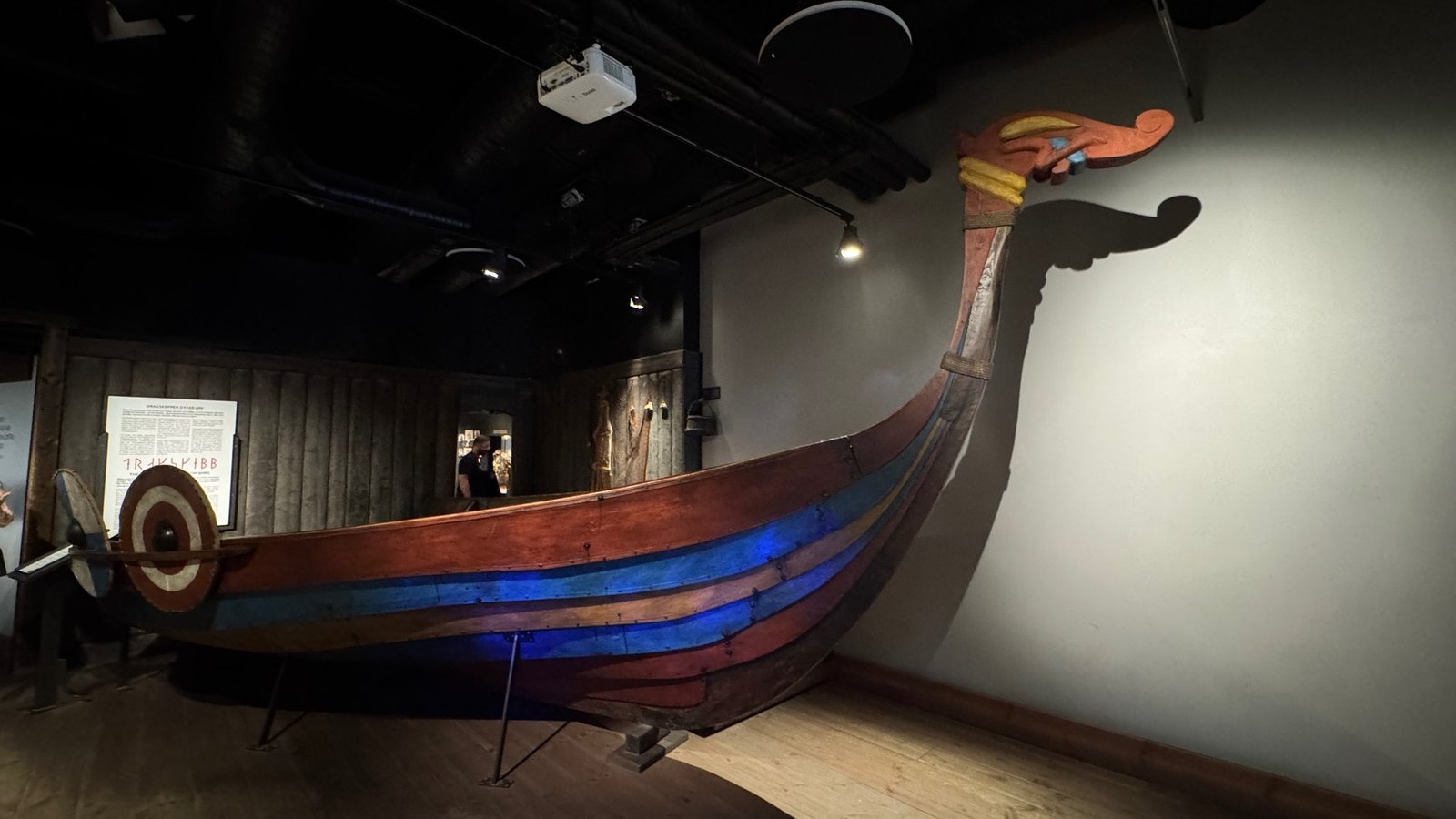
The largest object in my photos is a wooden Viking ship. It is painted in red, blue and yellow stripes. A carved head rises at the front, and its shadow falls large on the white wall behind it. Round shields hang at the back.
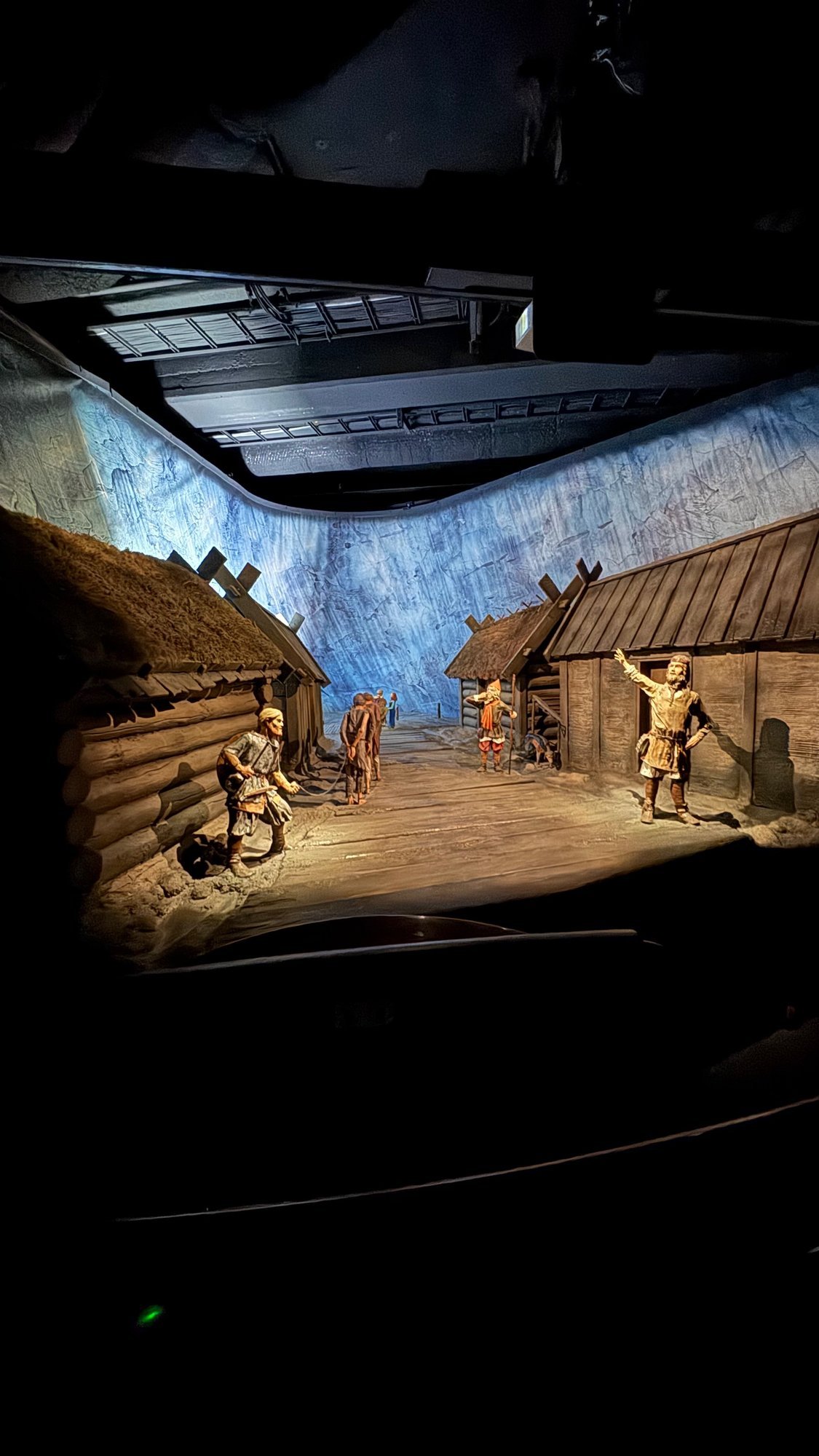
In a dark room, a lit scene shows a Viking village. Log houses stand on both sides of a lane. Some roofs are grass, some are wood. Small figures stand in the lane. One man points to the sky. Another holds a rope, and a line of people walks behind him. My photo shows no sign, so I do not say what the scene means. Ask your guide.
The museum says it shows the women, children and men who lived on farms in Scandinavia, as well as the people who sailed through Europe to raid and to trade.
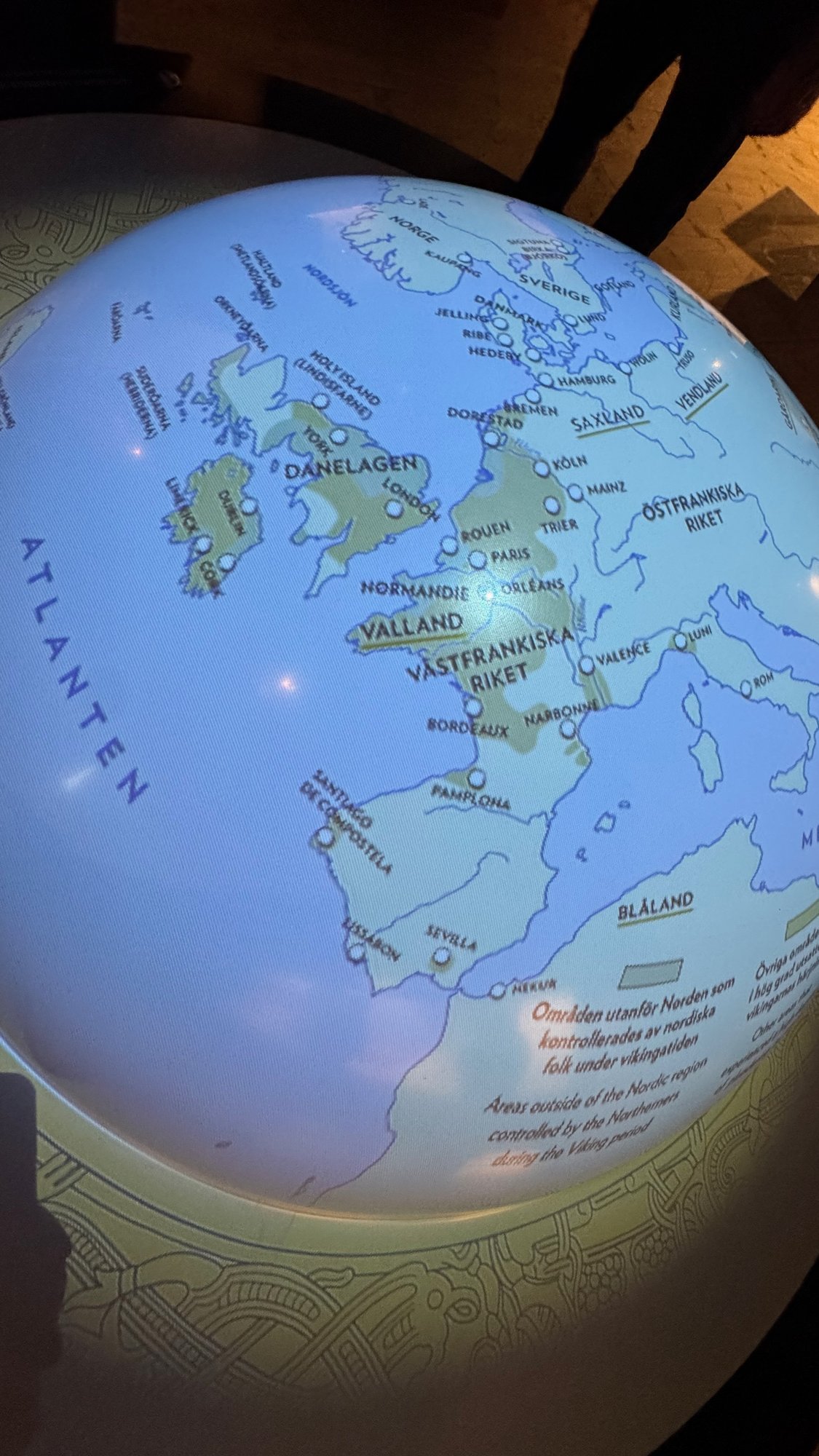
How far did they go? A lit globe answers that. It shows a map of Europe in the Viking Age, with names such as Danelagen (the Danelaw in England), Normandy, Paris, Sevilla and Atlanten, the Atlantic. Colored areas mark the land outside the Nordic region that Norse people controlled. The text on the globe is in Swedish and English.
Ragnfrid’s Saga, the ride
I rode Ragnfrid’s Saga, and I recommend it.
The ride lasts 11 minutes. It moves you through the story with sound, light and built scenes. The museum says the story starts at Frösala farm, where Ragnfrid and Harald live with their daughter Sigrid. Harald has wasted the family’s money. To win back the money and his honor, he goes on a Viking raid.
Look at the name. The ride is not called Harald’s Saga. It carries the name of Ragnfrid, the woman at home on the farm.
The ride is in nine languages: Swedish, English, Spanish, French, German, Italian, Russian, Finnish and Chinese. The museum says some parts are a little scary, so children under 7 should ride with an adult. The ride is included in the ticket.
A Viking to go
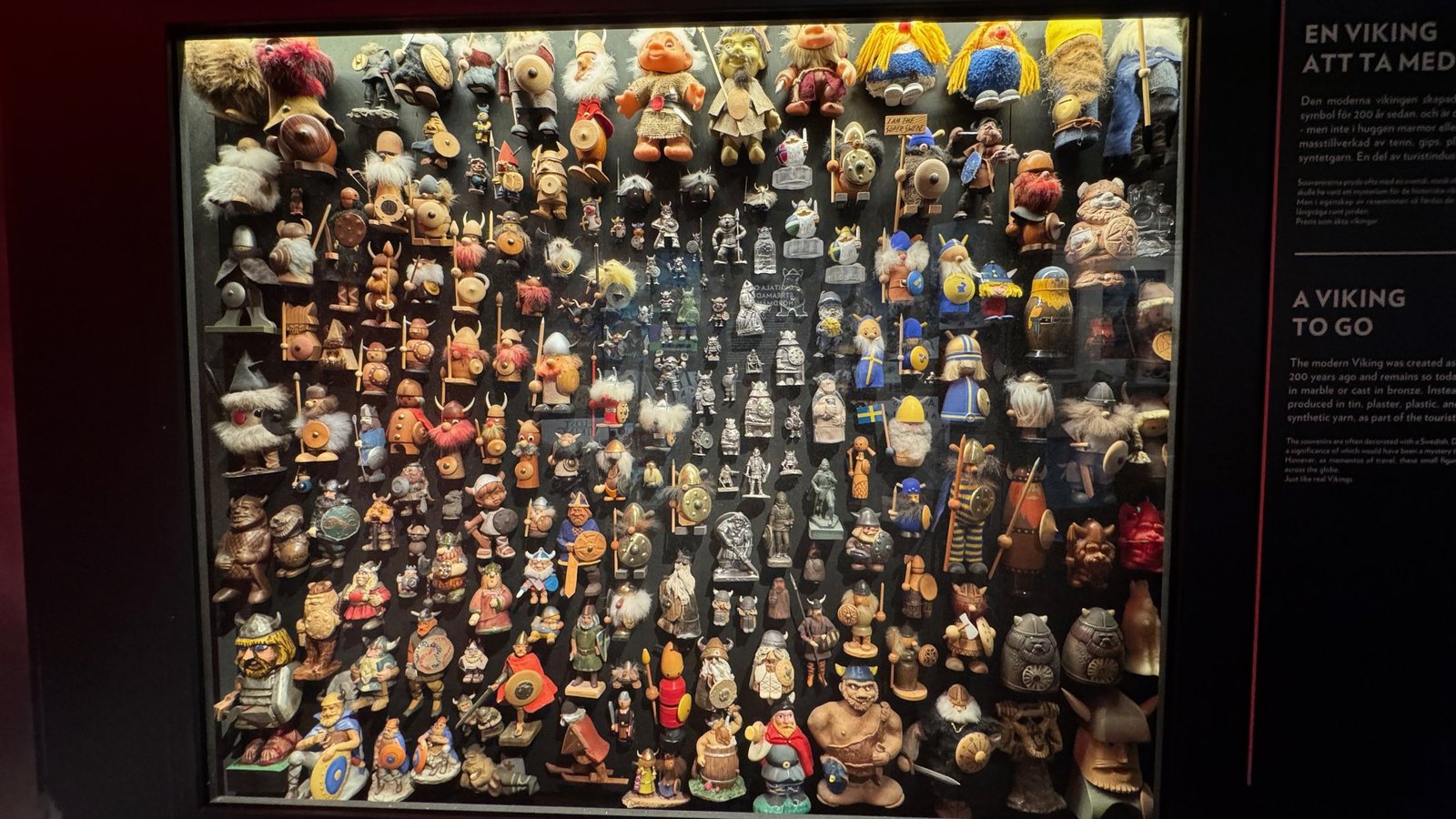
One glass case holds hundreds of souvenir Vikings. Wooden ones, tin ones, plastic ones, some with fur and yarn beards. Many wear horned helmets. Some hold a small Swedish flag. One holds a sign: I am the super Swede.
The panel next to the case is called A Viking to go. It says the modern Viking became a symbol 200 years ago, and it is still one today. Not in marble or bronze, but in tin, plaster, plastic and synthetic yarn, as part of the tourist industry. As travel souvenirs, these small figures go all over the world. Just like real Vikings.
And the horns? The museum answers that on its FAQ page. Vikings did not wear horned helmets. The museum says the myth started in the 1800s, when Richard Wagner put horned helmets in his opera cycle The Ring of the Nibelung.
Myth meets truth, in one glass case.
The shop and Restaurant Eld
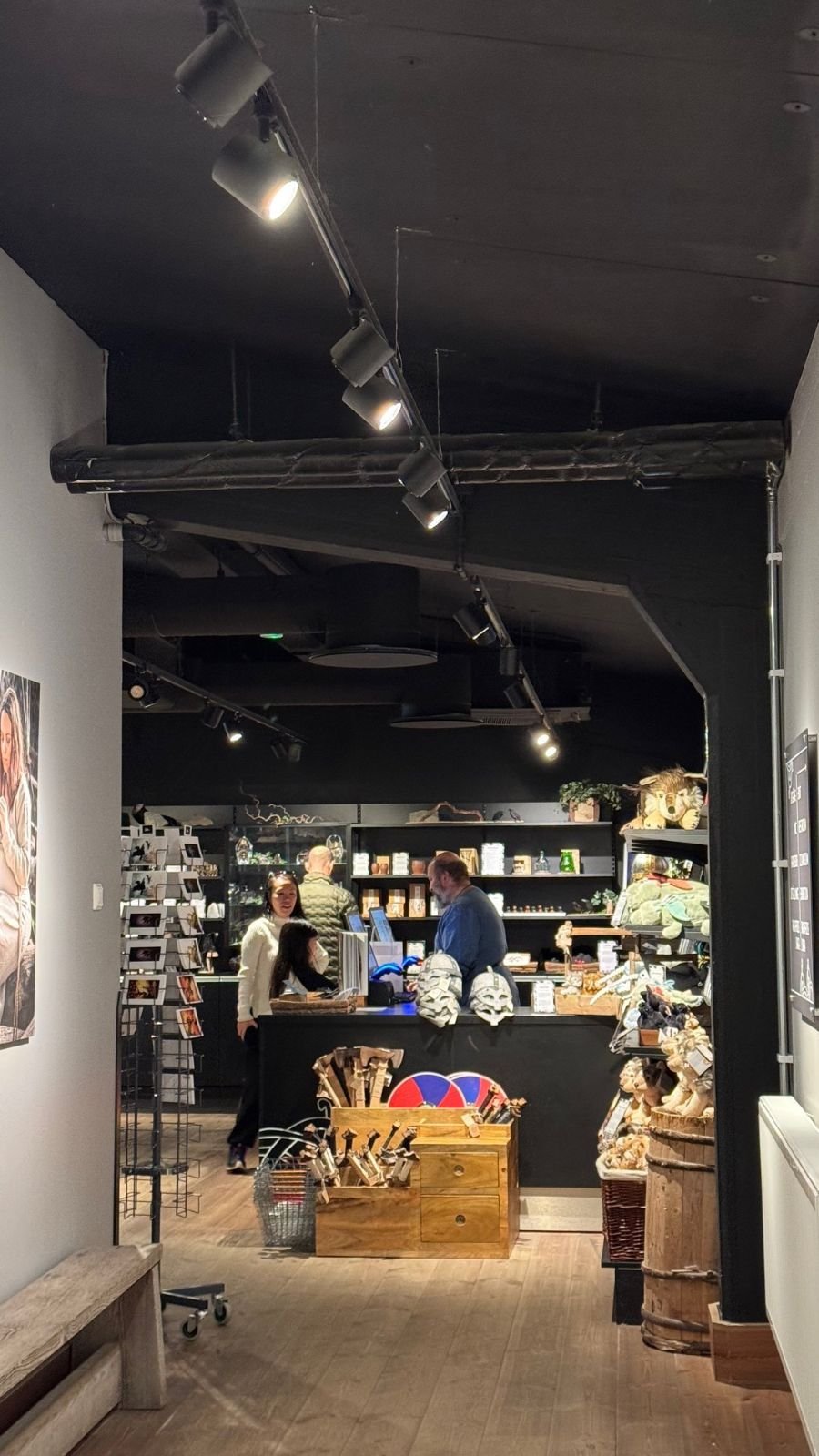
I visited the shop. In my photo, it has shelves of books and gifts, Viking helmets, round shields and a wooden counter. The museum says it sells tea, jam, Icelandic licorice, jewelry, drinking horns, historically correct Viking helmets, and books about the Viking Age for children and adults.
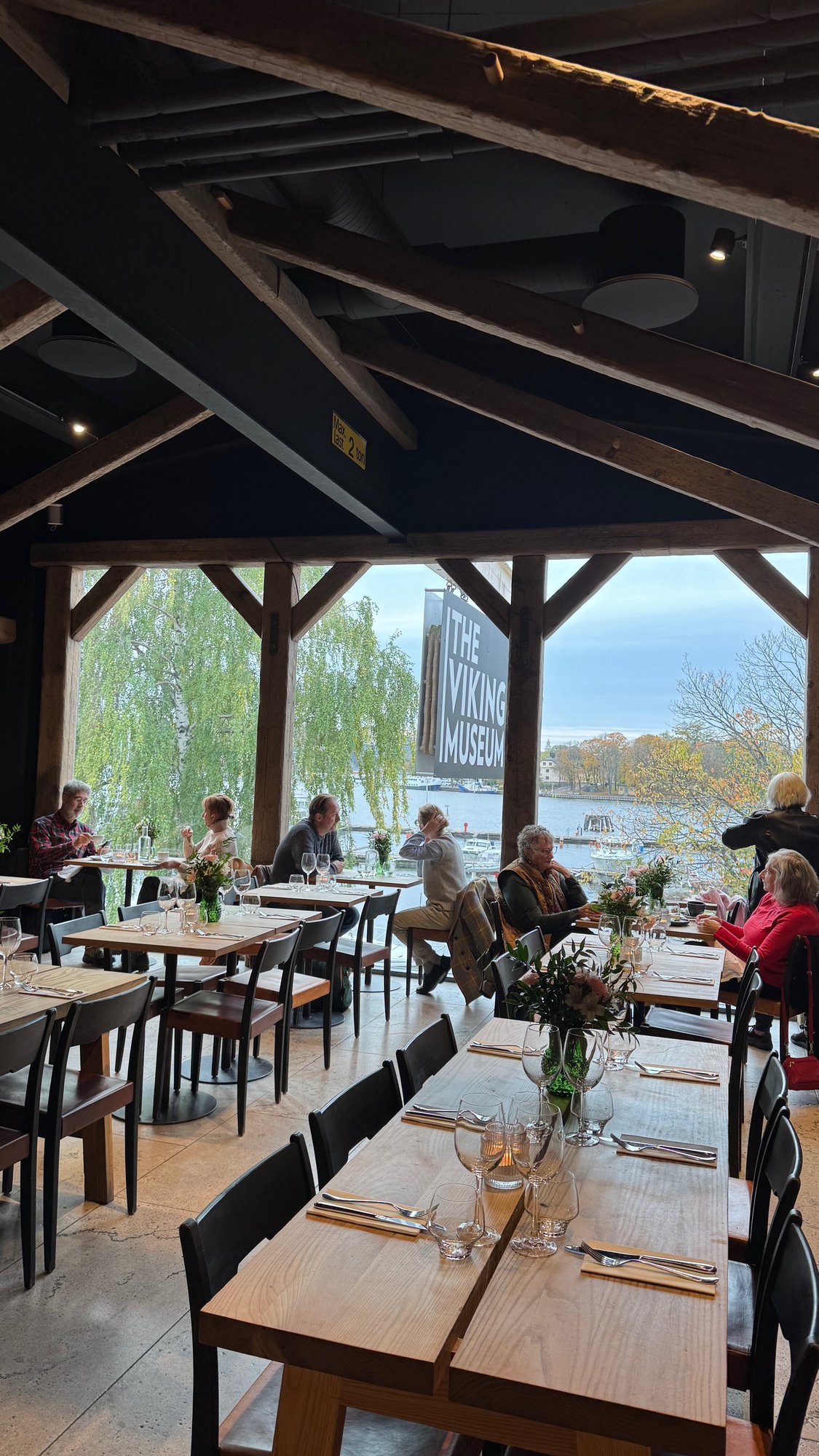
I did not eat at Restaurant Eld. It looks cozy, and the view over the water toward Skeppsholmen is excellent. It has wooden tables, a roof with dark wooden beams and large windows that face the water. The restaurant serves Nordic food with seasonal produce, such as game, fish and seafood. You do not need a museum ticket to eat there or to visit the shop.
Restaurant hours: Sunday to Tuesday 11:00–17:00, Wednesday and Thursday 11:00–21:00, Friday and Saturday 11:00–22:00. You can also add a mead tasting to your ticket: three kinds of mead and one braggot, with a sheet that explains them.
This autumn and winter
Autumn break, 24 October to 1 November 2026. The museum plans a family tour with a draugr, a Viking-age zombie. This tour is in Swedish only. A völva, a seeress, will be in the museum every day from 14:00 to 16:00. Families can hunt for monsters from Norse myth and collect them in their own bestiary. On 31 October at 14:00, a themed tour is about blót, the sacrifice ceremonies of the Viking Age.
Free entry for children. Children under 15 enter free with a paying adult. This does not apply to groups.
VIKING, a live action musical. It runs together with Restaurant Eld from 25 September to 12 December 2026. Check what’s on at The Viking Museum for dates and tickets.
Christmas. From 20 November to 30 December, Restaurant Eld serves a Christmas dinner. It is three courses served at the table, not a buffet. Over Christmas, the museum opens every day from 10:00 to 17:00, but it closes on 23 and 24 December.
Tickets and prices
Adults 239 SEK. Students and seniors 189 SEK. Youth 15 to 18 years 189 SEK. Children 0 to 14 years free with a paying adult.
The ticket includes the ride Ragnfrid’s Saga and the guided tours.
The museum is cash-free. You pay by card or Swish. Visitors with an LMA card, the ID card for asylum seekers in Sweden, enter free.
Getting there and access
Tram 7 runs from T-Centralen. Bus 67 runs from Odenplan. Get off at Liljevalchs/Gröna Lund and walk down toward Wasahamnen. From the Karlaplan metro station, take bus 67 or walk for about 15 minutes. The Djurgården ferry from Slussen and the boat M/S Emelie from Nybroplan both stop at Allmänna Gränd. The museum has no parking of its own, and Djurgården has few parking spaces.
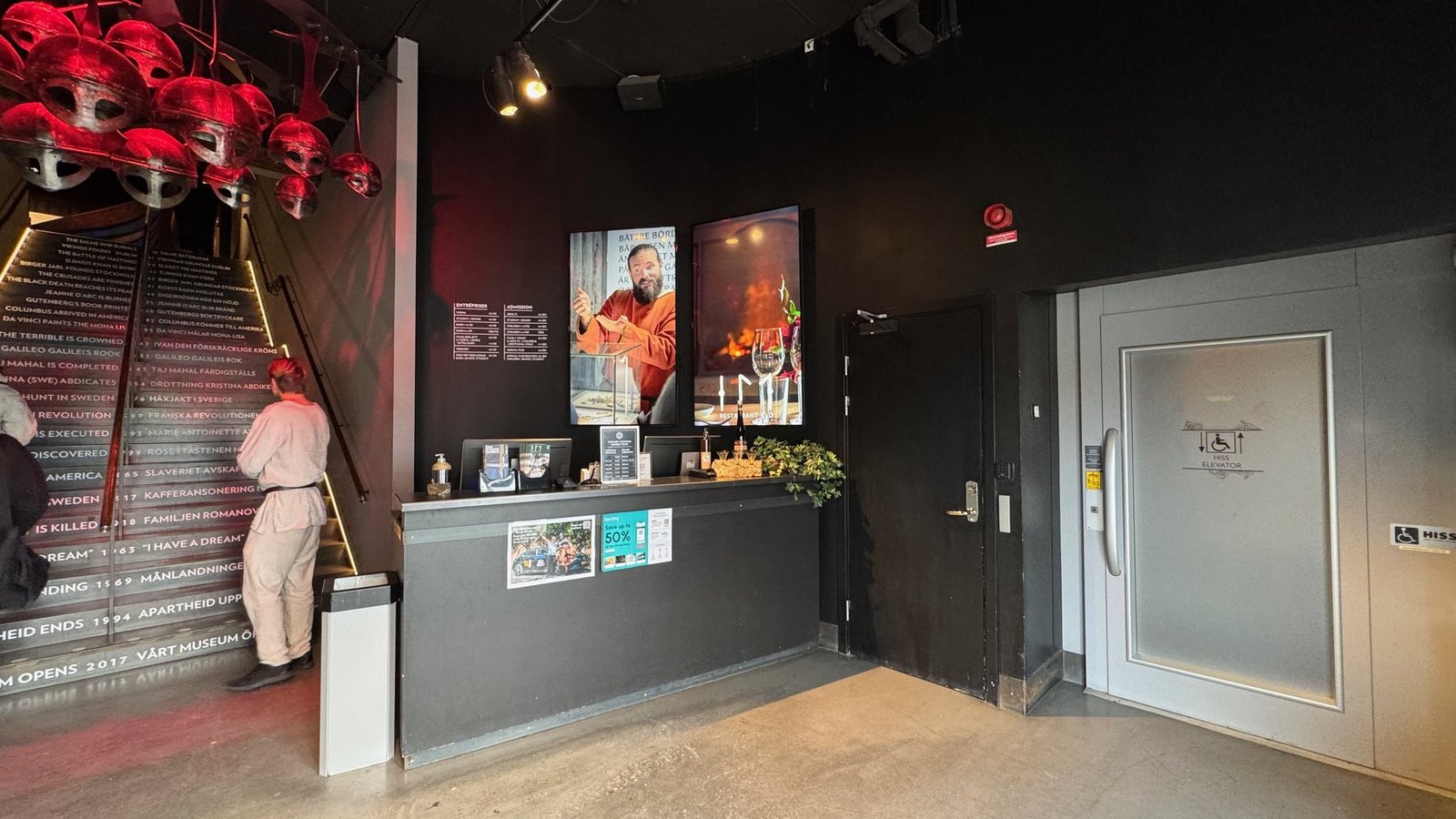
A lift with a wheelchair sign stands next to the ticket desk. The museum says the lift serves all floors. You can move through the exhibition, the shop and the restaurant in a wheelchair.
The ride. Two carriages are adapted for wheelchair users. One takes a whole wheelchair and a companion. In the other, you move from the wheelchair to the seat. That carriage has a side that folds down, and you sit with bent legs.
Sight. The audio guide is free. Visitors with low vision can touch some objects. Guide dogs are welcome in the whole building. Other dogs are not allowed. The rooms in my photos are dark, with spotlights, so plan for low light.
Hearing. There is a hearing loop at the entrance. The story of the ride is also available as text.
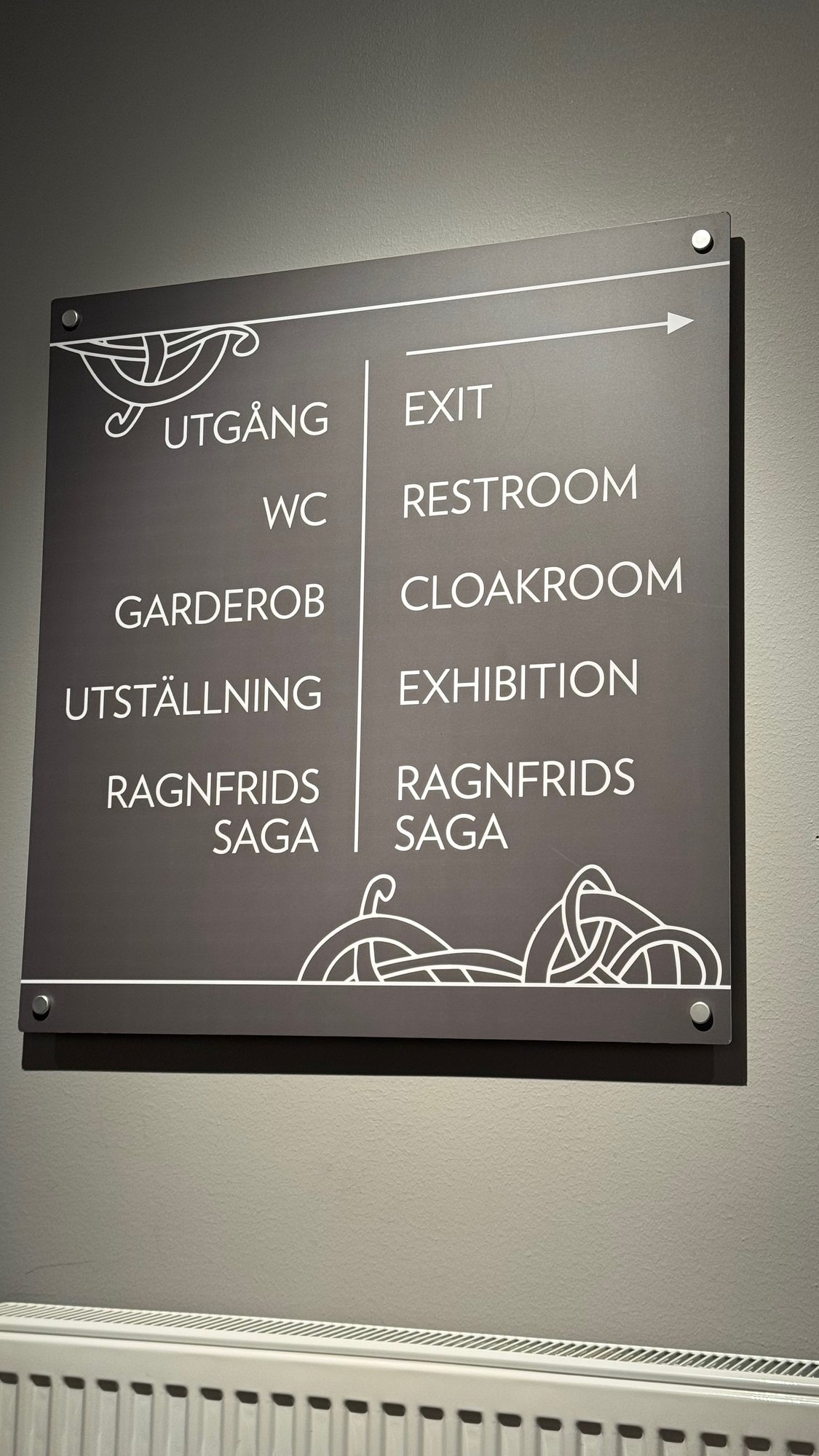
Signs. Wall signs in Swedish and English point the way to the exit, the restroom, the cloakroom, the exhibition and Ragnfrid’s Saga. The signs have white text on a dark background.
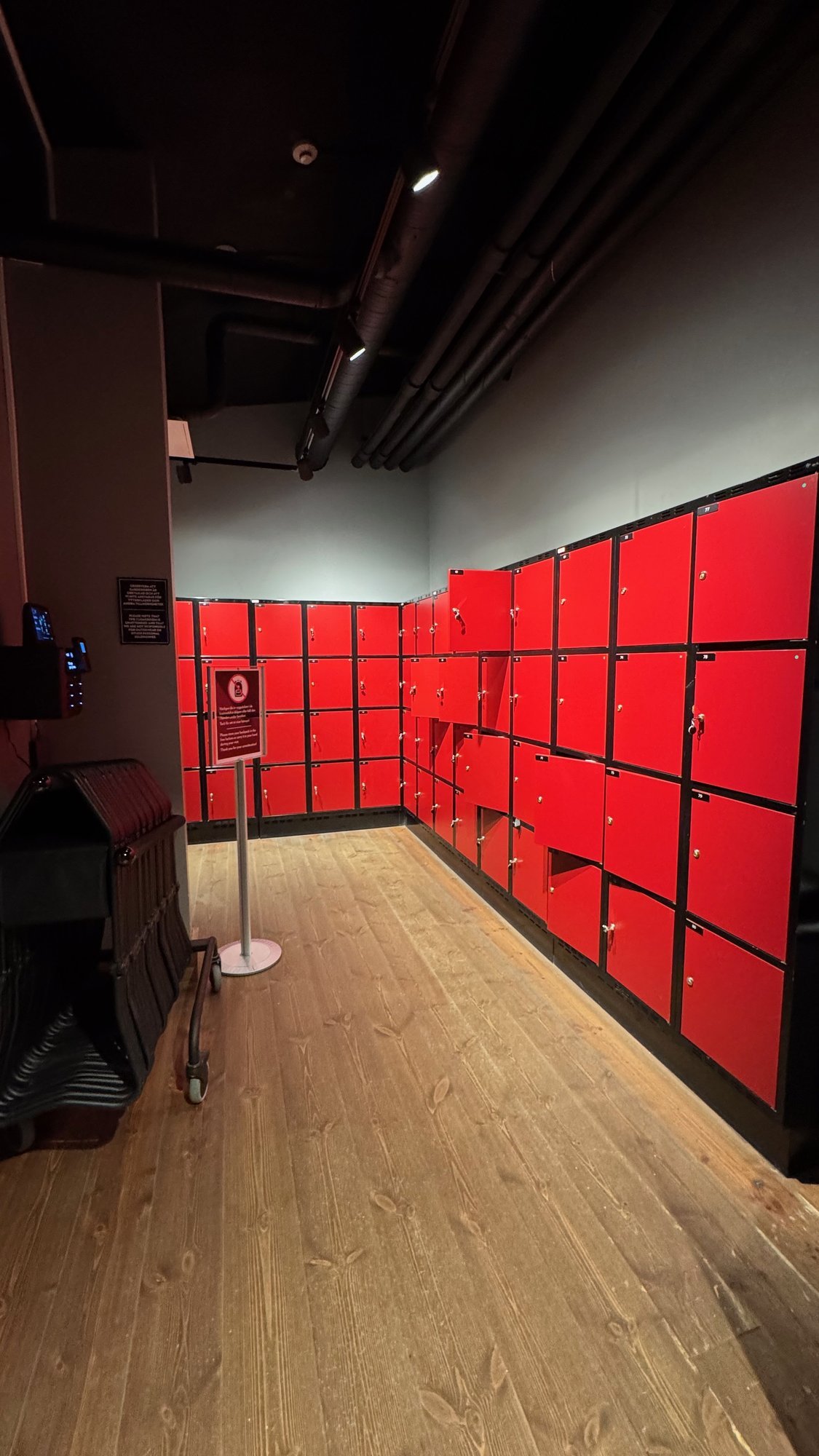
Bags and strollers. Red lockers stand on a wooden floor near the entrance. They measure 32 × 37 × 39 cm. In the exhibitions, a backpack goes in a locker or in your hand. From 1 June to 31 August, and on holidays and school breaks, strollers stay outside. Stroller parking is on the side of the building. In the low season, strollers may come in if there is space.
The museum puts these facts on its FAQ page, in plain words. I have written about why many museums are still hard to use in my Medium story Why Are Museums Inaccessible?
What is my verdict?
Go for the ride. I recommend Ragnfrid’s Saga, and the guided tour is included in the ticket.
This is a museum that tells stories. For a real Viking Age town, Birka on Lake Mälaren is a day trip from Stockholm, and it is on my list of museums in Stockholm by district. A short walk away on Djurgården, Skansen shows how people in Sweden lived in later centuries.
A ride named after a woman. A wall of plastic Vikings with horns they never wore. A staircase that runs back more than a thousand years. Which Viking will you take home?
Photo gallery
All photographs on this page were taken by Zayera Khan during a visit to the museum, and are her own property. Please do not reuse them without permission.
Sources: The Viking Museum, visit us; The Viking Museum, FAQ; The Viking Museum, find us; The Viking Museum, öppettider 2026; The Viking Museum, Restaurant Eld; The Viking Museum, museum shop; The Viking Museum, autumn break 2026; The Viking Museum, free admission for children; Visit Stockholm: Vikingaliv.