
Vrak – Museum of Wrecks in Stockholm: the shipwrecks of the Baltic Sea and the lost Resande Man
Up to 100,000 wrecks may lie on the floor of the Baltic Sea. One of them is a ship that sank on its way to Poland in 1660.
- Why visitThe museum says it is the first museum in the world about the maritime archaeology of the Baltic Sea. It shows wrecks and finds from the sea floor with films, VR, holograms and maps. It won Museum of the Year 2026 in Sweden.
- Best forAnyone curious about shipwrecks, the sea and archaeology. Divers. Families. Visitors to the Vasa Museum next door.
- AddressDjurgårdsstrand 17, 115 21 Stockholm, by the water between the Vasa Museum and Gröna Lund.
- Getting thereBus 67 or tram 7 to Liljevalchs/Gröna Lund. The Djurgården ferry, line 82, from Slussen to Gröna Lunds brygga.
- Opening hoursSeptember to May: every day 10:00–17:00, Wednesdays 10:00–20:00. June to August: every day 10:00–18:00, Wednesdays 10:00–20:00. Closed 24 and 25 December. 31 December: 10:00–15:00.
- AdmissionAdults 185 SEK. Children and youth 0 to 18 years free. Combo ticket with the Vasa Museum 315 SEK.
- Guided toursEvery day, in English and Swedish. Included in the ticket.
- FacilitiesCafé and bar Mackverket, a museum shop, lockers for small items, toilets with changing tables on both floors, and a free audio guide on your own phone.
- AccessibilityAll public spaces are accessible by wheelchair. There is a lift and a hearing loop on the upper floor. Companions of visitors with disabilities enter free. Details below.
- Official websitevrak.se
I visited Vrak – Museum of Wrecks on Djurgården on 15 October 2026. I joined a guided tour and saw the exhibition Vikings Before Vikings. I looked mostly at the maps and the screens. I took the photos on this page that day.
For me, the most important part of the visit is to understand how many wrecks lie around Stockholm, Dalarö and Skeppsholmen, and along the whole Baltic Sea. And for me, the most interesting wreck at Vrak is Resande Man.
Vrak opened in 2021, in a boat hangar from the 1940s by the architect Paul Hedqvist. In April 2026, it won Museum of the Year in Sweden. The Swedish Museums Association and Swedish ICOM give the award.
Resande Man: the ship that sank in 1660
Resande Man, Travelling Man, sank in a storm in the Stockholm archipelago in November 1660. Swedish Wikipedia gives the date as 27 November. The ship was going to Poland on a diplomatic mission. Wikipedia says the goal was a Polish–Swedish pact against Russia.
Swedish Wikipedia says the ship was a pinnace, a transport ship and warship in the Swedish navy. The ambassador Christoffer Carl von Schlippenbach was on board, and he died. The captain, Hans Månsson, had his wife with him. Wikipedia does not give her name. The ship carried gold, silver, jewels, a gilded carriage and a chest of coins.
The storm drove the ship onto the rocks. Vrak says fewer than half of the people on board survived. Wikipedia gives the numbers: 37 died and 25 survived. Seven people held on to the mainmast above the water. Two fell and drowned in the night. Fishermen saved five the next morning.
One survivor was the embassy secretary, Andreas Bjugg. He wrote a report about the wreck, and many people read it. In the exhibition, you can read his own words about how he survived.
In 1661, Hans Albrecht von Treileben salvaged most of the cannons with a diving bell. Then the wreck was lost. People searched for it for centuries. Anders Franzén, the man who found Vasa, searched from the 1950s. In May 2012, a group of divers found the wreck, and maritime archaeologists from Södertörn University confirmed it. Wikipedia says the wreck lies at 15 meters depth. The site has a ban on diving and anchoring.
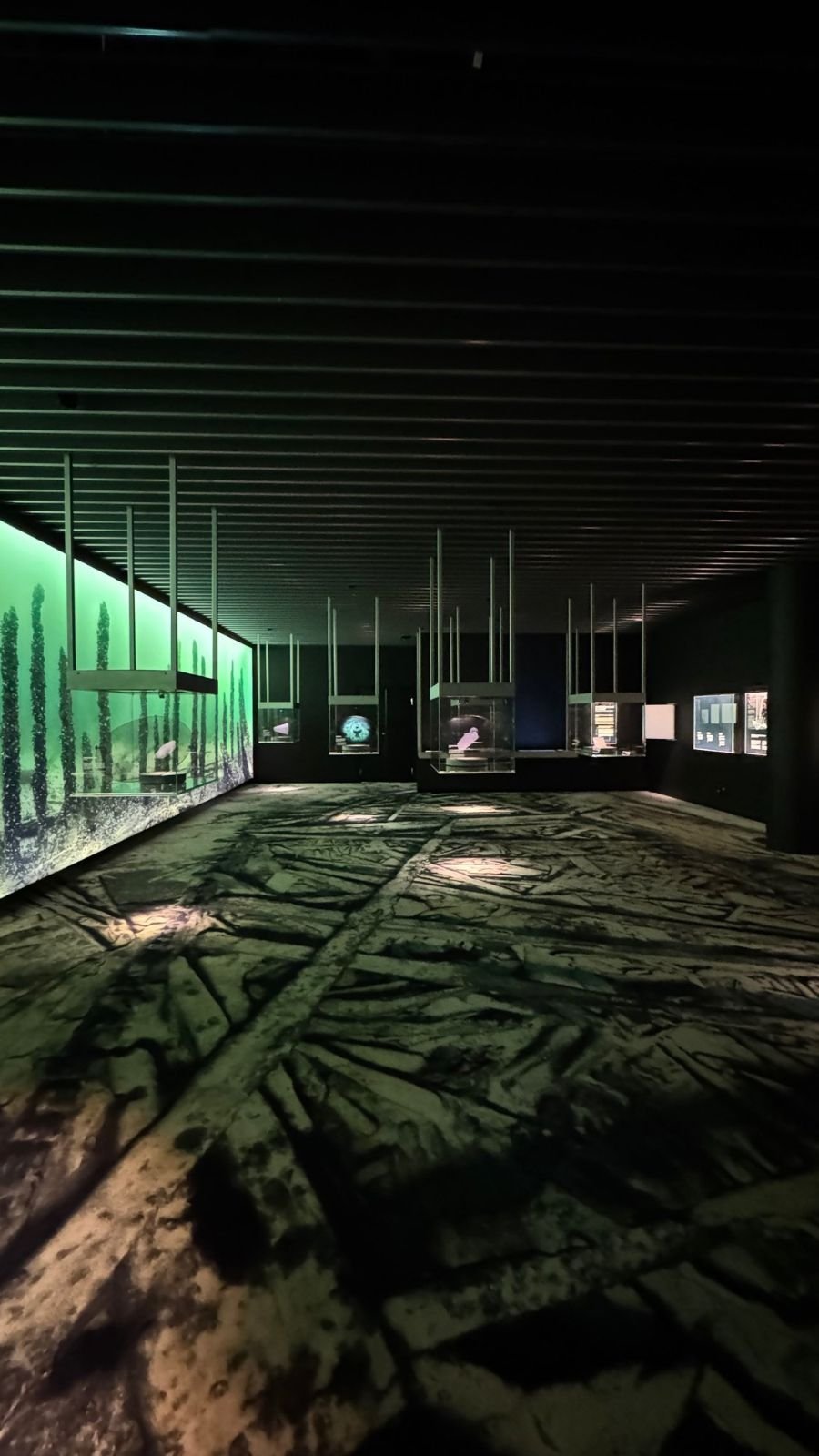
At Vrak, you meet Resande Man at full scale. A photo-realistic carpet on the floor shows the wreck as it looks on the sea floor. Look carefully, and you see objects from the site. Showcases hang above the wreck. They show holograms and films of the finds, at the exact places where divers found them. The room is dark, and the walls glow green. With the free Vrak app, you can see the ship in the room in AR.
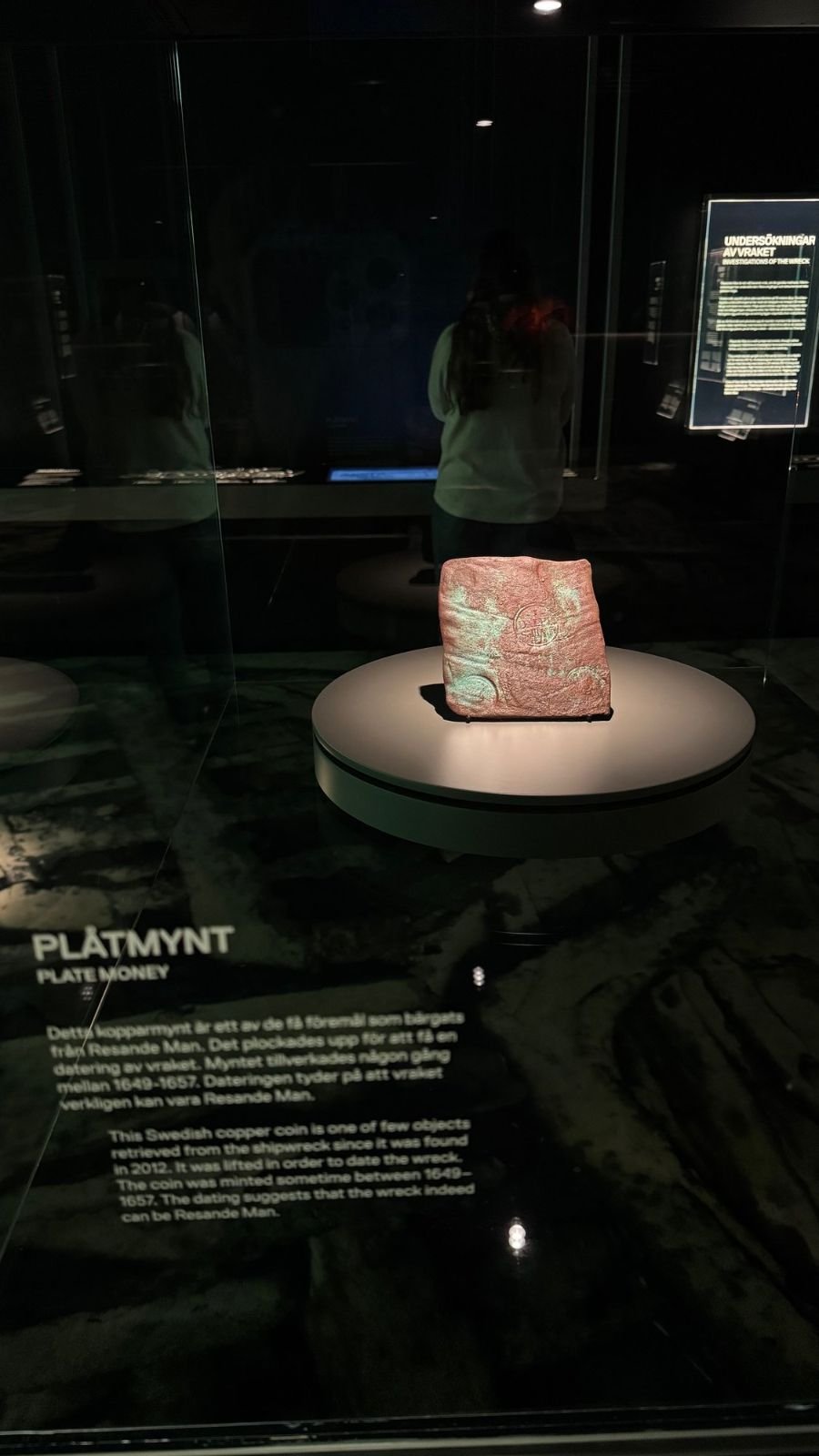
In a dark glass case, a square copper coin lies on a round stand. The sign calls it plåtmynt, plate money. It says the coin is one of the few objects lifted from the wreck since divers found it in 2012. It was lifted to date the wreck. It was made between 1649 and 1657, and the sign says this shows that the wreck can really be Resande Man.
Swedish Wikipedia says some of the dead may lie at the pilots’ cemetery at Herrhamra on Torö. Its oldest gravestone carries the year 1660.
How many wrecks lie in the Baltic Sea?
Vrak says about 17,000 wrecks are known in Swedish waters. In the whole Baltic Sea, there may be up to 100,000. The Swedish Agency for Marine and Water Management (HaV) also gives about 17,000 along the Swedish coasts.
In October 2025, SVT said experts estimate about 100,000 wrecks in the Baltic Sea, and that only a small part of them is mapped. Older numbers differ. In 2018, SVT quoted the Maritime Museum: about 20,000 wrecks around the Baltic Sea. The same year, Mitt i wrote 10,000 to 20,000 in the Swedish part. The numbers grow as archaeologists map more of the sea floor.
Wrecks are not the only remains down there. Vrak lists crashed planes, old jetties, ship barriers from the Viking Age and the Middle Ages, and Stone Age settlements now under water.
New finds come all the time. In May 2026, Vrak’s archaeologists found at least ten large wrecks at the island of Smörasken, outside Karlskrona. Some are up to 50 meters long. Sweden probably sank some of them on purpose in 1710 and 1712, to block an attack on the naval city. The largest one may be the ship Ulrika Eleonora. The museum still waits for the wood samples to confirm it.
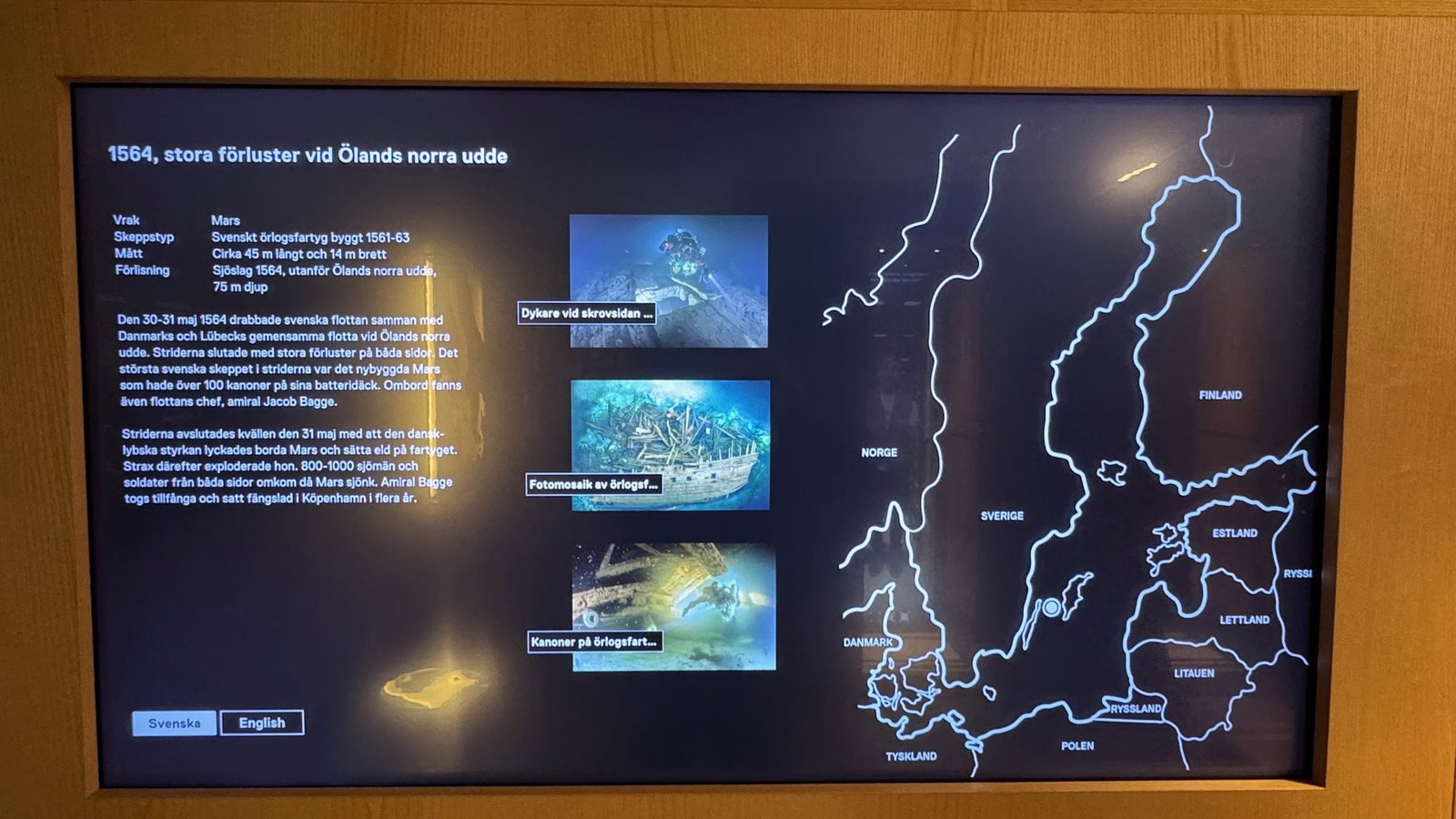
The warship Mars. At Vrak, a touch screen with a map of the Baltic Sea tells the story of one of its most famous wrecks. The screen says Mars was a Swedish warship built in 1561–63, about 45 meters long and 14 meters wide. On 30 and 31 May 1564, the Swedish fleet fought the fleets of Denmark and Lübeck off the northern tip of Öland. Mars was the largest Swedish ship in the battle, with more than 100 cannons. The admiral of the fleet, Jakob Bagge, was on board. On the evening of 31 May, the enemy boarded Mars and set fire to the ship. Soon after, it exploded. The screen says 800 to 1,000 sailors and soldiers from both sides died when Mars sank. The wreck lies at 75 meters depth.
Wrecks around Stockholm, Skeppsholmen and Dalarö
Stockholm has been Sweden’s capital and the home of the navy for a long time. Mikael Fredholm, a maritime archaeologist, told Mitt i in 2018 that a lot of sea traffic gives a lot of wrecks.
Under the city. Some wrecks lie under the streets. In 2016, Svenska Dagbladet published a map of 150 wrecks under Stockholm. One lies about four meters under Stureplan. Workers found it in 1863, when they dug a well. A maritime archaeologist at the Maritime Museum told SvD it probably dates from the late 1500s or early 1600s. Under Strandvägen, there may be a 32-meter catamaran with five sails and paddle wheels that the crew turned by hand. A newspaper notice from 1795 led to the discovery.
Around Djurgården. In 2018, archaeologists searched the bottom around Djurgården and Fjäderholmarna. They found about 40 vessels, from small boats to 30-meter barges. Aftonbladet reported that the nine they dived on first were from the late 1800s or later.
Skeppsholmen. In the 1600s and 1700s, Skeppsholmen was the heart of the Swedish navy. Vrak says the remains of sunken ships lie under its quays. Vrak’s archaeologist Jim Hansson tells their stories in a free audio walk, Under the Surface: Skeppsholmen. You listen on your phone while you walk on the island. Next door, at the west quay of Kastellholmen, lies a wreck that people believe is Grå Ulven. Mitt i wrote that it was a Danish ship that Sweden captured in 1659, and that it was probably sunk with stones as the base of an early bridge to Skeppsholmen. In 2013, the water was so low that people could see the wreck from land.
Dalarö. Dalarö was a base for the navy and the place where ships paid customs. So there are many wrecks there. Vrak names three special wrecks in Dalarö dive park. You may visit them only with a trained wreck guide:
- Anna Maria, a merchant ship built in Amsterdam in 1694. It sank on 6 February 1709 after a fire on board, with planks and iron bars as cargo.
- Jutholmsvraket, a wreck from about 1700. Nobody knows its name. It is named after the island Jutholmen.
- Bodekull, often called Dalarövraket. It was a frigate built in 1660 for King Karl X Gustav. It sank in 1678.
The royal ship Riksäpplet also lies at Dalarö. Vrak uses it in its film about how to dive carefully on a wreck.
Modern wrecks. In 2023, the Swedish Maritime Administration (Sjöfartsverket) mapped seven modern wrecks along the east coast. Three are in or near the Stockholm archipelago. One is the cargo ship Harm, which sank in 1969 after a collision north of Värmdölandet. It is a popular dive at 20 meters depth.
Why the wrecks survive, and what threatens them
Vrak says nowhere else in the world has so many well-preserved wooden wrecks. The reason is the water. The Baltic Sea is cold, dark and brackish, which means only a little salty. It also has little oxygen.
The shipworm cannot live there. It is a small mussel, not a worm, and it eats wood. In saltier seas, it can destroy a wreck in a short time. In the Baltic Sea, a wreck can look like the day it sank, hundreds of years later.
But the wrecks are at risk. Vrak names four threats:
- Pollution. The Baltic Sea is one of the most polluted seas in the world.
- A warmer climate. It may let the shipworm live in the Baltic. In 2009, researchers confirmed shipworm in wrecks in the southern Baltic Sea.
- Looting. Some private people steal objects from wrecks.
- Leaking modern wrecks. Metal ships rust, and oil or diesel can leak out. Mines from the world wars also lie on the bottom.
HaV says the Swedish Maritime Administration classes about 3,000 wrecks as possibly hazardous to the environment, 300 as hazardous, and about 30 as an acute danger. Two of the listed wrecks in the Stockholm area, Harburg and Nynäs I, sank in 1957 and 1963. HaV says the oil in Harburg has been salvaged.
Diving on wrecks: Swedish law and rules
You may dive on most wrecks in Sweden. But the law protects many of them, and the rule is simple: look, but do not touch.
Which wrecks are protected? Sweden’s Historic Environment Act (kulturmiljölagen, 1988:950) protects ancient remains, and a shipwreck counts as one. The law covers wrecks that can be assumed to have sunk before 1850. The county administrative board (länsstyrelsen) can also protect a younger wreck if it has special cultural value. The law protects wrecks that nobody has found yet, too.
What is forbidden? You must not move, remove, dig out, cover, change or damage a protected wreck. You must not take objects from it. Vrak says the objects and their place on the wreck are clues to its age, its story and where it came from.
The penalty. The crime is called fornminnesbrott. It gives a fine or up to six months in prison. A serious case gives up to four years in prison. In 2024, the Göta Court of Appeal sent three men to prison for looting wrecks off Öland. The stolen objects included coins and cannons. One cannon dated from 1664.
Diving bans. A few wrecks have a ban on diving and anchoring, such as Resande Man. Ask the county administrative board in your county which ones. Many harbors also ban diving, and so do some military protected areas and bird protection areas. Vrak says not all bans are marked on sea charts or signs.
Estonia. A separate law (1995:732) bans diving at the wreck of the passenger ship MS Estonia and in an area around it. The penalty is a fine or up to two years in prison.
Guides and permits. At Dalarö dive park, the three special wrecks need a trained wreck guide. You need a diving certificate for wreck dives, and SVT wrote in 2018 that some wrecks also need a permit.
How to dive carefully. Vrak gives this advice:
- Do not anchor near the wreck, and do not tie lines to it. Use a grapnel next to it.
- Move slowly. Kick your fins sideways or upwards (frog kicks), and keep your buoyancy under control.
- Do not swim into a wreck. It is dangerous for you and for the wreck.
- Do not fan away sediment to see better.
- If you do not know how old a wreck is, treat it as protected.
If you find something. Report a find from an old wreck to the county administrative board or the police. Finds from wrecks can also go to the Coast Guard (Kustbevakningen). Report a possible new wreck to Vrak or the county administrative board. If you find ammunition, a mine or mustard gas, call 112 at once.
To learn about known wrecks before you dive, search the Swedish National Heritage Board’s register, Fornsök, or the wreck map on Vrak’s website.
The guided tour, the maps and the VR dive
I joined a guided tour. Vrak has tours every day, in English and Swedish, and they are included in the ticket. In autumn, the museum lists a tour of Vikings Before Vikings at 12:00 and a tour of the whole museum at 15:00.
I looked mostly at the maps and the screens. The VR dive and the interactive displays are very interesting. In The Assignment, you put on a VR headset and dive to a wreck without getting wet. You examine the wreck and learn how archaeologists date finds and search archives.
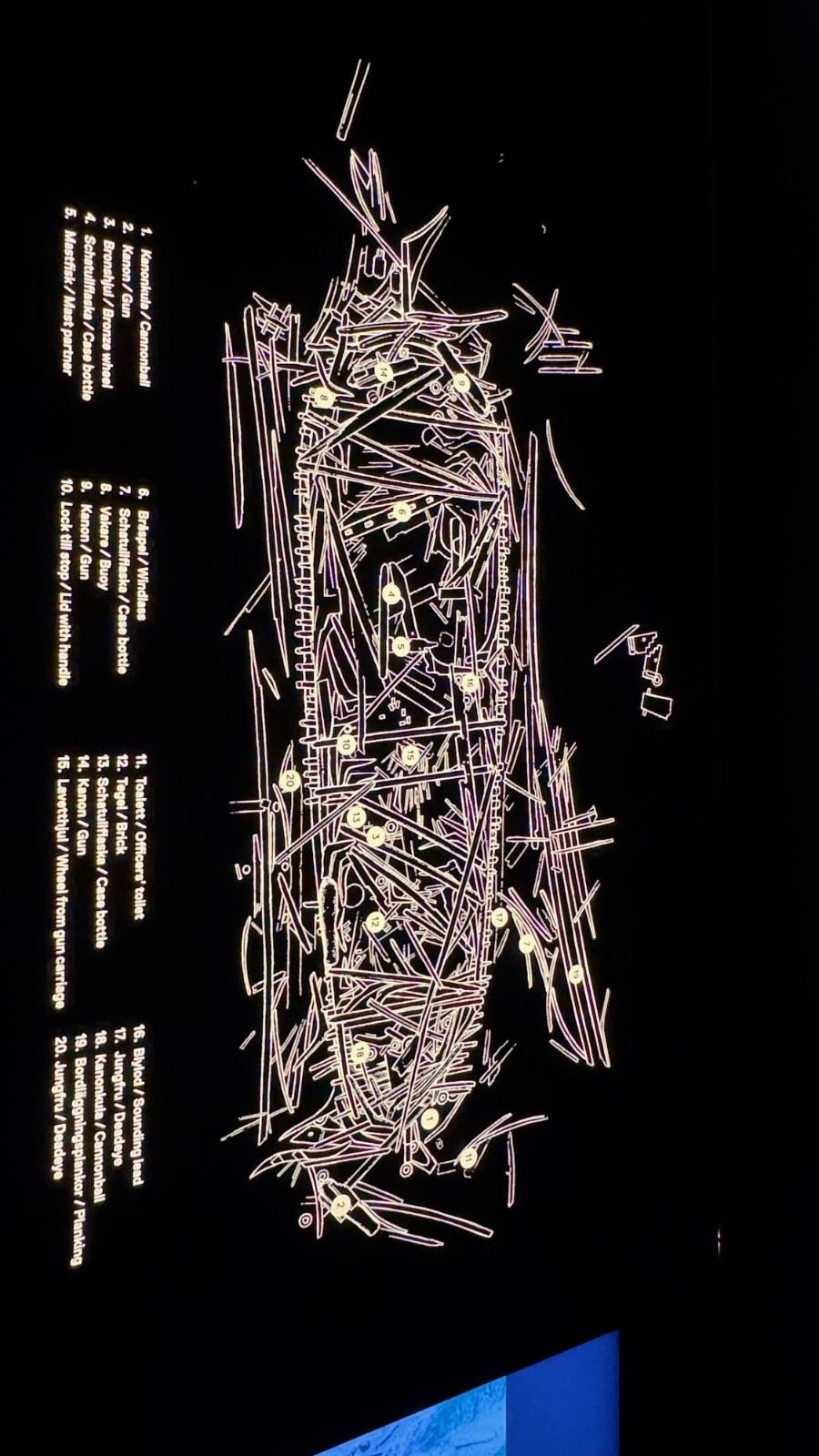
On a black wall, a white and purple drawing shows the timbers of a wreck, as archaeologists mapped them on the sea floor. A numbered list beside it names the finds, such as guns, cannonballs, case bottles, a windlass, a buoy and an officers’ toilet. My photo does not show the name of the wreck.
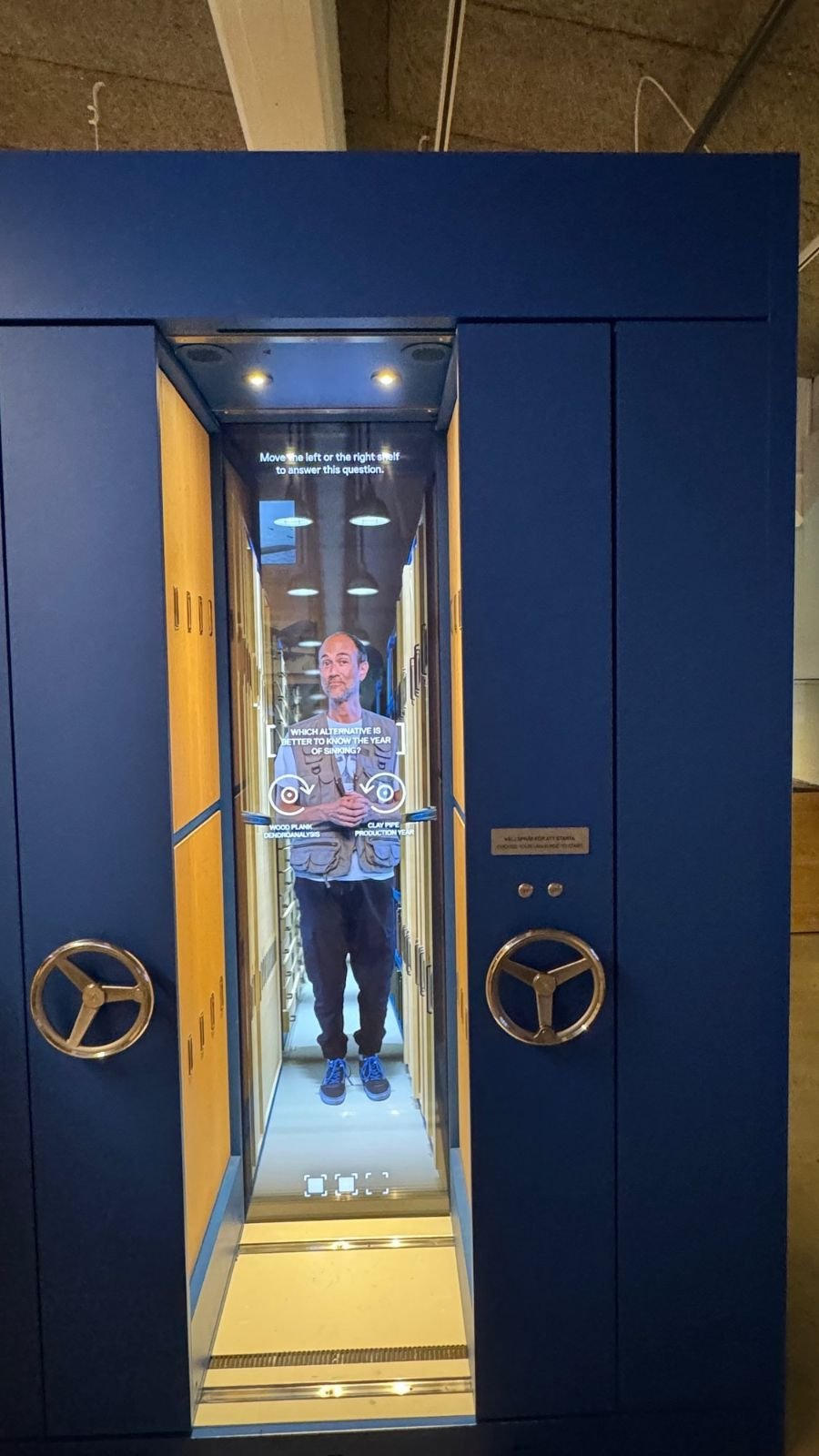
In a blue booth with brass wheels, a guide on a screen asks you questions. The screen says: Move the left or the right shelf to answer this question.
The visit can start with Sea of Memories, an underwater film in the museum’s cinema hall. The Divided Sea follows the shared history of the countries around the Baltic Sea. It uses finds from warships, trade ships and a sunken submarine. It starts in the 17th century and ends with the MS Estonia disaster.
There is also a free audio guide. Bring headphones.
Vikings Before Vikings
I saw the exhibition Vikings Before Vikings. Saaremaa Museum in Estonia made it. It builds on the Salme find. About 1,300 years ago, more than 40 Scandinavian warriors died in a battle on the island of Saaremaa. They were buried with their weapons in two ships on the shore.
Most books start the Viking Age in 793, with the raid on Lindisfarne in England. The museum says the Salme ships show that Vikings from what is now Sweden went on armed trips to the Baltic countries before then. You can see real swords and arrows, dress up in Viking clothes and row like a Viking.
The Salme ship burials are also on the top step of the stairs at The Viking Museum, a short walk away on Djurgården.
Vasa’s sister ship and the copper ships
Vasa had sister ships. One of them is Äpplet, built at the same time as Vasa. Sweden sank it on purpose at Vaxholm in 1659. Vrak’s archaeologists found it in 2021. The museum shows wood samples from Äpplet. The ship stays on the bottom, and diving there is prohibited.
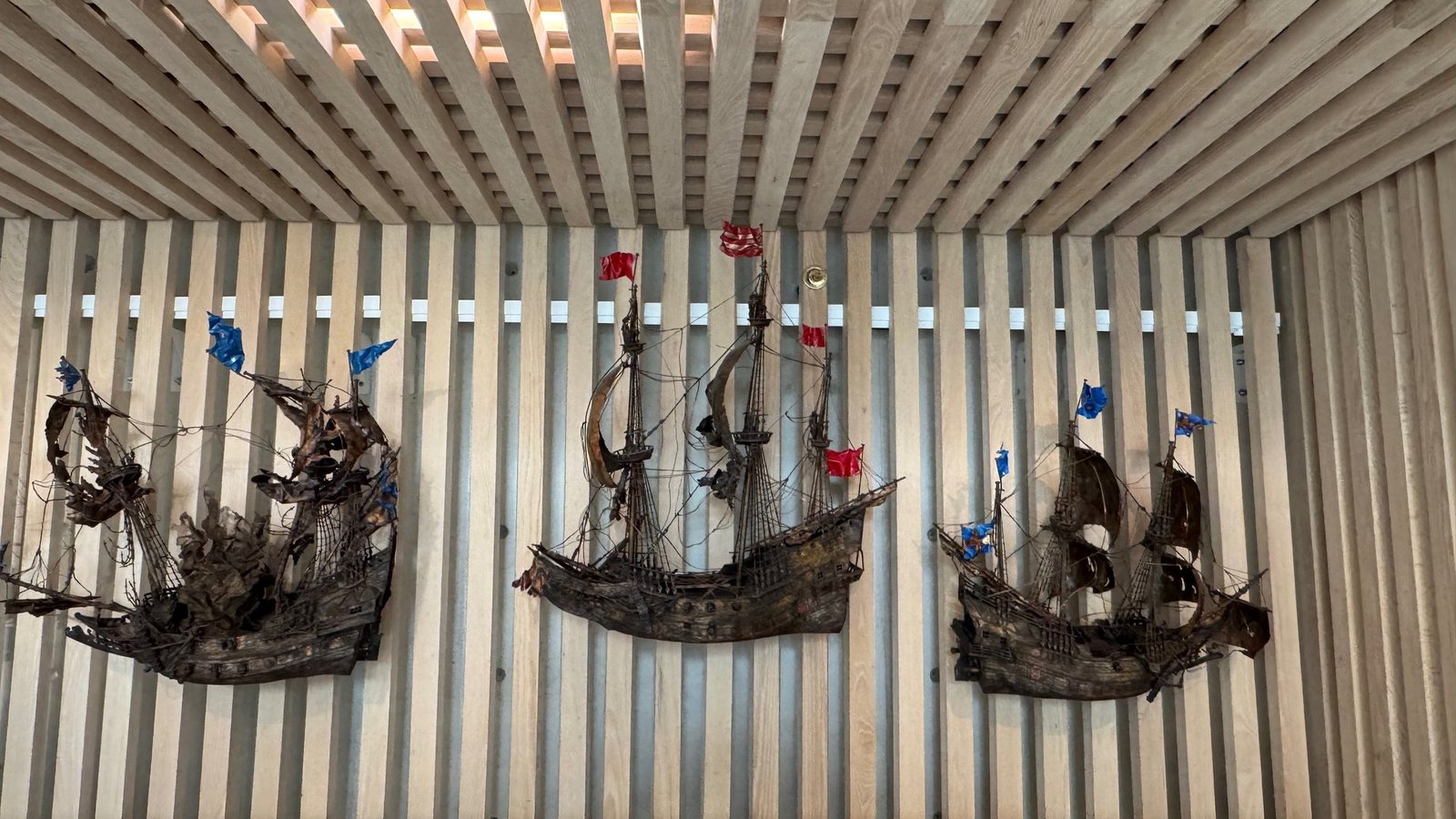
On the stairs, the artist Borney Bergstrand shows ships made of copper scrap, as in my photo at the top of this page. They are art, not finds. His work at shipyards and as a pipelayer shapes them.
The shop and Mackverket
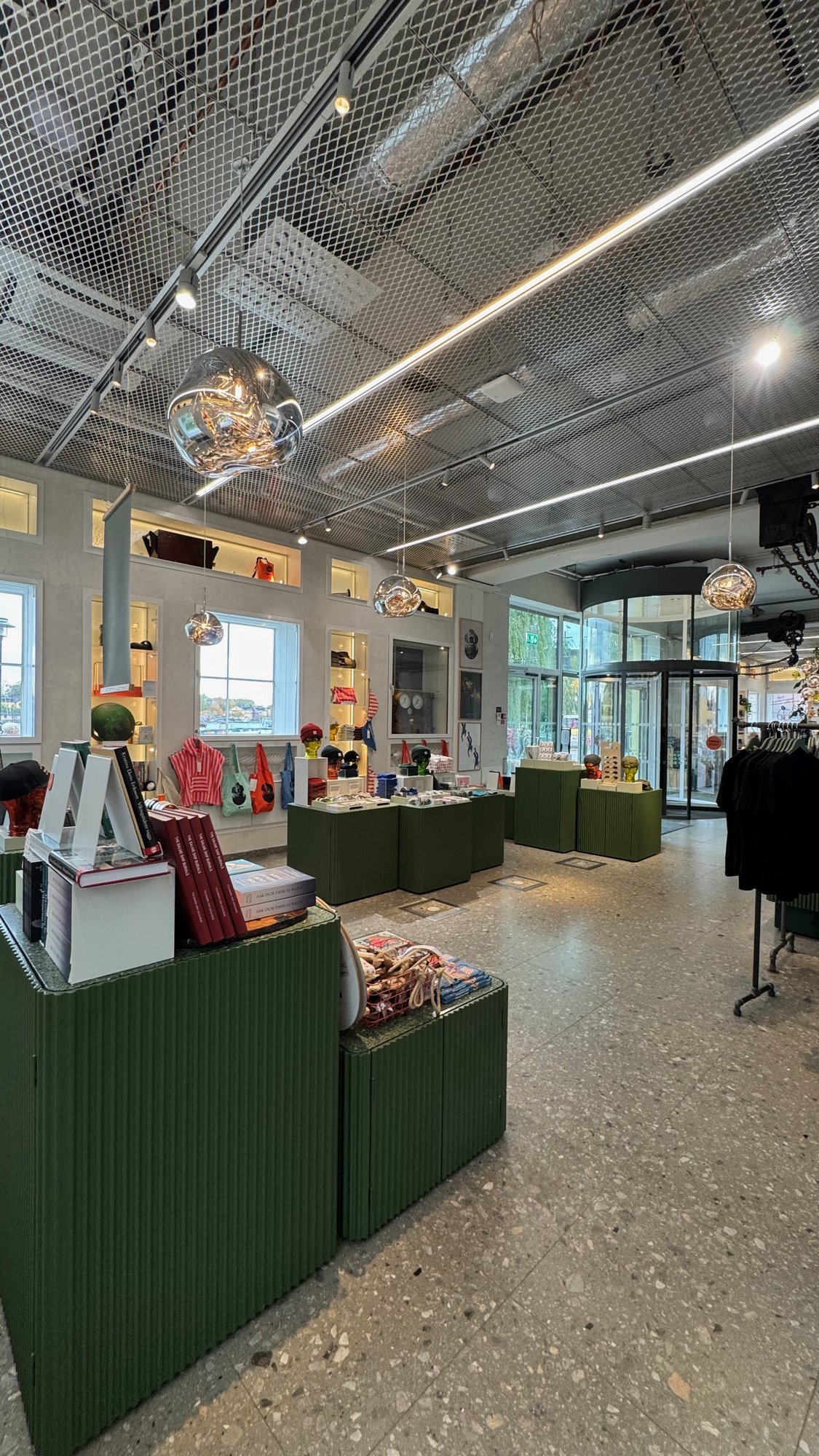
The shop is nice. The museum says it sells products from fair suppliers: books about the sea and maritime archaeology, caps, prints, ceramics, toys and Viking products.
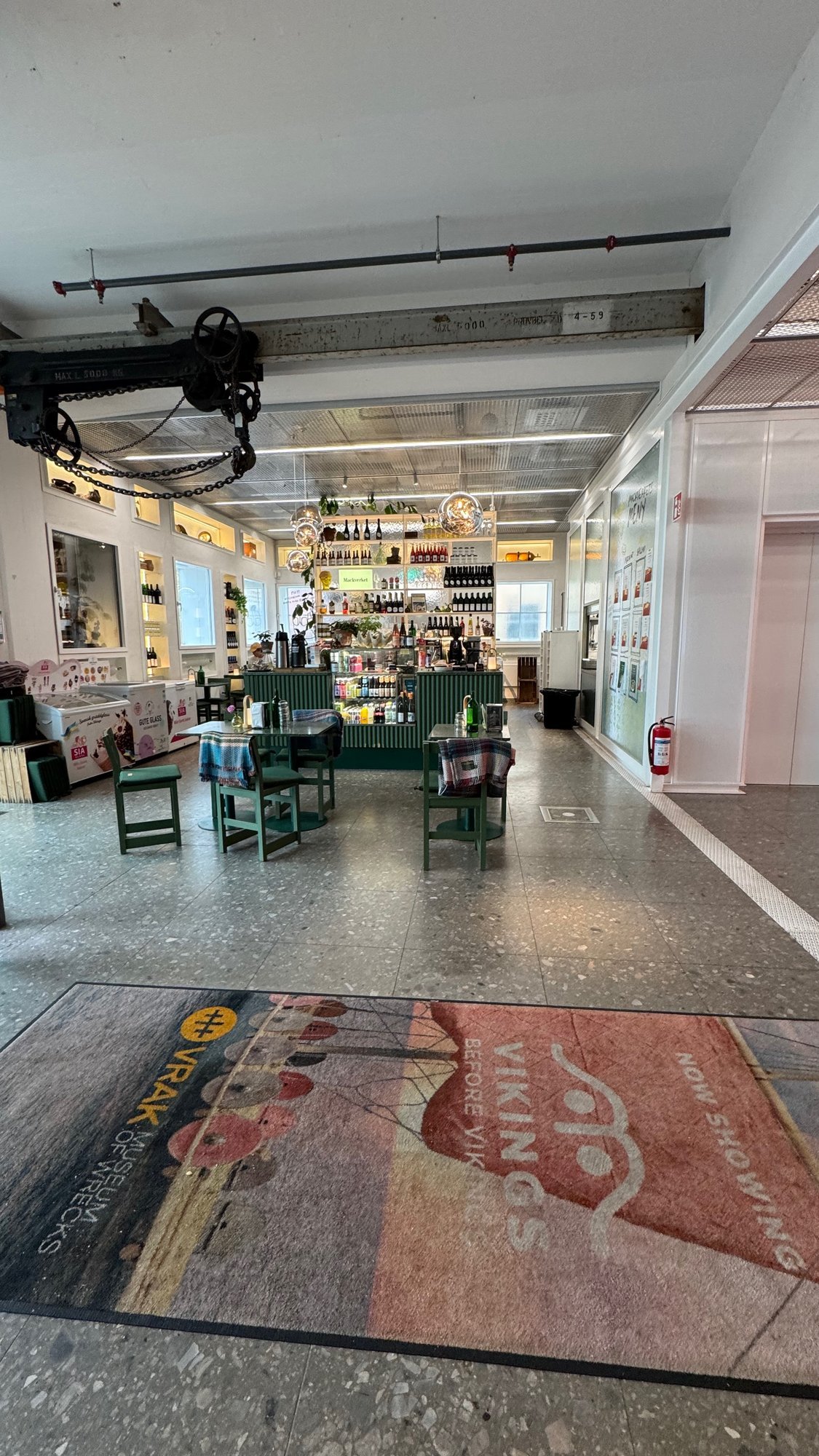
Mackverket, the café and bar, offers sandwiches. The museum says they are fresh sourdough sandwiches, with fika, drinks and a lunch offer every day. From spring to autumn, the outdoor seating looks out over Saltsjön. There is no room to eat a packed lunch.
The shop and Mackverket share a long, bright hall with a terrazzo floor. The shop has green displays and glass lamps. A large Vrak doormat lies at the door.
This autumn and winter
Who dares to hunt the Wreck Ghost? On 26, 27, 29 and 30 October, at 18:00–19:00, children hunt a ghost with flashlights in the dark museum. Ages 7 to 11, with an adult, and a maximum of two children per adult. You must book. The event page is in Swedish.
A calm tour for young people with NPF. On 26 November at 18:00–19:00, Vrak gives a tour for young people from 7 to 18 years with NPF diagnoses (neuropsychiatric conditions, such as ADHD and autism). An adult comes along. The group has a maximum of 15 people. You must book.
Christmas. Mackverket serves a Christmas table at Vrak: a classic julbord, a three-course Christmas dinner or a seafood buffet. You must book. From 26 December to 3 January, the museum plans nine days of activities.
Tickets and prices
Adults 185 SEK. Children and youth 0 to 18 years free. Combo ticket with the Vasa Museum 315 SEK. Annual Ticket 345 SEK. Annual Ticket Plus 395 SEK.
The combo ticket is valid for 72 hours, with one visit to each museum. The Annual Ticket Plus lets one more person in with you at each visit. Both annual tickets give 20% off in the shop and one entry to the Vasa Museum.
Visitors with disabilities pay the normal price. Their companions enter free.
Getting there and access
Bus 67 and tram 7 stop at Liljevalchs/Gröna Lund. The Djurgården ferry, line 82, goes from Slussen to Gröna Lunds brygga, and so does the boat M/S Emelie. From the city center, it is about a 40-minute walk or a 15-minute bike ride. Parking is limited. The car park Norra Varvsporten, Galärvarvsvägen 7, is just after Djurgårdsbron. Two parking spaces for visitors with a special permit are about 20 meters from the entrance.
Entrance and lift. A wide door with an automatic opener is to the right of the revolving doors. All public spaces are accessible by wheelchair and stroller. The lift door is 1.1 meters wide, and the lift is 1.55 × 1.55 meters inside. It has no audio.
Stairs. The staircase has 29 steps, railings on both sides and a bench halfway up. The first steps on both floors have tactile markings.
Toilets. There are toilets with changing tables on both floors. The restroom in my photo has a long stone sink counter, grey walls and separate toilet doors.
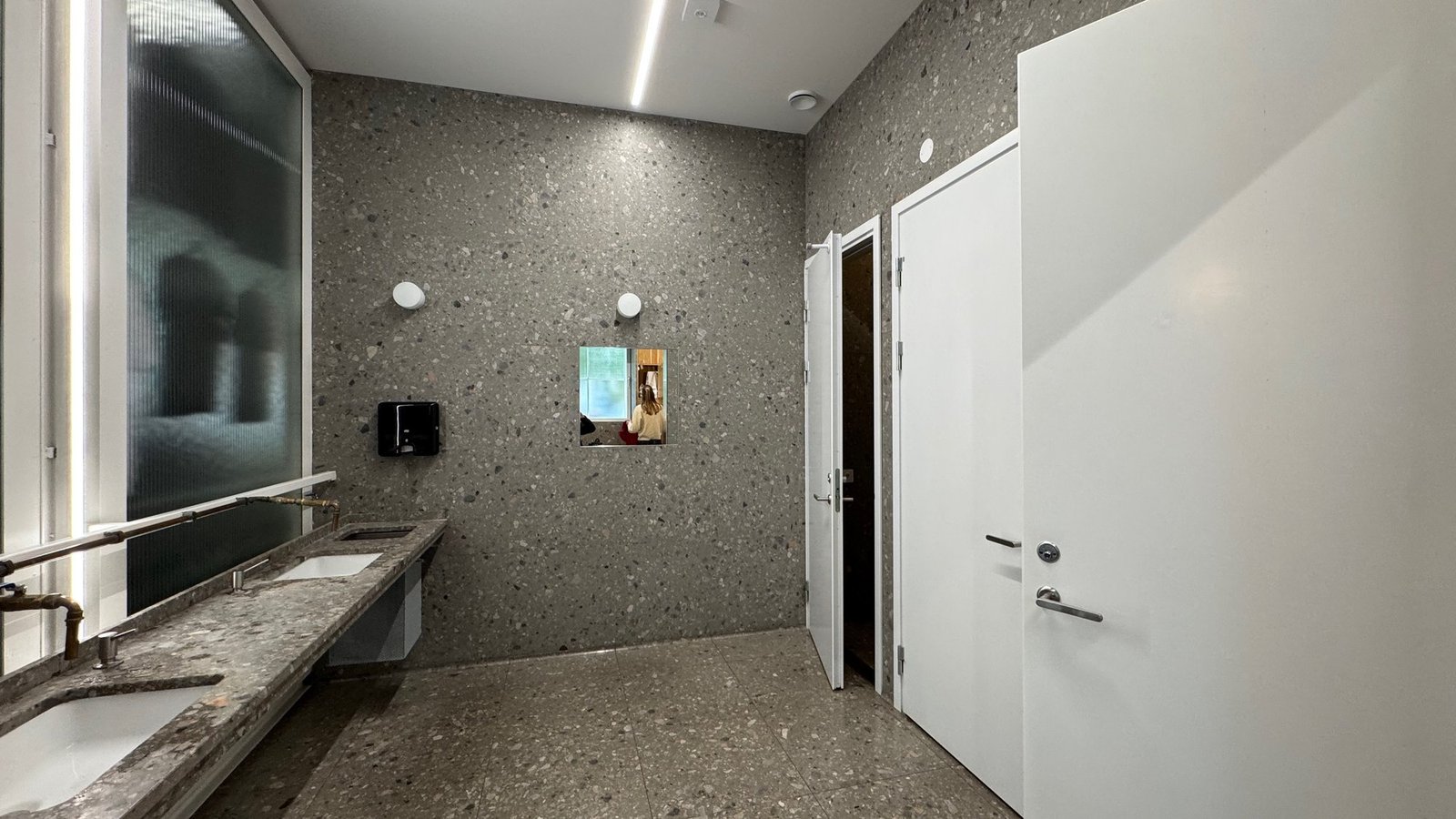
Hearing and sight. There are hearing loops on the upper floor. Scan a QR code, and your phone reads the exhibition texts aloud.
Epilepsy. The film in Sea of Memories can cause a risk of seizures. You can skip it and go to the room with Resande Man.
Other facts. One exhibition and the café use fragrant products. Only service dogs are allowed. The lockers take small items only. You may take photos for private use.
I have written about why so many museums are still hard to visit in my Medium story Barriers to Access: Why Aren’t Museums More Inclusive?
What is my verdict?
Vrak is about what stays under the surface. The VR dive and the interactive displays are very interesting, and the guided tour is included in the ticket. Stand by Resande Man, and think of the seven people who held on to the mast in the storm.
Then think of the numbers. Up to 100,000 wrecks may lie in the Baltic Sea. Some lie under Stureplan, under Skeppsholmen’s quays and off Dalarö.
How many of them have you already sailed over without knowing it?
All photographs on this page were taken by Zayera Khan during a visit to the museum, and are her own property. Please do not reuse them without permission.
Sources from Vrak: Vrak, Resande Man exhibition; Vrak, how many wrecks are in the Baltic Sea?; Vrak, unique Baltic Sea; Vrak, where can I dive?; Vrak, the Heritage Conservation Act; Vrak, wreck diving in Swedish waters; Vrak, Dalarö dive park; Vrak, ten ships found at Smörasken; Vrak, prison sentence for cultural heritage crime; Vrak, opening hours; Vrak, buy ticket; Vrak, getting here; Vrak, accessibility; Vrak, always at Vrak; Vrak, exhibitions; Vrak, Vikings Before Vikings; Vrak, museum and hub; Vrak, Museum of the Year; Vrak, hösten på Vrak; Vrak, Vem vågar jaga Vrakspöket?; Vrak, NPF-anpassad visning; Vrak, Mackverket.
Laws and agencies: Kulturmiljölag (1988:950), riksdagen.se; Lag (1995:732) om gravfriden vid Estonia, riksdagen.se; HaV, miljöfarliga vrak; Sjöfartsverket, nya bilder på vrak.
News: SVT 2025, Östersjön kan ha 100 000 vrak; SVT 2018, Östersjön ett mecka för vrakdykare; Aftonbladet 2018, flera vrak undersöks i Stockholm; SvD 2016, 150 vrak under Stockholm; SvD 2013, märkligt fartyg under Strandvägen; Mitt i 2018, historiska vrak utan dykutrustning.
Wikipedia: Wikipedia: Resande Man.