
Kristina Gyllenstierna: Why She Surrendered Stockholm
The men on the royal council gave up in March. She held out until September. Yet her surrender is the one we ask about.
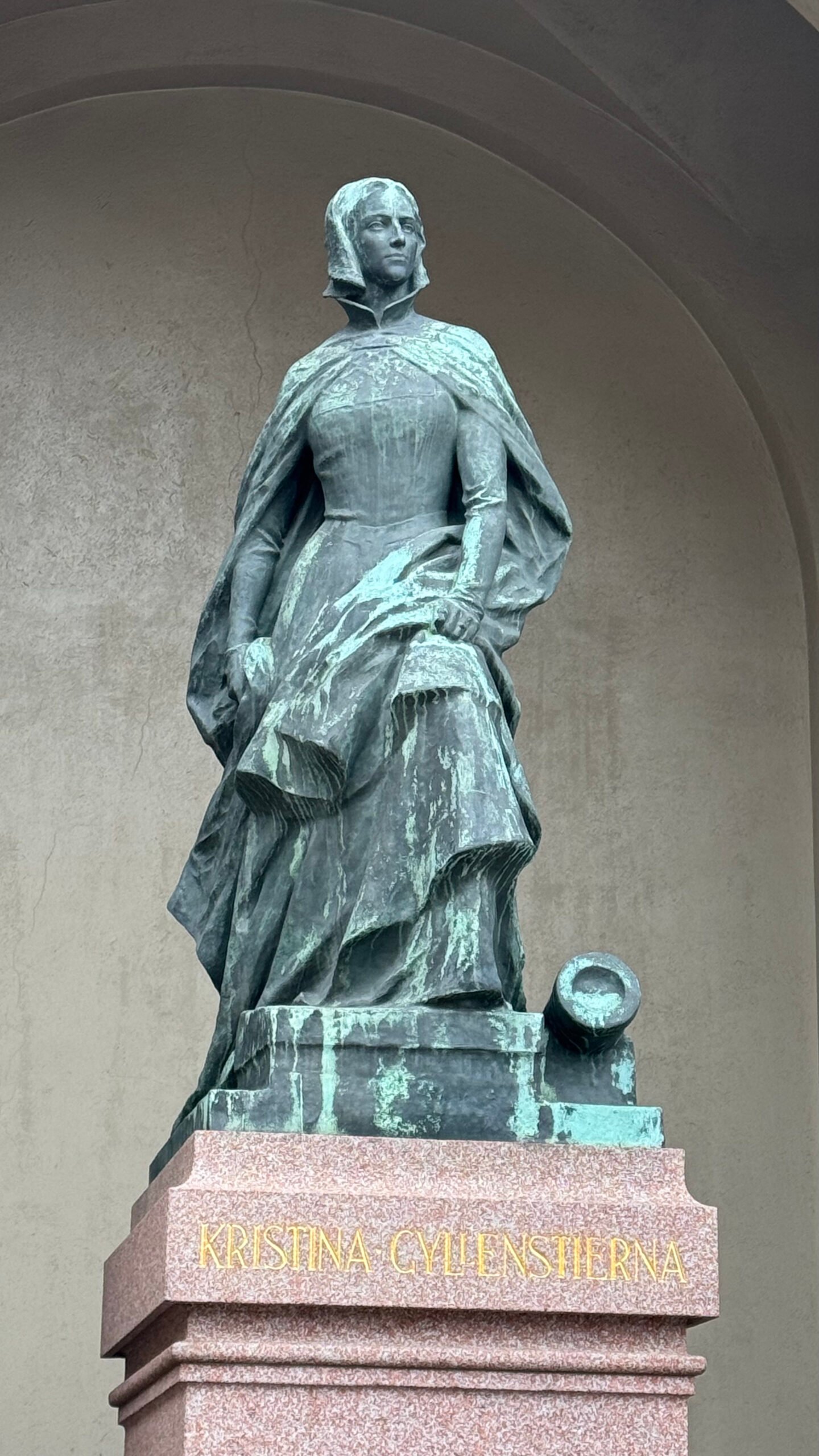
I live in Stockholm. In the outer courtyard of the Royal Palace, a woman stands in a stone niche. She wears a long dress, a cloak and a veil. She holds no sword. A cannon lies at her feet. The name on the red stone below her reads Kristina Gyllenstierna.
Visitors often ask one question about her: why did she give up?
It is a good question. It is also a strange one. We rarely ask it about men. And in 1520, she was not the first person to give up. She was the last.
Who was Kristina Gyllenstierna?
Kristina Nilsdotter was probably born in 1494. Some English sources spell her name Christina. Her father, Nils Eriksson (Gyllenstierna), sat on the royal council. Her mother was Sigrid Eskilsdotter (Banér). Through her mother, Kristina was the half-sister of Cecilia Månsdotter, the mother of Gustav Vasa.
On November 16, 1511, she married Sten Sture the Younger. A year later, he became regent of Sweden. They had five children who grew up: Nils, Iliana, Magdalena, Svante and Anna. A sixth child, a son, died as a baby in 1520.
Widow, mother and commander
In January 1520, a cannonball hit Sten Sture near Bogesund, today’s Ulricehamn. The Danish king, Christian II, wanted to take Sweden. Sten Sture died on February 3, before he reached Stockholm.
Kristina was 25 or 26 years old. She had five children and a baby. She took command. The Swedish Biographical Dictionary (SBL) says she continued the defense of Stockholm and encouraged resistance in the countryside.
She sent her chancellor, Peder Jakobsson (Sunnanväder), to Poland and the Hanseatic towns to look for help. Her eldest son, Nils, went with him. He was safer there.
She was not the only woman who defended a castle that year. Anna Eriksdotter (Bielke) led the defense of Kalmar Castle from February at the latest. The Biographical Dictionary of Swedish Women (SKBL) says she held out for several months, perhaps until August.
The siege of Stockholm
In early May, the Danish fleet arrived under Søren Norby. It closed Stockholm off from the sea. Christian II came in person in May. The Danes did not storm the city. They waited.
During the summer, the Danes brought in more forces, among them six ships from the Netherlands. Christian also tried to buy the people of Stockholm with salt and herring. Some took the gifts. Most did not. (Both facts come from Wikipedia.)
On September 5, 1520, Kristina and Christian reached an agreement. Two days later, the city gates opened. This is why sources give both September 5 and September 7.
Why did she surrender?
No source I have read gives Kristina’s own words about why. SKBL says only that she could not hold out against Christian in the long run. The rest is a picture I put together from what the sources tell us. I see six factors.
- The men had already given up. In March 1520, members of the royal council accepted Christian II as king, in return for a promise of amnesty. Sources give different dates, March 6 or March 31. Swedish Wikipedia says the nobles bargained with the enemy and the defense grew thin. Kristina refused to accept the agreement.
- The peasant army had lost. On Good Friday, April 6, 1520, the Danish army defeated a Swedish peasant army outside Uppsala. Kristina claimed a Swedish victory. English Wikipedia notes that war propaganda makes both sides’ claims unreliable.
- The city was shut in. From May, Stockholm was blocked from the sea. The Danes could get new forces. Stockholm could not.
- Help from abroad never came. Kristina asked Poland and the Hanseatic towns for help. I have found no source that says help arrived.
- The defenders were worked on one by one. Swedish Wikipedia says Hemming Gadh, who had changed sides, worked on the defenders one at a time and used their weaknesses.
- The terms were good. The Royal Palaces of Sweden write that the surrender letter “offered a generous amnesty and full forgiveness for all past actions.” Kristina was also promised Tavastehus County in Finland and several estates, among them Hörningsholm. English Wikipedia says Christian’s own supplies were running low. This suggests she negotiated while she still had something to bargain with.
SBL says she took command on behalf of her children. If that is true, the surrender was also about their inheritance. The amnesty and the estates protected her children’s future. That is my reading, not the sources’.
So when we ask why she gave up, maybe we ask the wrong question. How did she hold out so long, when the men around her had already given up?
The letter that became a death sentence
On November 4, 1520, Christian II was crowned in Stockholm Cathedral. Three days later, a trial began at the castle.
Archbishop Gustav Trolle accused Kristina, her dead husband, her mother and many others of crimes against him. In 1517, the Swedish assembly had decided to remove Trolle from office and tear down his castle, Stäket.
Kristina brought out that decision. Swedish Wikipedia says she wanted to show that removing Trolle was part of the rebellion, which the amnesty covered, and that a national assembly had made the decision. It was not her husband’s crime alone.
But the court declared that everyone who had signed the decision was guilty of heresy. The amnesty did not cover heresy. SBL says this verdict led to the Stockholm Bloodbath.
In 1969, the historian Curt Weibull wrote that her letter was decisive. Without it, the heresy charge had no legal basis.
It is easy to make her the woman who “gave the men away.” But look at her situation. A widow defends her dead husband before an enemy who has just broken his word. She uses the document that should protect them. Then the judges change the rules.
On November 8 and 9, about one hundred people were executed on Stortorget, according to the Royal Palaces of Sweden. The executioner, Jörgen Homuth, is said to have counted 82, according to the historian Lars Ericson Wolke. Kristina’s two brothers, Erik and Eskil, were among the dead. The bodies of her husband and their baby son were dug up and burned. I write more about the executions in my article on the Swedish word rackare and executions in Stockholm (in Swedish).
SKBL writes that she would surely also have been executed if she had been a man.
The women in prison
Kristina was held at the castle until August 1521. Then she was taken to Denmark. With her were her mother Sigrid, her half-sister Cecilia and Cecilia’s daughter Emerentia.
Cecilia, Emerentia and Kristina’s daughter Magdalena died in captivity, according to SKBL. Cecilia was Gustav Vasa’s mother.
SBL says that only in January 1524 did the Danish council promise that Kristina and the other imprisoned Swedish women could go home.
Back in Gustav Vasa’s Sweden
Meanwhile, Gustav Vasa had taken power. He was Kristina’s nephew. But Kristina stood for the Sture family, and the Stures had support among the people.
At Christmas 1526, the king arranged her engagement to his cousin, Johan Turesson (Tre Rosor). They married in 1527. Swedish Wikipedia says the king probably wanted to stop her from leading the Sture party.
In the province of Dalarna, a young man appeared who said he was her son Nils. People called him Daljunkern, the young lord of Dalarna. SBL says that in 1528 Kristina signed a statement that only Svante was still alive. Her statement helped lead to the man’s execution in Rostock. SKBL says she wrote under pressure from Gustav Vasa, and that some researchers believe Daljunkern really was Nils.
Imagine being forced to write that a man is not your son, and knowing what that means for him.
What she carried forward
Kristina had seven children in two marriages. With Johan Turesson, she had a son, Gustav Johansson (Tre Rosor), who sat on the royal council and died in 1566.
Her son Svante married Märta Leijonhufvud. On May 24, 1567, King Erik XIV had Svante and two of his sons, Nils and Erik, killed at Uppsala Castle. Swedes call it the Sture murders.
Kristina did not live to see it. She died on January 5, 1559, at Hörningsholm on the island of Mörkö. She was buried in Trosa Rural Church. Her burial vault burned in 1773.
For a time, she also cared for Gustav Vasa’s children after he became a widower. The nephew who kept her away from power left his children with her.
According to the news site Royal Central, the Crown Princess’s family learned in 2020 that Princess Estelle descends from Kristina. I have found only one source for this.
The statue in the outer courtyard
The sculptor Theodor Lundberg made the statue in 1897. It has stood in the outer courtyard of the Royal Palace since 1912. The Society for the Permanent Defence of Stockholm paid for it. The Royal Palaces of Sweden call it “Sweden’s first official female statue.”
So it took 392 years from the defense of Stockholm until a woman got an official statue in Sweden. And she got it for defending a city, not for being someone’s wife.
Next time you stand in the outer courtyard, remember that the men gave up first. Whose surrender do we remember?
Read more: How Swedish royal houses are linked through women · Museum Tre Kronor at the Royal Palace
Sources
Reference works and official sources
- SBL: Kristina Nilsdotter Gyllenstierna, by Hans Gillingstam (vol. 17, 1967–1969, in Swedish)
- SKBL: Kristina Nilsdotter (Gyllenstierna), by Katarina Harrison Lindbergh (2018, in Swedish)
- SKBL: Anna Eriksdotter (Bielke), by Maria Sjöberg (2018)
- The Royal Palaces of Sweden: Kristina Gyllenstierna and the Stockholm Bloodbath (2020)
- The Swedish History Museum: The Stockholm Bloodbath
Research and press
All photos by Zayera Khan. Zayera Khan is the photographer and copyright owner.