
Sjöhistoriska museet in Stockholm: ship models, a royal stern and a sea world for children
The Swedish National Maritime Museum tells the story of Sweden and the sea, from warships to cargo ships, by the water at Djurgårdsbrunnsviken.
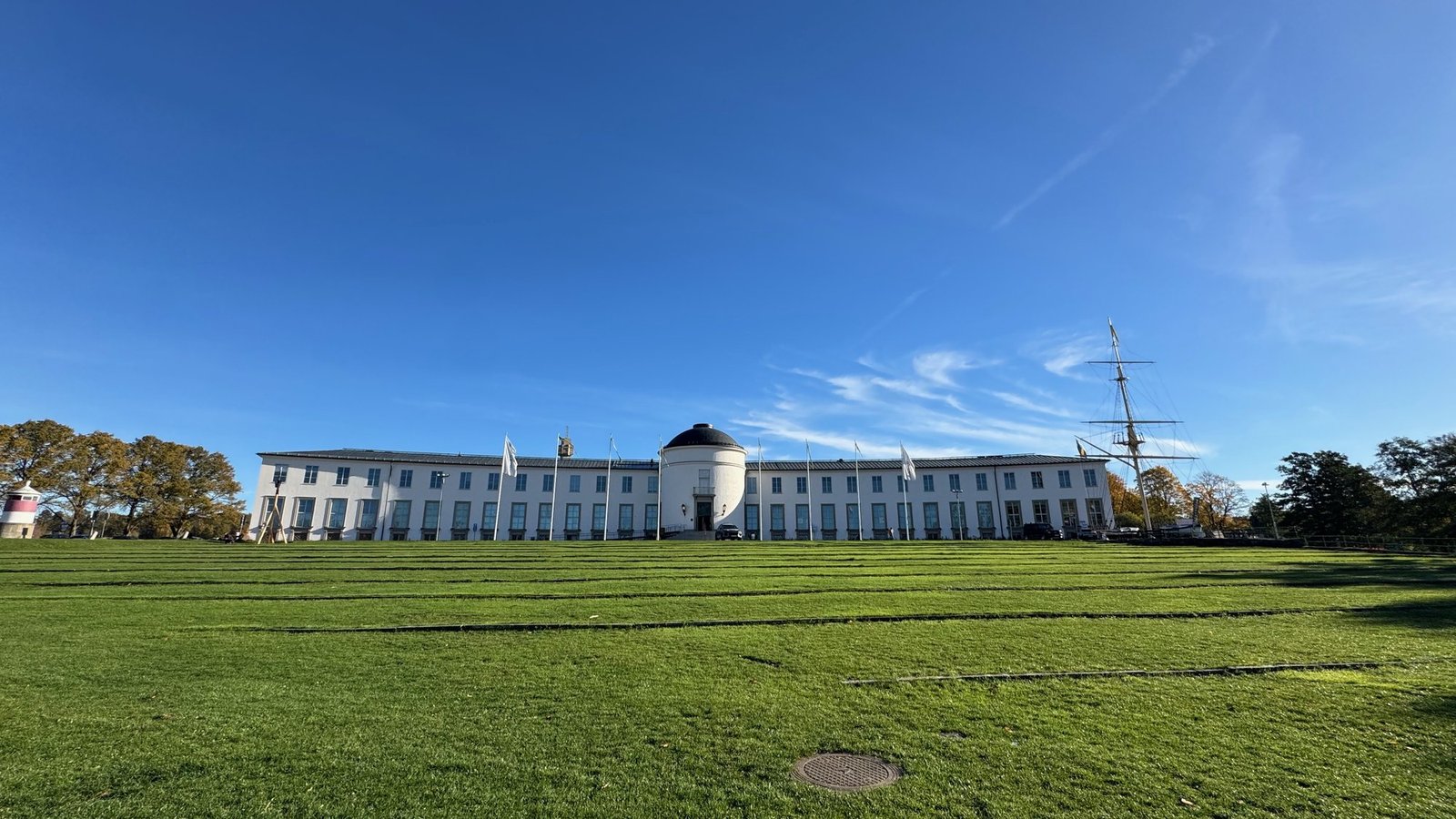
- Why visitThe national museum of Swedish maritime history. Warship models, figureheads, the gilded stern of Gustav III’s ship Amphion, merchant shipping and a play room for small children.
- Best forFamilies with children, and anyone curious about ships, the navy and the sea.
- AddressDjurgårdsbrunnsvägen 24, 115 27 Stockholm, by the bay Djurgårdsbrunnsviken.
- Getting thereBus 69 from Centralen stops right outside. The nearest metro stations are Karlaplan and Gärdet. From Djurgårdsbron, it is a 15-minute walk along the water.
- Opening hoursTuesday to Sunday 10:00–17:00. Wednesdays until 20:00 from September to May. Closed on Mondays, but open on Monday 26 October 2026. Check the website for other changes.
- AdmissionAdults 150 SEK. Seniors and students 110 SEK. Children and youth 0 to 18 years free. Annual card 250 SEK. The museum is cash-free.
- Guided toursA welcome tour every day, in Swedish at 11:00 and in English at 15:00, about 25 minutes, included in the ticket. A free audio guide in five languages.
- For childrenThe play room Blubb for children aged 0 to 6, and the creative workshop Ruskpricken on weekends and school holidays. Both are included in the ticket.
- FoodSjöhistoriska Café, Tuesday to Sunday 10:30–16:00. A room for packed lunches.
- AccessibilityA ramp at the main entrance and a lift at the back. All public spaces are normally accessible by wheelchair and stroller. Details below.
- Official websitesjohistoriska.se
I visited Sjöhistoriska museet on 18 October 2026. I walked around on my own and took the photos on this page that day.
The museum has a nice space for children, and interesting exhibitions about naval history and ship models.
Sweden has a long coast, many lakes, rivers and canals. The museum says that people here have always depended on the waterways to move goods and people. Sjöhistoriska is the museum for that story. In English it is called the Swedish National Maritime Museum. It is part of a group of state museums for maritime, transport and military history (SMMTF).
A museum built with one strict rule
The museum’s story starts in 1913. That year, the Association for Swedish Maritime Museums in Stockholm decided that the city should have a maritime museum. On 15 February 1914, a small museum opened at Skeppsbron 46 in Gamla Stan. It was about shipping companies, merchant ships, navigation and seamanship. The naval collections of the state, about the history of the Swedish Navy, were shown separately, on Strandvägen from 1928.
The two collections needed one home. In 1931, the Knut and Alice Wallenberg Foundation offered 800,000 SEK, a very large sum in Sweden between the wars. The museum says the money came with conditions. The state had to give a site. The stern and cabin of Amphion had to have a prominent place. And the building must not be in the functionalist style.
Three of the best-known Swedish architects competed: Ragnar Hjorth, Cyrillus Johansson and Ragnar Östberg. Östberg, the architect of Stockholm City Hall, won. The museum says it was built in 1934 and 1935. Wikipedia gives 1933 to 1936. The style is neoclassical, inspired by ancient Greece and Rome. The museum adds that there are a few traces of functionalism anyway, in the bright, clean surfaces and smooth façades.
King Gustav V opened the museum on 28 May 1938, in bright sunshine, with 1,500 invited guests. Wikipedia says the collections hold about 50,000 objects, 900,000 photos and 45,000 drawings.
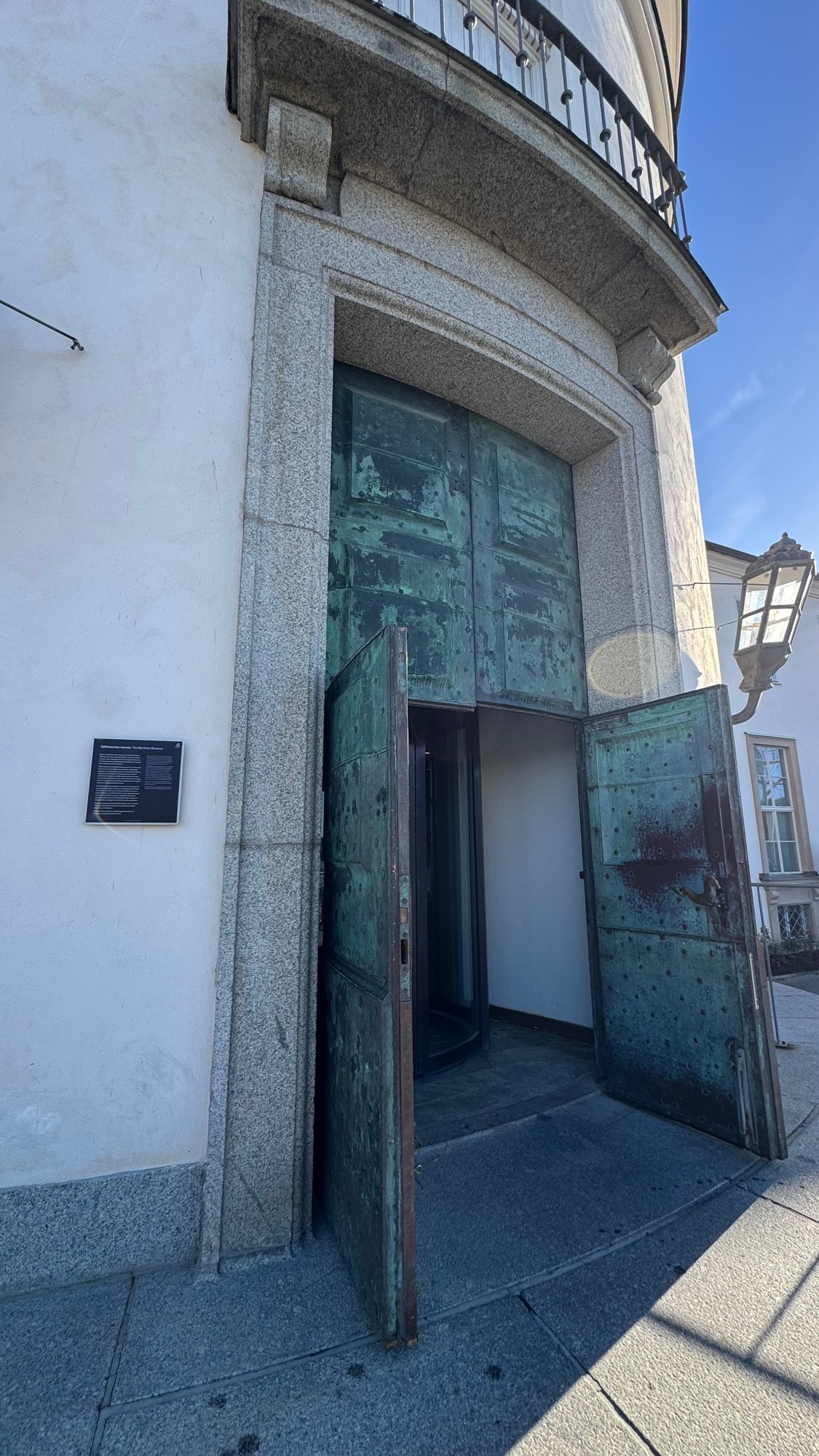
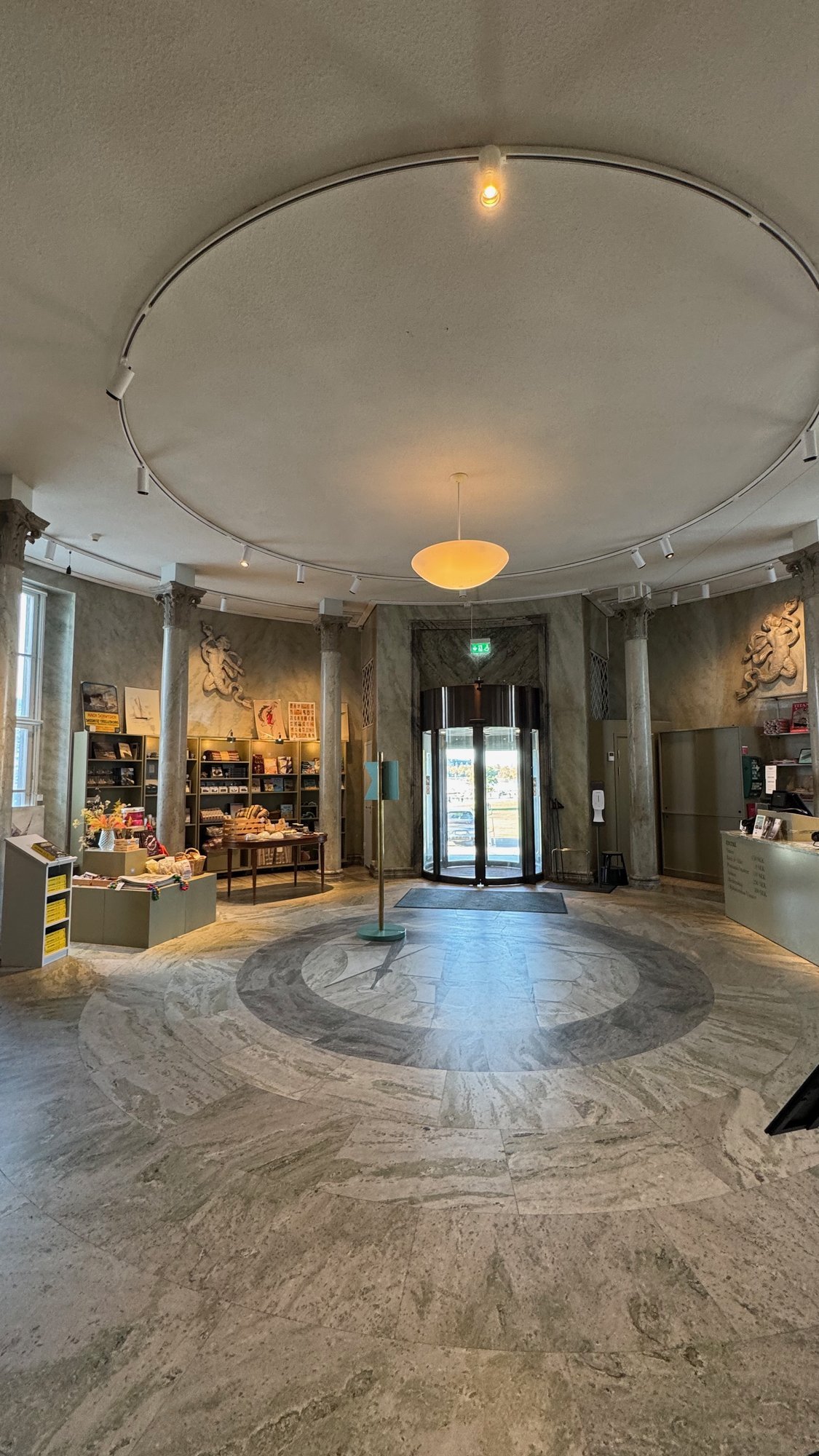
You enter through tall green bronze doors into a round entrance hall with a stone floor. Look straight ahead.
Amphion: the king’s pleasure ship
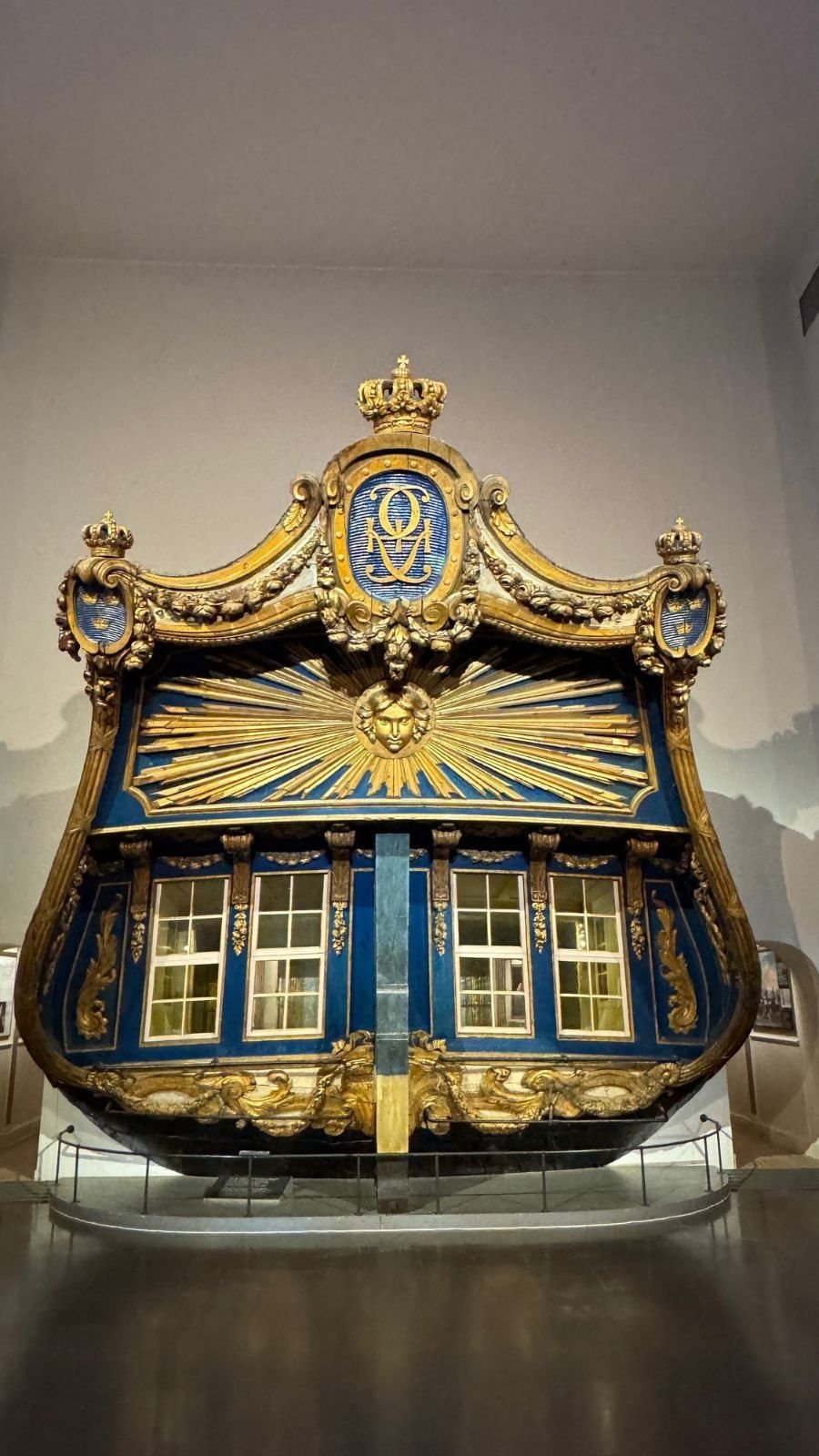
From the entrance hall, you see a gilded stern with a golden face in a sunburst, and a crown on top. This is all that is left of Amphion, the pleasure ship of King Gustav III. The museum says this part of the building was built for the stern and cabin. The ship was inspired by the luxury of the French court at Versailles.
Amphion had a dramatic life:
- 1778: the ship was launched. It nearly sank on its first voyage. The poet Carl Michael Bellman later wrote songs about it.
- 1788 and 1790: Amphion was a command ship in the war against Russia, and the Russians nearly captured it.
- 1792: Gustav III was murdered, and the ship was put away in a shed until 1829.
- 1850s: Amphion became a quarantine ship for cholera patients. In 1875 it became a barracks ship.
- 1885: the ship was broken up. Only the stern was kept.
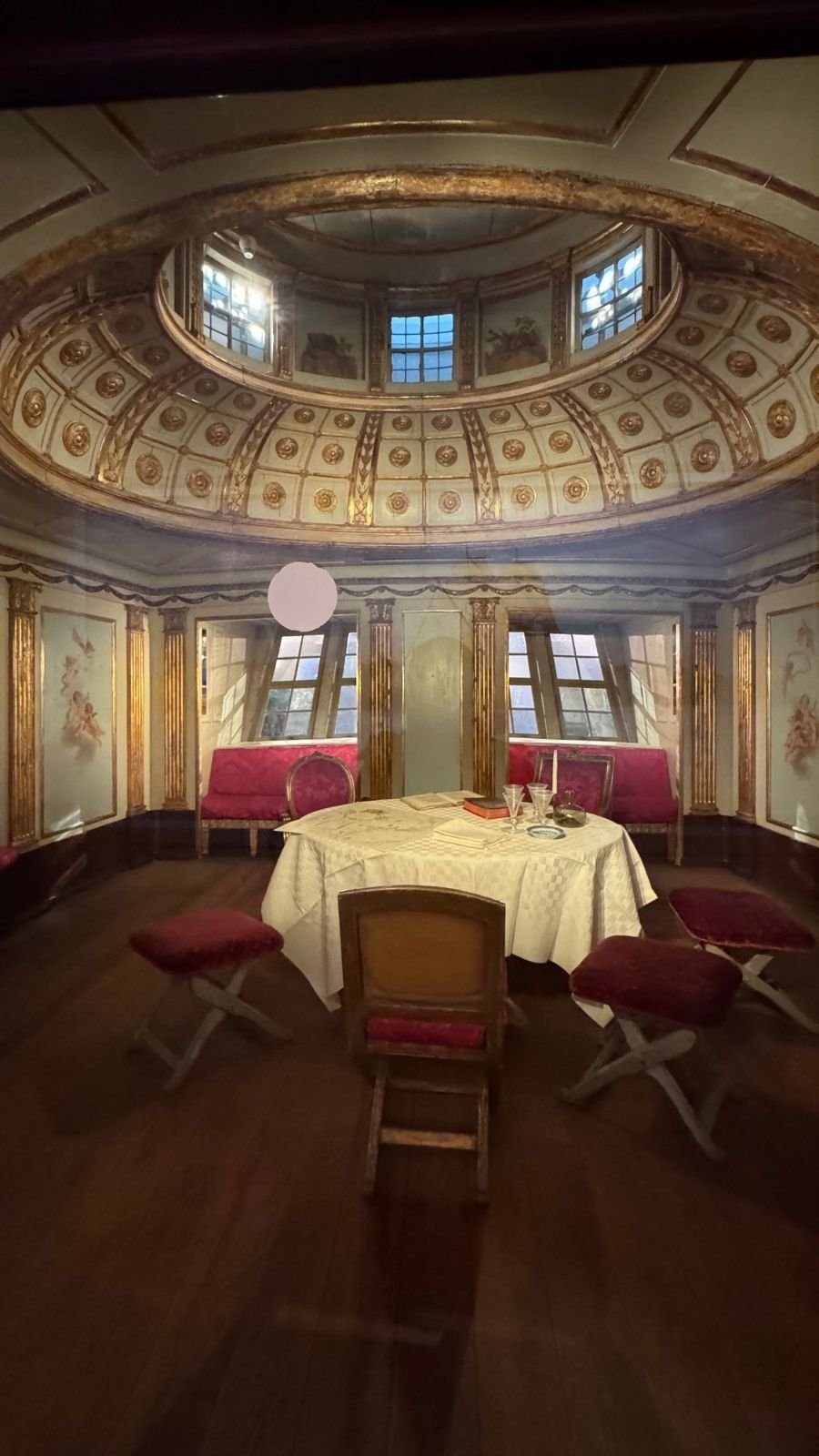
Behind the stern is the royal cabin, with a round table, a white tablecloth, red chairs and a painted dome with windows. The museum calls it the cabin with its preserved interior. Wikipedia calls it a replica of the cabin.
Naval history and warship models
The exhibition Battle Stations! (Klart skepp!) is, as the museum says, much of the essence of Sjöhistoriska. One rule for the new building in the 1930s was that it must have room for the state collection of warship models.
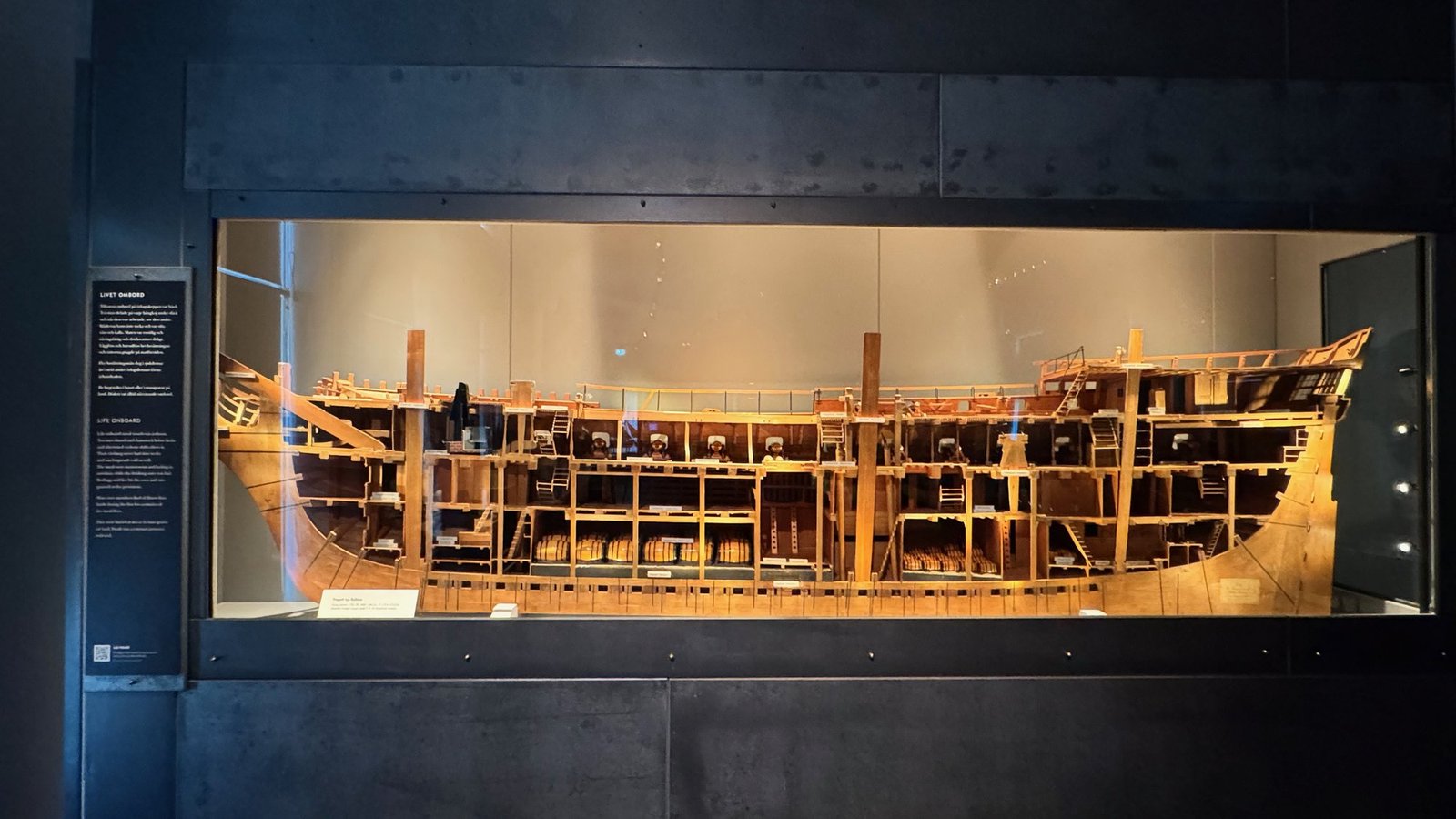
The models tell the story of the ships of the Swedish Navy from the 1700s until today: frigates, gunboats, submarines and modern corvettes. Some were built by the famous shipbuilder Fredrik Henrik af Chapman. One model is believed to be from the late 1600s. In my photo, a large model of a ship is cut open, so you can see the decks, the beams and the rooms inside.
The exhibition also has real objects, from pikes to a submachine gun, and tools for navigation, such as a medieval Jacob’s staff and a sextant. The saddest objects come from the submarine Ulven. In 1943 it hit a German mine outside Gothenburg during an exercise, and 33 men died. Its telephone buoy, which floats up when a submarine sinks, broke loose and was found days later. It is now on display.
The women in the fleet
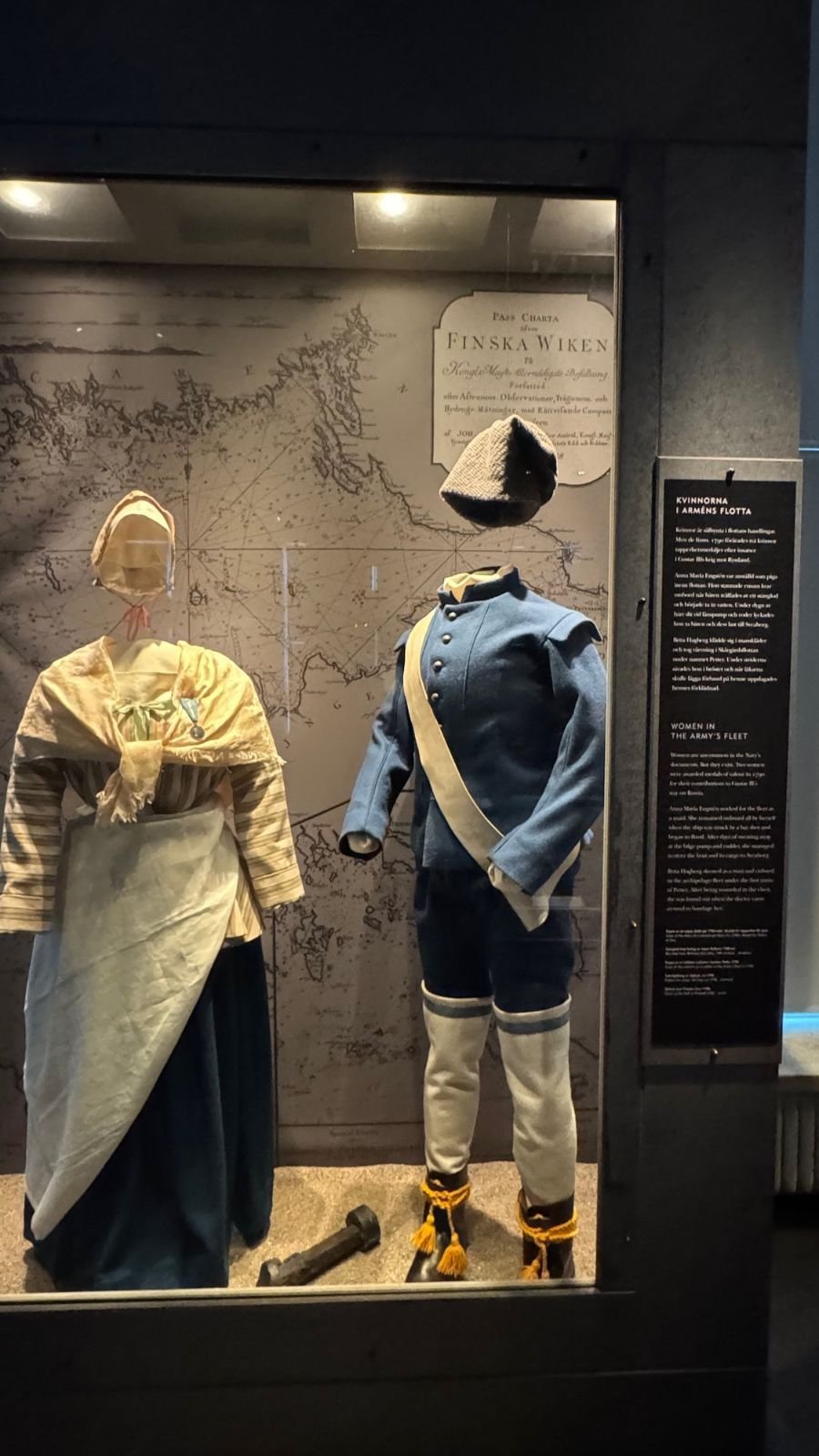
One glass case shows a woman’s dress and a sailor’s uniform. The panel next to it is called Women in the army’s fleet. It says women are rare in the navy’s documents, but they exist. In 1790, two women got medals for bravery in Gustav III’s war against Russia.
Anna Maria Engstén worked as a maid in the fleet. The panel says she stayed on board alone when the ship was hit and began to take in water. After days at the pump and the rudder, she brought the boat and its cargo to Sveaborg. Brita Hagberg dressed as a man and joined the archipelago fleet under the name Peter. She was wounded in the chest, and when the doctor came to bandage her, her secret came out.
Shipbuilding in the basement
In the basement, three large cases show a short history of shipbuilding. The museum says it goes from Bronze Age rock carvings, through Viking and medieval finds, the age of the great sailing ships, to steam and engines. Professional model builders, sailors and skilled amateurs made the models. One is the wood boat Greta Linnéa, ordered by the museum in 1931. Measurements of that model later helped to build a full-size replica, Sofia Linnéa, in the 1980s.
Figureheads with their own stories
The museum says it has one of the largest collections of figureheads in Sweden. The ships are gone, but the figures remain. In my photo, a carved wooden figurehead leans out from the wall, next to a long room with ship models in lit glass cases.
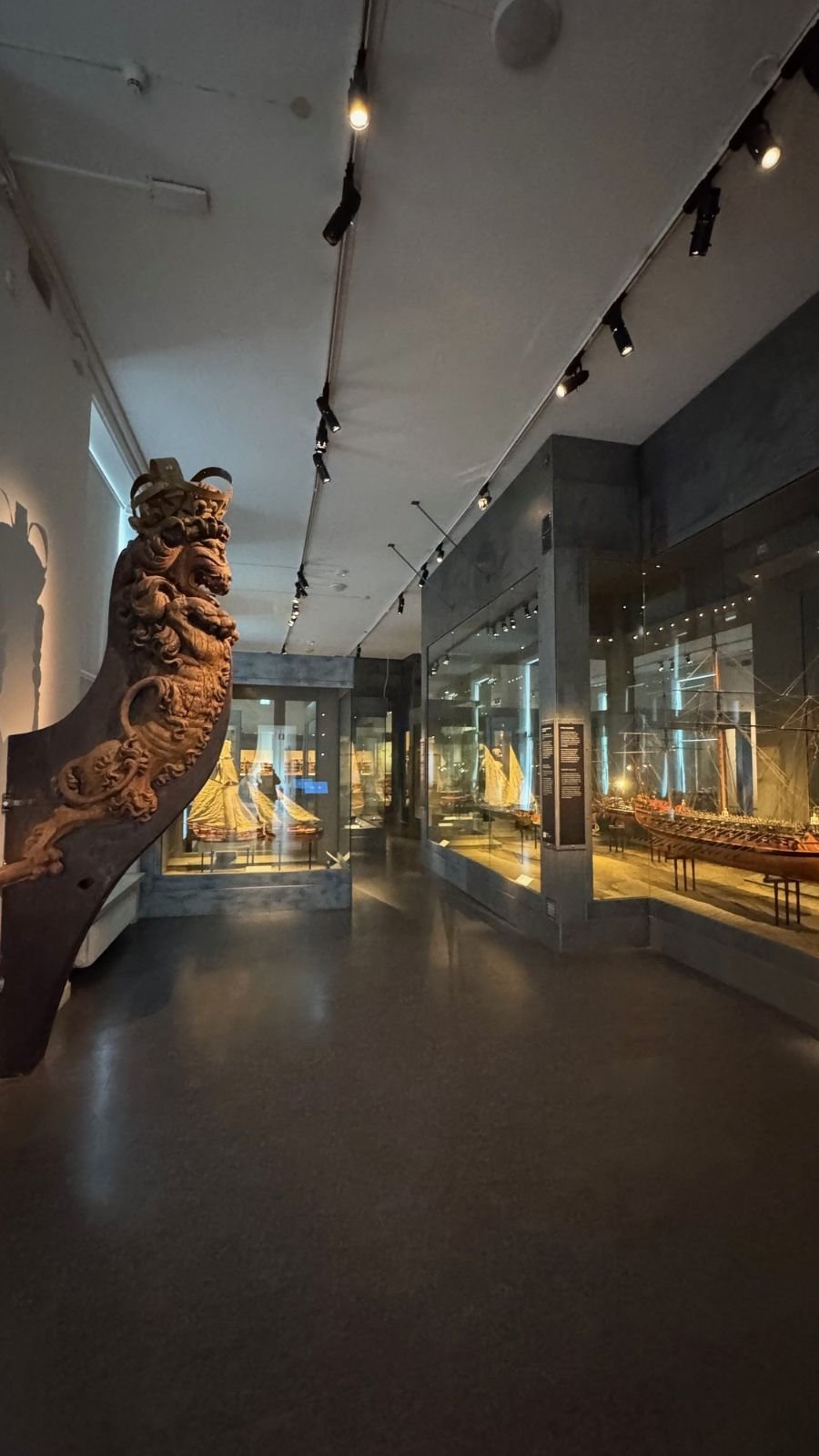
Fashions changed. In the 1600s and early 1700s, the lion was a common figurehead, a sign of power. The museum has a lion from the early 1700s, carved from an Asian hardwood, that probably sat on a ship of the Swedish East India Company. In the 1800s, many figureheads showed the daughters or wives of shipowners.
The Memorial Hall holds the figurehead of the steam frigate Vanadis, from the 1860s. It shows the Norse goddess Freya and was carved by Henrik Nerpin. The largest and heaviest figurehead, from the ship of the line Dygden, is a huge red male figure by the Admiralty sculptor Johan Törnström.
Look up in the south stairwell. A dragon’s head with a tail hangs there. The museum says it was the figurehead of a royal boat from the early 1800s. The dragon is also one of the museum’s mascots.
Shipping, a shipwreck and paddling
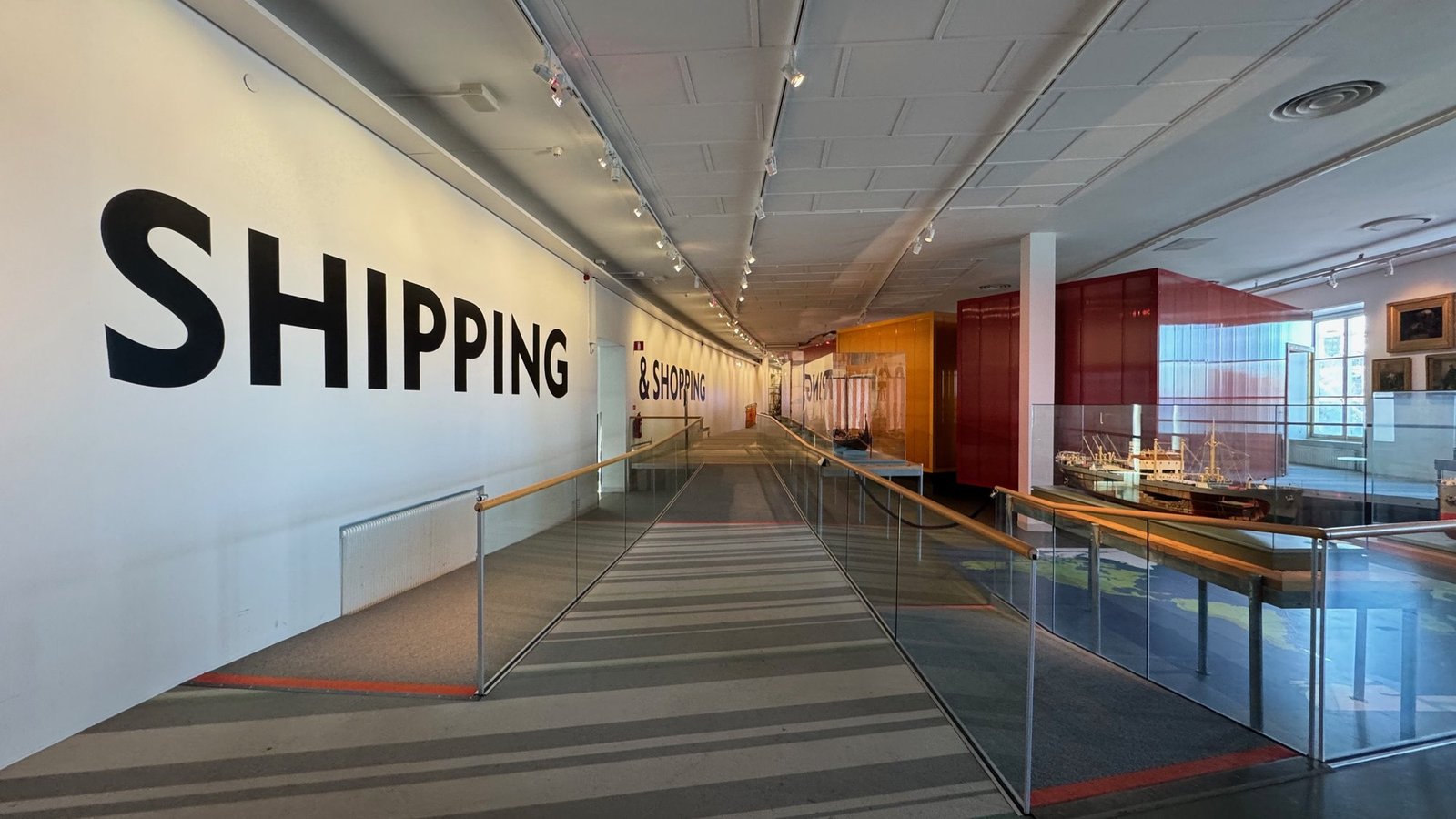
Shipping & Shopping. The museum says your way of life would not be possible without trade, and trade is not possible without shipping. The exhibition asks why ships look as they do, what it is like to be a sailor, and how shipping has changed our habits. In my photo, the word Shipping runs in big black letters along a long white room.
S/S Hansa – Memory of a Shipwreck. On 24 November 1944, a Soviet submarine torpedoed the passenger ship Hansa on its way from Nynäshamn to Visby. The museum says the ship sank within a minute, and only two of the 86 people on board survived. The wreck was found in 1988, 100 meters deep. The exhibition shows objects from the ship together for the first time.
The Baltic Sea holds many wrecks like this. I wrote about them in my article on Vrak – Museum of Wrecks and the shipwrecks of the Baltic Sea.
Paddle! This exhibition tells the story of paddling, from long historic journeys to outdoor life today. You can try to pack a kayak, test your balance or crawl into a tent with the sounds of nature.
Queen Victoria’s saloon. One room has part of the original smoking saloon from the train ferry Drottning Victoria, built in Newcastle in 1909 for the Trelleborg–Sassnitz route. The room is rented out for meetings and dinners. The museum shows it on request, if it is free.
Blubb and Ruskpricken: space for children
Blubb is a play room for children aged 0 to 6, together with an adult. The sign at the door says that many old, forgotten wrecks lie at the bottom of the Baltic Sea, and invites you on a journey under the surface. In my photo, the entrance is a grey door like a ship’s hatch, with round windows, next to shelves for shoes.
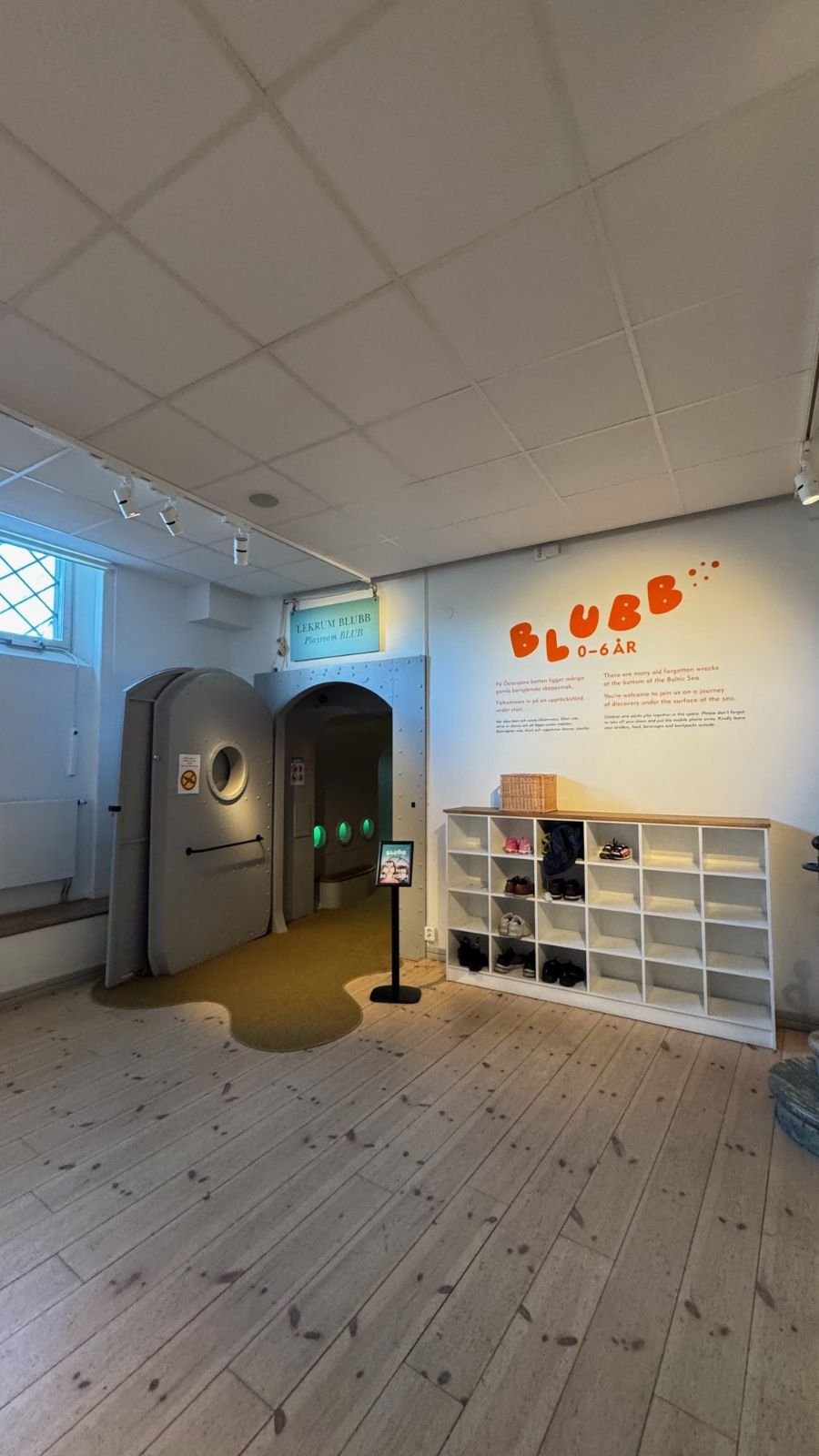
The museum says children can slide down a slide in a sailing ship, steer a fishing boat, fix things in the engine room, dress up as a captain, look at the sunken cargo and listen to stories among the seals. For the smallest, there are sounds, lights and things to squeeze, feel and crawl on. A quiet corner has soft toys and books. To keep it pleasant, no more than 30 children and adults may be in the room at the same time. The sign asks you to take off your shoes, put your phone away and leave strollers, food, drinks and backpacks outside.
Next to Blubb are a cloakroom, a packed lunch room, toilets, a baby changing table and a nursing room.
Ruskpricken is a creative workshop where children and adults make things together about ships, boats and the sea. Museum educators are there to help. It is open on Saturdays and Sundays 10:15–16:30, closed for lunch 12:00–12:45, and every day during the Stockholm school holidays. It is included in the ticket, but you need a separate free ticket from the main entrance.
This autumn break, 24 October to 1 November 2026, the museum fills with sea ghosts. There is a family tour about sea ghosts and old sailors’ superstitions for children aged 6 to 10, and a story time for children aged 4 to 6, both every day at 11:00, 12:00, 14:00 and 15:00. A ghost quiz walk goes through the museum. The event page is in Swedish. Tickets are free at the entrance, first come, first served.
The café, the packed lunch room and the library
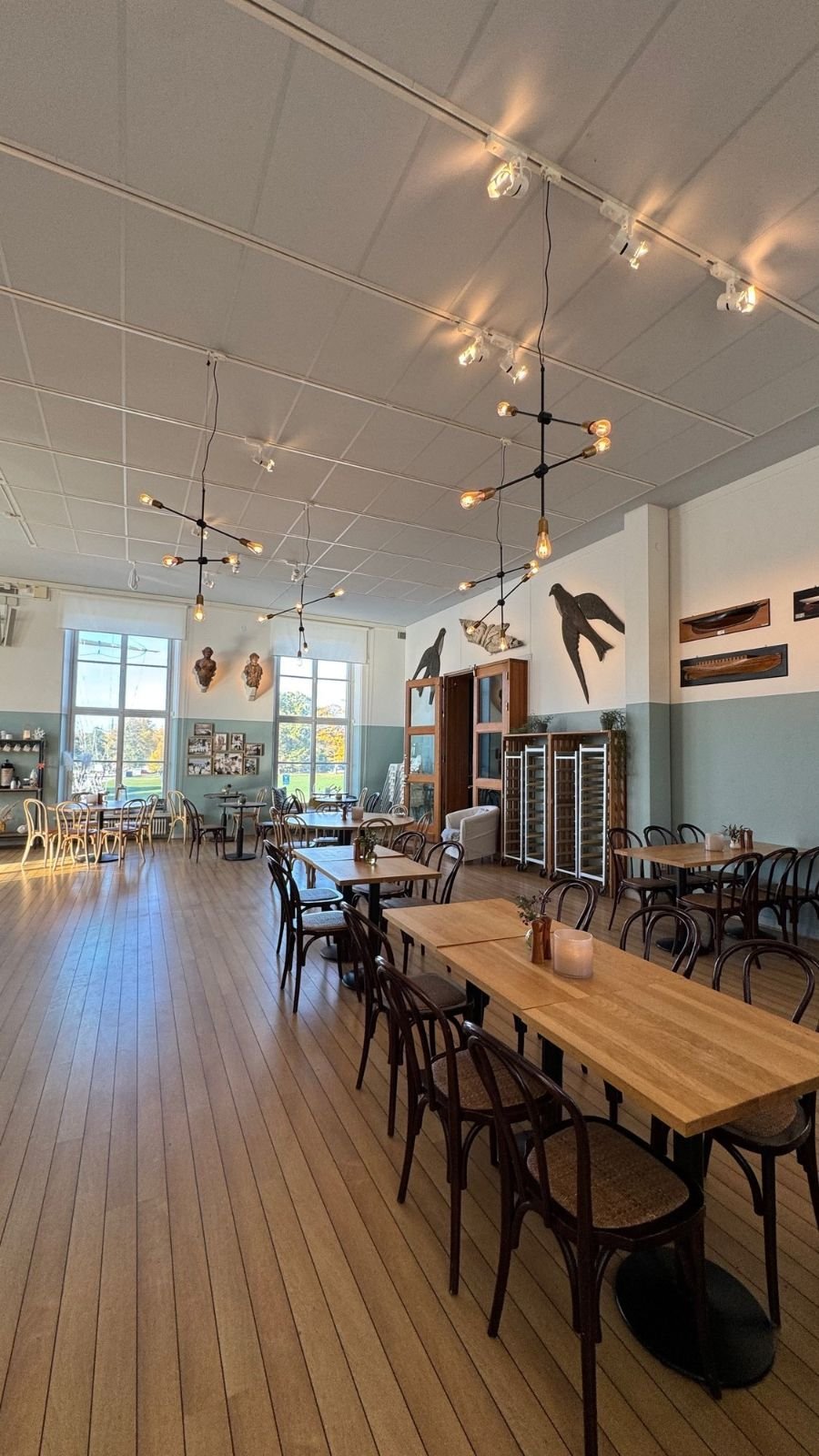
Sjöhistoriska Café is open Tuesday to Sunday 10:30–16:00. The museum says it serves lunch, sandwiches, cakes and fika, with a great view. In my photo, it is a bright room with long wooden tables and big windows. On Wednesday evenings from September to May, the café and bar stay open with the museum.
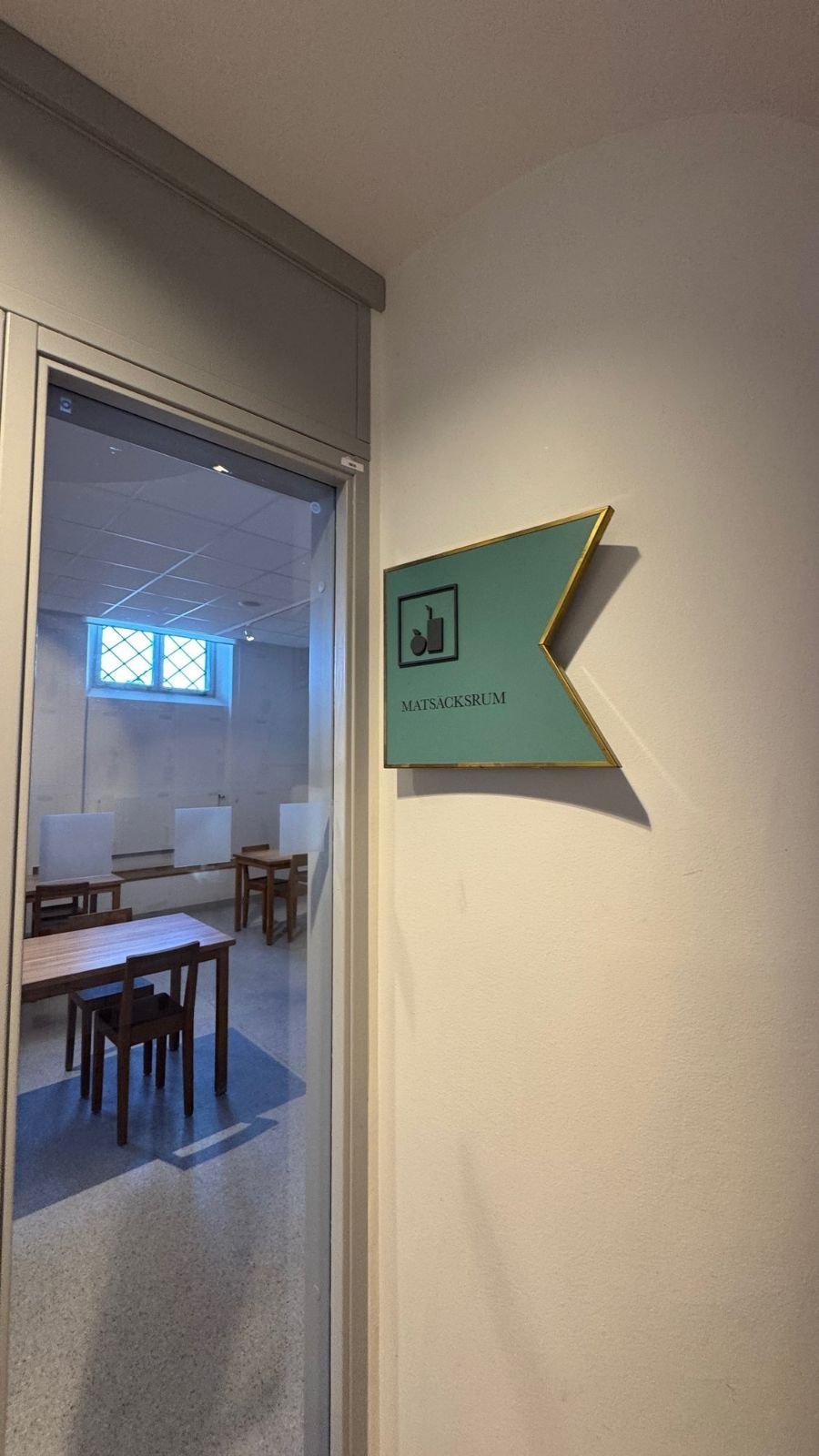
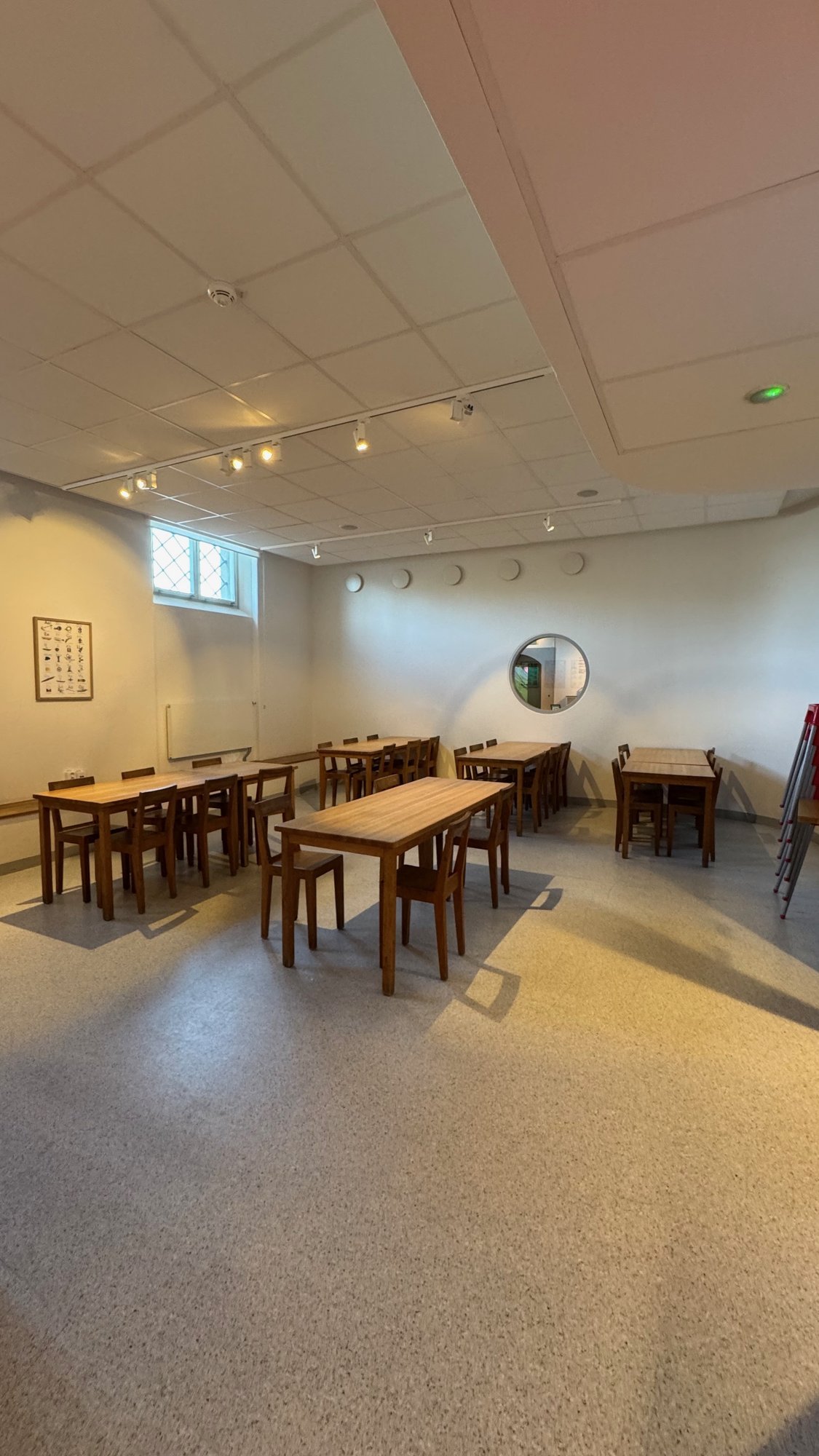
The packed lunch room. If you bring your own food, a green arrow sign points to the matsäcksrum, a room with wooden tables and chairs.
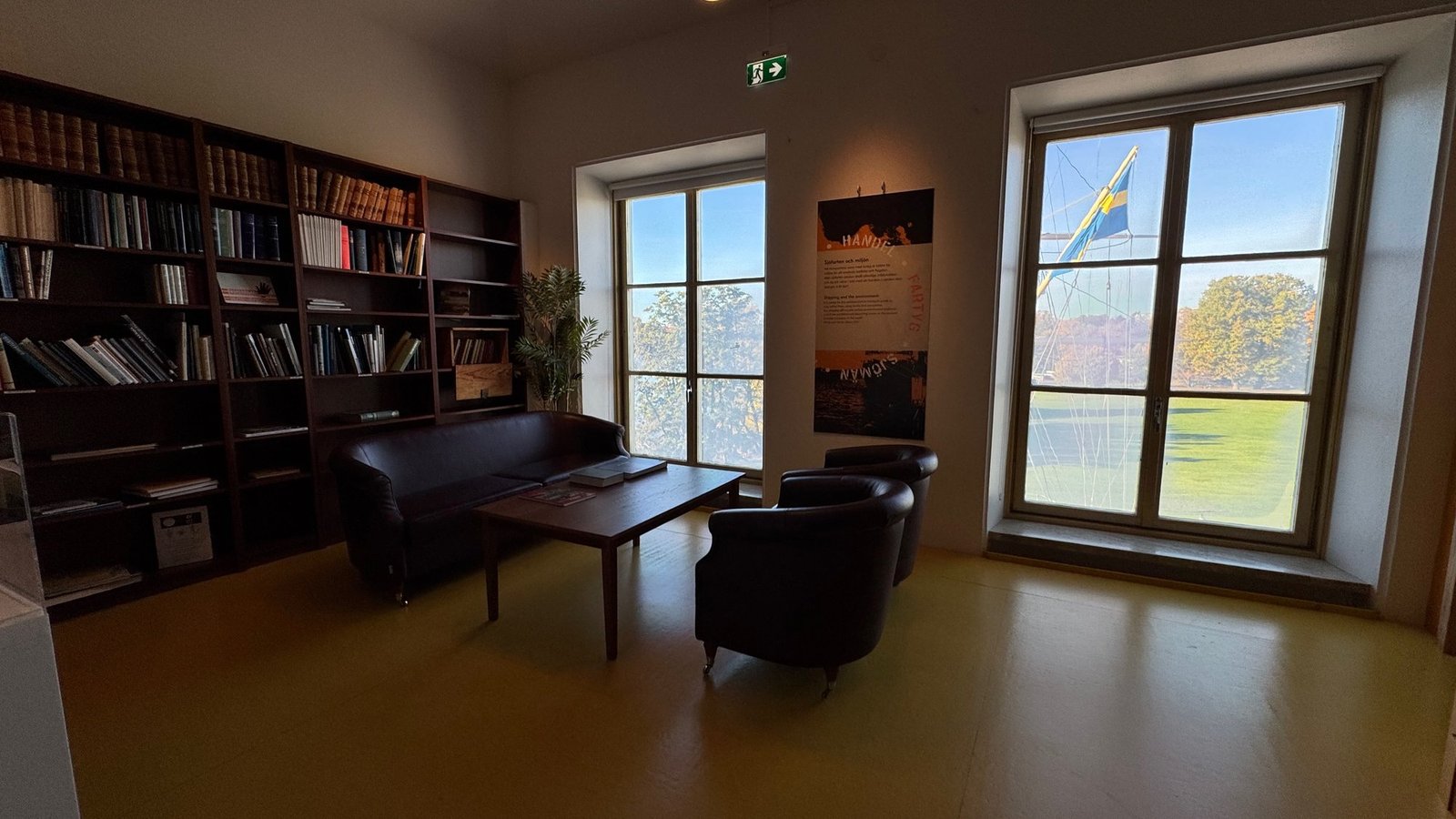
The library. The museum has a library, open on Tuesdays and Wednesdays 12:00–16:00. In my photo, its reading room has full bookshelves, black leather chairs and tall windows with a view of the park.
The museum ships
The museum also has two ships at its own pier at Galärvarvsvägen 24, just below the Vasa Museum: the icebreaker Sankt Erik from 1915 and the lightvessel Finngrundet. They are open in summer only. In 2026 they were open from 29 May to 13 September, Thursday to Sunday 11:00–18:00. They are now closed until the spring.
If you want to see the archipelago from the water, my private Island Journey by ferry to the archipelago visits historic maritime villages such as Vaxholm and Grinda.
Tickets and prices
Adults 150 SEK. Seniors and students 110 SEK. Children and youth 0 to 18 years free. The annual card costs 250 SEK and is valid for 365 days.
You can buy tickets online or at the museum. The museum and the café are cash-free. The welcome tour, Blubb and Ruskpricken are included in the ticket. The audio guide is free, in Swedish, Finnish, English, French and German.
Getting there and access
Bus 69 from Centralen stops right outside the museum. The museum also recommends the 15-minute walk from Djurgårdsbron along the bay. The nearest metro stations are Karlaplan and Gärdet. There is a large paid car park, free for buses and motorcycles.
Entrance. You can reach the main entrance by stairs or by a ramp. The door opening is 100 cm. Parking for visitors with a disability permit is by the main entrance and at the back of the building.
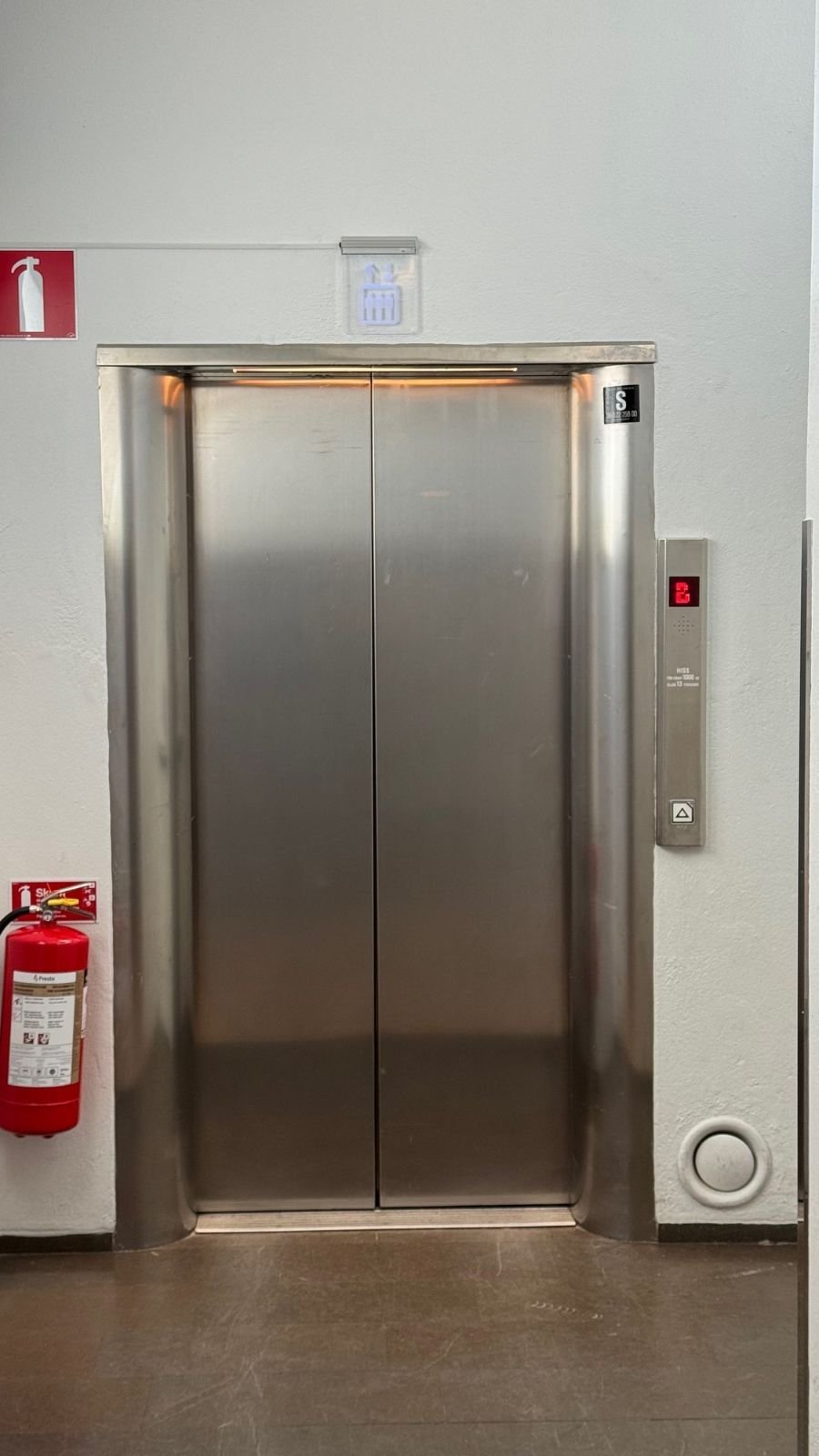
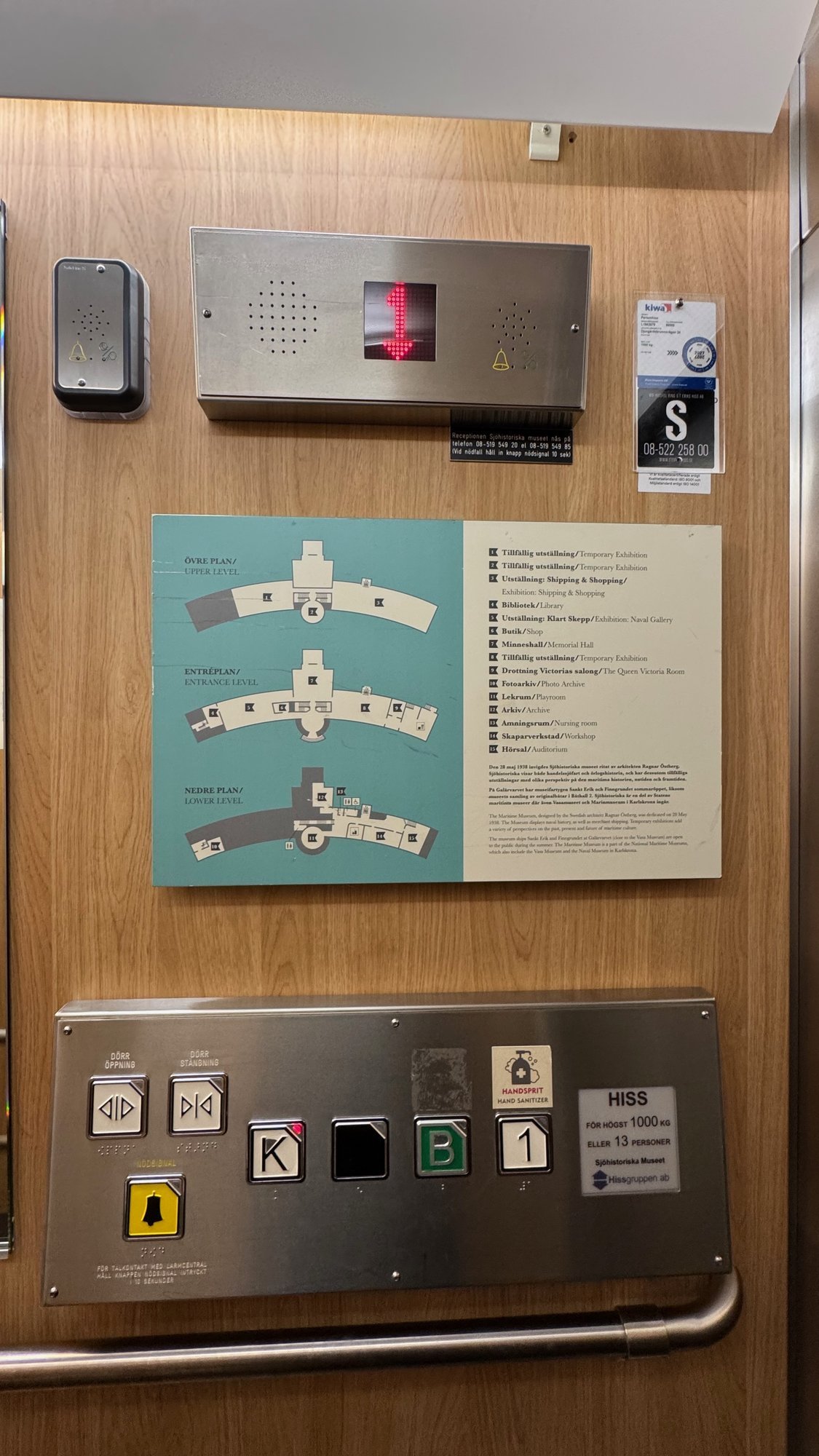
Lift. The lift is at the back of the museum, two meters from the parking spaces. It has a door phone to call the entrance staff and an automatic door opener. The door opening is 110 cm, and the lift is 140 × 300 cm. In my photo, the panel inside shows a floor plan of the museum next to the buttons.
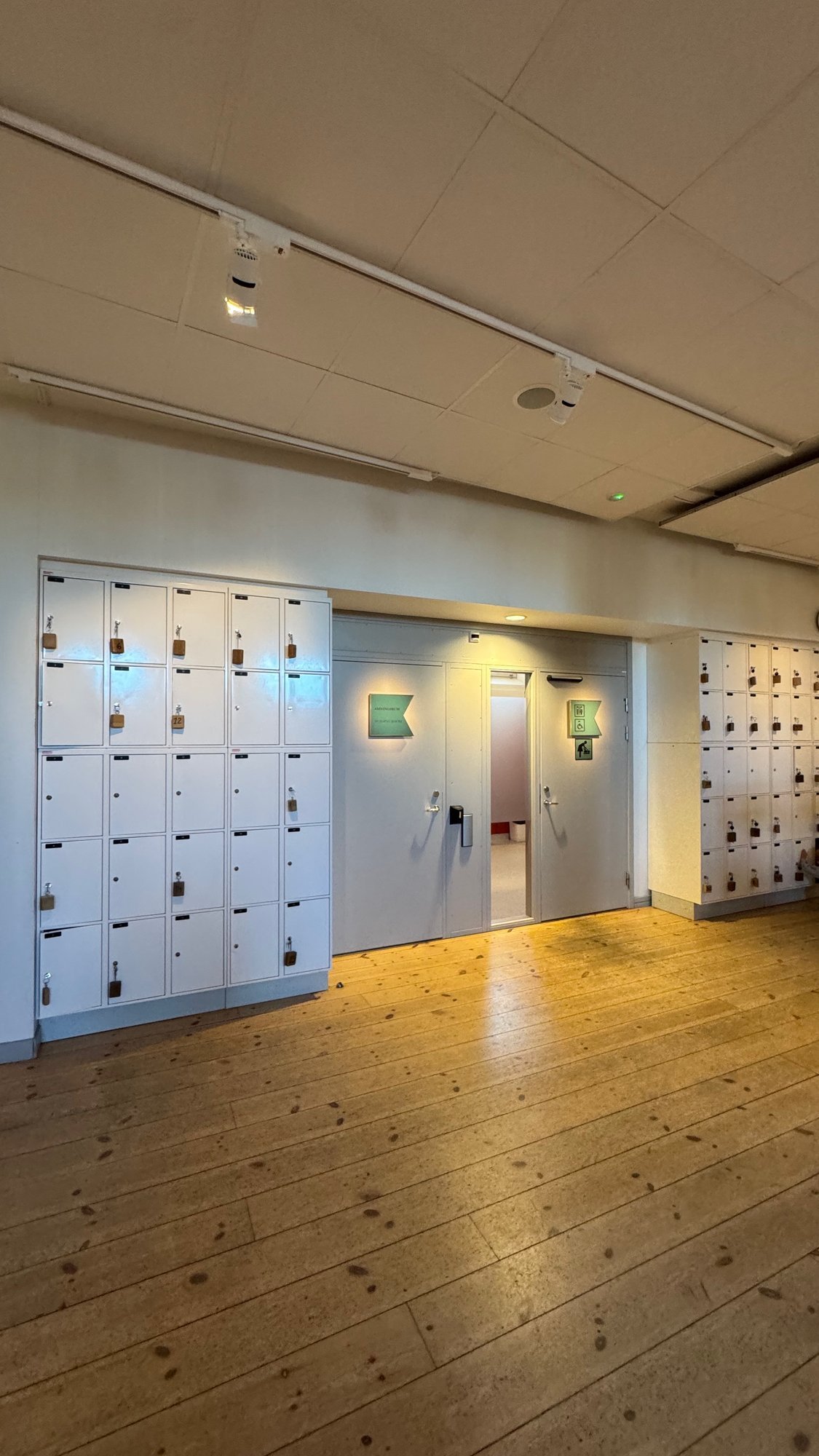
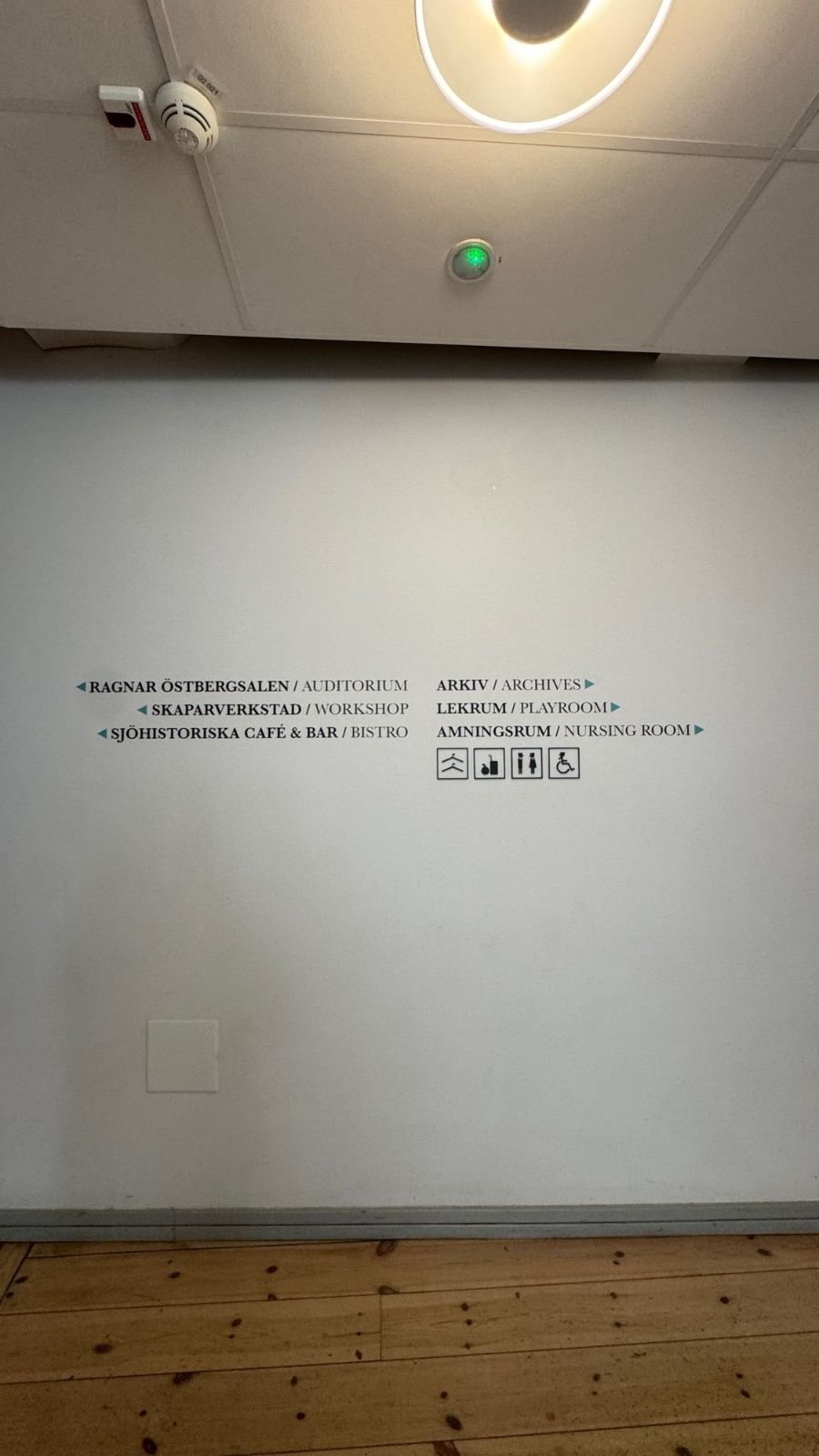
The lower floor. Toilets for everyone, a baby changing room and a quiet nursing room are on the lower floor. The museum says this floor has safe places for wheelchair users to wait during an evacuation, and visual fire alarms for visitors with impaired hearing. The lockers for small bags and coats are also here. A sign on the wall points the way to the auditorium, the workshop, the café, the archives, the play room and the nursing room, with access symbols.
Wheelchairs and strollers. You can borrow a wheelchair at the entrance. The museum says all public spaces are normally accessible by wheelchair and stroller.
Hearing and sign language. Hearing aid equipment is available on all guided tours. You can book a tour with sign support (teckenstöd), for 1,750 SEK in the daytime, Tuesday to Sunday.
Other facts. Animals are not allowed, except service and assistance dogs. Dogs are welcome at the outdoor café. You may take photos, but without flash.
I have written about the barriers many visitors still meet in my Medium story Barriers to Access: Why Aren’t Museums More Inclusive?
What is my verdict?
Sjöhistoriska has a nice space for children, and interesting exhibitions about naval history and ship models.
A royal stern that survived a cholera ship and a scrap yard. Warship models built over three centuries. A maid who sailed a sinking boat to safety, and a woman who went to war as Peter. And downstairs, a sea world where the smallest visitors crawl through a hatch to look for sunken treasure.
How many of the 1,500 guests in 1938 would have guessed that the women of the fleet would one day get their own panel?
Photo gallery
All photographs on this page were taken by Zayera Khan during a visit to the museum, and are her own property. Please do not reuse them without permission.
Sjöhistoriska museet: Sjöhistoriska, Plan your visit; Sjöhistoriska, Opening hours; Sjöhistoriska, Kvällsöppet på museet; Sjöhistoriska, Tickets; Sjöhistoriska, Guidade visningar; Sjöhistoriska, Museum history; Sjöhistoriska, Amphion; Sjöhistoriska, Battle Stations!; Sjöhistoriska, Figureheads; Sjöhistoriska, Trappmontrar; Sjöhistoriska, Skeppsbyggeri; Sjöhistoriska, Shipping & Shopping; Sjöhistoriska, S/S Hansa; Sjöhistoriska, Paddle!; Sjöhistoriska, Drottning Victorias salong; Sjöhistoriska, Lekrummet Blubb; Sjöhistoriska, Skaparverkstaden Ruskpricken; Sjöhistoriska, Höstlov 2026; Sjöhistoriska, Café; Sjöhistoriska, The museum ships; Sjöhistoriska, Getting here; Sjöhistoriska, Tillgänglighet.
Wikipedia: Wikipedia: Maritime Museum (Stockholm).