
Polismuseet in Stockholm: 175 years of police life, crime scenes and a hate crime exhibition
The Swedish Police Museum lets you try a uniform, sit in a police car and look at a crime scene, and it does not avoid the hard questions.
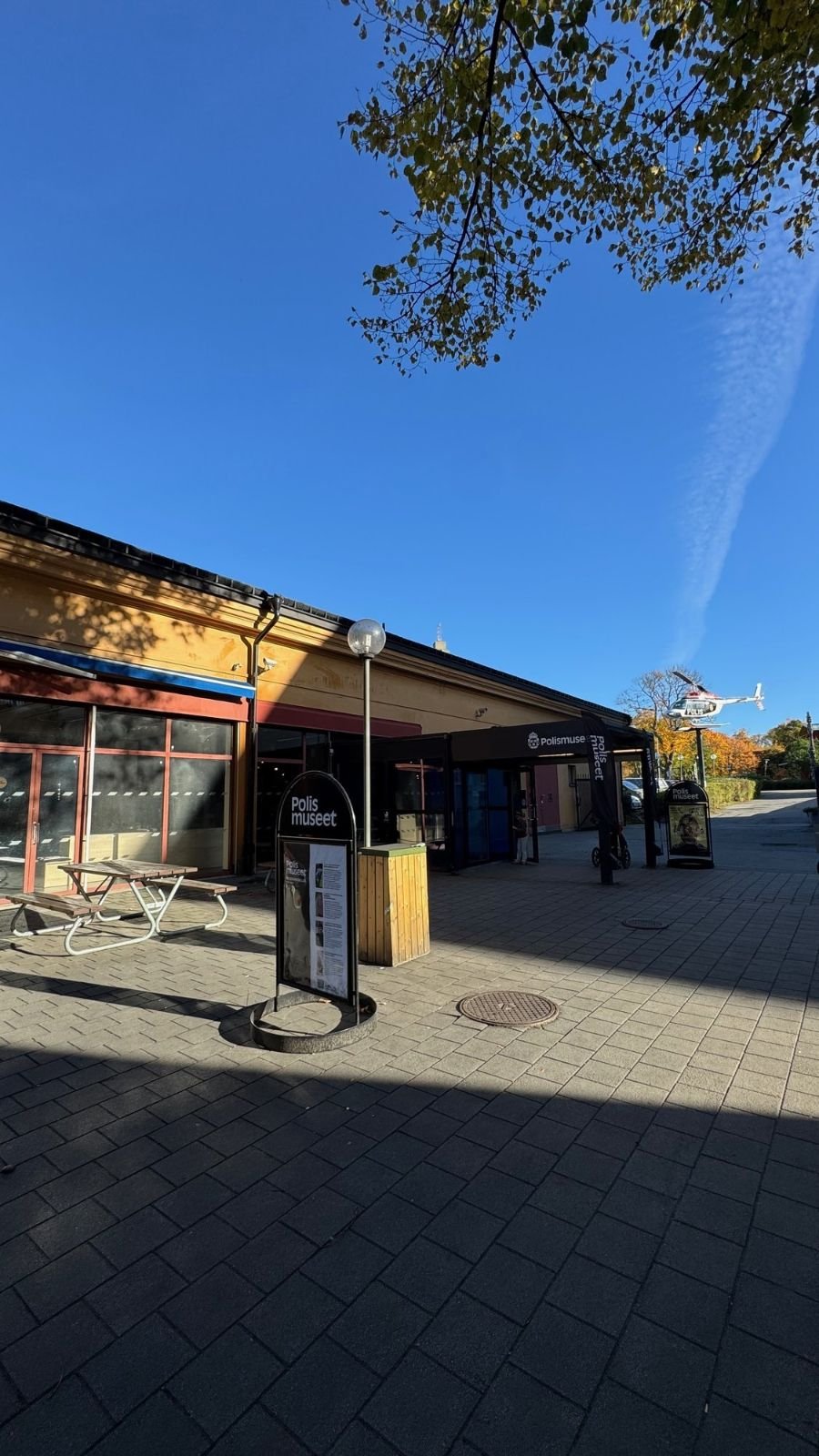
- Why visitThe national museum of the Swedish police. The history of the police from 1850 until today, a crime scene to study, the work of the police today, and an exhibition about hate crime.
- Best forFamilies with children, school classes, and anyone curious about the police, crime and society.
- AddressMuseivägen 7, 115 27 Stockholm, in Museiparken next to Tekniska museet.
- Getting thereBus 69 toward Blockhusudden or Kaknästornet. Get off at Museiparken.
- Opening hoursTuesday to Friday 12:00–17:00. Saturday and Sunday 11:00–17:00. Closed on Mondays. Autumn break, 24 October to 1 November 2026: every day 11:00–17:00. Closed 23 to 28 December and 31 December.
- AdmissionAdults 80 SEK. Students and pensioners 60 SEK. Children and young people up to and including 19 years free. Annual card 250 SEK. Pay at the reception, no online tickets.
- FoodNo café. A few seats for packed lunches upstairs and picnic tables outside.
- AccessibilityThe whole museum is accessible by wheelchair and walker. An automatic lift, an accessible toilet and free lockers at the entrance. Easy-to-read texts. Details below.
- Official websitepolismuseet.se
I visited Polismuseet on 18 October 2026 and took the photos on this page that day.
The museum says that children are often curious about police officers. On its tours, they can ask their questions and look at police equipment close up. The questions for adults are harder: how do the police protect our right to demonstrate, and what happens when someone is attacked only because of who they are?
A museum that is part of the police
Polismuseet has existed in its present form since 2007. It is part of the Swedish Police. The museum says its task is to share knowledge about the work of the police, above all with children and young people, and to care for the cultural heritage of the police.
Like the police, the museum works to prevent crime. Its educators meet more than 800 school classes a year and make teaching material that is used all over Sweden. The museum says it has more than 70,000 visitors a year. It also says it often deals with difficult and sensitive subjects, and that it wants to give a nuanced picture of the police.
In 2026 the museum was closed for renovation from 1 January to 27 March. It reopened with a new main exhibition, Polisliv (Police Life).
Polisliv: police life from 1850 until today
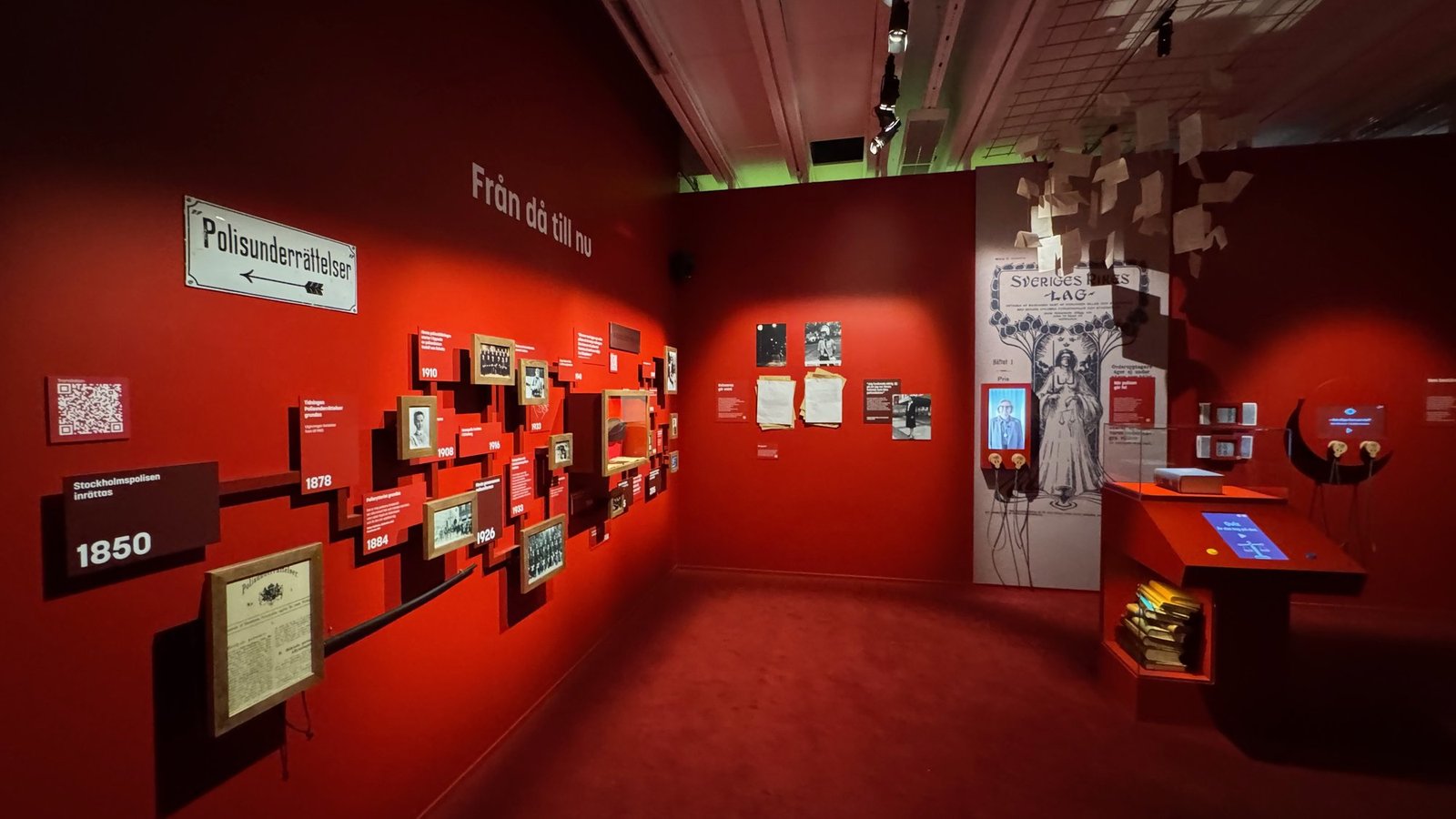
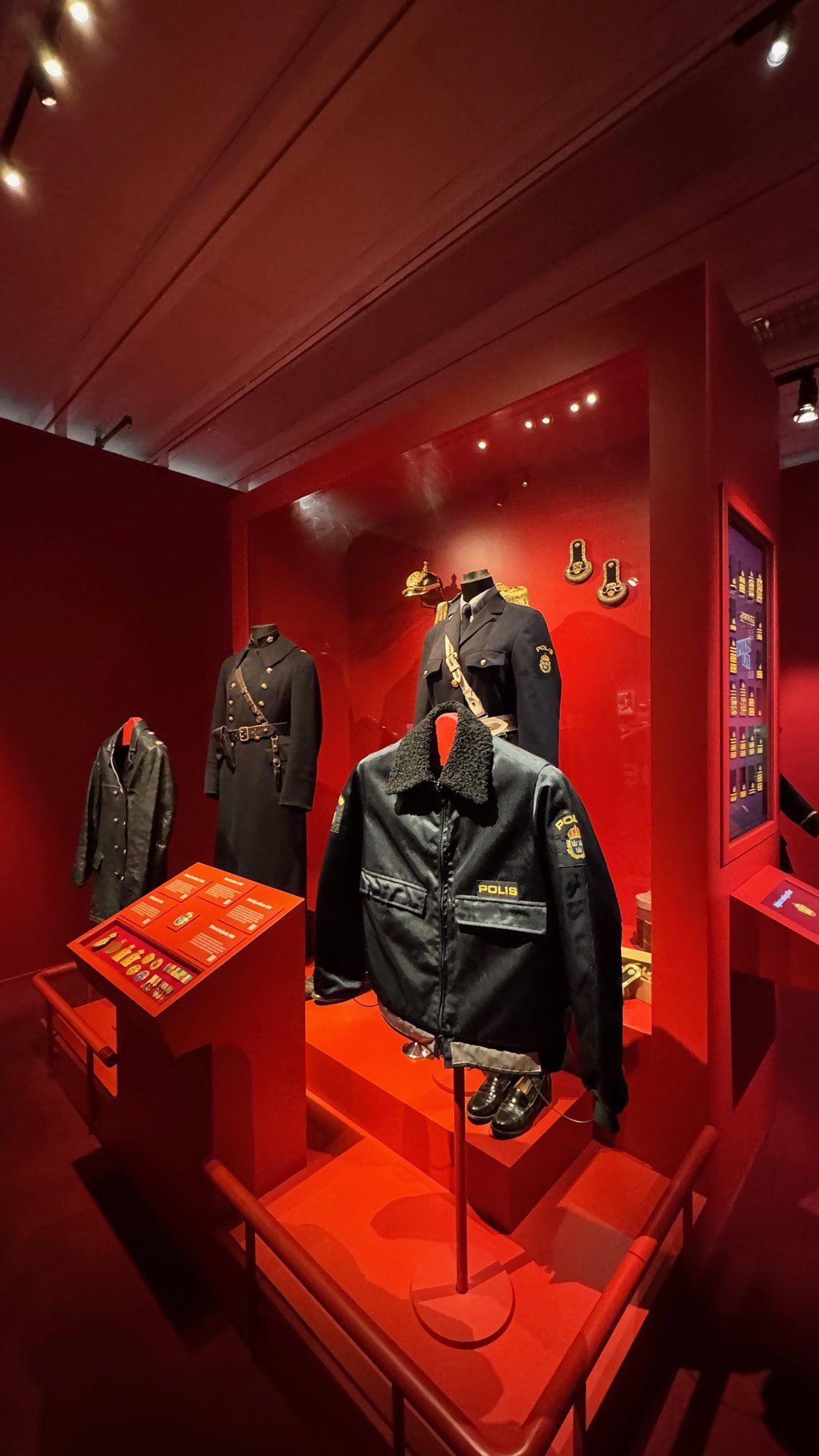
The exhibition starts in 1850, the year the police in Sweden became organized. The museum says the first police constables patrolled on foot or by bicycle. In the first room, you meet rural police officers (fjärdingsmän) and officers who patrolled a fixed beat, in hard conditions. You can try to patrol a beat yourself, with a time clock to stamp. In my photo, the room is red, with police history on the walls.
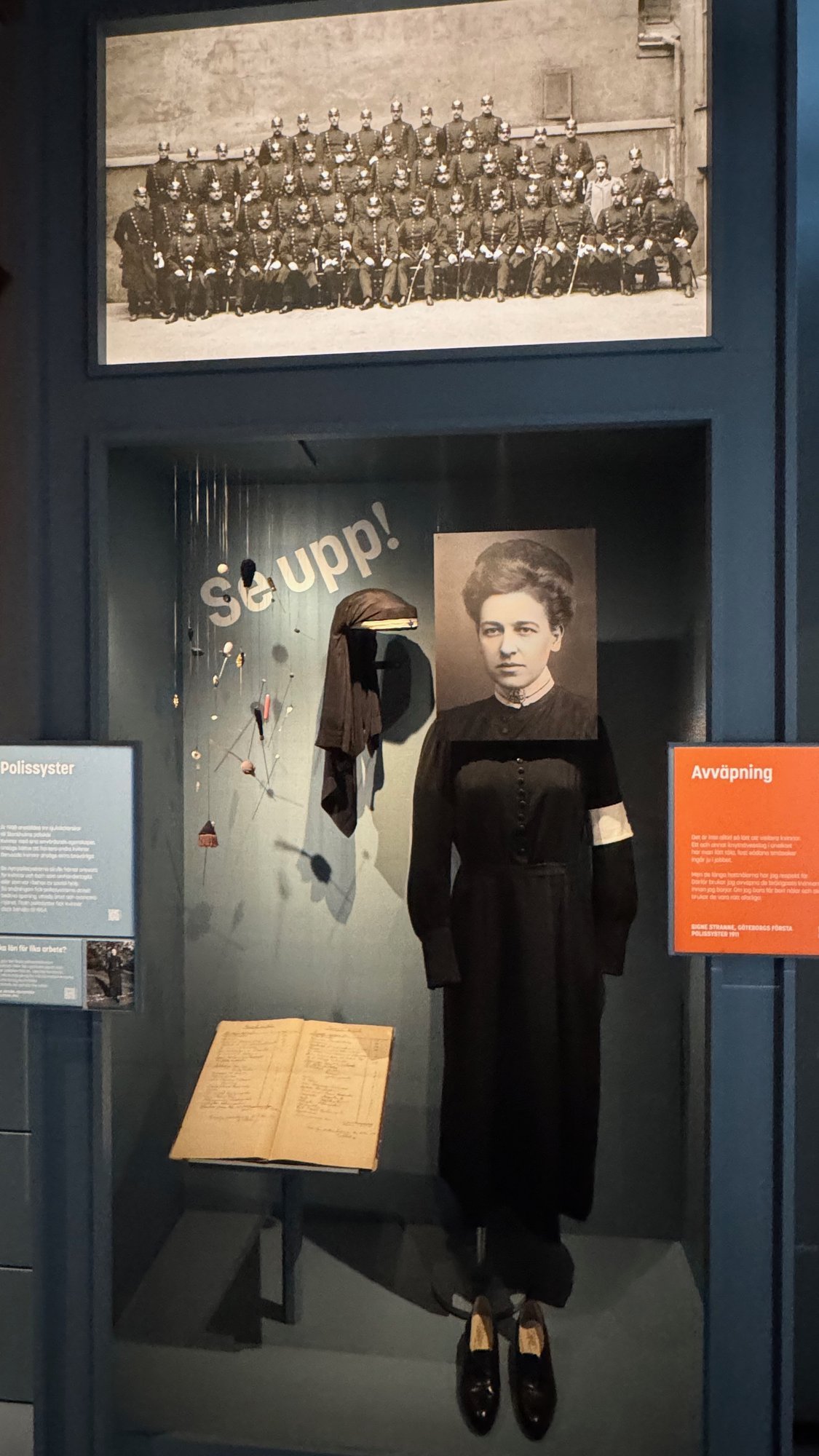
Then you step into a police kiosk from the 1930s. The story goes on to the fight against alcohol smugglers, the first women in the police, who were called polissystrar (police sisters), and one of the first police vehicles, an Indian motorcycle from 1918. In my photo of one case, a portrait of a woman in a black dress stands under a large historic group photo.
The museum shows how the police changed from local, municipal forces to one national Police Authority. You can learn to read ranks and badges, see the staff once used by the city prosecutor of Stockholm, and try on real police uniforms.
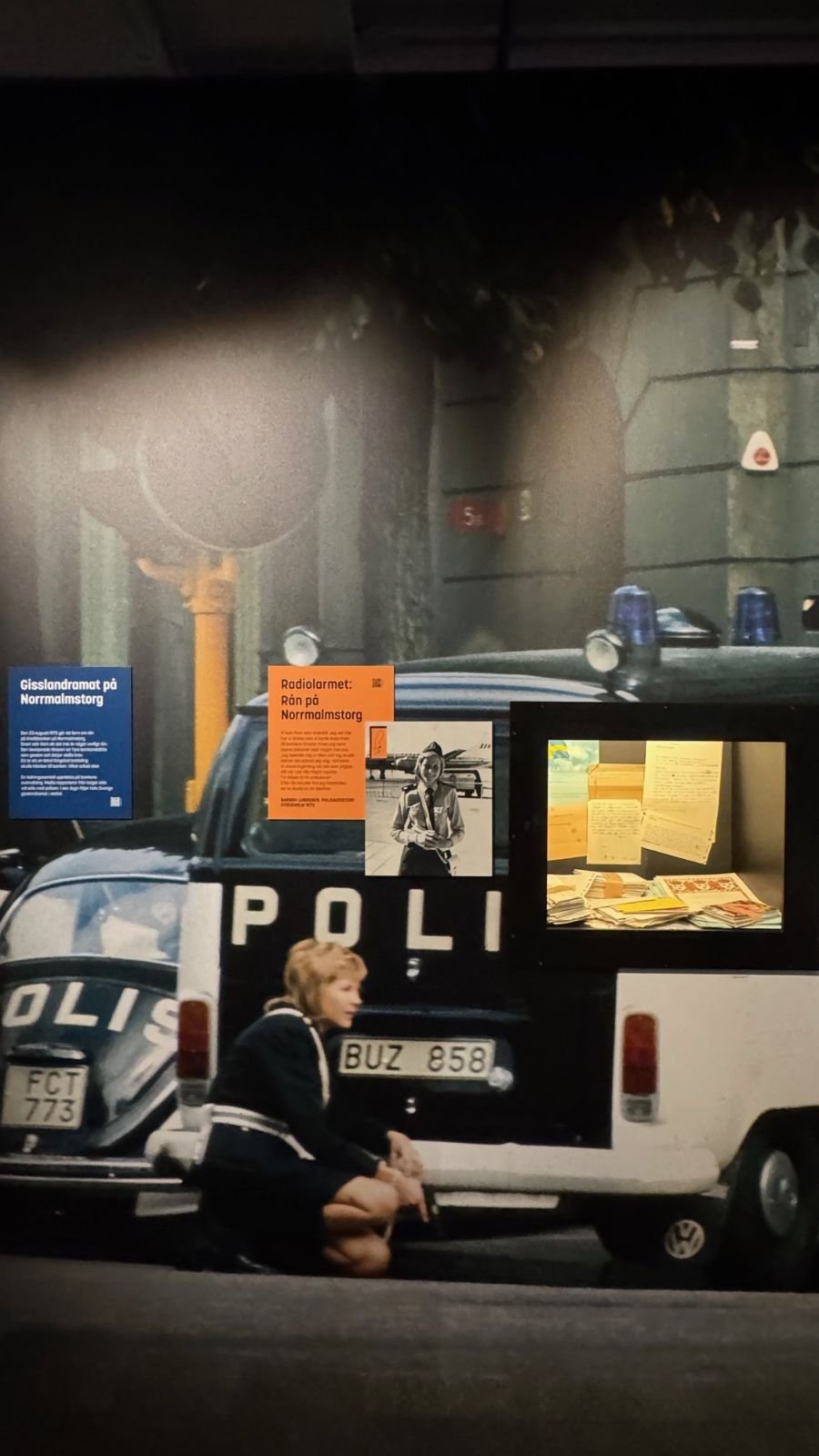
New vehicles changed the work. You can see a Dodge command bus from 1968, which made the police reachable everywhere. The exhibition shows how the police handle demonstrations and protect democratic rights, and you can sit on the wooden horse that mounted police trained on. It also tells about hard events that changed how the police work: the Norrmalmstorg robbery, the disco fire in Gothenburg and the events in Malexander.
At the end, you can study your own fingerprints and test if you can tell real goods from fake ones. The museum says the history is told by the police themselves.
A Bigger Task: the police at work today
En större uppgift – om polisyrkets växlande vardag (A Bigger Task) is about the police today. You meet officers and other staff in different roles. The museum asks: do you have the care a crime scene technician needs, the patience of a surveillance officer, the fitness of a dog handler, or can you make quick decisions under pressure?
In my photo, a model police dog sits in front of a green wall, next to leashes and dog equipment. The wall says Polisens bästa vän, the police’s best friend.
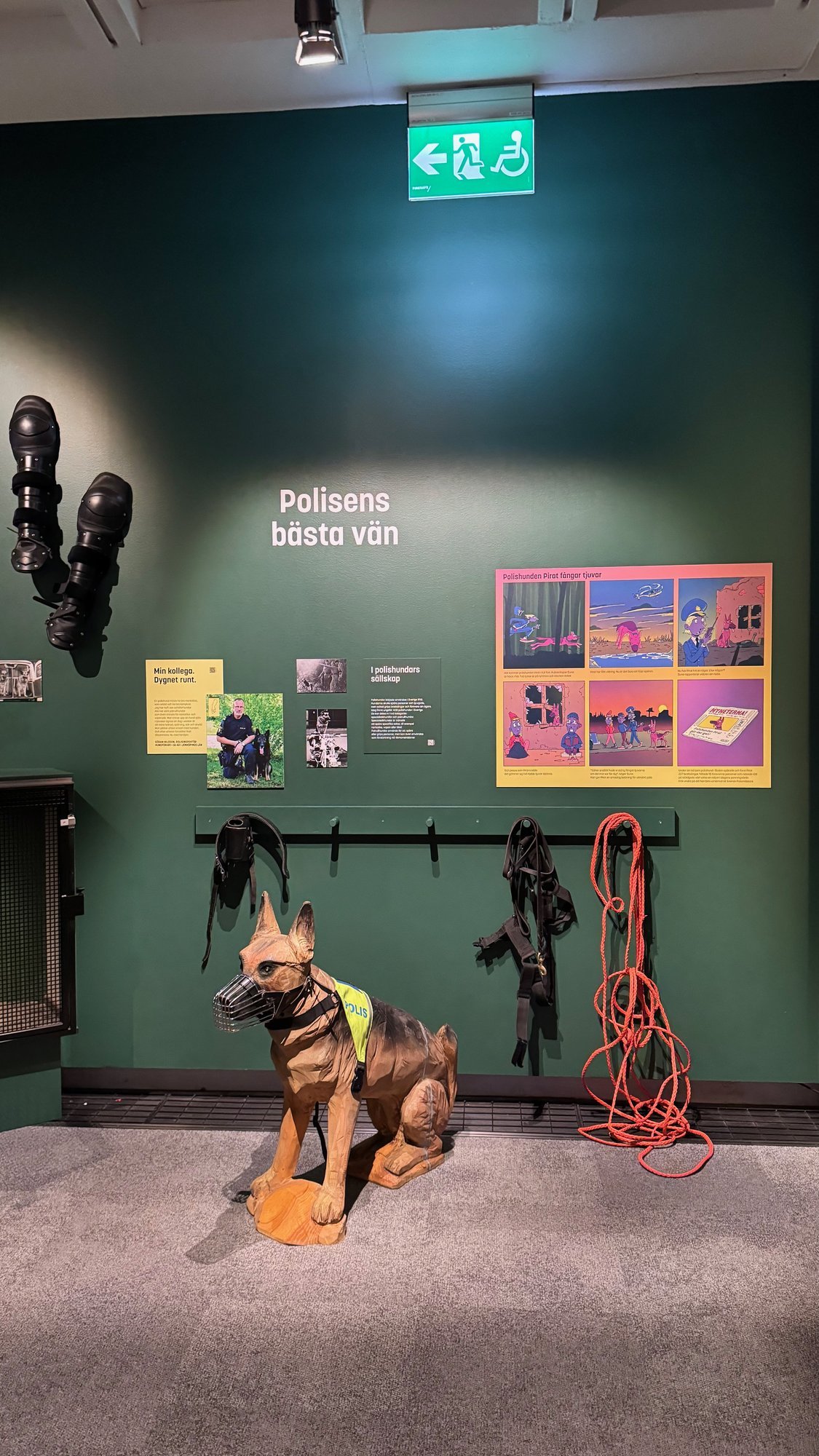
You can test-drive a police motorcycle, and feed and groom the wooden police horses. At the end, you can step into a virtual police uniform. When you need a break, the inner room has games and books. The museum calls this att parisa, an old word for when a police officer slipped away from the beat.
Brottsspår: a crime scene to solve
In Brottsspår (Crime Traces), a crime scene is in the center: a broken table, broken glass and scattered playing cards, a clock, some bottles and blood spatter. Why are there only three table legs? You take the role of a crime scene technician.
The exhibition uses real cases from the 1900s and today. The museum says you learn how DNA helped the police identify the murderer of the foreign minister Anna Lindh, and how a profile helped to track the “Laser Man”. It also shows objects from real cases, such as the Knutby murders and the crimes of the serial shooter Peter Mangs.
The museum recommends Brottsspår from 12 years. Younger children should have an adult with them. The texts are in easy-to-read Swedish.
Vi & Dom: an exhibition about hate crime
A hate crime is a crime against a person only because of their sexual orientation, religion or ethnic background. Vi & Dom (Us & Them) is an interactive exhibition about it. The museum says it asks you to think, feel and reflect on how you would react in different situations, and that it wants to reduce the acceptance of hate crime.
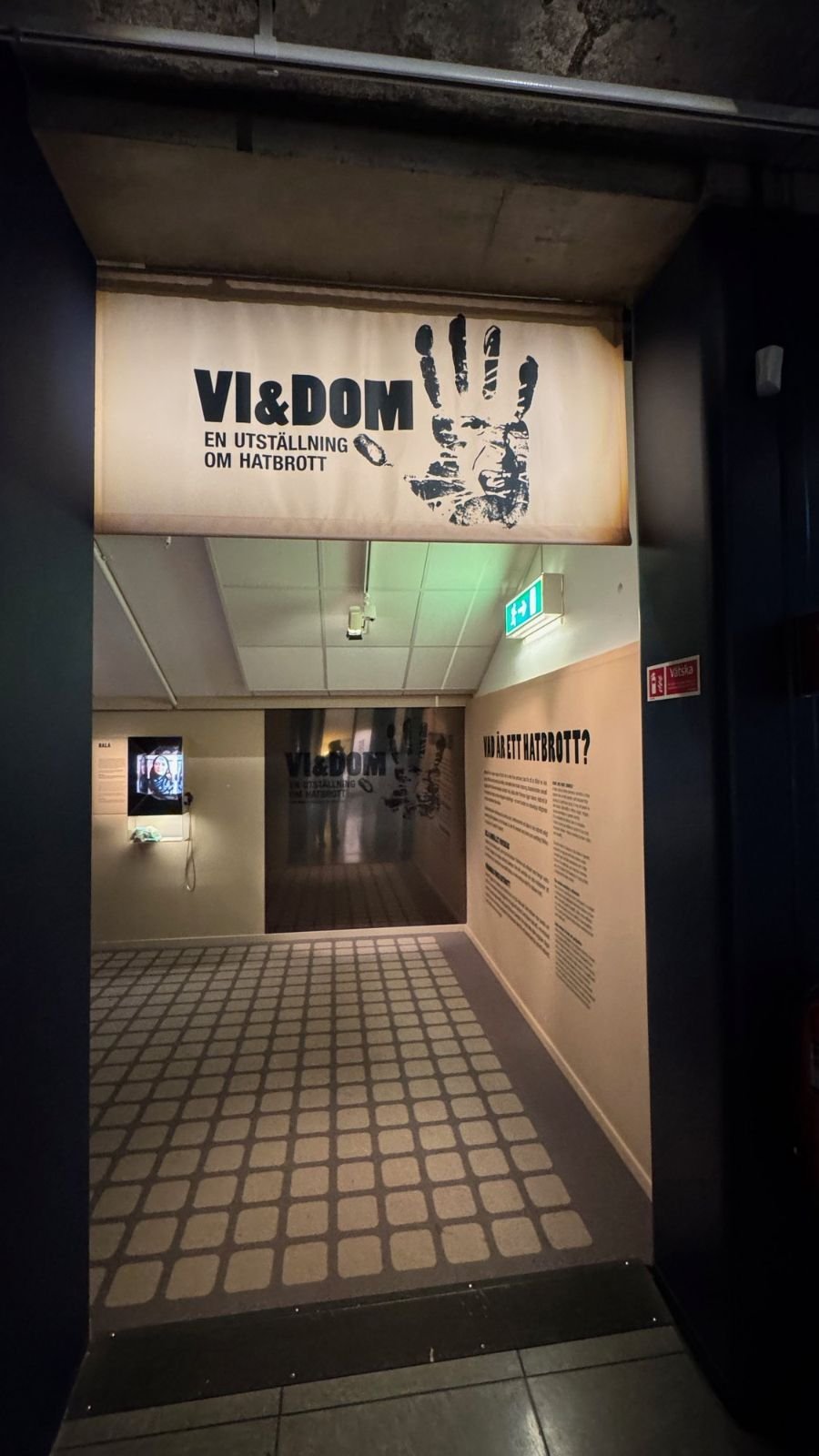
The museum tells the stories of young people. One is Elsa, 20, who walked hand in hand with her girlfriend Elvira in a park in Lund. Someone shouted at them, asked if they were lesbians and told them to leave. Elsa was kicked and Elvira was punched. Another is David, 16, a Roma boy who is insulted at school almost every day, by both students and teachers. The exhibition wants visitors to feel that they can act: report, speak up and support the people who are targeted.
I have also written about the LGBTQ community in my Medium story Being A Member Of The LGBTQ Community.
For children and families
The museum calls itself an active museum for the whole family. Children and adults can play games and quizzes, try out the vehicles and the uniforms, and ride along on a call-out with blue lights in the modern police car. In my photo, a big hall has a police car, a foosball table and long activity tables.
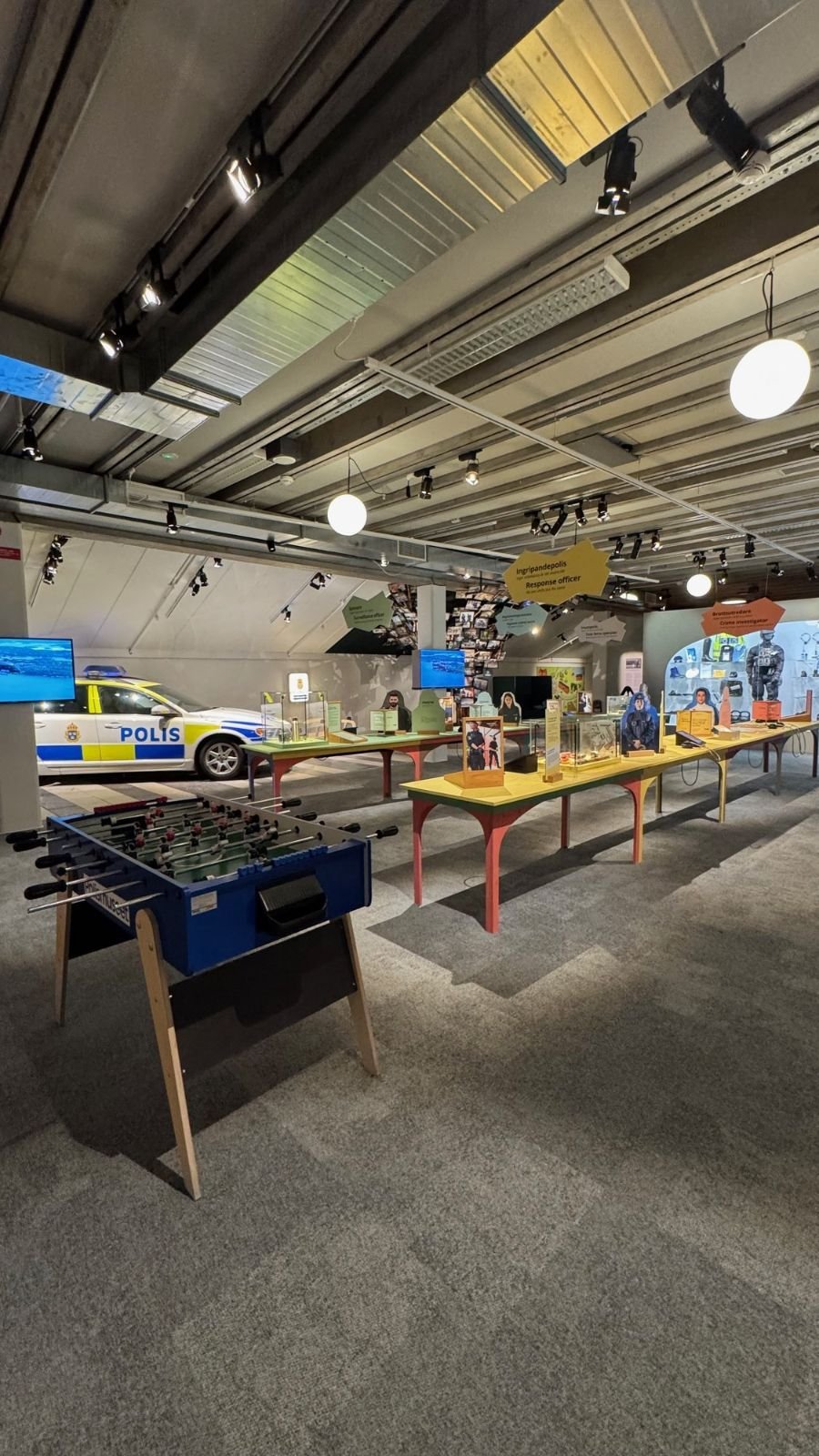
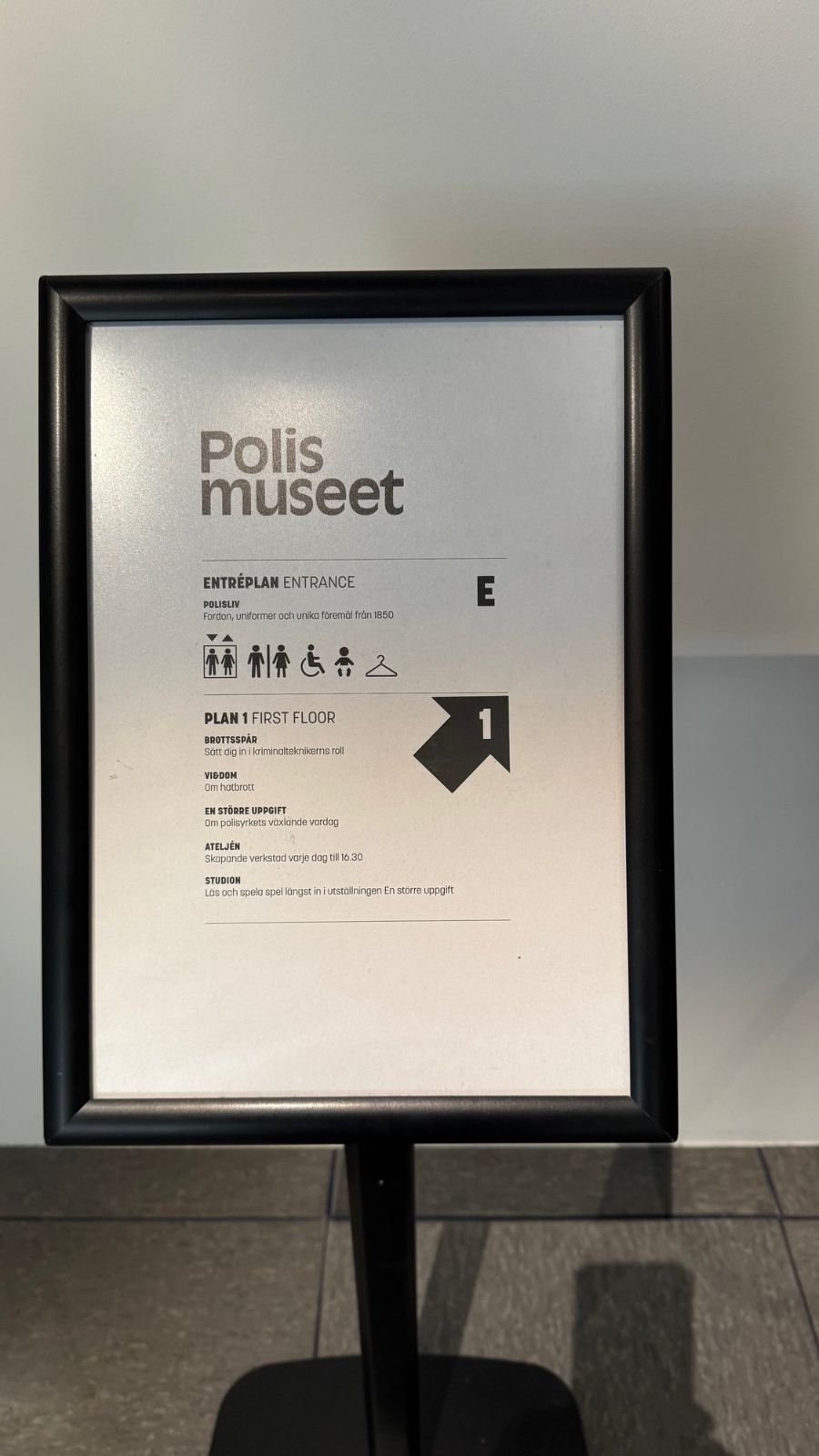
The sign at the entrance lists Ateljén upstairs, a creative workshop every day until 16:30, where adults and children can draw and make things together, and Studion, where you solve and play games at the end of A Bigger Task. The museum also has children’s trails in the exhibitions.
The traffic playground. Outside, children can climb, play and rent pedal cars to learn the traffic rules. It costs 40 SEK for 20 minutes, plus an adult ticket, and a helmet is included. The pedal cars are rented in spring, summer and autumn. The last day for this autumn was 18 October.
Autumn break, 24 October to 1 November 2026. The museum is open every day 11:00–17:00. Children can fold their own paper boat hat and try real police uniforms. Small children can drive a soft toy police car through Polisliv, and older children can solve a word puzzle in A Bigger Task. There are guided tours every day:
- 12:00–12:30, Polisliv: 175 years of police life, for adults and children from 12.
- 13:00–13:30, Här är polisen! (Here are the police!): children ask their questions and look at police equipment close up, for children from 5.
- 14:00–14:30, Från brott till bevis (From crime to evidence): how crime scene technicians work with fingerprints, shoe prints and bullet holes, for children from 11. Only during the autumn break.
- 15:00–15:30, Polisliv for the whole family: an interactive tour about police work then and now. How often do the police use their pistols today?
The tours are in Swedish.
Evening programs. On 22 October, the community police officer Rissa Seidou talks about gang crime and young people in Järva. On 26 November, the ballistics expert Johan Ekman shows how the police analyze evidence after a shooting. Both start at 17:30, last about an hour and need booking.
The shop and the packed lunch room
The small shop sells police items for children and adults, from police sweaters and coffee cups to books, toy police cars and games. You do not need a ticket to visit the shop.
The museum does not sell food or drinks. Upstairs there are a few seats for visitors with a packed lunch, and there are picnic tables outside. The museum suggests the restaurants of the neighboring museums: Etnografiska museet, Tekniska museet and Sjöhistoriska. You may leave to eat and come back later if you show your receipt.
Tickets and prices
Adults 80 SEK. Students 60 SEK. Pensioners 60 SEK. Children and young people up to and including 19 years free. The annual card for adults costs 250 SEK.
Police employees, retired police staff and police students enter free. A companion enters free with a companion card. You pay at the reception. There is no online ticket booking.
Getting there and access
Take bus 69 toward Blockhusudden and get off at Museiparken. The museum says the bus stops right opposite the entrance. The museum is next to Tekniska museet, and close to Riksidrottsmuseum and Sjöhistoriska museet. I have written an article about each of them.
Entrance and floors. The museum has two floors in one spacious building. In my photo, the entrance hall is wide, with a flat floor. Toilets and lockers are by the entrance. You can lock in your coat for free.
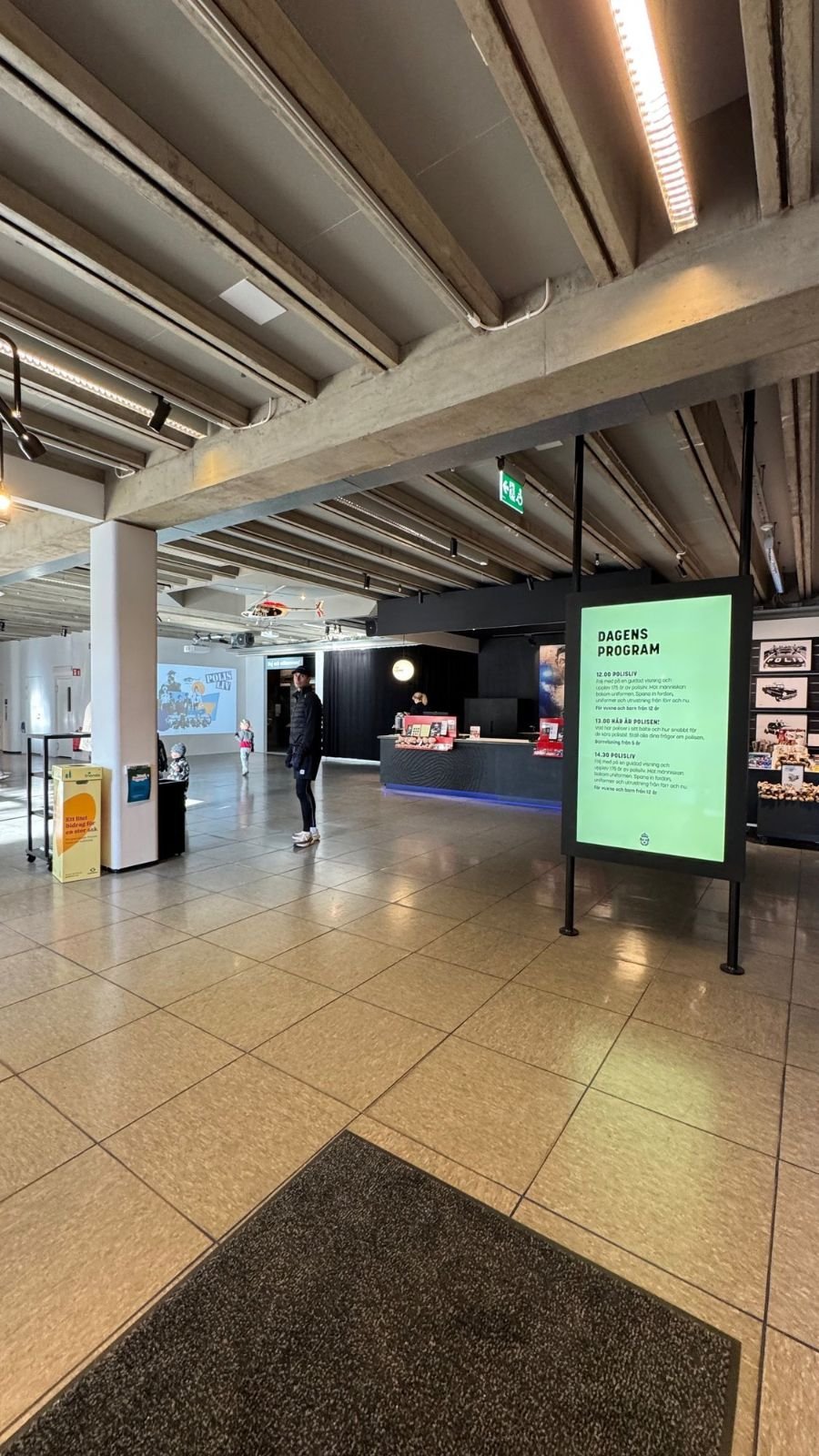
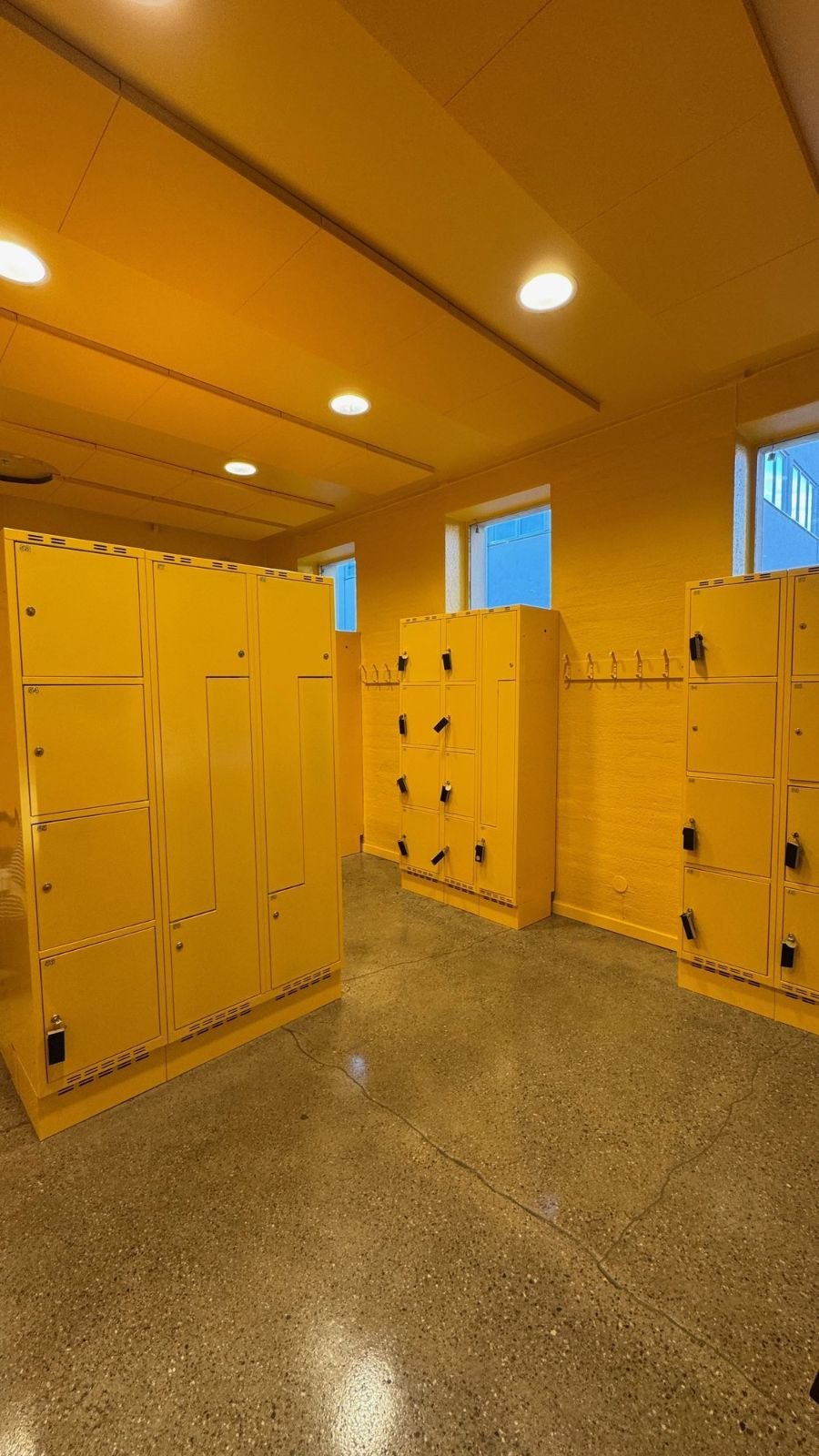
Wheelchairs and walkers. The museum says you can move through the whole museum with a wheelchair or a walker. The lift opens automatically and is next to the stairs. An accessible toilet is in the entrance hall.
Signs and texts. The museum uses pictograms to help you find your way. The English page also mentions tactile text and Braille. Centrum för lättläst has edited the exhibition texts into easy-to-read Swedish. In my photo, a sign shows what is on each floor, with symbols for the lift, toilets, accessible toilet, baby changing and cloakroom.
Sight and hearing. There are several audio illustrations for visitors with impaired vision. All exhibitions have written text. The English page also mentions an induction loop.
Strollers. You can visit the museum with a stroller. The Swedish page says the stroller parking is outdoors. The English page says you can also leave it in the cloakroom. A baby changing room is by the toilets in the entrance hall.
Animals. Guide dogs, signal dogs and assistance dogs in a work vest are welcome, but no other animals.
Language. Most of the museum is in both Swedish and English.
What is my verdict?
Polismuseet covers a wide range. A 1930s police kiosk and a motorcycle from 1918. A wooden horse for mounted police. A crime scene with three table legs. And an exhibition where young people tell what hate crime did to them.
Children and young people up to 19 enter free, and the museum sits in Museiparken next to Tekniska museet, Riksidrottsmuseum and Sjöhistoriska museet.
When Elsa and Elvira walked hand in hand in a park in Lund, what would you have done if you had been there?
Photo gallery
All photographs on this page were taken by Zayera Khan during a visit to the museum, and are her own property. Please do not reuse them without permission.
Polismuseet: Polismuseet, home page; Polismuseet, Besök Polismuseet; Polismuseet, Visit us; Polismuseet, Om Polismuseet; Polismuseet, Utställningar; Polismuseet, Polisliv; Polismuseet, En större uppgift; Polismuseet, Brottsspår; Polismuseet, Vi & Dom; Polismuseet, Spännande för hela familjen; Polismuseet, Trafiklekplats; Polismuseet, Höstlov 2026; Polismuseet, Höstens programkvällar; Polismuseet, Butik; Polismuseet, Matsäcksplats; Polismuseet, Tillgänglighet; Polismuseet, Accessibility.